Daily Digest
UPSC · Civil Services Examination
Current Affairs · Friday, 29 August 2025
Current affairs curated and edited by Anantam IAS faculty — pulled from The Hindu, PIB, IDSA, Foreign Affairs and the ministries. Read, annotate, revise.
Old Rajinder Nagar · Delhi 110005 · anantamias.com
Demographic Dividend

Why in news:
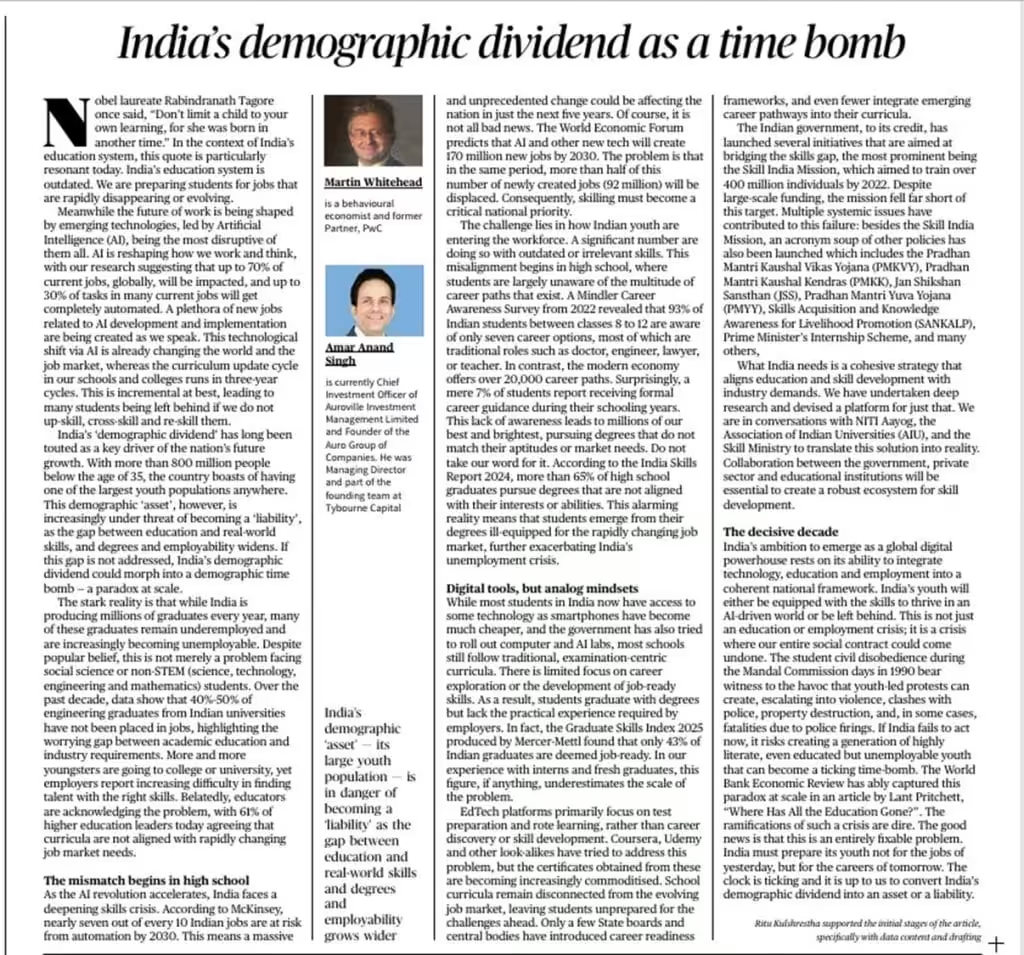
This article highlights the paradox of India’s demographic dividend – while a large youth population is often considered an asset, in India’s case, it is increasingly at risk of turning into a “demographic time bomb.”
UPSC Relevance:
UPSC PYQ 2013:
Q. To obtain full benefits of demographic dividend, what should India do?
(a) Promoting skill development
(b) Introducing more social security schemes
(c) Reducing infant mortality rate
(d) Privatization of higher education
UPSC PYQ 2012:
Q. Consider the following specific stages of demographic transition associated with economic development: (2012)
- Low birthrate with low death rate
- High birthrate with high death rate
- High birthrate with low death rate
Select the correct order of the above stages using the codes given below:
(a) 1, 2, 3
(b) 2, 1, 3
(c) 2, 3, 1
(d) 3, 2, 1
UPSC PYQ 2016:
Q. “Demographic Dividend in India will remain only theoretical unless our manpower becomes more educated, aware, skilled and creative.” What measures have been taken by the government to enhance the capacity of our population to be more productive and employable?
UPSC PYQ 2014:
Q. “While we flaunt India’s demographic dividend, we ignore the dropping rates of employability.” What are we missing while doing so? Where will the jobs that India desperately needs come from? Explain. ?
Key Points from the Article:
- Demographic Dividend Concept
- India has one of the largest youth populations globally, with over 800 million people below the age of 35.
- Challenges Highlighted
- Mismatch of Skills and Jobs:
- India produces millions of graduates every year, but many lack employability due to outdated curricula and insufficient skills.
- Example: 40–50% of engineering graduates remain unemployed or underemployed.
- Technological Disruption:
- AI and automation are reshaping work. Research suggests 70% of current global jobs will be impacted, with 30% completely automated.
- India risks massive job losses if workers are not re-skilled.
- Education Deficit:
- Curricula in Indian schools and universities are not aligned with real-world skills or evolving job market demands.
- 61% of employers believe graduates lack job-ready capabilities.
- Awareness Gap:
- A large portion of youth are unaware of the full range of career opportunities.
- Surveys show 93% of students between classes 8–12 consider only 7 career options (doctor, engineer, lawyer, etc.), ignoring newer fields.
- Mismatch of Skills and Jobs:
What is Demographic Dividend:
Demographic dividend is the economic growth potential a country can achieve when its working-age population (ages 15-64) is significantly larger than its dependent population of children and the elderly.
Understanding India’s demographic dividend
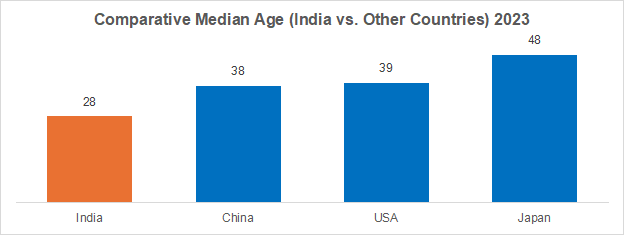
With over 65% of its population under 35 and a median age of 28 compared to 38 in China and 48 in Japan, India possesses a dynamic labour force capable of driving productivity.
Key drivers of India’s demographic dividend:
- Expanding labour force:
- India’s working-age population is expected to grow to 1 billion by 2047, sustaining the demographic dividend well into the next few decades. This increasing labour force is key as many developed nations face shrinking working populations.
- The rise of the gig economy and the spread of digital platforms like Uber, Swiggy, and Zomato have created flexible employment opportunities, particularly for the youth. Remote work models and hybrid job structures are integrating India’s talent pool into the global workforce.
- Urbanisation and economic participation
- Rapid urbanisation has been a driver of India’s economic growth. With 35% of the population residing in cities, this figure is expected to reach 50% by 2050. Urban centres serve as hubs for industrial activity and financial services, creating employment opportunities across sectors.
- The growth of smart cities and large-scale infrastructure projects under the Smart Cities Mission and AMRUT has further accelerated urban development. These initiatives have enhanced urban living standards and expanded employment in construction, real estate, transportation, and utilities.
- Increasing female participation
- Despite the demographic advantage, India’s female labour force participation remains a challenge. The Female Labor Force Participation Rate (FLFPR) stands at 41%, significantly lower than the global average of 47%. Socio-cultural norms, lack of workplace safety, inadequate childcare facilities, and limited access to skill training contribute to this disparity.
- Education and skill development
- A well-educated and skilled workforce is fundamental to leveraging the demographic dividend. While India has made significant strides in improving literacy rates, the focus now shifts to enhancing the quality of education.
- The Skill India Mission and Pradhan Mantri Kaushal Vikas Yojana (PMKVY) have been instrumental in providing vocational training to millions of youth. These initiatives focus on foundational and advanced skills, ranging from IT services and AI to renewable energy and healthcare management.
Source: https://anantamias.com/current-affairs/demographic-dividend/
Population Census 2027

Why in News?
The pre-test exercise for the Population Census, 2027 will be conducted in October and November, the Registrar-General and Census Commissioner (RG & CCI) has informed the Directorates of Census Operations (DCOs) in the States.
UPSC Relevance
Important terms related to population and demography as well trends and developments for Prelims
PYQ
2009
Consider the Following statements:
1. Between Census 1951 and Census 2001, the density of the population of India has increased more than three times.
2. Between Census 1951 and Census 2001 the annual growth rate (exponential) of the population of India has doubled.
Which of the statements given above is/are correct?
a) 1 only
b) 2 only
c) Both 1 and 2
d) Neither 1 nor 2
2024
The total fertility rate in an economy is defined as:
a) the number of children born per 1000 people in the population in a year.
b) the number of children born to a couple in their lifetime in a given population.
c) the birth rate minus death rate.
d) the average number of live births a woman would have by the end of her child-bearing age.

Population Census 2027 Pre-Test
- Pre-Test Schedule: The pre-test for the Population Census, 2027 will be conducted in October and November.
- Purpose: The pre-test is designed to assess the effectiveness and readiness of the entire census process. This evaluation will cover:
- Proposed questions and data collection methods.
- Effectiveness of training and logistics.
- Printing processes and data quality assessment.
- Identification of potential field issues before the main census.
- Main Census Details: The main census, set to be completed in 2027, will be the first since 2011. It will be conducted in two phases:
- Houselisting and Housing Schedule (HLO)
- Population Enumeration
The exercise is scheduled to run from April 1, 2026, to February 28, 2027.
- Key Innovations: The upcoming census introduces several new features:
- It will be the first digital census.
- It will be the first time since independence that caste will be enumerated.
- A mobile app will be used for data collection for the first time.
- The pre-test will also try out self-enumeration, digital mapping tools, and a web-based portal for real-time monitoring.
- Pre-Test Scope: Unlike the pre-test for the 2021 Census, this year’s pre-test will only cover questions related to the first phase (Houselisting and Housing Schedule). It will not include the second phase, where caste is to be tabulated.
- National Population Register (NPR):
- The government has stated that no decision has been made to update the NPR during the 2027 Census exercise.
- The NPR, which contains details of 119 crore residents, was first created in 2010 and updated in 2015-16.
- According to the Citizenship Rules, 2003, the NPR is the first step toward creating a National Register of Citizens (NRC).
- Administrative Preparedness: To ensure a smooth process, the Registrar-General of India (RGI) has instructed states to freeze the boundaries of administrative units (tehsils and districts) by December 31.
Comparison of Census, National Population Register (NPR), and National Register of Citizens (NRC)
| Feature | Census | National Population Register (NPR) | National Register of Citizens (NRC) |
| Primary Purpose | To collect detailed, aggregated statistical data on the entire population (demographics, social, economic, housing). This data is used for government planning, policy formulation, and research. | To create a comprehensive identity database of all usual residents of the country. This register is meant for better governance, delivery of government schemes, and security. | To identify and document all legal citizens of India and distinguish them from illegal immigrants. The primary goal is to verify citizenship status. |
| Legal Backing | The Census Act, 1948. This act makes it mandatory for every person to truthfully provide information and guarantees confidentiality. | The Citizenship Act, 1955 and the Citizenship (Registration of Citizens and Issue of National Identity Cards) Rules, 2003. | The Citizenship Act, 1955 and the Citizenship (Registration of Citizens and Issue of National Identity Cards) Rules, 2003. |
| People Included | All individuals residing within the geographical boundaries of India at the time of enumeration. This includes both citizens and non-citizens. | All “usual residents” of the country, defined as a person who has resided in an area for the past six months or more, or who intends to reside there for the next six months or more. | Exclusively Indian citizens. |
| Criteria for Inclusion | Based on physical presence at the time of enumeration. Information is primarily based on self-declaration, without a requirement for documentary proof. | Any person who has been living in an area or locality for six months or more or intends to live in an area/locality for the next six months at the time of a survey is considered a resident. While based on self-declaration, it is the initial step for creating a comprehensive identity database. It collects demographic and, potentially, biometric data. | Requires documentary proof of citizenship. In the case of the Assam NRC, this involved proving that a person or their ancestors were in India before a specific cut-off date (e.g., March 24, 1971). A nationwide NRC would also require similar documentary evidence. |
| Who Conducts | The Office of the Registrar General and Census Commissioner, under the Ministry of Home Affairs. Field operations are a joint effort with state governments. | The Office of the Registrar General and Census Commissioner, under the Ministry of Home Affairs. It is often conducted simultaneously with the houselisting phase of the Census. | The Office of the Registrar General and Census Commissioner, under the Ministry of Home Affairs. The Assam NRC was a Supreme Court-monitored exercise. |
| Confidentiality | Data collected about an individual is strictly confidential and cannot be shared with any government department or individual. The Census Act guarantees this confidentiality. | The data collected can be shared with other government departments for the implementation of welfare schemes and for security purposes. The information is not considered confidential in the same way as census data. | The register is intended to be a public document to verify citizenship status and is not confidential. |
| Frequency | Decennial (once every 10 years). The last complete census was conducted in 2011. The 2021 Census has been postponed. | Was first prepared in 2010 and updated in 2015. It is designed to be a dynamic, continuously updated register. | The only nationwide NRC was prepared in 1951. An updated NRC has been conducted only in Assam. A nationwide NRC has been proposed but not yet implemented. |
| Last Conducted | 2011 (Complete Census) | Updated in 2015 | The final list for the Assam NRC was published in 2019. |
| Relationship to Each Other | A completely separate and independent exercise from both the NPR and the NRC. | The NPR can be seen as the foundational step for the NRC. The Citizenship Rules, 2003, explicitly state that the NPR data can be used to prepare the NRC after a verification process to determine citizenship. | The NRC is the final outcome of the citizenship verification process, potentially using the NPR as the base list of residents. It is the end goal for identifying legal citizens. |
The Indian Census
- Historical Context and Significance: It has a history spanning over 130 years, with the first census conducted non-synchronously in 1872 and then decennial Census since 1881. This decennial exercise provides valuable insights into the demographic, economic, and social characteristics of India’s people.
- From 1881 to 2011, the census exercise was conducted uninterruptedly every ten years except 2021.
- Administrative Authority: The responsibility for conducting the census lies with the Office of the Registrar General and Census Commissioner of India (RGI), which operates under the Ministry of Home Affairs.
- Evolution of the Census Organization:
- Prior to 1951, the census organization was set up on an ad-hoc basis for each enumeration.
- The Census Act of 1948 was enacted to provide a legal framework for conducting the census and to define the duties and responsibilities of census officers.
- In May 1949, the government established the Office of the RGI and ex-officio Census Commissioner within the Ministry of Home Affairs to systematically collect data on population and vital statistics.
- Later, this office was also tasked with implementing the Birth and Death Registration Act, 1969.
- Organizational Structure: The census organization in India consists of its headquarters in New Delhi and a network of 34 Directorates of Census Operations that function in different states and union territories.
Source: https://anantamias.com/current-affairs/population-census-2027/
Sectors hit by USA Tariffs

Why in news:
On July 30, 2025, U.S. President Donald Trump abruptly announced a 25% tariff on all goods from India, effective August 1, 2025, coupled with an unspecified “penalty” targeting India’s purchases of energy and military hardware from Russia. This move – framed by Trump as a response to a “massive” U.S. trade deficit with India and India’s “vast” imports from Russia– marks a sharp escalation in U.S.-India trade tensions. It underscores the increasingly complex interplay between economic policy and geopolitical strategy in international affairs.
Sectors Most Severely Hit:
- Shrimp Industry
- Exports: $2.4 billion to the U.S. (32.4% of total shrimp exports).
- Tariffs rose from 10% → 60%.
- Andhra Pradesh shrimp prices fell 20%, with more decline expected.
- Diamonds, Gold & Jewellery
- Exports: $10 billion (40% of the sector’s exports).
- Tariffs: 2.1% → 52.1%.
- Surat’s diamond polishing industry (12 lakh workers) facing production cuts.
- Textiles & Apparel
- Exports: $10.8 billion; apparel alone $5.4 billion.
- U.S. share: 35% of Indian apparel exports.
- Tariffs: 13.9% → 63.9%.
- Effects
- Tiruppur rushing shipments, cancelling new designs.
- Noida-Gurugram halting expansions.
- Ludhiana showing slump in yarn/fabric demand.
- Bengaluru units planning shift cuts.
- Carpets
- Exports: $1.2 billion; U.S. share 58.6%.
- Tariffs: 2.9% → 52.9%.
- Other Vulnerable Sectors
- Handicrafts, leather, shoes, furniture, bedding.
- Agricultural items: basmati rice, spices, tea, pulses, sesame
For Detail Understanding of India-USA Tariff Issue:
Source: https://anantamias.com/current-affairs/sectors-hit-by-usa-tariffs/