Pradhan Mantri Kaushal Vikas Yojana (PMKVY) is the flagship skill development scheme of the Ministry of Skill Development and Entrepreneurship (MSDE). Launched on 15 July 2015 — celebrated annually as World Youth Skills Day — it is the operational core of the Skill India Mission. PMKVY aims to enable a large number of Indian youth to take up industry-relevant skill training so they can secure better livelihoods. Through its four phases, the scheme has trained over 1.4 crore candidates. For UPSC candidates, PMKVY is a case study in large-scale human resource development, policy design, and the challenges of scaling skill training in a country with one of the world’s youngest populations.
Background — The Demographic Window
India has roughly 65% of its population below 35 years and a median age of around 29. By 2030, India will have the largest workforce in the world. Without skilling, the demographic dividend risks becoming a demographic liability.
| Indicator | Estimate (pre-PMKVY) |
|---|---|
| Formally skilled workforce | ~4.7% (NSSO 2011–12) |
| China (comparison) | ~24% |
| Germany | ~75% |
| South Korea | ~96% |
| Annual youth entering job market | ~12 million |
Against this backdrop, the Sharda Prasad Committee (2016) review of sector skill councils and the government's National Skill Development Mission (2015) together framed the need for a concentrated, outcome-linked skilling programme — PMKVY.
Scheme Architecture
PMKVY is implemented by the National Skill Development Corporation (NSDC) under the guidance of the MSDE and the National Skill Development Agency (NSDA).
| Element | Entity / Role |
|---|---|
| Ministry | Ministry of Skill Development and Entrepreneurship (MSDE), created Nov 2014 |
| Implementing body | National Skill Development Corporation (NSDC) — PPP, 49% Govt + 51% private |
| Standards body | National Council for Vocational Education and Training (NCVET) |
| Sector bodies | 37 Sector Skill Councils (SSCs) |
| Training centres | Pradhan Mantri Kaushal Kendras (PMKKs) + affiliated training partners |
| Framework | National Skills Qualifications Framework (NSQF) — 10 levels |
The Two Components
PMKVY has two core training tracks:
1. Short-Term Training (STT)
- For school/college dropouts or unemployed youth
- Duration: 150–300 hours depending on job role
- Includes soft skills, entrepreneurship, financial and digital literacy
- Trainees receive training, certification, placement assistance
- Monetary reward to trainee on certification + placement
2. Recognition of Prior Learning (RPL)
- For workers already skilled informally (electricians, tailors, mechanics, domestic workers)
- Duration: 12–80 hours of bridge/orientation training
- Skills assessed and certified under NSQF
- Brings informal workers into the formal certification system
- Certificate recognised for jobs, loans, and government schemes
RPL is one of the most innovative features — it formalises decades of informal skills and makes workers eligible for credit and government benefits they had been locked out of.
The Four Phases of PMKVY
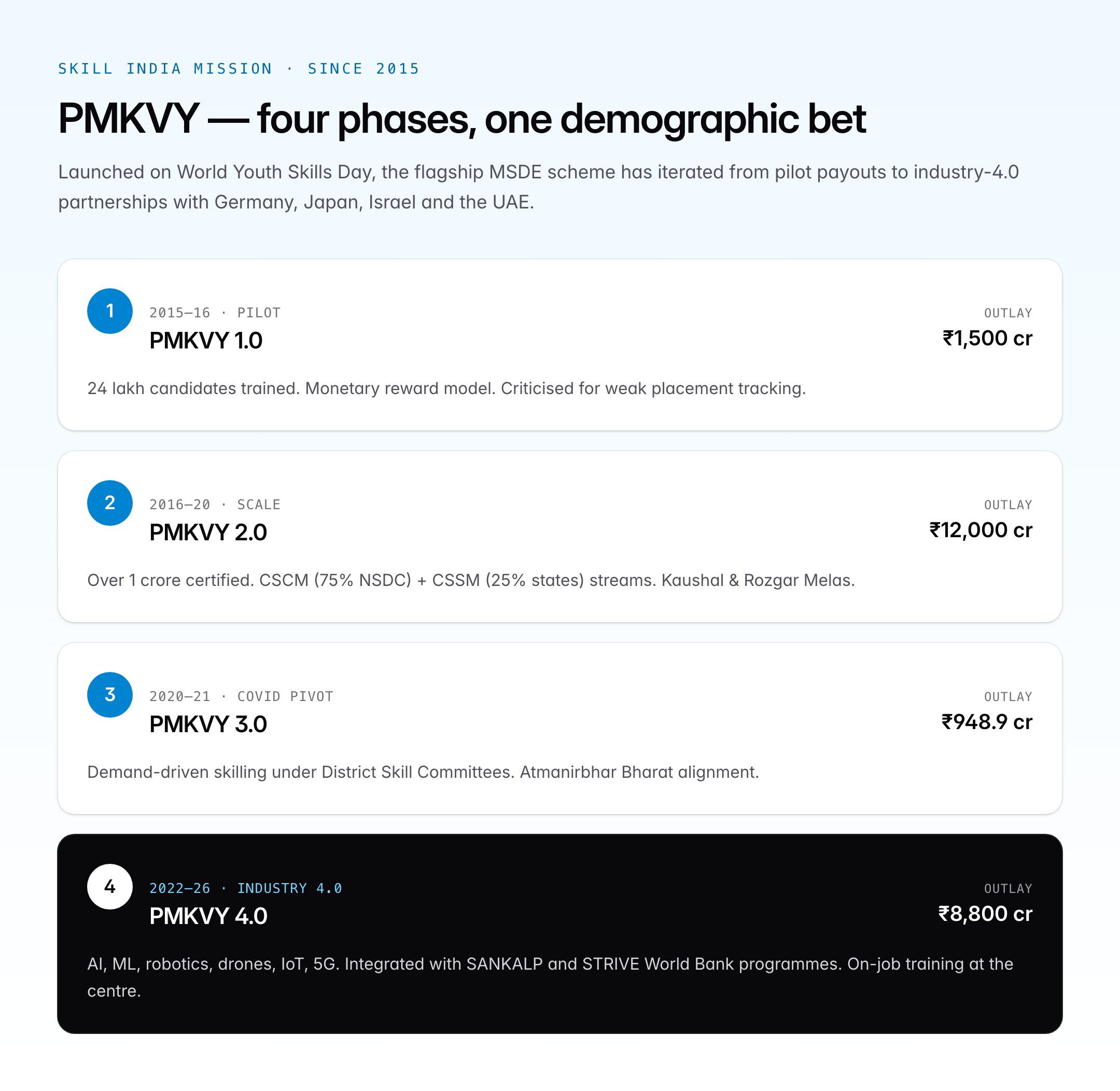
PMKVY has been rolled out in phases, each building on lessons from the previous.
| Phase | Period | Outlay | Targets / features |
|---|---|---|---|
| PMKVY 1.0 | 2015–16 | Rs 1,500 crore | Pilot; 24 lakh trained |
| PMKVY 2.0 | 2016–20 | Rs 12,000 crore | 1 crore target; centrally sponsored + centrally funded streams |
| PMKVY 3.0 | 2020–21 | Rs 948.90 crore | COVID-19 skilling, demand-led, district skill committees |
| PMKVY 4.0 | 2022–26 | Part of Rs 8,800 crore (World Bank aided SANKALP + STRIVE integration) | Industry 4.0 focus — AI, ML, robotics, drones, 3D printing, 5G |
PMKVY 1.0 (2015–16)
- Pilot scheme; Rs 1,500 crore outlay
- Monetary reward model
- 24 lakh candidates trained
- Criticised for weak placement tracking
PMKVY 2.0 (2016–20)
- Outlay expanded to Rs 12,000 crore — 40% for RPL, 60% for STT
- Centrally Sponsored Centrally Managed (CSCM) stream — 75% of funds via NSDC
- Centrally Sponsored State Managed (CSSM) stream — 25% via states
- Kaushal and Rozgar Mela events across districts
- Over 1 crore certified
PMKVY 3.0 (2020–21)
- Short transition phase during COVID-19
- Demand-driven — training based on local industry needs
- District Skill Committees (DSCs) empowered
- 8 lakh candidates targeted; focus on Atmanirbhar Bharat
PMKVY 4.0 (launched 2023, running 2022–26)
- Announced in Budget 2023–24
- Focus on Industry 4.0: AI, ML, robotics, drones, IoT, 5G
- On-job training and industry partnerships at the centre
- New age courses aligned with emerging sectors
- Integrated with SANKALP and STRIVE World Bank programmes
Key Institutions and Terms
| Term | Full form / meaning |
|---|---|
| MSDE | Ministry of Skill Development and Entrepreneurship |
| NSDC | National Skill Development Corporation (PPP) |
| NSDA | National Skill Development Agency (merged into NCVET 2018) |
| NCVET | National Council for Vocational Education and Training (regulator) |
| NSQF | National Skills Qualifications Framework |
| SSC | Sector Skill Council (industry-led standard body) |
| PMKK | Pradhan Mantri Kaushal Kendra — model district training centre |
| RPL | Recognition of Prior Learning |
| STT | Short Term Training |
| SANKALP | Skills Acquisition and Knowledge Awareness for Livelihood Promotion |
| STRIVE | Skills Strengthening for Industrial Value Enhancement |
Achievements
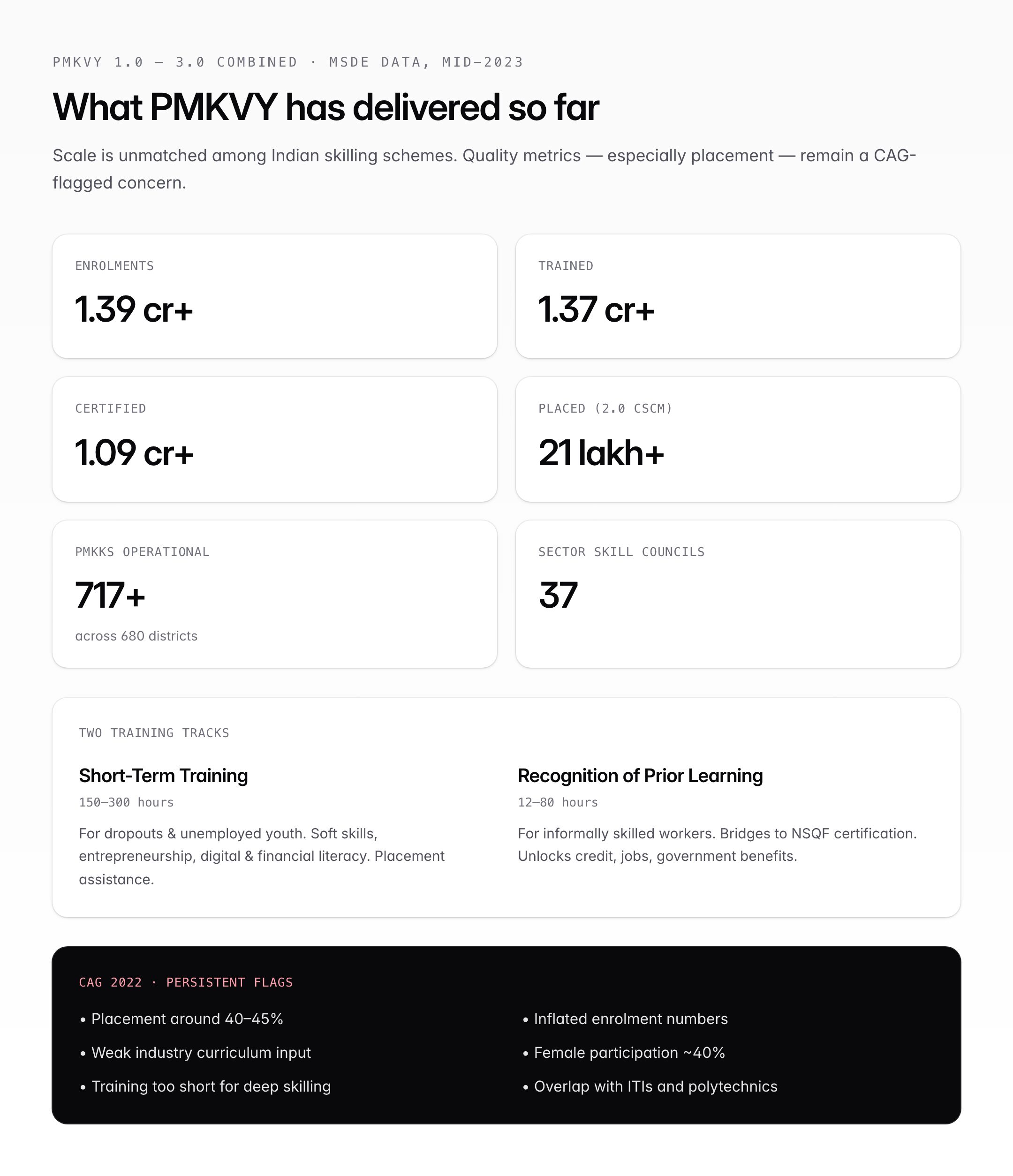
As per MSDE data (PMKVY 1.0–3.0 combined, as of mid-2023):
| Metric | Number |
|---|---|
| Total enrollments | 1.39 crore+ |
| Trained | 1.37 crore+ |
| Certified | 1.09 crore+ |
| Placed (PMKVY 2.0 CSCM) | Over 21 lakh |
| PMKK operational | 717+ across 680 districts |
| Sector Skill Councils | 37 |
PMKVY 4.0 additions:
- 30 Skill India International Centres (SIIC) being planned for overseas-ready skilling
- Partnerships with the UAE, Japan, Germany, Israel on mutual skill recognition
- Digital Skill Voucher piloted for self-paced learning
Criticisms and Challenges
Multiple evaluations — government and independent — have flagged persistent problems.
| Criticism | Evidence |
|---|---|
| Low placement rate | PMKVY 2.0 placement hovered around 40–45% |
| Short duration | 150–300 hours considered too short for deep skilling |
| Quality of training centres | Some fly-by-night TPs set up only to claim payouts |
| Misalignment with local labour market | Training in sectors with no local demand |
| Weak industry linkage | Industry input limited in curriculum design |
| Dropout rates | High; especially in RPL |
| Gender gap | Female participation only ~40% |
| Data integrity | CAG Report 2022 flagged inflated enrolment numbers |
| Overlap with ITIs/Polytechnics | Duplication; weakening of traditional vocational institutions |
The Sharda Prasad Committee Report (2016) and the CAG Performance Audit (2022) remain the most cited critical references.
Comparison with Other Skill Schemes
| Scheme | Ministry | Focus |
|---|---|---|
| PMKVY | MSDE | Short-term skilling + RPL |
| DDU-GKY (Deen Dayal Upadhyaya Grameen Kaushalya Yojana) | Ministry of Rural Development | Rural poor youth (15–35) placement-linked |
| DAY-NULM Skilling | Ministry of Housing and Urban Affairs | Urban poor skilling |
| National Apprenticeship Promotion Scheme (NAPS) | MSDE | Apprenticeship engagement |
| PM-DAKSH | Ministry of Social Justice | SC/OBC/ DNT/ safai karamcharis |
| Skill India International Centres | MSDE | Overseas employment readiness |
| Craftsmen Training Scheme (ITIs) | MSDE (DGT) | Long-term (1–2 year) technical skilling |
PMKVY is the largest by scale but works alongside these schemes. An emerging policy concern is rationalising overlap without losing targeted focus.
Way Forward
The Economic Survey 2023–24 and the NITI Aayog strategy for 2030 converge on several recommendations:
- Quality over quantity — fewer, better-equipped training centres
- Longer duration courses for complex skills
- Industry partnership — apprenticeship at scale under NAPS
- Digital credentials — skill passports on DigiLocker
- Gender-targeted schemes and safe travel/training
- Credit integration with Mudra and PM-Vishwakarma
- Overseas placement through bilateral migration and mobility partnerships
UPSC Relevance
PMKVY is a staple governance and economy topic.
- Prelims: Year of launch (2015), parent ministry (MSDE — created 2014), implementing body (NSDC), regulator (NCVET), framework (NSQF), two components (STT, RPL), four phases, associated schemes (PMKK, NAPS, DDU-GKY, SANKALP, STRIVE, PM-DAKSH)
- Mains GS Paper II: Government policies for skill development, institutional architecture, welfare of vulnerable sections
- Mains GS Paper III: Demographic dividend, employment and skill challenges, inclusive growth, industry 4.0 preparedness
- Current affairs: Budget 2023–24 Skill India International Centres announcement, CAG 2022 report, PMKVY 4.0 rollout, PM Vishwakarma scheme (2023), Digital Skill Voucher
- Essay: "Turning India's demographic dividend into reality" or "Skills, not slogans"
Candidates should be able to distinguish between MSDE, NSDC, NSDA, NCVET, and SSCs, place PMKVY within the wider Skill India Mission, and discuss both its achievements and the CAG-flagged weaknesses with specific figures.
Tell Google you want more of this.
Add Anantam IAS as a preferred sourceOne tap, and this site shows up more often in your own Top Stories, AI Overviews and AI Mode. Remove it any time.