Daily Digest
UPSC · Civil Services Examination
Current Affairs · Thursday, 4 September 2025
Current affairs curated and edited by Anantam IAS faculty — pulled from The Hindu, PIB, IDSA, Foreign Affairs and the ministries. Read, annotate, revise.
Old Rajinder Nagar · Delhi 110005 · anantamias.com
Coffee

Why in news:
India’s coffee-producing regions — especially Chikkamagaluru, Coorg, and Hassan districts of Karnataka — have been severely impacted by incessant rainfall, extreme cold, and prolonged lack of sunlight over the past three months.
UPSC Relevance:
UPSC CSE in prelims examination has focused on different boards like Tea Board, Coffee Board and Turmeric Board etc. A case in point is a following PYQ.
UPSC Prelims PYQ 2022
Consider the following States:
- Andhra Pradesh
- Kerala
- Himachal Pradesh
- Tripura
How many of the above are generally known as tea-producing States?
(a) Only one State
(b) Only two States
(c) Only three States
(d) All four States
Coffee:
- India’s journey with coffee began centuries ago, when the legendary holy saint Baba Budan brought seven Mocha seeds to the hills of Karnataka in the 1600s. His simple act of planting these seeds in the courtyard of his hermitage in Baba Budan Giri unknowingly set in motion the rise of India as one of the world’s prominent coffee producers.
- India is now the seventh-largest coffee producer globally with exports reaching $1.29 billion in FY 2023-24, almost double the $719.42 million in 2020-21.
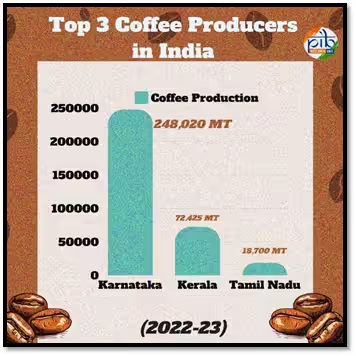
- India’s coffee is primarily grown in the ecologically rich Western and Eastern Ghats, areas famous for their biodiversity. Karnataka leads in production, contributing 248,020 MT in 2022-23, followed by Kerala and Tamil Nadu.
Types of Coffee Grown in India:
- Arabica: Known for its mild flavor and aromatic profile, Arabica coffee is predominantly grown in high-altitude regions.
- Robusta: Stronger and less acidic, Robusta thrives in lower altitudes and is valued for its higher yield. Specialty coffees like monsooned Malabar coffee, which undergoes a unique aging process during the monsoon, and organic and shade-grown coffees are gaining popularity in domestic and international markets.
Growing Conditions:
- In the coffee the predominant climate is tropical and equatorial, where Moisture prevails all year round
- The optimum range for the cultivation of arabica coffee is between 18 and 22ºC, while for robusta coffees it is between 22 and 26ºC.
- The appropriate amount of rainfall for the crop is between 1,500 and 2,000 millimeters per year, about 125 millimeters per month. Excessive rainfall can easily damage the flowering of coffee plants.
- The recommended number of hours of sunshine is 1,800 hours per year.
- Coffee thrives in deep, well-drained, loamy soils, rich in organic matter, and with good aeration, often found in volcanic regions or on hill slopes.
About the Coffee Board:
- The Government of India established the ‘Coffee Board’ through a constitutional act “Coffee Act VII of 1942” under the administrative control of Ministry of Commerce and Industry.
- The Board comprises 33 members including the Chairman and the Secretary & Chief Executive Officer. The remaining 31 members represent the various interests such as coffee growing industry, coffee trade interests, curing establishments, interests of labour and consumers, representatives of governments of the principal coffee growing states, and Members of Parliament.
- Statutory Committees: The Board functions through six statutory committees which are appointed for one year term each and the functions of each committee as per the Coffee Act are:
- Executive Committee: Deals with functions specifically assigned to it under the Coffee Rules. In addition to that deals with matters not specifically assigned to the Propaganda, Marketing, Research, or any other committees constituted by the Board.
- Propaganda Committee: Deals with matters relating to promotion of sale and increasing the consumption in India and elsewhere of the coffee produced in India.
- Marketing Committee: Deals with coffee marketing scheme as set forth in the Act and Rules.
- Research Committee: Deals with promotion of agricultural and technological research in the interest of the coffee industry in India.
- Development Committee: Deals with the measures that may be undertaken for the development of coffee estates.
- Quality Committee: Deals with all issues relating to the improvement in the quality of coffee produced in India.
Ministry:
MOC&I(Ministry of Commerce and Industry)
Headquarter:
Bengaluru
Practice Question:
Consider the following statements
- India is the largest producer of coffee
- The Indian Coffee Board is located in Uttar Pradesh
- India is the largest producer of Arabica coffee
How many of the above statements are/are false?
a) Only one
b) Only two
c) All three
d) None of the above
GST Council and GST Reforms

Why in news:
India’s GST Council, in its 56th meeting, has overhauled the indirect tax system by moving to a two-rate structure of 5% and 18%, along with a special 40% rate on luxury and harmful goods such as tobacco, large cars, yachts, and helicopters.
UPSC Relevance
Prelims, GS3, Budgeting
PYQ’s:
2018 Prelims
With reference to India’s decision to levy an equalization tax of 6% on online advertisement services offered by non-resident entities, which of the following statements is/are correct?
- It is introduced as a part of the Income Tax Act.
- Non-resident entities that offer advertisement services in India can claim a tax credit in their home country under the “Double Taxation Avoidance Agreements”.
Select the correct answer using the code given below:
(a) 1 only
(b) 2 only
(c) Both 1 and 2
(d) Neither 1 nor 2
2024
Consider the following items:
- Cereal grains hulled
- Chicken eggs cooked
- Fish processed and canned
- Newspapers containing advertising material
Which of the above items is/are exempted under GST (Goods and Services Tax)?
1 only
2 and 3 only
1, 2 and 4 only
1, 2, 3 and 4
Mains 2020 – Explain the rationale behind the Goods and Services Tax (Compensation to States) Act of 2017. How has COVID-19 impacted the GST compensation fund and created new federal tensions?
About GST Council:
- As per Article 279A (1) of the amended Constitution, the GST Council has to be constituted by the President within 60 days of the commencement of Article 279A. The notification for bringing into force Article 279A with effect from 12th September, 2016 was issued on 10th September, 2016.
As per Article 279A of the amended Constitution, the GST Council which will be a joint forum of the Centre and the States, shall consist of the following members: –
- Union Finance Minister – Chairperson
- b) The Union Minister of State, in-charge of Revenue of finance – Member
- c) The Minister In-charge of finance or taxation or any other Minister nominated by each State Government – Members
Voting Power:
- 1/3rd- Centre Govt.
- 2/3rd- State Govt.
- 3/4th- for final decision
GST Council Meeting:
56th Meeting of the GST Council held at New Delhi, today
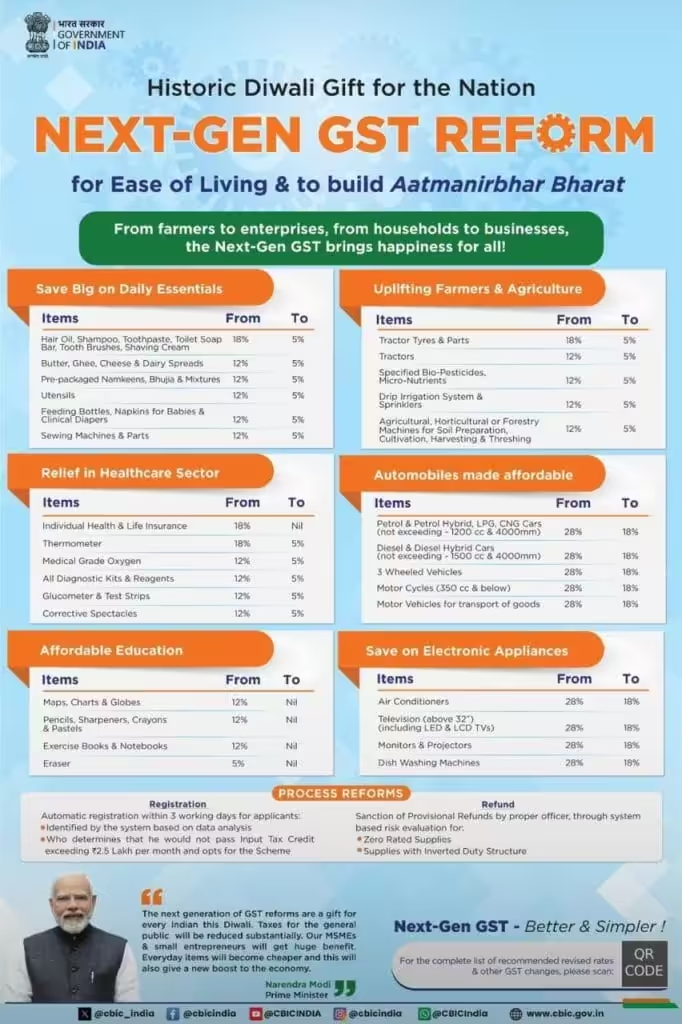
For GST Reform:- https://anantamias.com/current-affairs/gst-reforms/
Source: https://anantamias.com/current-affairs/gst-council-and-gst-reforms/
Role of Private Sector Banks In National Building

Why in news:
Union Finance Minister Nirmala Sitharaman highlighted the crucial role of private sector banks in India’s nation-building efforts during the 120th foundation day celebrations of City Union Bank (CUB) in Chennai.
UPSC Relevance:
Indian Economy and issues relating to planning, mobilization, of resources, growth, development and employment.
UPSC PYQ:
Q. With reference to the Banks Board Bureau (BBB), which of the following statements are correct? (2022)
- The Governor of RBI is the Chairman of BBB.
- BBB recommends for the selection of heads for Public Sector Banks.
- BBB helps the Public Sector Banks in developing strategies and capital raising plans.
Select the correct answer using the code given below:
(a) 1 and 2 only
(b) 2 and 3 only
(c) 1 and 3 only
(d) 1, 2 and 3
Pvt. Banks:
Private sector banks (PSBs) have emerged as an important pillar of India’s financial system since liberalisation (1991 onwards). They complement public sector banks by enhancing efficiency, innovation, competition, and financial inclusion. Today, they account for nearly 40% of total banking assets in India (RBI 2023 data) and play a decisive role in nation-building.
Key Roles in the Economy:
1. Credit Expansion & Investment Support
- As of March 2024, private banks held ~38% share in total bank credit (RBI).
- They provide credit to corporates, retail borrowers, MSMEs, and startups.
- Example: HDFC Bank, ICICI Bank, Axis Bank are leaders in housing loans, auto loans, and personal finance, fueling consumption-driven growth.
2. Financial Inclusion & Digital Innovation
- Private banks pioneered digital banking, UPI adoption, mobile wallets, and net banking.
- Example: Kotak Mahindra Bank’s 811 digital account expanded low-cost accounts to rural youth.
- Contribution to Jan Dhan–Aadhaar–Mobile (JAM) trinity by expanding reach of DBTs and government schemes.
3. Support to MSMEs & Entrepreneurs
- MSMEs contribute ~30% to GDP but face credit crunch.
- Private banks like Yes Bank (SME loans) and ICICI Bank (MSME digital loans) bridge this gap.
- RBI’s ECLGS scheme (Emergency Credit Line Guarantee Scheme during COVID-19) saw strong participation from private banks.
4. Stability & Efficiency in Financial System
- Asset Quality: Gross NPAs of private banks were just 2.1% in FY23, compared to 5%+ for PSBs (RBI Financial Stability Report 2023).
- Their efficiency and risk management reduce systemic risk and improve investor confidence.
5. Employment Generation & Skill Development
- Private banks employ lakhs of professionals in fintech, credit analysis, and financial services.
- Example: HDFC Bank alone employs ~1.73 lakh people (2023).
6. Contribution to Capital Markets
- Active in investment banking, mutual funds, wealth management.
- Example: ICICI Securities, Axis Securities provide capital market depth, mobilising savings into productive investments.
7. Nation-Building Role
- Banks like ICICI, HDFC are key partners in PMAY (housing for all) and Make in India.
- Financing infrastructure projects, green energy, and startups.
- Example: IndusInd Bank’s green financing for EVs and renewable energy.
Source: https://anantamias.com/current-affairs/role-of-private-sector-banks-in-national-building/