Daily Digest
UPSC · Civil Services Examination
Current Affairs · Sunday, 5 July 2026
Current affairs curated and edited by Anantam IAS faculty — pulled from The Hindu, PIB, IDSA, Foreign Affairs and the ministries. Read, annotate, revise.
Old Rajinder Nagar · Delhi 110005 · anantamias.com
Placenta-on-chip: Indian scientists recreate the maternal-fetal barrier
Why in News?
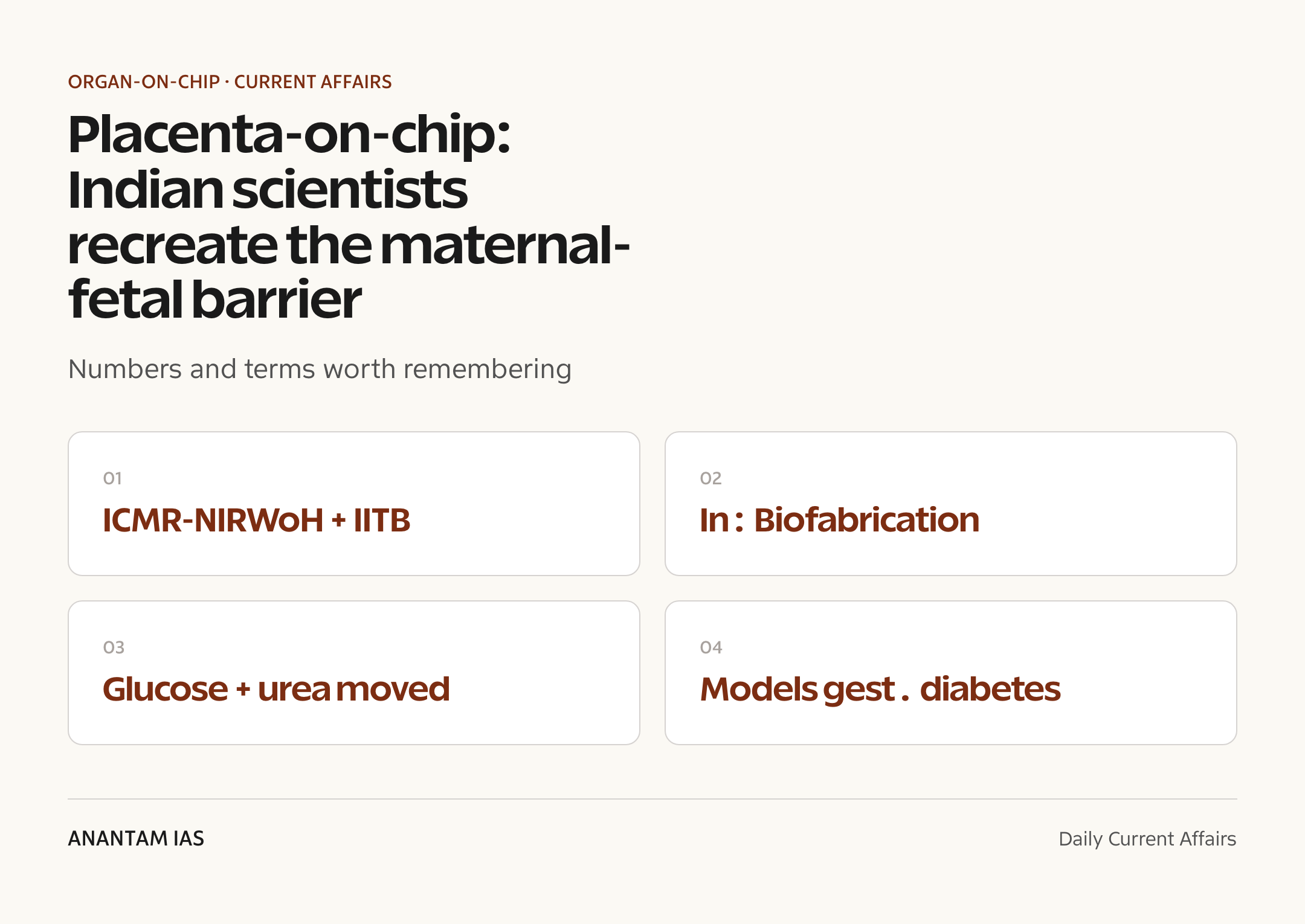
Researchers from the ICMR-National Institute for Research on Women’s Health (ICMR-NIRWoH), Mumbai, with IIT Bombay, have built an indigenous lab-grown placenta-on-chip that recreates key functions of the human placental barrier. The Hindu (PTI) reported the milestone in early July 2026.
The team’s study, published in the journal Biofabrication, describes a microphysiological system that mimics the interface between mother and foetus and reproduces hormone production, nutrient transfer, waste exchange and selective barrier function.
- Built by ICMR-NIRWoH (formerly ICMR-NIRRCH), Mumbai, with the engineering design and fabrication done at IIT Bombay.
- Co-corresponding authors Deepak Modi (ICMR-NIRWoH) and Abhijit Majumder (IIT Bombay); biological validation led by Anshul Bhide.
- The chip produces pregnancy hormones, transports glucose from the maternal to the foetal side and removes waste such as urea.
- It responds to hyperglycaemic conditions resembling gestational diabetes, changing placental transport as a real placenta would.
- Unlike systems needing continuous perfusion, the platform is designed to be simple, scalable and compatible with conventional lab workflows.
The development matters in the context of:
- The placenta is the foetus’s first life-support organ yet one of the least understood, because it is hard to study directly during pregnancy.
- The work strengthens India’s push toward human-relevant models that can complement or replace animal studies in reproductive research.
UPSC Relevance
Prelims Relevance
- Placenta-on-chip — an organ-on-chip / microphysiological system
- ICMR-NIRWoH (formerly ICMR-NIRRCH), Mumbai; IIT Bombay
- Journal of publication: Biofabrication
- Maternal-fetal barrier and trophoblast interface
- Functions mimicked: hormone output, glucose transport, urea removal, selective barrier
- Gestational diabetes / hyperglycaemia modelling
- New Approach Methodologies (NAMs) — non-animal test methods
- New Drugs and Clinical Trials (Amendment) Rules, 2023 allowing non-animal drug tests; CDSCO
- BioE3 Policy (Biotechnology for Economy, Environment and Employment)
- Microfluidics and lab-on-chip technology
Mains Relevance
GS Paper 3
- Indigenous organ-on-chip platforms and India’s push for self-reliant biotech R&D.
- Alternatives to animal testing — ethical, scientific and regulatory dimensions of NAMs.
GS Paper 2
- Human-relevant models for maternal and foetal health and pregnancy-disorder research.
Essay
- Science that serves the vulnerable: technology for maternal and reproductive health.
- Ethics of the laboratory — replacing animal experiments with human-relevant models.
Background and Context
What organ-on-chip technology is
The platform belongs to a fast-growing class of miniature living systems.
- An organ-on-chip is a thumb-sized device lined with living human cells that recreates the key functions of an organ under controlled conditions.
- It sits within the field of microphysiological systems — engineered models that reproduce human physiology outside the body.
- Many chips rely on microfluidics: precisely engineered channels that move tiny volumes of fluid to mimic blood flow and nutrient exchange.
- By recreating an organ’s behaviour, such chips let scientists watch biology in real time without opening a living body.
- Global research has already produced lung, liver, gut, kidney and blood-brain-barrier chips; a placenta-on-chip extends the toolkit to reproductive biology.
- The value lies in functional fidelity — a chip is judged by whether it behaves like the organ, not merely by how it looks.
Why the placenta is so hard to study
The placenta is central to pregnancy but has long resisted direct observation.
- It acts as the baby’s first life-support system — delivering oxygen and nutrients, clearing waste, shielding the foetus and making hormones.
- Studying it during pregnancy is difficult and risky, so much of its working stays hidden.
- The maternal-fetal barrier — the selective interface that decides what crosses from mother to baby — is key to healthy development.
- Poorly understood placental function underlies disorders such as pre-eclampsia, foetal growth restriction and gestational diabetes.
What the Indian chip demonstrated
The device reproduced several core placental functions, not just structure.
- It produced pregnancy hormones, showing hormonal activity of the placental interface.
- It transported glucose from the maternal to the foetal side, modelling nutrient transfer.
- It removed waste products such as urea, mirroring the placenta’s clearance role.
- It reproduced selective barrier function — controlling what passes across the interface.
- It modelled hyperglycaemic conditions resembling gestational diabetes and showed altered placental transport in response.
- Crucially, the demonstration is functional: the chip performs placental jobs, rather than only holding placental cells in place.
- That functional read-out is what lets researchers test how the barrier reacts under both healthy and diseased pregnancy conditions.
The indigenous design edge
The team stressed engineering simplicity as much as biological fidelity.
- Fabrication and engineering were led at IIT Bombay, with biological validation at ICMR-NIRWoH.
- Unlike many existing chips that need sophisticated equipment and continuous perfusion, this one avoids that complexity.
- It is designed to be simple, scalable and compatible with standard laboratory infrastructure.
- That lowers the barrier to adoption, so more Indian labs could use it for pregnancy and reproductive-health research.
- It reflects interdisciplinary teamwork across reproductive biology, microengineering and cell biology.
- Wider affordability could spread advanced pregnancy research beyond a few elite labs, an equity gain for domestic science.
Alternatives to animal testing (NAMs)
The chip fits a global and Indian shift away from animal experiments.
- New Approach Methodologies (NAMs) are non-animal methods — organ-on-chip, organoids and computer models — that predict human responses.
- India’s New Drugs and Clinical Trials (Amendment) Rules, 2023 permitted developers to use non-animal and human-relevant methods for drug safety, overseen by the CDSCO.
- Human-cell platforms can avoid the species mismatch that makes animal data an imperfect guide to human biology.
- The approach echoes the long-standing 3Rs principle — replace, reduce and refine the use of animals in research.
- Regulators worldwide, including the US FDA, have begun accepting NAM data for parts of drug safety assessment, signalling a broader shift.
- Researchers frame the chip as a way to complement or replace animal studies in selected reproductive-research applications, where scientifically appropriate.
Where it could be used
Applications range from basic biology to drug safety in pregnancy.
- Studying placental biology and how the barrier behaves in health and disease.
- Investigating pregnancy complications such as pre-eclampsia, foetal growth restriction and gestational diabetes.
- Evaluating how medicines cross the placental barrier, to flag drugs that are safe or unsafe in pregnancy.
- Supporting more predictive, human-relevant research models than animal experiments alone.
- Serving as a low-cost screening tool for maternal-health questions, given India’s high burden of pregnancy complications.
Policy backdrop: BioE3 and indigenous biotech
The advance aligns with India’s stated biotechnology direction.
- The BioE3 Policy (Biotechnology for Economy, Environment and Employment), cleared in 2024, pushes high-performance biomanufacturing and next-generation health solutions.
- Developing advanced human-relevant models within the country strengthens India’s biomedical innovation base.
- It supports the wider self-reliance goal of building critical research tools domestically rather than importing them.
- ICMR-NIRWoH’s Director framed the work as advancing solutions for women’s and reproductive health.
- It aligns with global efforts to develop more predictive alternatives to animal experimentation and to strengthen indigenous biomedical capability.
Way Forward
Validate and standardise
- Benchmark the chip against clinical placental data so results are reproducible across labs.
- Develop shared protocols so a scalable platform becomes a common research standard.
Build the ecosystem
- Fund interdisciplinary engineer-biologist teams that made this project possible.
- Link chips to regulatory acceptance so CDSCO and industry can rely on the data.
Pair indigenous organ-on-chip work with clear ethical and regulatory pathways so human-relevant models steadily reduce, and where possible replace, animal testing in reproductive research.
Conclusion
A placenta on a chip is a small device with an outsized promise: a window into an organ that has stayed opaque through the whole history of medicine. By reproducing hormone output, nutrient transport and barrier function, the ICMR-NIRWoH and IIT Bombay platform turns an inaccessible interface into something scientists can watch and probe.
Its real significance is that it is indigenous, simple and scalable, and points toward safer, more human-relevant testing. For a country balancing maternal-health burdens with the ethics of animal experimentation, that combination matters.
UPSC Practice Questions
Prelims MCQ 1
With reference to the recently developed indigenous placenta-on-chip platform, consider the following statements:
- It was developed by ICMR-NIRWoH, Mumbai, in collaboration with IIT Bombay.
- It reproduces functions including hormone production, glucose transport and waste removal.
- It requires a continuous perfusion system and sophisticated equipment to operate.
How many of the above statements are correct?
(a) Only one (b) Only two (c) All three (d) None
Answer: (b) Only two
Explanation:
Statements 1 and 2 are correct. Statement 3 is wrong: the platform was specifically designed to be simple and scalable, avoiding the continuous perfusion and sophisticated equipment that many existing chips need.
Prelims MCQ 2
“New Approach Methodologies (NAMs)”, recently in the news, are best described as:
(a) Non-animal methods such as organ-on-chip and organoids to predict human responses (b) New accounting methods for public-sector research funding (c) A classification of newly discovered antimicrobial molecules (d) A satellite navigation augmentation system
Answer: (a) Non-animal methods such as organ-on-chip and organoids to predict human responses
Explanation:
NAMs are human-relevant, non-animal test methods (organ-on-chip, organoids, in-silico models). India’s 2023 amendment to the drug rules allowed developers to use such methods for drug testing.
UPSC Mains Questions
- Organ-on-chip platforms are reshaping biomedical research. Discuss how indigenous microphysiological systems such as the placenta-on-chip can advance both India’s biotechnology self-reliance and the ethics of drug testing.
- “Human-relevant models can complement or replace animal experimentation in specific applications.” Examine this statement in the context of New Approach Methodologies and India’s regulatory reforms since 2023.
- The placenta remains one of the least understood human organs. How can new laboratory models improve the study of pregnancy disorders such as pre-eclampsia and gestational diabetes?
Sources: The Hindu (PTI) and Biofabrication (journal).
Frequently Asked Questions
What is a placenta-on-chip?
It is an organ-on-chip: a small device lined with living human cells that recreates key functions of the placenta under controlled lab conditions. The Indian version mimics the maternal-fetal barrier, producing hormones, transporting glucose and removing waste, so scientists can study the placenta without observing it inside a pregnancy.
Who developed the Indian placenta-on-chip?
Researchers at the ICMR-National Institute for Research on Women’s Health (ICMR-NIRWoH, formerly ICMR-NIRRCH), Mumbai, built it with IIT Bombay. Deepak Modi and Abhijit Majumder were co-corresponding authors, and Anshul Bhide led the biological validation. The study appeared in the journal Biofabrication.
What functions does the chip recreate?
It reproduces several core placental functions: producing pregnancy hormones, transporting glucose from the maternal to the foetal side, removing waste such as urea, and maintaining a selective barrier. It also modelled hyperglycaemic conditions resembling gestational diabetes and showed altered transport in response.
Why does this reduce reliance on animal testing?
The placenta-on-chip is a human-relevant model, so it can predict human responses more directly than animal experiments in some applications. It supports New Approach Methodologies (NAMs), the non-animal test methods India’s 2023 drug-rules amendment allowed developers to use, overseen by the CDSCO.
What pregnancy disorders could it help study?
Because it recreates the maternal-fetal interface, the platform can help investigate pre-eclampsia, foetal growth restriction and gestational diabetes. It can also test how medicines cross the placental barrier, helping identify drugs that are safe or unsafe during pregnancy.
How does it link to India’s BioE3 Policy?
Developing advanced human-relevant models within India strengthens the country’s biomedical innovation base, in line with the BioE3 Policy (Biotechnology for Economy, Environment and Employment). Building such critical research tools domestically also supports the wider goal of self-reliance in biotechnology.
Source: https://anantamias.com/current-affairs/human-placenta-on-chip-indian-scientists/
Credit-deposit gap: why banks are turning to costly funds
Why in News?
The Reserve Bank of India’s latest Financial Safety Report flagged bank funding as an emerging challenge, warning that the liability profile is shifting from low-cost CASA (Current Account and Savings Account) deposits to costlier term deposits and certificates of deposit, pushing up the marginal cost of funds.
The gap between credit growth and deposit growth widened sharply through the first half of 2026, forcing banks to lean on price-sensitive wholesale money to keep funding a strong credit pipeline.
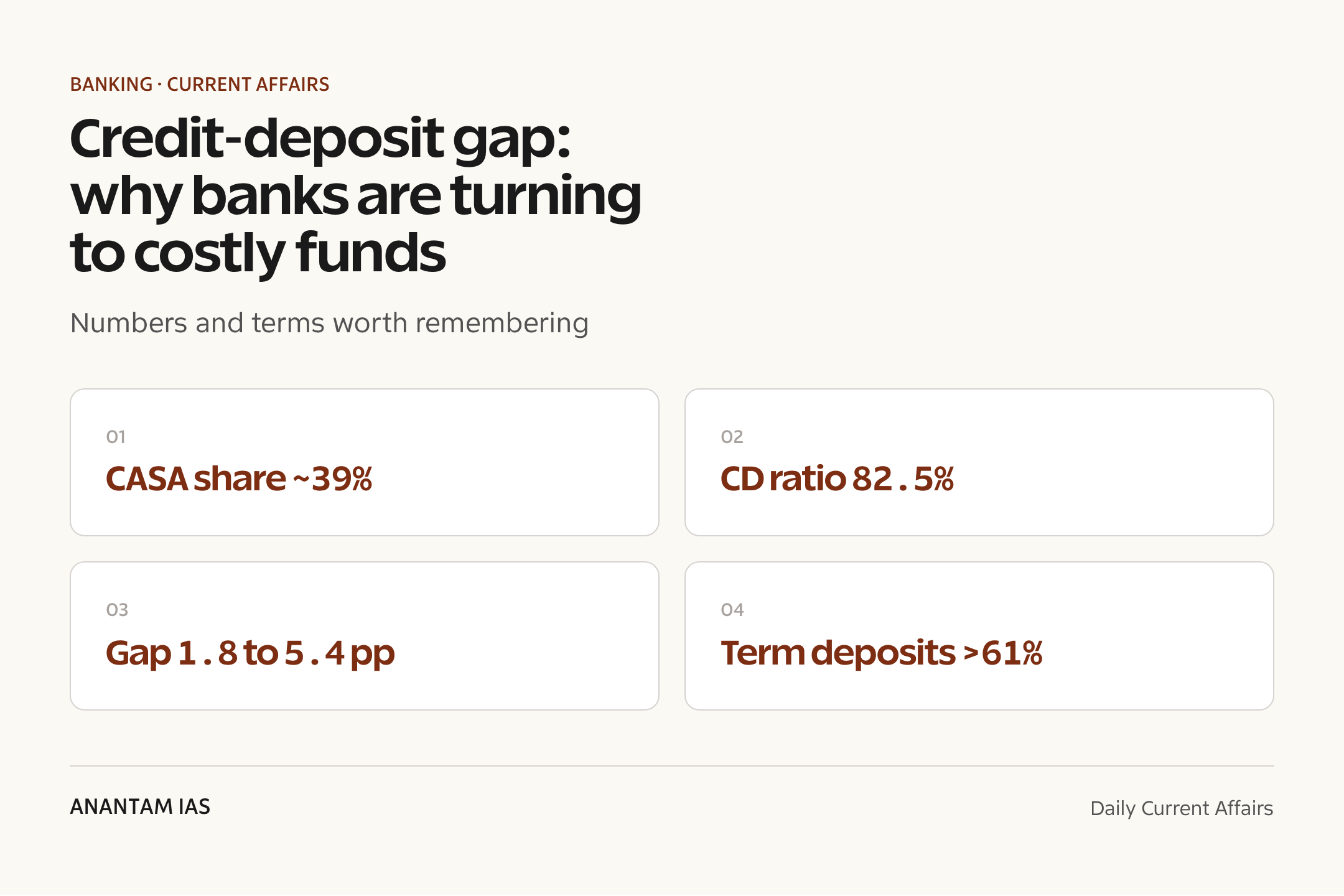
- The credit-deposit growth gap widened from 1.8 percentage points in December to 5.4 percentage points as of June 15, per RBI data.
- The system credit-to-deposit ratio rose to 82.5% (June 15) from about 75% in mid-2025.
- The share of CASA in total deposits fell to about 39% from a peak of near 44% in FY22.
- Term deposits’ share climbed to an all-time high above 61%, up from around 56% in FY23.
- CASA carries roughly 3-4% interest for banks; term deposits and CDs cost 7-8%.
- RBI’s Financial Safety Report flagged that term-deposit growth ‘continued to outpace’ CASA, signalling a sustained saver preference for interest-bearing money.
The development matters in the context of:
- Deposits are the cheapest, most stable funding base of a bank; a thinning low-cost base directly threatens net interest margins and lending capacity.
- The stress tests the durability of India’s credit boom and the reach of RBI’s monetary transmission.
- Liability quality is emerging as the key competitive moat when asset quality across banks looks broadly similar.
UPSC Relevance
Prelims Relevance
- CASA = Current Account + Savings Account deposits; low-cost, low-interest, ‘sticky’ funds
- Credit-Deposit (CD) ratio = share of deposits deployed as loans; ~82.5% (June 2026)
- Certificate of Deposit (CD) = negotiable money-market term instrument for corporates/institutions
- Term (time) deposit = money locked for a fixed tenure; includes FDs and recurring deposits
- Net Interest Margin (NIM) = (interest earned – interest paid) / average earning assets
- Repo rate cut by 125 basis points in 2025; anchors the rate structure
- FCNR(B) = Foreign Currency Non-Resident (Bank) deposits, classified as term deposits
- Marginal cost of funds underlies the MCLR lending-rate benchmark
- LCR (Liquidity Coverage Ratio), CRR and SLR shape a bank’s liquidity buffers
- EBLR (External Benchmark Lending Rate) links loans to the repo rate
Mains Relevance
GS Paper 3
- Examine how a widening credit-deposit gap and shrinking CASA base affect banks’ cost of funds, margins and lending rates.
- Discuss the role of deposit mobilisation and financial inclusion in a stable banking liability structure.
GS Paper 3
- Analyse RBI’s tools – repo rate, liquidity operations, CRR/SLR, LCR – for managing bank funding stress and monetary transmission.
Essay
- Savings behaviour and the financialisation of household wealth in a growing economy.
- Stability versus growth: the trade-offs in funding a credit-hungry economy.
Background and Context
What CASA deposits are and why they are prized
CASA is the cheapest and most stable slice of a bank’s funding.
- Current accounts – used by businesses and traders for high-frequency transactions – usually earn no interest, since the depositor values liquidity over yield.
- Savings accounts pay only a small administered rate, so the blended CASA cost to a bank is roughly 3-4% – well below any market-linked instrument.
- CASA is treated as ‘sticky’ money: churn is low because households and firms rarely move their primary current or savings balance to a rival bank over a marginal rate difference.
- Low cost plus stickiness lets a bank fund longer-tenure loans – its main revenue source – at a healthy spread, matching short-term liabilities against long-term assets with less rollover worry.
- A higher CASA ratio generally signals franchise strength: it widens the net interest margin, cushions rate shocks, and keeps credit cheaper for borrowers.
The credit-deposit ratio and why ~75% is the comfort zone
The CD ratio measures how much of every rupee of deposits a bank has lent out.
- The credit-to-deposit (CD) ratio is loans as a percentage of deposits; a reading of 82.5% means Rs 82.5 of every Rs 100 of deposits is deployed as credit.
- A ratio in the 70-75% band is generally seen as comfortable – it leaves a cushion once banks set aside statutory reserves and hold liquidity buffers.
- Banks must first park funds against the CRR (Cash Reserve Ratio) and SLR (Statutory Liquidity Ratio), so not every deposit rupee is even lendable.
- A high CD ratio squeezes profits once operational, marketing and funding costs are counted, and leaves thin headroom to grow loans without raising fresh, costlier money.
- The jump from about 75% to 82.5% within a year is the clearest signal that credit has outrun the deposit base funding it.
Why the credit-deposit gap widened
Loans are growing faster than the deposits meant to fund them.
- Credit growth picked up over recent months on the back of retail, MSME and personal lending, but deposit growth failed to keep pace, per RBI data cited by The Indian Express.
- The growth gap stretched from 1.8 percentage points in December to 5.4 percentage points by June 15 – a threefold widening in six months.
- The system credit-to-deposit ratio climbed to 82.5% from roughly 75% a year earlier, per RBI.
- The mismatch is not a one-bank story: it is a system-wide divergence that forces every lender to compete harder for the same shrinking pool of deposits.
- When banks bid up deposit rates to close the gap, they import the very cost pressure that erodes their margins.
The savings shift: financialisation of household wealth
Households now have richer, easier alternatives to a plain savings account.
- Retail savers are moving money into equities, mutual funds (via SIPs) and higher-yield fixed deposits that comfortably beat CASA returns.
- Digitisation and the simplification of regulatory norms have made these avenues far more accessible – a smartphone now opens a demat or MF account in minutes.
- This is a structural financialisation of savings: as incomes rise and trust in markets grows, households hold less idle cash in low-yield accounts.
- RBI’s report noted term-deposit growth ‘continued to outpace’ CASA, showing a sustained preference for interest-bearing deposits.
- The 5-year average share of CASA in incremental deposits is 40.2%, but it slid to 21% / 23% / 33% in FY24 / FY25 / FY26, per Equirus Securities – CASA has been under pressure for three straight years.
Term deposits and CDs: the costlier fix
Banks are plugging the gap with pricier, more volatile funds.
- A term (time) deposit locks money for a fixed tenure in return for interest – fixed and recurring deposits are the retail versions.
- A Certificate of Deposit (CD) is a negotiable money-market instrument corporates and institutions use to raise short-duration money; banks lean on CDs to manage near-term liquidity.
- CASA’s share of total deposits fell to about 39% from a 44% FY22 peak, while term deposits touched a record above 61% from about 56% in FY23.
- RBI’s push to attract foreign inflows led banks to aggressively hike rates on FCNR(B) offerings, which sit under term deposits and add to the higher-cost pile.
- Analysts note CDs are wholesale, price-sensitive money with 3-12 month tenors; in a tight-liquidity phase, rollover costs can spike quickly, unlike granular retail CASA.
Cost of funds and the net interest margin squeeze
Costlier liabilities are starting to bite into profitability.
- Term deposits and CDs cost banks about 7-8% against CASA’s 3-4%, so each rupee that shifts from CASA to term money lifts the marginal cost of funds.
- A rising cost of funds directly compresses the net interest margin (NIM) – the spread between what a bank earns on loans and pays on deposits, relative to earning assets.
- Large lenders including SBI, HDFC Bank and Canara Bank saw NIMs slip in the January-March quarter as the shift began to seep through.
- The blow is cushioned for now by the low-rate cycle after RBI cut the repo rate by 125 basis points in 2025, letting banks pay depositors less across the board.
- CDs and bulk term deposits reprice downward fastest, so wholesale reliance is ‘cheapest to carry precisely now’ – but the risk flips the moment the rate cycle turns upward.
- Analysts expect the full impact of higher bulk-deposit costs to flow into cost of funds during the second half of FY27.
RBI's liquidity toolkit and monetary transmission
How the deposit squeeze tests the passage of RBI’s rate signals to borrowers.
- The repo rate is RBI’s policy anchor; its 125 bps cut in 2025 influences interest rates across the entire banking system.
- RBI manages day-to-day liquidity through VRR (Variable Rate Repo) injections and VRRR (Variable Rate Reverse Repo) absorptions, alongside the CRR and SLR that set reserve requirements.
- The Liquidity Coverage Ratio (LCR) obliges banks to hold enough high-quality liquid assets to survive a 30-day stress run, shaping how aggressively they can chase loans.
- Most floating-rate loans are now linked to the EBLR (repo-linked), while older loans track the MCLR, which moves with the marginal cost of funds.
- A rising cost of funds slows the pass-through of repo cuts into MCLR-linked lending rates, testing how cleanly monetary transmission reaches borrowers.
Systemic risk: cyclical squeeze or structural shift?
Experts read the CASA squeeze mainly as a liquidity cycle, not a permanent break.
- Analysts view the slowdown as largely cyclical, tied to overall system liquidity after the post-Covid boom faded.
- The post-pandemic surge in CASA came from RBI’s easy-liquidity steps during Covid; that flush is now unwinding as policy normalises.
- With asset quality broadly similar across banks, a strong liability franchise – granular, low-cost, sticky deposits – is becoming the key competitive moat in Indian banking.
- The tail risk is real: a fresh RBI rate hike or an external shock could hit the sector hard if reliance on short-term wholesale funds is high and CASA growth has not revived.
- The financialisation of savings, though, has a structural element – as households keep migrating to markets, banks may never fully recover the CASA shares of the easy-money years.
Way Forward
Rebuild the low-cost deposit base
- Deepen financial inclusion and anchor salary, pension and transaction relationships to grow granular CASA rather than chasing bulk money.
- Compete on service, digital experience and branch-plus-app reach – the ‘liability franchise’ moat – not only on headline rates.
- Use targeted products for underbanked and rural savers to widen the deposit funnel that markets and mutual funds do not yet fully reach.
Manage funding and liquidity prudently
- Cap over-reliance on short-tenor CDs and bulk deposits that can reprice sharply when liquidity tightens.
- Use the current low-rate window to lock in stable, longer-duration funding and protect net interest margins before the cycle turns.
- Strengthen asset-liability management so that LCR buffers and deposit maturities are matched to the loan book’s tenure profile.
Policy and monetary transmission
- RBI can calibrate liquidity operations (VRR/VRRR), CRR and LCR settings to ease genuine funding stress without fuelling risky lending.
- Guard monetary transmission so that repo-rate signals reach borrowers even as banks’ cost of funds shifts upward.
- Continue monitoring the credit-deposit ratio as a system-stability metric, so that credit growth stays anchored to a durable deposit base.
Conclusion
The widening credit-deposit gap and the drift from CASA to term deposits mark a quiet but consequential shift in how Indian banks fund themselves. Cheap, sticky savings are giving way to costlier, price-sensitive money, and the buffer of a low-rate cycle is doing much of the work in keeping margins intact for now.
Part of this is cyclical – a hangover from the post-Covid liquidity surge that is unwinding. But part is structural: as households financialise their savings into equities, mutual funds and higher-yield deposits, the era of abundant, near-free CASA may not fully return. Liability franchise quality, not asset quality, is becoming the moat that separates strong banks from the rest.
The over-reliance on temporary wholesale fixes is a double-edged sword. It funds today’s credit boom, but a rate hike or an external shock could expose the sector if CASA growth is not revived. Rebuilding a stable, low-cost deposit base – through inclusion, trust and service – is the durable answer, and keeping the credit-deposit ratio in check is the discipline that protects both margins and monetary transmission.
UPSC Practice Questions
Prelims MCQ 1
With reference to CASA deposits in the Indian banking system, consider the following statements:
- CASA deposits are typically a higher-cost source of funds than certificates of deposit.
- Current account and savings account balances are considered relatively ‘sticky’ funds for banks.
- A rising share of CASA in total deposits tends to support a bank’s net interest margin.
How many of the above statements are correct?
(a) Only one (b) Only two (c) All three (d) None
Answer: (b) Only two
Explanation:
Statement 1 is wrong: CASA (~3-4%) is cheaper than CDs/term deposits (~7-8%). Statements 2 and 3 are correct – CASA is sticky and a higher CASA share widens NIM.
Prelims MCQ 2
The credit-to-deposit (CD) ratio of a bank indicates:
(a) The share of a bank’s deposits that has been deployed as loans (b) The ratio of a bank’s cash reserves to its total liabilities (c) The proportion of low-cost deposits in total deposits (d) The gap between the repo rate and the reverse repo rate
Answer: (a) The share of a bank's deposits that has been deployed as loans
Explanation:
The CD ratio is loans as a percentage of deposits; a ratio of 82.5% means Rs 82.5 of every Rs 100 of deposits is lent out.
UPSC Mains Questions
- The share of low-cost CASA deposits in Indian banks has fallen even as credit growth outpaces deposit growth. Examine the implications for banks’ cost of funds, net interest margins and lending rates, and suggest measures to rebuild a stable deposit base. (250 words)
- “Liability franchise quality is becoming the key competitive moat in Indian banking.” Discuss the causes of the current deposit-mobilisation challenge and the role of RBI’s liquidity and monetary-policy tools in addressing it. (250 words)
Sources: Reserve Bank of India and The Indian Express (Explained).
Frequently Asked Questions
What are CASA deposits?
CASA stands for Current Account and Savings Account deposits. Current accounts (used mainly by businesses) usually pay no interest, and savings accounts pay a small rate, so CASA is a low-cost source of funds for banks – roughly 3-4%. Because depositors rarely move these balances, CASA is also considered stable or ‘sticky’ money.
Why is the credit-deposit gap a concern?
When loans grow faster than deposits, banks have less low-cost funding to support lending. The growth gap widened from 1.8 percentage points in December to 5.4 percentage points by June 15, 2026, per RBI data. Banks then turn to costlier term deposits and certificates of deposit, which raises their cost of funds and squeezes profits.
What is the credit-to-deposit ratio?
It is the percentage of a bank’s deposits deployed as loans. A ratio of 82.5% means that for every Rs 100 of deposits, about Rs 82.5 is lent out. The system ratio rose to 82.5% by June 15, 2026, from around 75% a year earlier, leaving banks with thinner headroom to lend.
How do term deposits and CDs differ from CASA?
Term deposits lock money for a fixed tenure in return for interest, and include retail fixed and recurring deposits. A certificate of deposit is a money-market term instrument used by corporates and institutions. Both cost banks more – about 7-8% – and CDs are price-sensitive wholesale money whose rollover costs can spike when liquidity is tight.
How does this affect net interest margins?
Net interest margin is the gap between interest a bank earns on loans and interest it pays on deposits, relative to earning assets. Replacing cheap CASA with 7-8% term deposits and CDs raises funding costs and narrows margins. Large lenders including SBI, HDFC Bank and Canara Bank saw NIMs fall in the January-March 2026 quarter.
Is the CASA slowdown structural or cyclical?
Analysts see it as largely cyclical, linked to overall system liquidity after the post-Covid boom faded. Savers are also shifting to stocks, mutual funds and higher-yield deposits made easier by digitisation. The low-rate cycle, after RBI’s 125-basis-point repo cut in 2025, is cushioning the impact – but the risk rises if rates turn or an external shock hits.
Source: https://anantamias.com/current-affairs/casa-deposits-bank-credit-deposit-gap/
WHO Emergency Use Listing: First Molecular Test for Bundibugyo Virus
Why in News?
On July 2, 2026, the World Health Organization (WHO) added the first molecular diagnostic test for the Bundibugyo virus (BDBV) to its Emergency Use Listing (EUL). The test confirms infection by detecting the virus’s genetic material in blood samples, a step meant to speed up case confirmation during the ongoing Ebola-family outbreak in Central Africa.
The listing follows the Public Health Emergency of International Concern (PHEIC) the WHO declared on May 17, 2026 over the Bundibugyo strain outbreak in the Democratic Republic of Congo (DRC), with cases spilling into Uganda.
- This is the first-ever EUL for a Bundibugyo virus test, giving countries a quality-assured, emergency-cleared molecular assay.
- The test works by identifying viral RNA (genetic material) in blood, the basis of RT-PCR molecular diagnosis.
- As of July 1, the DRC had reported 1,460 confirmed cases and 452 deaths; Uganda reported 20 cases and 2 deaths by July 2.
- The WHO called this the largest and possibly most brutal Bundibugyo outbreak in the region.
- No approved vaccine or specific treatment currently exists for Bundibugyo virus disease.
The development matters in the context of:
- Rapid, accurate diagnosis is central to isolation, contact tracing and surveillance that break outbreak transmission chains.
- The EUL pathway was earlier used to fast-track COVID-19 vaccine candidates, showing its role in global health emergencies.
- For India, the episode reinforces ICMR-NIV diagnostic readiness and the value of a domestic in-vitro diagnostics base.

UPSC Relevance
Prelims Relevance
- Bundibugyo virus (BDBV) — a species of Orthoebolavirus in the Ebola family (Filoviridae)
- Emergency Use Listing (EUL) — WHO risk-based procedure for unlicensed vaccines, therapeutics and diagnostics
- EUL differs from WHO Prequalification (PQ), which applies to licensed products in non-emergency times
- PHEIC — declared by the WHO Director-General under the International Health Regulations (IHR) 2005
- RT-PCR / molecular test — detects viral genetic material (RNA) rather than antibodies
- In-vitro diagnostics (IVDs) — tests run on samples outside the body
- Outbreak epicentre: Democratic Republic of Congo (DRC), with spread to Uganda
- Africa CDC — African Union’s continental public-health agency, WHO’s response partner
- Experimental treatments named: MBP134 antibody and the antiviral remdesivir
Mains Relevance
GS Paper 3
- Diagnostic preparedness and the role of molecular testing in outbreak control.
- Biotechnology and in-vitro diagnostics manufacturing as a strategic capability.
GS Paper 2
- WHO’s global health governance role and instruments (EUL, PHEIC, IHR 2005).
- Equitable access to health products for low- and middle-income countries.
Essay
- Preparedness over panic: building institutions before the next pandemic.
- Science and cooperation as the frontline against borderless threats.
Background and Context
What Bundibugyo virus is
Bundibugyo is a rare but lethal member of the Ebola family, not a new pathogen.
- BDBV is one of the species in the genus Orthoebolavirus (family Filoviridae), which also includes Zaire ebolavirus, the strain behind most large Ebola epidemics.
- It was first identified in 2007 in the Bundibugyo district of western Uganda, which gave the strain its name.
- Bundibugyo virus disease (BVD) is comparatively rare — before 2026 it had caused only two recorded outbreaks.
- Symptoms overlap with common febrile illnesses like malaria, so the WHO stresses that BVD cannot be told apart without laboratory confirmation.

Why diagnosis is the bottleneck
In a filovirus outbreak, testing is the hinge on which the whole response turns.
- A molecular test detects the virus’s genetic material (RNA) directly, confirming infection rapidly and accurately.
- RT-PCR (reverse-transcription polymerase chain reaction) converts viral RNA to DNA and amplifies it, the gold standard for filoviruses.
- Fast confirmation drives isolation of cases, targeted contact tracing, safe burials and treatment decisions.
- Until now, control relied on case identification, isolation, contact tracing, safe burials and community engagement — all weaker without a validated Bundibugyo-specific test.
- Molecular tests are prized for their specificity and early detection, catching the virus before antibodies (used in serological tests) appear.
- Alongside lab-based assays, the response is scaling near-point-of-care molecular tests and antigen rapid diagnostic tests to widen reach beyond central labs.
What the WHO listing actually did
The EUL puts an emergency-cleared, quality-assured test into the hands of responders.
- Less than two weeks after the PHEIC, the WHO invited makers of in-vitro diagnostics to submit Expressions of Interest for the EUL.
- The listed test is the first quality-assured molecular assay cleared specifically for the Bundibugyo virus.
- WHO’s Yukiko Nakatani said timely access to quality-assured tests can make a critical difference in containing transmission.
- Further Bundibugyo IVD applications submitted through the EUL are under review, signalling a pipeline of additional tests.
- By vouching for a test’s quality and performance, the WHO lowers the risk for procurers and speeds deployment to the outbreak front line.
EUL versus Prequalification
The EUL is an emergency shortcut; prequalification is the peacetime standard.
- EUL is a risk-based procedure to assess and list unlicensed vaccines, therapeutics and diagnostics, to expedite availability during a public-health emergency.
- It checks quality, safety and performance on available evidence, ensuring minimum international standards and the needs of low- and middle-income countries.
- Prequalification (PQ), by contrast, is the WHO’s fuller, non-emergency assessment of licensed products used for routine procurement by UN agencies.
- In short, EUL trades some evidentiary certainty for speed in a crisis; prequalification prioritises a complete evidence base in normal times.
- The EUL was previously used to enlist COVID-19 vaccine candidates during the pandemic, its most familiar precedent.
The outbreak and the response network
The 2026 outbreak is the region’s largest, met by a multi-partner testing push.
- The PHEIC was declared on May 17, 2026 for the DRC outbreak, under the IHR 2005 framework.
- The WHO has called the 2026 episode the largest and possibly most brutal Bundibugyo outbreak the region has seen.
- The WHO and Africa CDC expanded testing to a network of 10 laboratories across affected provinces, with capacity of over 2,000 tests per day.
- Partners PATH, FIND and CHAI, with Unitaid support, are building a joint validation platform to evaluate lab-based, near-point-of-care and antigen rapid tests in real outbreak settings.
- A treatment trial enrolled its first patient on July 2, testing the MBP134 antibody alone and in combination with the antiviral remdesivir across more than 1,000 patients.
- No licensed vaccine or specific therapy exists for Bundibugyo, so validated diagnostics and supportive care remain the core response.
Governance and the India angle
The listing is a case study in global health governance with lessons for India.
- A PHEIC is the WHO’s highest alarm under the IHR 2005, triggering coordinated surveillance and response duties.
- The episode reflects One Health thinking — filoviruses have animal reservoirs and cross the human-animal-environment interface.
- For India, the ICMR and the National Institute of Virology (NIV), Pune anchor high-containment diagnostics and outbreak surveillance.
- A strong domestic IVD manufacturing base lets India both protect itself and supply affordable tests to the Global South.
- India’s earlier experience scaling RT-PCR capacity during COVID-19 is a template for rapid diagnostic ramp-ups in future emergencies.
Way Forward
Shorten the diagnostics lag
- Sustain EUL-style fast tracks so validated tests reach outbreak zones within weeks, not months.
- Scale near-point-of-care and antigen rapid tests to push confirmation closer to patients.
Fix the market failure
- Fund R&D for rare, neglected pathogens where commercial incentives are thin.
- Use pooled mechanisms like Unitaid and validation platforms to de-risk product development.
Build India's readiness
- Deepen ICMR-NIV reference-lab capacity and an assured domestic IVD supply chain.
- Embed One Health surveillance across health, animal-husbandry and environment agencies.
Conclusion
The WHO’s first Emergency Use Listing for a Bundibugyo virus test is a small technical act with an outsized message — in a fast-moving filovirus outbreak, a trusted diagnostic is the first line of defence.
For aspirants, the story ties together the durable machinery of global health governance: the IHR 2005 and PHEIC, the EUL-versus-prequalification distinction, and the One Health logic behind outbreak preparedness. For India, the lesson is to keep building diagnostic capacity and a resilient IVD base before the next emergency arrives.
UPSC Practice Questions
Prelims MCQ 1
With reference to the WHO’s Emergency Use Listing (EUL), consider the following statements:
- It is a risk-based procedure for unlicensed vaccines, therapeutics and in-vitro diagnostics.
- It is meant to expedite availability of products during a public health emergency.
- It was used to enlist COVID-19 vaccine candidates during the pandemic.
How many of the above statements are correct?
(a) Only one (b) Only two (c) All three (d) None
Answer: (c) All three
Explanation:
The EUL is a risk-based, emergency procedure for unlicensed vaccines, therapeutics and diagnostics; it was earlier used for COVID-19 vaccine candidates. All three statements are correct.
Prelims MCQ 2
The Bundibugyo virus, in news recently, is best described as:
(a) A mosquito-borne flavivirus (b) A species in the Ebola family (genus Orthoebolavirus) (c) A bacterial cause of haemorrhagic fever (d) A novel coronavirus variant
Answer: (b) A species in the Ebola family (genus Orthoebolavirus)
Explanation:
Bundibugyo virus (BDBV) is one of the species of the genus Orthoebolavirus in the Filoviridae family, causing Bundibugyo virus disease, an Ebola-type illness.
UPSC Mains Questions
- Rapid, quality-assured diagnostics are the first line of defence in an outbreak. In this light, examine the significance of the WHO’s Emergency Use Listing mechanism for global health preparedness.
- Distinguish between the WHO’s Emergency Use Listing and Prequalification procedures. How do these instruments, together with the IHR 2005 and PHEIC, shape global responses to outbreak-prone pathogens?
- Discuss how strengthening India’s in-vitro diagnostics manufacturing and ICMR-NIV capacity contributes to both national and global outbreak preparedness.
Sources: World Health Organization (WHO) and The Hindu.
Frequently Asked Questions
What is the Bundibugyo virus?
Bundibugyo virus (BDBV) is a species in the genus Orthoebolavirus, part of the Ebola family (Filoviridae). First identified in Uganda’s Bundibugyo district in 2007, it causes Bundibugyo virus disease, a rare but often deadly haemorrhagic illness. It is one of the strains that can cause Ebola-type disease.
What did the WHO actually list in July 2026?
On July 2, 2026, the WHO added the first molecular diagnostic test for the Bundibugyo virus to its Emergency Use Listing. The test detects the virus by identifying its genetic material in blood samples, allowing rapid, accurate confirmation of infection during the outbreak in Central Africa.
What is the WHO’s Emergency Use Listing (EUL)?
The EUL is a risk-based procedure the WHO uses to assess and list unlicensed vaccines, therapeutics and in-vitro diagnostics during a public health emergency. It checks quality, safety and performance on available evidence, aiming to speed up access, especially for low- and middle-income countries.
How is EUL different from WHO Prequalification?
The EUL is an emergency pathway for unlicensed products, cleared quickly on available evidence during a crisis. Prequalification is the WHO’s fuller, non-emergency assessment of licensed products for routine procurement by UN agencies. EUL trades some certainty for speed; prequalification prioritises full evidence.
Why does rapid diagnosis matter in an Ebola-type outbreak?
Because Bundibugyo disease looks like malaria and other fevers, it cannot be identified without lab confirmation. A validated molecular test lets responders quickly isolate cases, trace contacts, guide treatment and improve surveillance, breaking the chains of transmission that let an outbreak spread.
What is the relevance for India?
India has no cases, but the episode underlines the value of diagnostic preparedness. Institutions like the ICMR and the National Institute of Virology, Pune, anchor high-containment testing, while a strong domestic in-vitro diagnostics base lets India protect itself and supply affordable tests to other countries.
Source: https://anantamias.com/current-affairs/who-bundibugyo-virus-molecular-test-eul/
Heritage in the Crossfire: Protecting Cultural Property in Armed Conflict
Why in News?
The Indian Express reported that Israeli military operations since 2023 have damaged several UNESCO-listed and heritage landmarks across Lebanon, Iran and Gaza, reviving debate over the law that protects cultural property during war.
The reported damage spans the ancient port city of Tyre in Lebanon, the Golestan Palace in Tehran, and Gaza’s Great Omari Mosque and Church of Saint Porphyrius, drawing UNESCO condemnation of what it called unlawful attacks on cultural property.
- Lebanon’s Culture Minister Ghassan Salame told Reuters on June 28 that a full damage assessment is blocked because a roughly 10-km deep zone in the south remains off-limits.
- A crown was reportedly blown off an ancient column at the UNESCO-listed Al-Bass site in Tyre; Lebanon has asked UNESCO to reclassify Tyre as World Heritage in Danger.
- Israeli strikes on March 1 reportedly damaged mirrorwork at Tehran’s Golestan Palace, a World Heritage complex.
- In Isfahan, strikes reportedly reached the 17th-century Chehel Sotoun Palace, the Masjed-e Jame and the Ali Qapu Palace on Naqsh-e Jahan Square.
- UNESCO added Gaza’s Saint Hilarion Monastery, among the oldest monastery complexes in the Middle East, to its List of World Heritage in Danger.
The development matters in the context of:
- The episode tests whether the 1954 Hague Convention and 1972 World Heritage Convention can shield cultural property once fighting begins.
- Deliberate destruction of cultural heritage is now a recognised war crime under the Rome Statute, a threshold set by the ICC’s Al Mahdi case.

UPSC Relevance
Prelims Relevance
- 1954 Hague Convention for the Protection of Cultural Property in Armed Conflict (+ 1954 and 1999 Protocols)
- UNESCO World Heritage Convention, 1972 and the List of World Heritage in Danger
- The Blue Shield emblem as the distinctive marking for protected cultural property
- Rome Statute of the ICC and the Al Mahdi (Timbuktu) conviction for destroying cultural heritage
- UNESCO-listed sites named: Tyre (Lebanon), Golestan Palace and Naqsh-e Jahan Square (Iran)
- ‘Enhanced protection’ regime under the 1999 Second Protocol to the Hague Convention
- India as a State Party to the 1954 Hague Convention and the 1972 World Heritage Convention
- The World Heritage Committee and the UNESCO ‘Blue Helmets for Culture’ initiative
Mains Relevance
GS Paper 1
- Cultural heritage as a marker of civilisation and identity; the cost of losing tangible heritage in conflict.
- Why heritage destruction during war is treated as a loss to all humanity, not one nation.
GS Paper 2
- International conventions and the UN system’s role in protecting cultural property; gaps in enforcement.
- How international humanitarian law balances military necessity against cultural safeguards.
GS Paper 4
- Ethics of proportionality and restraint in armed conflict where cultural and civilian interests intersect.
Essay
- Heritage belongs to humanity, not to armies: the ethics of protecting culture in war.
- When monuments fall, memory follows: conflict and the fragility of civilisation.
Background and Context
The 1954 Hague Convention: the core treaty
The foundational rulebook for cultural property in war was drafted in the shadow of the Second World War’s devastation.
- The 1954 Hague Convention for the Protection of Cultural Property in Armed Conflict was the first universal treaty focused solely on safeguarding heritage during war.
- It obliges states to protect and respect cultural property and to refrain from using it, or its surroundings, for military purposes.
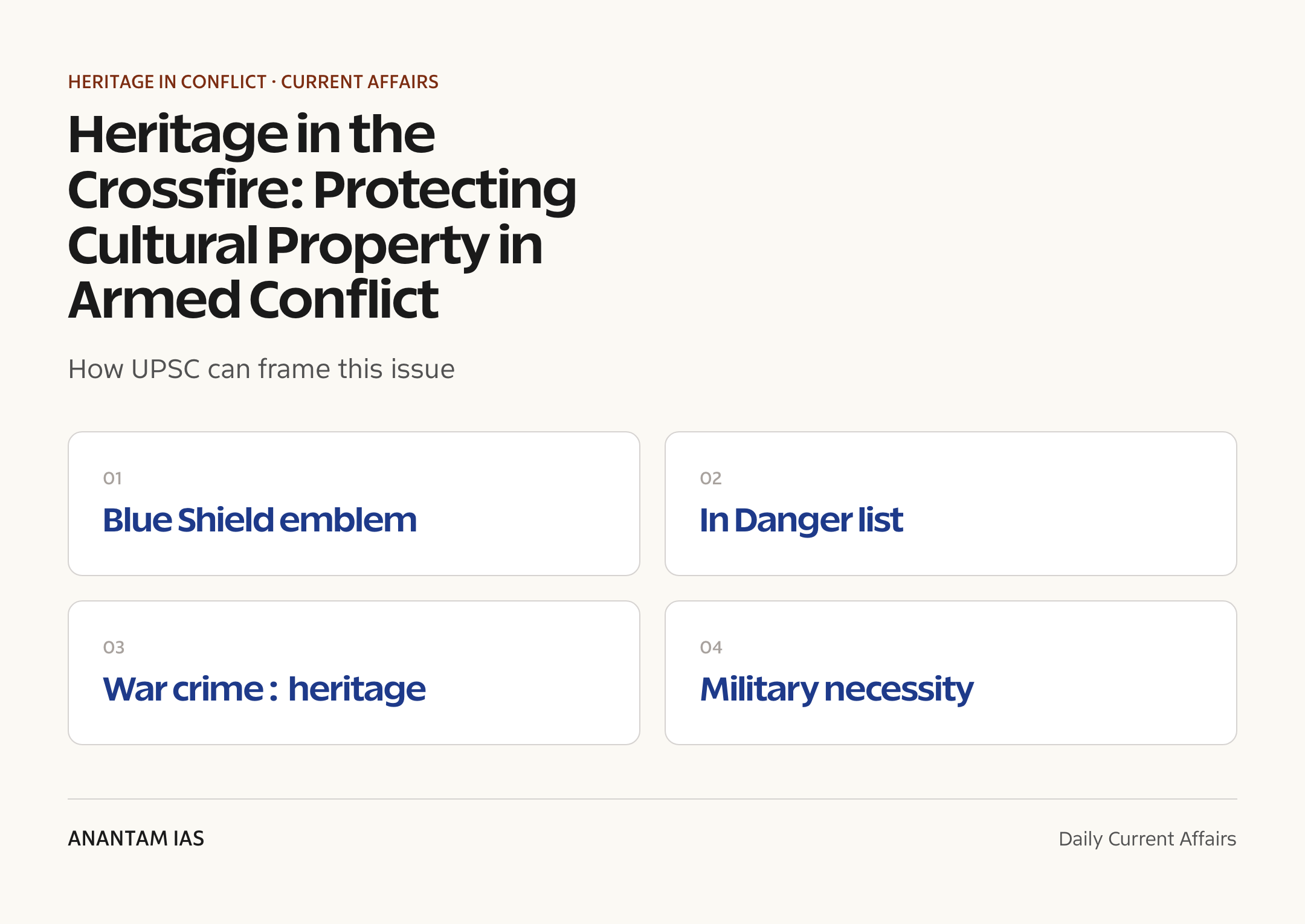
- It introduced the Blue Shield emblem as the internationally recognised marker for protected sites, akin to the Red Cross for cultural property.
- Its 1954 First Protocol curbs the export and return of cultural property from occupied territory; the 1999 Second Protocol created an ‘enhanced protection’ tier and clarified individual criminal responsibility.
- A key limit is the ‘military necessity’ exception, which parties have historically invoked to justify strikes near cultural sites.
The 1972 World Heritage Convention and the Danger List
A separate UNESCO framework identifies sites of ‘outstanding universal value’ and flags those under threat.
- The World Heritage Convention, 1972 created the World Heritage List and the World Heritage Committee that inscribes sites.
- The List of World Heritage in Danger signals sites facing serious, specific threats, including armed conflict, and can unlock international assistance.
- UNESCO added Gaza’s Saint Hilarion Monastery to the Danger List, and Lebanon has sought the same status for Tyre.
- Listing is largely a moral and diplomatic lever; the Convention has no standing army to physically defend a site.
- UNESCO can document damage, satellite-monitor sites, and mobilise emergency funds, but relies on states honouring their obligations.
Sites reported damaged across three theatres
The reported damage cuts across Phoenician ports, Safavid palaces and some of the oldest Christian and Islamic sites in the region.
- Lebanon: Tyre, a nearly 5,000-year-old port that flourished under Phoenicians, Greeks and Romans; the Crusader-era Beaufort Castle; and the 12th-century Chama Citadel.
- Iran: the Qajar-era Golestan Palace in Tehran, and in Isfahan the Safavid Chehel Sotoun and Ali Qapu palaces plus the Masjed-e Jame.
- Gaza: the Great Omari Mosque, Gaza’s oldest, heavily damaged in December 2023, and the Church of Saint Porphyrius, among the world’s oldest churches in use.
- Iran’s cultural heritage minister told Al Jazeera that restoring Golestan Palace alone would take at least two years, with some losses possibly permanent.
- UNESCO said it was ‘deeply alarmed’ and condemned what it termed unlawful attacks against cultural property.
Destroying heritage as a war crime
International criminal law has moved from treating heritage destruction as collateral damage to prosecuting it as a distinct crime.
- The Rome Statute of the International Criminal Court lists intentional attacks on historic monuments and buildings dedicated to religion as a war crime, absent military justification.
- In the landmark Al Mahdi case (2016), the ICC convicted a defendant for destroying mausoleums in Timbuktu, Mali, the first conviction solely for cultural destruction.
- The 1999 Second Protocol to the Hague Convention also provides for individual criminal responsibility for serious violations.
- Enforcement remains uneven: jurisdiction depends on state cooperation, and major military powers are not all parties to the ICC.
- UN Security Council Resolution 2347 (2017) was the first to focus squarely on protecting cultural heritage in conflict.
The Blue Shield and monitoring architecture
Beyond treaties, a network of institutions tries to shield heritage in real time.
- The Blue Shield organisation is the cultural counterpart to the Red Cross, working to protect heritage before, during and after conflict.
- UNESCO uses satellite imagery and remote monitoring to assess damage where ground access is blocked, as in southern Lebanon.
- The ‘enhanced protection’ list under the 1999 Protocol offers the strongest treaty-based immunity, though few sites are enrolled.
- UNESCO’s proposed ‘Blue Helmets for Culture’ concept envisions rapid-response teams to safeguard heritage in emergencies.
- Documentation matters: verified damage records feed future accountability, restoration funding and Danger-List decisions.
The India angle
India is embedded in this legal architecture and carries its own memory of heritage lost to conflict.
- India is a State Party to both the 1954 Hague Convention and the 1972 World Heritage Convention.
- India hosts 43 World Heritage Sites and has an interest in a strong, enforceable protection regime.
- India’s own experience, from monuments damaged in past wars and communal strife to the recovery of smuggled antiquities, informs its stake in cultural-property law.
- The Antiquities and Art Treasures Act, 1972 governs the protection and movement of India’s cultural objects domestically.
- As a rising voice at UNESCO, India can champion accountability for heritage destruction and the return of illicitly trafficked artefacts.
Way Forward
Strengthen the treaty regime
- Widen ratification of the 1999 Second Protocol and enrol more sites under ‘enhanced protection’.
- Push warring parties to publish ‘no-strike’ lists of cultural sites and honour the Blue Shield marking.
Improve monitoring and access
- Guarantee neutral experts and UNESCO teams safe access to assess damage promptly.
- Scale satellite monitoring and open damage databases to preserve evidence for accountability.
Close the accountability gap
- Use UNSC Resolution 2347 and the ICC framework to deter deliberate destruction.
- Fund emergency restoration and support Danger-List interventions before losses become permanent.
Conclusion
Cultural heritage is a shared inheritance, and its destruction in war is treated in international law as a loss to all humanity rather than to any single side.
The reported damage across Lebanon, Iran and Gaza shows the gap between the promise of the 1954 Hague Convention and the reality of modern conflict, where enforcement lags behind aspiration.
For a heritage-rich State Party like India, the durable lesson is to strengthen the norms, monitoring and accountability that turn treaty text into real protection on the ground.
UPSC Practice Questions
Prelims MCQ 1
With reference to the protection of cultural property in armed conflict, consider the following statements:
- The 1954 Hague Convention introduced the Blue Shield emblem to mark protected cultural property.
- The List of World Heritage in Danger is maintained under the 1972 World Heritage Convention.
- India is not a party to the 1954 Hague Convention.
How many of the above statements are correct?
(a) Only one (b) Only two (c) All three (d) None
Answer: (b) Only two
Explanation:
Statements 1 and 2 are correct. Statement 3 is wrong: India is a State Party to the 1954 Hague Convention as well as the 1972 World Heritage Convention.
Prelims MCQ 2
The ICC’s Al Mahdi case (2016) is significant because it was the first international conviction for:
(a) using chemical weapons in an internal conflict (b) recruiting child soldiers (c) the intentional destruction of cultural heritage (d) crimes of aggression between two states
Answer: (c) the intentional destruction of cultural heritage
Explanation:
Ahmad al-Faqi al-Mahdi was convicted for directing attacks on historic and religious mausoleums in Timbuktu, Mali, the first ICC conviction based solely on cultural-heritage destruction as a war crime.
UPSC Mains Questions
- International conventions protecting cultural property in war have grown in ambition but remain weak in enforcement. Critically examine, with reference to the 1954 Hague Convention and the 1972 World Heritage Convention. (250 words)
- The destruction of cultural heritage during conflict is a loss to all humanity, not to one nation. Discuss the international legal framework that treats such destruction as a war crime, and India’s stake in it. (250 words)
Sources: The Indian Express (Explained) and UNESCO.
Frequently Asked Questions
What is the 1954 Hague Convention?
It is the first universal treaty devoted to protecting cultural property, such as monuments, museums and archives, during armed conflict. Adopted after the Second World War, it obliges states to respect and safeguard such property, avoid military use of heritage sites, and mark protected property with the Blue Shield emblem.
What is the World Heritage in Danger list?
Maintained under the 1972 World Heritage Convention, it flags World Heritage Sites facing serious, specific threats, including armed conflict, natural disaster or unchecked development. Listing draws global attention and can unlock emergency assistance, but it is chiefly a diplomatic and moral tool rather than a physical shield.
Is destroying heritage a war crime?
Yes. The Rome Statute of the International Criminal Court treats intentional attacks on historic monuments and buildings dedicated to religion or education as a war crime when there is no military justification. The ICC’s 2016 Al Mahdi conviction, over the Timbuktu mausoleums in Mali, was the first based solely on cultural destruction.
What is the Blue Shield?
The Blue Shield is the distinctive emblem created by the 1954 Hague Convention to mark cultural property that must be protected in conflict, functioning as culture’s counterpart to the Red Cross. An associated international organisation, also called Blue Shield, works to safeguard heritage before, during and after emergencies.
Is India part of these frameworks?
India is a State Party to both the 1954 Hague Convention and the 1972 World Heritage Convention, and hosts 43 World Heritage Sites. Domestically, the Antiquities and Art Treasures Act, 1972 governs the protection and movement of cultural objects, giving India a direct stake in a strong, enforceable protection regime.
Why does heritage protection lag in practice?
The treaties rely on states honouring their obligations, and the ‘military necessity’ exception is often invoked to justify strikes near cultural sites. UNESCO has no army to defend a site, ICC jurisdiction depends on cooperation, and access for damage assessment is frequently blocked, so enforcement trails behind the aspirations set out on paper.
Source: https://anantamias.com/current-affairs/israel-wars-middle-east-heritage-sites/
Odisha’s 575-km coastline: harnessing the blue economy
Why in News?
The Odisha government has approved dedicated policies to harness the economic potential of its 575-km coastline on the Bay of Bengal, framed as a push for blue-economy-led growth. The Indian Express reported the decisions in early July 2026.
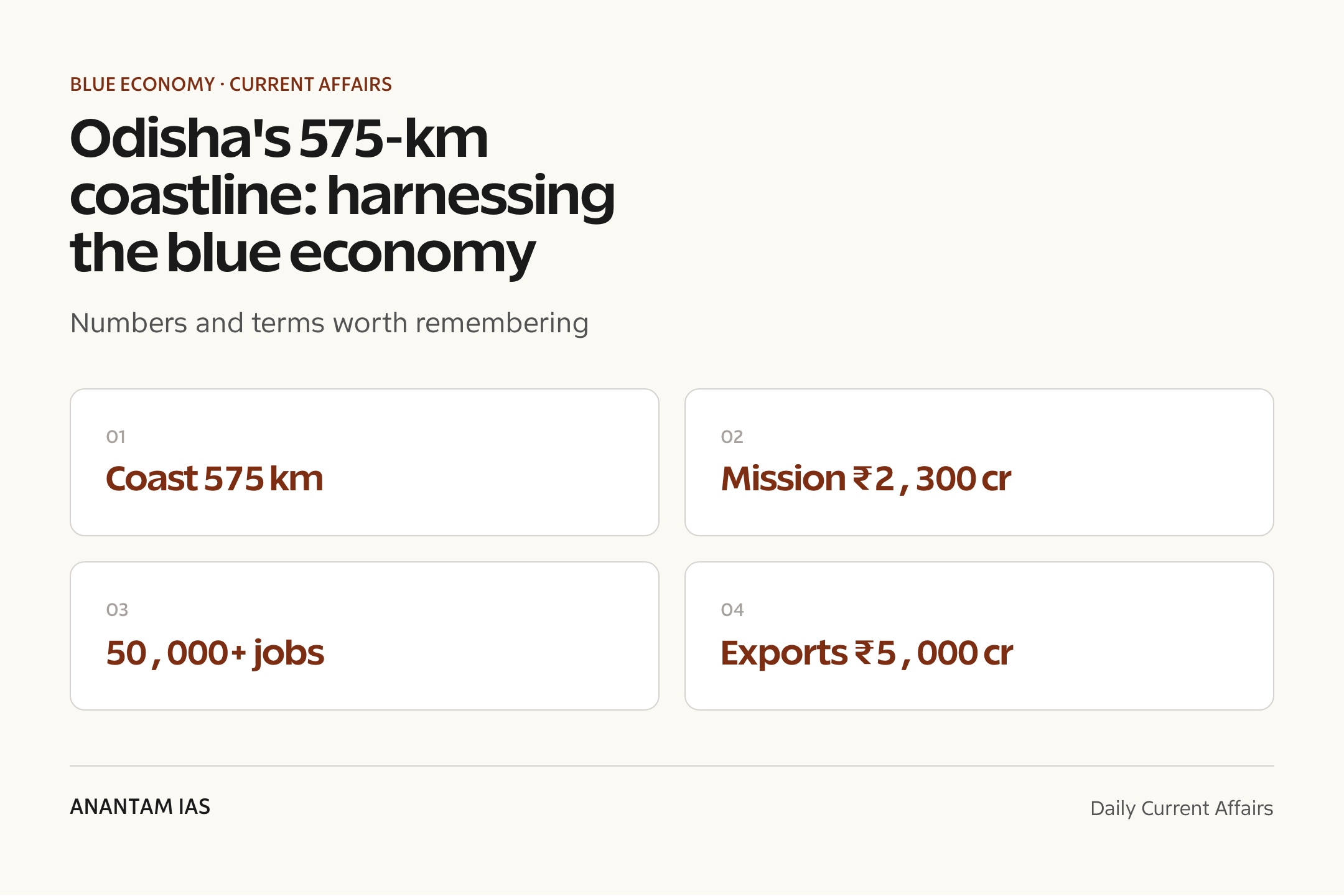
The two headline measures are a 10-year Deep Sea Fishing Mission (2026-36) with a ₹2,300-crore outlay, and a new regulatory framework letting white-leg shrimp culture extend into inland saline waters beyond the Coastal Aquaculture Authority’s 2-km coastal belt.
- Odisha’s marine fishing population is around 15 lakh across 800-plus villages, but operations stay confined to near-shore waters.
- Chief Secretary Anu Garg cited scientific assessments of untapped offshore and deep-sea resources — tuna, billfish, oceanic squid and other pelagic species.
- The Mission targets an extra 2 lakh tonnes of marine fish a year and 50,000-plus jobs, lifting marine exports from below ₹1,000 crore to about ₹5,000 crore.
- A dedicated Blue Economy Hub (B-Hub) will act as the Mission’s knowledge, innovation and coordination centre.
- Shrimp rules now cover the 2-10 km inland saline zone, targeting 25,000 ha of new area and a jump in production from 1.6 lakh MT to 9 lakh MT.
The development matters in the context of:
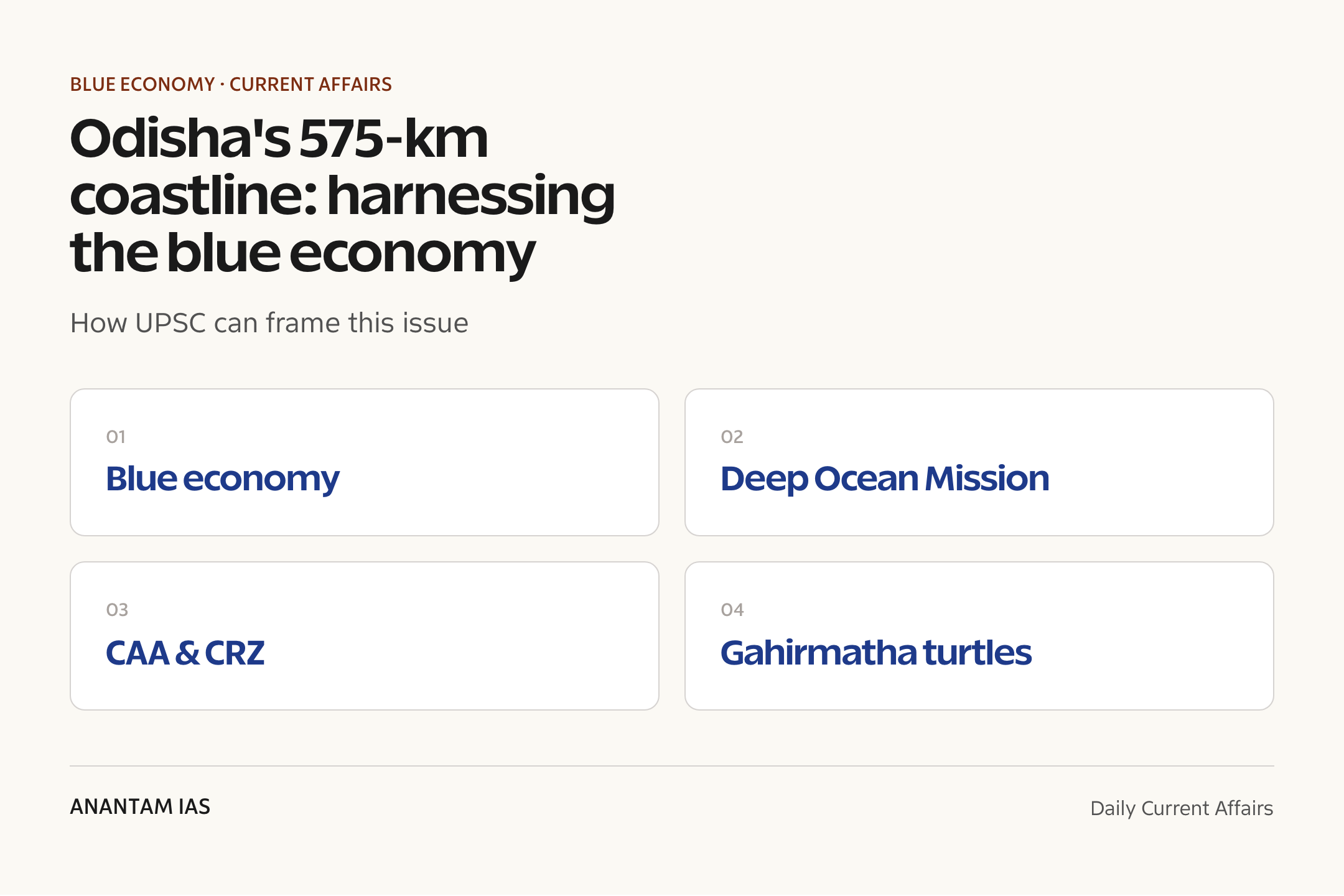
- The move connects a state coastal-development plan to India’s national Blue Economy framework, Sagarmala port-led growth and the Deep Ocean Mission.
- It reopens the tension between livelihood expansion and fragile coastal ecology — mangroves, turtle rookeries and Ramsar wetlands sit along the same shore.
UPSC Relevance
Prelims Relevance
- Blue economy — sustainable use of ocean resources for growth, jobs and ocean-ecosystem health.
- Deep Ocean Mission — Ministry of Earth Sciences flagship; Samudrayaan manned submersible.
- Sagarmala — port-led development programme, Ministry of Ports, Shipping and Waterways.
- Coastal Aquaculture Authority (CAA) — statutory body under the Ministry of Fisheries; regulates the 2-km coastal aquaculture belt.
- Litopenaeus vannamei — the white-leg (Pacific) shrimp, India’s dominant farmed export shrimp.
- Chilika Lake — Asia’s largest brackish-water lagoon; India’s first Ramsar site (1981).
- Gahirmatha — world’s largest mass-nesting rookery of Olive Ridley turtles; a marine sanctuary.
- Bhitarkanika — mangrove and Ramsar wetland in the Brahmani-Baitarani delta.
- Paradip, Dhamra, Gopalpur — Odisha’s major/notified ports on the Bay of Bengal.
- CRZ Notification, 2019 — Coastal Regulation Zone rules governing coastal activity.
Mains Relevance
GS Paper 3
- Blue economy as a growth strategy — fisheries, ports, aquaculture and coastal jobs.
- Balancing marine-fisheries expansion with sustainable stock management and ecosystem-based fishing.
GS Paper 1
- Coastal geography of the east coast — deltas, lagoons, mangroves and the resources they anchor.
GS Paper 2
- Centre-state division on coastal aquaculture regulation (CAA jurisdiction vs state inland-saline rules).
Essay
- Development along a coast is a negotiation with the sea, not a conquest of it.
- The ocean as India’s next frontier of growth — and of restraint.
Background and Context
What the blue economy means
The term frames the ocean as an economic space that must be grown without being exhausted.
- The blue economy covers fisheries, aquaculture, shipping, ports, coastal tourism, offshore energy, marine biotechnology and seabed minerals — used sustainably.
- India’s Draft Blue Economy Policy Framework (Ministry of Earth Sciences) treats coasts and the Exclusive Economic Zone as engines of growth, jobs and food security.
- India’s EEZ spans about 2.2 million sq km, giving vast fishing, energy and mineral rights beyond the territorial sea.
- The idea sits alongside SDG 14 (Life Below Water) and India’s SAGAR maritime-neighbourhood vision.
Odisha's coast: the geography
The state’s shoreline is a stack of deltas, lagoons, mangroves and turtle beaches — an ecologically loaded coast.
- Odisha’s coast is cited by the state at 575 km; the long-used Survey-of-India figure is about 480 km, so the higher number reflects a revised shoreline measurement.
- Chilika Lake — Asia’s largest brackish lagoon and India’s first Ramsar site — supports fisheries and Irrawaddy dolphins.
- Bhitarkanika, in the Brahmani-Baitarani delta, holds India’s second-largest mangrove cover and a Ramsar wetland.
- Gahirmatha beach is the planet’s largest mass-nesting site for Olive Ridley turtles, protected as a marine sanctuary.
- Major cargo gateways — Paradip (a major port), Dhamra and Gopalpur — line the same coast.
The Deep Sea Fishing Mission (2026-36)
The flagship measure pushes fishing effort from crowded near-shore waters out into untapped deep-sea grounds.
- A ₹2,300-crore, 10-year mission to modernise marine fisheries and build a deep-sea and export hub in eastern India.
- Interventions include modern deep-sea vessels, upgraded mechanised boats and mother vessels for offshore operations.
- Plans cover fishing harbours, fish-landing centres, seafood parks, cold-chain, processing units, digital governance and vessel monitoring systems (VMS).
- Scientific management tools — resource assessment, traceability, artificial reefs, sea ranching and ecosystem-based fisheries — are built in.
- A Blue Economy Hub (B-Hub) anchors knowledge and coordination; private players will be roped in.
Inland saline shrimp culture
The second decision stretches shrimp farming inland, into a zone the central regulator does not cover.
- Litopenaeus vannamei (white-leg shrimp) is currently farmed in brackish water within a 2-km belt of the high-tide line under the Coastal Aquaculture Authority.
- Odisha’s new framework opens the 2-10 km inland saline band — beyond CAA jurisdiction — to regulated shrimp and brackish-water species.
- Safeguards include mandatory online farm registration, scientific site selection, biosecurity, disease surveillance, water-quality monitoring and effluent-treatment systems.
- The model is cluster-based with common infrastructure, aiming at 25,000 ha of new area and output up from 1.6 to 9 lakh MT.
- By 2036 the state targets seafood exports rising from about ₹5,429 crore to ₹15,000 crore and roughly 2.5 lakh livelihoods.
National frameworks it plugs into
Odisha’s plan is a state expression of several central marine and coastal programmes.
- Sagarmala drives port-led growth, coastal shipping and hinterland connectivity — relevant to Paradip and Dhamra.
- Deep Ocean Mission (Ministry of Earth Sciences) explores deep-sea minerals, biodiversity and the Samudrayaan submersible.
- The Pradhan Mantri Matsya Sampada Yojana (PMMSY) funds fisheries infrastructure, harbours and exports.
- The CRZ Notification, 2019 and coastal-zone management plans govern what may be built along the shore.
- Offshore wind targets under the National Offshore Wind Energy Policy add a renewable-energy dimension to the coast.
- The Central Marine Fisheries Research Institute (CMFRI) supplies the stock assessments on which sustainable deep-sea quotas ultimately depend.
The ecological tightrope
Every new tonne of catch or hectare of ponds presses on a coast that is already ecologically stressed.
- Intensive shrimp aquaculture risks salinisation of soil and groundwater, effluent loading and mangrove loss if effluent-treatment rules slip.
- Deep-sea fleets can trigger overfishing and bycatch of turtles and marine mammals without strict quotas and gear rules.
- Gahirmatha imposes seasonal fishing bans to protect Olive Ridley nesting — a recurring flashpoint with fishers.
- Mangroves at Bhitarkanika are natural cyclone buffers on a coast repeatedly hit by Bay of Bengal storms.
- Coastal erosion and sea-level rise make the shoreline itself a moving, contested resource.
- Prawn and shrimp ponds have historically been a driver of mangrove clearance along Indian coasts, so the 2-10 km push needs firm no-conversion lines to avoid repeating that pattern.
Way Forward
Manage the stock, not just the catch
- Tie the deep-sea push to a hard, science-based total allowable catch and stock assessments by CMFRI before fleets scale up.
- Mandate turtle-excluder devices and honour Gahirmatha seasonal bans to keep bycatch and protected-species deaths down.
Make aquaculture genuinely sustainable
- Enforce effluent-treatment and biosecurity in the 2-10 km zone from day one, with third-party audits and real-time water-quality data.
- Protect mangroves and Ramsar buffers as no-conversion zones so pond expansion never eats into cyclone defences.
Share the gains with fishers
- Channel training, credit and cooperative ownership so traditional fisherfolk — not only private operators — capture the deep-sea and export upside.
Conclusion
Odisha’s twin decisions turn a 575-km shoreline from a backdrop into a balance sheet — deep-sea fleets, shrimp clusters and a Blue Economy Hub aimed at jobs and exports. It is a concrete, state-level test of what the blue economy means in practice.
The prize is real: more protein, higher exports and livelihoods for a fishing population of 15 lakh. But the same coast holds Chilika, Bhitarkanika and Gahirmatha. Whether growth and guardianship can share one shoreline is the question the plan will have to answer.
UPSC Practice Questions
Prelims MCQ 1
With reference to the concept of the blue economy in India, consider the following statements:
- The blue economy is limited to marine and coastal fisheries alone.
- The Deep Ocean Mission is implemented by the Ministry of Earth Sciences.
- India’s Exclusive Economic Zone extends up to 200 nautical miles from the baseline.
How many of the above statements are correct?
(a) Only one (b) Only two (c) All three (d) None
Answer: (b) Only two
Explanation:
Statement 1 is wrong — the blue economy spans fisheries, shipping, ports, tourism, offshore energy and seabed minerals, not fisheries alone. Statements 2 and 3 are correct: the Deep Ocean Mission is a Ministry of Earth Sciences flagship, and the EEZ extends to 200 nautical miles.
Prelims MCQ 2
The Coastal Aquaculture Authority, referred to in the context of Odisha’s shrimp-culture rules, functions under which Union ministry?
(a) Ministry of Environment, Forest and Climate Change (b) Ministry of Fisheries, Animal Husbandry and Dairying (c) Ministry of Earth Sciences (d) Ministry of Ports, Shipping and Waterways
Answer: (b) Ministry of Fisheries, Animal Husbandry and Dairying
Explanation:
The Coastal Aquaculture Authority, a statutory body regulating aquaculture within the 2-km coastal belt, works under the Department of Fisheries in the Ministry of Fisheries, Animal Husbandry and Dairying.
UPSC Mains Questions
- The blue economy is often called India’s next growth frontier. Using Odisha’s coastal-development plans as a reference, examine how deep-sea fisheries and coastal aquaculture can be scaled without degrading marine ecosystems.
- Discuss the ecological significance of Odisha’s coast — Chilika, Bhitarkanika and Gahirmatha — and evaluate the challenges of reconciling fisheries expansion with the protection of these habitats.
- Analyse the roles of Sagarmala, the Deep Ocean Mission and the Pradhan Mantri Matsya Sampada Yojana in operationalising India’s blue-economy vision.
Sources: The Indian Express (Explained) and Department of Fisheries, Government of Odisha.
Frequently Asked Questions
What is the blue economy?
The blue economy is the sustainable use of ocean and coastal resources for economic growth, jobs and improved livelihoods while keeping marine ecosystems healthy. It covers fisheries, aquaculture, shipping, ports, coastal tourism, offshore renewable energy, marine biotechnology and seabed minerals. India frames it as a growth engine anchored in its long coastline and vast Exclusive Economic Zone.
How long is Odisha’s coastline?
The Odisha government now cites its coastline at about 575 km along the Bay of Bengal, the figure used in its new blue-economy plans. The long-standing Survey of India figure is roughly 480 km, so the higher number reflects a revised, more detailed shoreline measurement. Either way, it is one of India’s most ecologically rich coasts.
What is the Deep Sea Fishing Mission?
It is Odisha’s 10-year (2026-36) mission, backed by about ₹2,300 crore, to move fishing effort from crowded near-shore waters into untapped deep-sea grounds. It funds modern vessels, mother ships, harbours, seafood parks, cold chains and vessel monitoring, aiming to add 2 lakh tonnes of fish a year, create over 50,000 jobs and raise marine exports toward ₹5,000 crore.
Why is the 2-10 km shrimp rule significant?
White-leg shrimp farming was earlier allowed only within 2 km of the high-tide line, under the central Coastal Aquaculture Authority. Odisha’s new framework opens the 2-10 km inland saline band — outside that jurisdiction — to regulated shrimp culture, targeting 25,000 ha of new area. It shows a state extending aquaculture into zones the central regulator does not cover, with its own safeguards.
What is the Deep Ocean Mission?
The Deep Ocean Mission is a Ministry of Earth Sciences flagship to explore the deep sea for minerals, biodiversity and energy, and to build ocean technology. Its best-known component is Samudrayaan, a manned submersible designed to carry scientists to depths of several thousand metres. It is a core pillar of India’s blue-economy and ocean-research ambitions.
Why is Odisha’s coast ecologically sensitive?
The coast holds Chilika, Asia’s largest brackish lagoon and India’s first Ramsar site; Bhitarkanika’s mangroves in the Brahmani-Baitarani delta; and Gahirmatha, the world’s largest Olive Ridley turtle nesting beach. These habitats buffer cyclones and sustain biodiversity, so any expansion of fishing or shrimp ponds must avoid mangrove loss, effluent pollution and turtle bycatch.
Source: https://anantamias.com/current-affairs/odisha-coastline-blue-economy-potential/
Vizhinjam port stake sale: why Kerala opposes the Adani-MSC deal
Why in News?
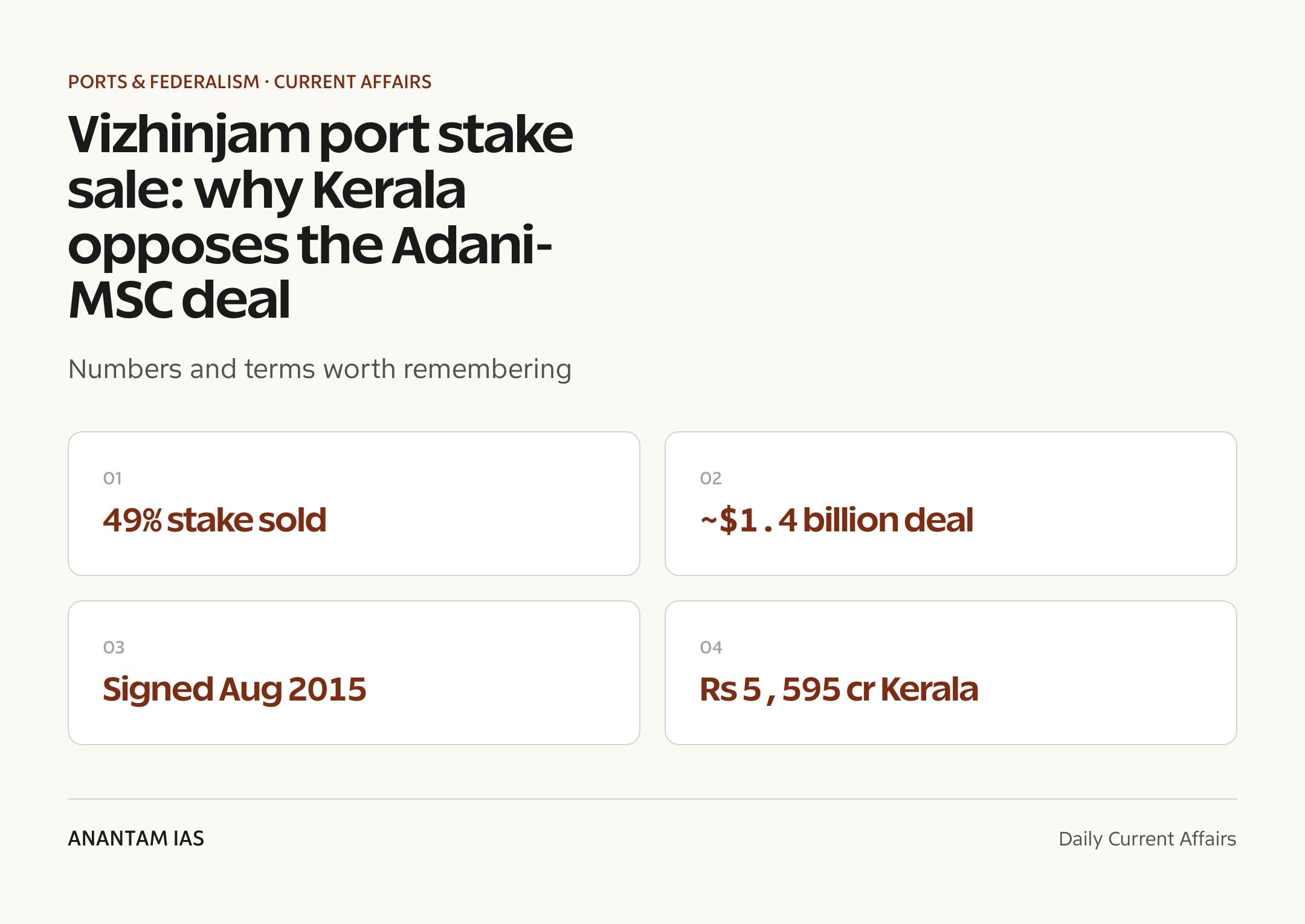
Adani Ports and SEZ (APSEZ) is moving to sell a 49% stake in Kerala’s Vizhinjam port, India’s first deep-water container transshipment port, to a subsidiary of Switzerland-based shipping giant MSC Group for around $1.4 billion (more than Rs 13,000 crore). The Kerala government has objected, saying the concession agreement makes its approval mandatory for such a change in ownership.
The Indian Express reported that the buyer is Mundi Ltd, a subsidiary of Terminal Investment Ltd (TiL), the terminal-operating arm of MSC, the world’s biggest container shipping line. APSEZ disclosed the deal to SEBI and then informed the state ports department on July 1, 2026.
- APSEZ to divest a 49% stake in the port’s concessionaire for about $1.4 billion (over Rs 13,000 crore).
- Buyer is Mundi Ltd, a subsidiary of Terminal Investment Ltd (TiL), MSC’s terminal arm.
- Kerala’s Congress-led government and the Opposition CPI(M) both say the state was not consulted.
- The concession agreement was signed with Adani Vizhinjam Port Pvt Ltd (AVPPL) on 17 August 2015.
- APSEZ disclosed the deal to SEBI and then informed the state on 1 July 2026.
The development matters in the context of:
- Tests PPP infrastructure governance when a concessionaire changes ownership mid-project.
- Raises Centre-State questions on who controls strategic port assets and foreign entry.
- Flags market-concentration risk if the world’s largest liner controls India’s flagship transshipment hub.
UPSC Relevance
Prelims Relevance
- Vizhinjam is India’s first deep-water container transshipment port, near Thiruvananthapuram, Kerala.
- Developed on the DBFOT (Design, Build, Finance, Operate, Transfer) PPP model.
- Concessionaire: Adani Vizhinjam Port Pvt Ltd (AVPPL); concession agreement signed 2015.
- Buyer’s chain: Mundi Ltd → TiL → MSC Group (Mediterranean Shipping Company).
- Transshipment: cargo transferred between ships at a hub port before onward voyage.
- Historically Indian cargo was transshipped via Colombo, Salalah and Singapore.
- Sagarmala is the Union port-led development programme (Ministry of Ports, Shipping and Waterways).
- Major ports are a Union subject; minor/intermediate ports sit on the Concurrent List.
- Kerala invested Rs 5,595 crore in phase 1; Adani put in Rs 2,454 crore.
Mains Relevance
GS Paper 3
- PPP models in infrastructure and the risks of ownership change in long-gestation concessions.
- Port-led growth, transshipment self-reliance, and reducing dependence on foreign hubs.
GS Paper 2
- Centre-State roles in ports and the friction between a private concessionaire’s commercial freedom and a state’s consent rights.
- Regulation of monopoly/market concentration and FDI in strategic infrastructure.
Essay
- Nation-building on private capital: who owns strategic infrastructure?
- Self-reliance and the sea: India’s quest to keep its cargo at home.
Background and Context
What Vizhinjam is and why it matters
Vizhinjam is India’s first purpose-built deep-water transshipment hub, meant to keep Indian cargo out of foreign ports.
- Located near Thiruvananthapuram on Kerala’s southern coast, it is India’s first deep-water container transshipment port.
- Its natural draft of about 18-20 metres lets it berth the largest mother vessels without heavy dredging or reclamation.
- It sits close to the busy east-west international shipping lane connecting Europe, West Asia and the Far East, needing only a short deviation for calling ships.
- A transshipment hub aggregates cargo from smaller feeder ships onto large mother vessels, so scale and location, not just hinterland demand, decide its viability.
- In June 2025 the MSC IRINA, then the world’s largest container ship, called at Vizhinjam, signalling its big-ship readiness.
Transshipment and why India relied on Colombo
For decades most Indian container cargo was routed through foreign hubs because Indian ports could not handle the largest ships.
- Transshipment is the transfer of cargo from one ship to another at a hub port before its onward journey.
- A large share of India’s transshipment cargo has historically moved via Colombo, Singapore and Salalah (Oman), by many estimates around three-quarters.
- Indian ports long lacked the deep draft needed for the biggest ships, so lines used foreign hubs as their pivot points.
- Routing through foreign hubs adds freight cost and transit time and exports value, revenue and jobs to overseas ports.
- It also leaves Indian trade exposed to congestion or disruption at a hub outside national control, as seen during past crises at Colombo.
- A domestic deep-water hub like Vizhinjam is meant to reclaim this cargo, build port-led jobs and cut logistics costs.
The landlord-port and PPP structure
Vizhinjam follows a landlord-port, public-private partnership design that split money and control between the state and Adani.
- It is built on the DBFOT (Design, Build, Finance, Operate, Transfer) model, a variant of the landlord-port framework.
- In a landlord port, the public authority owns the land and basic infrastructure while a private operator builds superstructure and runs the terminal on a long concession.
- The Kerala government owns the land and core assets; the private concessionaire builds and runs operations before eventual transfer back to the state.
- The concessionaire is Adani Vizhinjam Port Pvt Ltd (AVPPL), an APSEZ entity.
- Kerala invested Rs 5,595 crore in phase 1 against Adani’s Rs 2,454 crore, so the state is the larger financial stakeholder despite being the public partner.
- The concession agreement between the state and AVPPL was signed on 17 August 2015 under a Congress government, and it governs equity, ownership and dispute rules.
The deal and the disputed consent clause
The clash centres on whether selling 49% counts as a change in ownership needing the state’s prior approval.
- APSEZ is selling a 49% stake in AVPPL to Mundi Ltd (a TiL/MSC subsidiary) for about $1.4 billion.
- Kerala says a transfer of 25% or more of the concessionaire’s equity is a change in ownership needing prior approval on national-security and public-interest grounds.
- Adani argues it must hold 51% only during construction and the first year of commercial operations.
- APSEZ says the port is now in its second year of operations, letting it dilute up to 74% of its stake.
- The dispute would be tested against the concession agreement’s ownership and arbitration clauses.
Why Kerala fears an MSC monopoly
The state’s core worry is that the world’s biggest liner gaining control could distort the hub’s neutrality.
- MSC is the world’s largest container shipping company, so its control raises competition concerns.
- Kerala fears the hub could tilt toward MSC’s own traffic, hurting its status as a common-user port open to all lines on equal terms.
- A liner that both ships cargo and controls the terminal has an incentive to favour its own boxes, a vertical-integration worry regulators watch closely.
- The state also flags lost bargaining power over a strategic asset it heavily co-funded with public money.
- In 2023, TiL had already acquired a 49% equity stake in the Adani Ports Ennore container terminal, a precedent Kerala cites for creeping consolidation.
Centre-State roles and ports governance
Vizhinjam also surfaces the constitutional split between Union major ports and state-handled minor ports.
- Major ports fall under the Union List and the Major Port Authorities Act, 2021.
- Minor and intermediate ports like Vizhinjam sit on the Concurrent List, giving states an operational role.
- The Union’s Sagarmala programme drives port-led development, coastal shipping and hinterland connectivity.
- As a state-anchored PPP, Vizhinjam gives Kerala consent rights that a purely Union project would not.
FDI, capital and the wider infrastructure question
The deal also sits within India’s push to draw foreign capital into long-gestation infrastructure without ceding control of strategic assets.
- India allows 100% FDI under the automatic route in port construction and maintenance, so foreign entry is not itself barred.
- Foreign strategic investors bring capital, cargo commitments and global networks that can raise a hub’s throughput.
- The tension is that a concessionaire’s freedom to raise capital by diluting equity can clash with a host state’s control and consent rights.
- A liner-owned terminal can guarantee base volumes, but it also risks tying the hub’s fortunes to one shipping alliance.
- How the concession’s ownership clause is read will signal to future investors how predictable India’s PPP contracts are.
Way Forward
Settle the consent question
- Read the concession agreement clauses transparently and, if disputed, refer to the agreed arbitration forum rather than litigate publicly.
- Ensure any equity transfer meets the national-security and public-interest review the agreement contemplates.
Protect competition and neutrality
- Bind the hub to common-user, non-discriminatory access so no single liner is favoured.
- Involve the Competition Commission of India where market-concentration risk is material.
Strengthen PPP governance
- Write clearer change-of-ownership triggers and state-consent rules into future concessions.
- Balance a private partner’s need to raise capital with the state’s stake as a large public co-investor.
Conclusion
Vizhinjam’s promise is strategic: a home-grown deep-water hub that keeps Indian cargo out of Colombo and Salalah and cuts logistics costs. The stake sale to MSC’s arm could bring capital and traffic, but it also concentrates control of a flagship asset in the world’s largest liner.
The real test is governance, not the headline price. How India reads consent clauses, guards competition and honours a state’s stake in a PPP will shape investor confidence and Centre-State trust in the next wave of port infrastructure.
UPSC Practice Questions
Prelims MCQ 1
With reference to the Vizhinjam port project, consider the following statements:
- It is India’s first deep-water container transshipment port.
- It is being developed on the Design, Build, Finance, Operate and Transfer (DBFOT) public-private partnership model.
- The concessionaire is a subsidiary of Adani Ports and SEZ.
How many of the above statements are correct?
(a) Only one (b) Only two (c) All three (d) None
Answer: (c) All three
Explanation:
Vizhinjam is India’s first deep-water transshipment port, built on the DBFOT PPP model, with Adani Vizhinjam Port Pvt Ltd (an APSEZ entity) as the concessionaire. All three are correct.
Prelims MCQ 2
The buyer in the proposed Vizhinjam stake sale, Mundi Ltd, is ultimately linked to which shipping group?
(a) Maersk (b) CMA CGM (c) MSC (Mediterranean Shipping Company) (d) Hapag-Lloyd
Answer: (c) MSC (Mediterranean Shipping Company)
Explanation:
Mundi Ltd is a subsidiary of Terminal Investment Ltd (TiL), the terminal-operating arm of MSC, the world’s largest container shipping company.
UPSC Mains Questions
- Vizhinjam is India’s first deep-water transshipment port, yet its ownership is contested. Discuss how the public-private partnership model handles change of control in long-gestation infrastructure, and what safeguards a host state should retain.
- Foreign entry into strategic port assets promises capital and traffic but raises competition and sovereignty concerns. Examine this trade-off with reference to the proposed Adani-MSC deal at Vizhinjam.
- Explain why India’s containers were long transshipped through foreign hubs, and assess how ports like Vizhinjam and the Sagarmala programme aim to change that.
Sources: The Indian Express (Explained) and SEBI disclosure by Adani Ports and SEZ (APSEZ).
Frequently Asked Questions
What is the Vizhinjam port deal about?
Adani Ports and SEZ (APSEZ) is selling a 49% stake in Vizhinjam port’s concessionaire to Mundi Ltd, a subsidiary of MSC’s terminal arm TiL, for about $1.4 billion (over Rs 13,000 crore). Kerala has objected, saying the concession agreement makes the state’s prior approval mandatory for such a change in ownership.
Why is Vizhinjam port strategically important?
It is India’s first deep-water container transshipment port, near Thiruvananthapuram, with a deep natural draft that can handle the largest ships. It aims to keep Indian transshipment cargo at home instead of routing it through Colombo, Singapore or Salalah, cutting costs and building port-led growth.
What is transshipment and why did India rely on foreign ports?
Transshipment is transferring cargo between ships at a hub before onward carriage. Most Indian container transshipment moved via foreign hubs because Indian ports lacked the depth for the largest vessels, adding cost and time. A deep-water hub like Vizhinjam is meant to reclaim this traffic.
Why does Kerala oppose the Adani-MSC deal?
Kerala says a transfer of 25% or more of the concessionaire’s equity is a change in ownership needing the state’s prior approval on national-security and public-interest grounds. It also fears a monopoly, since MSC is the world’s largest liner, and notes it invested Rs 5,595 crore in phase one.
What is the DBFOT model at Vizhinjam?
DBFOT stands for Design, Build, Finance, Operate and Transfer, a public-private partnership form of the landlord-port model. The Kerala government owns the land and core assets while the private concessionaire, Adani Vizhinjam Port Pvt Ltd, builds and operates the port before eventual transfer.
How are ports divided between the Centre and states?
Major ports fall under the Union List and the Major Port Authorities Act, 2021. Minor and intermediate ports such as Vizhinjam sit on the Concurrent List, giving states an operational and consent role. The Union’s Sagarmala programme drives port-led development nationally.
Source: https://anantamias.com/current-affairs/vizhinjam-port-stake-sale-adani-msc-kerala/
SCOTUS birthright citizenship ruling: how it compares with India
Why in News?
On June 30, 2026, the Supreme Court of the United States (SCOTUS) upheld birthright citizenship guaranteed by the Fourteenth Amendment to the US Constitution, and struck down an executive order that had sought to end unconditional citizenship by birth. The Hindu reported the 6-3 judgment on July 5, 2026.
The ruling reaffirms that anyone born on US soil becomes a citizen regardless of the immigration status of the parents, subject only to narrow exceptions. It offers a sharp contrast with India’s jus sanguinis (citizenship by descent) framework under the Citizenship Act, 1955, making it a rich comparative-polity case.
- SCOTUS by 6-3 upheld the 14th Amendment guarantee and voided Executive Order 14160 (Jan 2025) that targeted children of certain non-citizens born after Feb 19, 2025.
- Exceptions to US jus soli remain only for children of foreign diplomats and members of an invading army.
- The Court held the constitutional text is clear and that changed circumstances cannot justify a narrower reading.
- The Immigration and Nationality Act (INA), 1952 mirrors the constitutional guarantee, declaring a person born in the US and subject to its jurisdiction a citizen ‘at birth’.
- The administration signalled a legislative route, but it lacks the two-thirds support needed for a constitutional amendment in the US Congress.
The development matters in the context of:
- US follows jus soli (right of the soil); India follows a diluted jus sanguinis (right of blood) after the 1987 and 2004 amendments.
- The distinction shapes how each democracy manages migration, statelessness and citizenship documentation.
UPSC Relevance
Prelims Relevance
- Jus soli vs jus sanguinis — the two doctrines of acquiring citizenship at birth.
- US 14th Amendment (1868) — ‘all persons born or naturalised in the United States, and subject to the jurisdiction thereof, are citizens’.
- United States v. Wong Kim Ark (1898) — affirmed jus soli for a child of Chinese immigrants.
- India — Articles 5-11 of the Constitution deal with citizenship at commencement; Article 11 empowers Parliament to legislate.
- Citizenship Act, 1955 — modes: birth, descent, registration, naturalisation, incorporation of territory.
- Section 3, Citizenship Act — citizenship by birth, tightened by the 1987 and 2003/2004 amendments.
- Overseas Citizen of India (OCI) — introduced by the 2005 amendment; not dual citizenship.
- India permits single citizenship only; the US permits dual/multiple citizenship.
Mains Relevance
GS Paper 2
- Comparative constitutional design: entrenched fundamental guarantees (US 14th Amendment) versus statute-driven citizenship (India’s Citizenship Act) and the ease of altering each.
- Judicial review as a check on executive action on citizenship and immigration.
GS Paper 2
- Citizenship as a determinant of rights, inclusion and statelessness in large democracies.
GS Paper 1
- How the history of slavery and equality shaped modern citizenship regimes.
Essay
- Who belongs? Citizenship, migration and the idea of the nation.
- The soil and the blood: two competing philosophies of belonging.
Background and Context
Jus soli and jus sanguinis — the core distinction
Citizenship at birth flows from one of two competing principles.
- Jus soli (‘right of the soil’) — citizenship is granted to anyone born within the territory, whatever the parents’ status. The US, Canada and much of the Americas follow it.
- Jus sanguinis (‘right of blood’) — citizenship passes from parents to child by descent, independent of birthplace. Most of Europe, Asia and modern India lean this way.
- Few states use pure jus soli today; many, including India, have shifted toward conditional or descent-based rules to manage irregular migration.
- The doctrines shape passports, documentation, and the risk of statelessness for children of migrants — a stateless child has no country obliged to grant nationality.
- A country can also mix the two: some grant birthright citizenship only if a parent is a lawful resident, blending soil and blood.
- The choice is not merely technical — it encodes a nation’s answer to who belongs and on what terms.
The US 14th Amendment and the SCOTUS ruling
The 2026 judgment reaffirmed a guarantee written into the US Constitution after the Civil War.
- The 14th Amendment, ratified in 1868, was framed to settle the citizenship of freed slaves after the 13th Amendment abolished slavery.
- It overrode the notorious Dred Scott (1857) ruling that had held no Black person could be a US citizen — the case that had made the status of freed slaves ambiguous.
- The provision built on the Civil Rights Act, 1866, which had legislated that any person born in the country is a citizen; its principle was written into the Constitution to shield it from a future Congress or President.
- In 2026, SCOTUS struck down Executive Order 14160 (January 2025), which had directed agencies to stop issuing passports and social-security numbers to some US-born children of non-citizen or temporary-status parents born after 19 February 2025.
- The majority held the framers chose deliberately sweeping, universal language so the guarantee could not be narrowed by a future court or executive, and that changed circumstances cannot justify a new meaning for a clear text.
- The administration had argued the guarantee was only a remedy for former slaves and should be read narrowly; the Court rejected that reading.
- The dispute over whether jus soli is ‘constitutional and statutory’ or ‘only statutory’ echoes India’s debate over whether citizenship rules are constitutionally entrenched or ordinary legislation — one judge, Justice Kavanaugh, treated it as a statutory question.
United States v. Wong Kim Ark — the anchoring precedent
A 19th-century case still defines the scope of US birthright citizenship.
- In United States v. Wong Kim Ark (1898), the Supreme Court held that a child born on US soil to Chinese immigrant parents was a US citizen by birth.
- It read ‘subject to the jurisdiction thereof’ narrowly — excluding only children of diplomats and hostile occupying forces.
- That reading has anchored US jus soli for over a century and framed the 2026 challenge.
- The INA, 1952 later codified the same principle in statute, declaring a person born in the US and subject to its jurisdiction a citizen ‘at birth’ — a legislative guarantee layered over the constitutional one.
- Because the guarantee sits in both the Constitution and statute, ending it would require either a constitutional amendment or, on a contested view, a new law — neither easy to secure.
India's citizenship framework — Articles 5-11 and the 1955 Act
India’s Constitution set the starting roll; Parliament governs acquisition thereafter.
- Articles 5-11 (Part II) defined who was a citizen at commencement on 26 January 1950; Article 11 lets Parliament regulate citizenship by law.
- The Citizenship Act, 1955 provides five modes — by birth, descent, registration, naturalisation, and incorporation of territory.
- India started close to jus soli — Section 3 once granted citizenship to almost anyone born in India.
- For births before 1 July 1987, birth on Indian soil was largely enough — a near jus soli position.
- The 1987 amendment required at least one parent to be an Indian citizen for those born on or after 1 July 1987.
- The 2003 amendment (effective 2004) tightened it further: for births on or after 3 December 2004, one parent must be an Indian citizen and the other not an illegal migrant — a clear jus sanguinis tilt.
- Naturalisation and registration remain the routes for foreigners and persons of Indian origin, subject to residence and other qualifying conditions in the Act.
Single citizenship, OCI and the neutral NRC/CAA backdrop
India’s design differs from the US on dual nationality and documentation.
- India permits only single citizenship; acquiring another nationality ends Indian citizenship. The US allows dual/multiple citizenship.
- The OCI card (2005 amendment) gives long-term residence and entry rights to persons of Indian origin, but it is not dual citizenship and carries no voting or public-office rights.
- The National Register of Citizens (NRC) is a record of citizens; the Citizenship (Amendment) Act, 2019 created a faster naturalisation path for specified non-Muslim migrants from three neighbouring countries who entered before 2015.
- Both remain contested and are cited here only as institutional context for how a descent-based system verifies citizenship.
- The contrast is sharp: US birthright status attaches automatically at birth, while India increasingly relies on parentage and documentary proof of descent.
- That reliance on documentation is a direct consequence of the jus sanguinis tilt — where the soil no longer decides, records of parentage must.
Jus soli vs jus sanguinis around the world
The global map shows a retreat from unconditional birthright citizenship.
- Unconditional jus soli survives mainly in the Americas — the US, Canada, Brazil, Mexico and much of Latin America.
- Many countries adopted conditional jus soli — birthright applies only if a parent is a citizen or lawful resident (Ireland, France, the UK moved this way).
- Most of Europe and Asia, including India, China, Japan and the Gulf, follow jus sanguinis, prioritising descent.
- The trend, driven by migration concerns, is toward hybrid rules — which is precisely the direction India took in 1987 and 2004.
- This makes the US position an outlier among large economies, and explains why its birthright guarantee draws recurring political challenge.
Way Forward
Read citizenship as constitutional design
- For GS2, treat the case as a lesson in entrenchment — a guarantee in the constitutional text (US 14th Amendment) is far harder to reverse than one in ordinary statute (India’s Citizenship Act).
- Note that judicial review checked executive overreach on a core status question, echoing how Indian courts have policed citizenship determinations.
- An executive order or a simple statute cannot override a clear constitutional guarantee — amendment is the only durable route, and it demands broad consensus.
Balance inclusion with verification
- A descent-based system must guard against statelessness and arbitrary exclusion while verifying parentage.
- Robust, non-discriminatory documentation and due process matter as much as the underlying doctrine.
- Verification failures can leave genuine citizens undocumented, so procedural fairness is central to any jus sanguinis regime.
Use the case as comparative material
- The doctrinal pair — jus soli versus jus sanguinis — is the durable exam takeaway, along with how India moved from one toward the other across 1987 and 2004.
- Pair it with the global trend away from unconditional birthright citizenship to build a rounded comparative-polity answer.
Conclusion
The 2026 SCOTUS ruling preserved one of the world’s most expansive jus soli guarantees, rooted in the post-Civil-War promise of the 14th Amendment and the century-old Wong Kim Ark precedent. Its strength lies in being written into the constitutional text, beyond the reach of an executive order or an ordinary statute.
India travelled the opposite road. Starting near jus soli in 1955, it moved decisively toward jus sanguinis through the 1987 and 2004 amendments, tying citizenship at birth to a parent’s citizenship. For comparative polity, the two systems frame a single enduring question — whether belonging follows the soil one is born on or the blood one is born from.
UPSC Practice Questions
Prelims MCQ 1
With reference to citizenship doctrines and the 2026 SCOTUS ruling, consider the following statements:
- The US Fourteenth Amendment embodies the principle of jus soli.
- The 2026 SCOTUS judgment ended unconditional birthright citizenship in the United States.
- United States v. Wong Kim Ark (1898) affirmed birthright citizenship for a child of immigrant parents.
How many of the above statements are correct?
(a) Only one (b) Only two (c) All three (d) None
Answer: (b) Only two
Explanation:
Statements 1 and 3 are correct. Statement 2 is wrong — SCOTUS UPHELD birthright citizenship and struck down the executive order that had sought to end it.
Prelims MCQ 2
Which one of the following best describes India’s approach to citizenship by birth after the Citizenship (Amendment) Act, 2003 (effective 2004)?
(a) Pure jus soli — anyone born in India is a citizen (b) Jus sanguinis tilt — at least one parent must be an Indian citizen and the other not an illegal migrant (c) Dual citizenship is granted automatically at birth (d) Citizenship depends solely on the religion of the parents
Answer: (b) Jus sanguinis tilt — at least one parent must be an Indian citizen and the other not an illegal migrant
Explanation:
For births on or after 3 December 2004, Section 3 requires one parent to be an Indian citizen and the other not an illegal migrant — a clear move away from jus soli toward jus sanguinis. India also permits only single citizenship.
UPSC Mains Questions
- Compare the constitutional guarantee of birthright citizenship in the United States with India’s statutory citizenship framework. What does the difference in entrenchment reveal about how the two democracies protect the status of citizenship? (250 words)
- ‘India has moved from jus soli toward jus sanguinis.’ Examine this shift with reference to the Citizenship Act, 1955 and its subsequent amendments, and its implications for inclusion and statelessness. (250 words)
- Discuss the role of judicial review in checking executive action on core questions of citizenship, drawing on comparative examples. (150 words)
Sources: The Hindu and US Constitution, 14th Amendment (constitution.congress.gov).
Frequently Asked Questions
What did SCOTUS rule on birthright citizenship in 2026?
On June 30, 2026, the US Supreme Court, by a 6-3 vote, upheld birthright citizenship under the Fourteenth Amendment and struck down Executive Order 14160, which had sought to deny citizenship to some US-born children of non-citizen parents. Anyone born on US soil remains a citizen, with narrow exceptions for children of diplomats and invading armies.
What is the difference between jus soli and jus sanguinis?
Jus soli (‘right of the soil’) grants citizenship to anyone born within a country’s territory, regardless of the parents’ status — the US model. Jus sanguinis (‘right of blood’) passes citizenship from parents to child by descent, independent of birthplace — the model most of Europe, Asia and modern India follow.
Does India follow jus soli or jus sanguinis?
India began close to jus soli under the Citizenship Act, 1955, but shifted toward jus sanguinis. Since 1987, at least one parent had to be an Indian citizen; since December 2004, one parent must be an Indian citizen and the other not an illegal migrant. India’s system is now predominantly descent-based.
Which articles of the Indian Constitution deal with citizenship?
Articles 5 to 11 in Part II cover citizenship. Articles 5-8 defined who was a citizen at commencement in 1950, Article 9 bars dual citizenship, Article 10 continues citizenship, and Article 11 empowers Parliament to make laws on citizenship — the basis for the Citizenship Act, 1955.
What is United States v. Wong Kim Ark?
It is an 1898 US Supreme Court case that held a child born on US soil to Chinese immigrant parents was a citizen by birth. It read the 14th Amendment’s ‘subject to the jurisdiction thereof’ narrowly, excluding only children of diplomats and hostile forces, and has anchored US birthright citizenship ever since.
Is OCI status the same as dual citizenship for India?
No. Overseas Citizen of India (OCI) status, introduced by the 2005 amendment, offers long-term residence, entry and some economic rights to persons of Indian origin, but it is not dual citizenship. OCI holders cannot vote, hold constitutional office, or enter certain government jobs, and India permits only single citizenship.
Source: https://anantamias.com/current-affairs/scotus-birthright-citizenship-ruling/
GLM-5.2: China’s open LLM narrows the gap with US AI models
Why in News?
On 16 June 2026, China’s Zhipu AI (branded Z.ai, listed in Hong Kong as Knowledge Atlas Technology) unveiled GLM-5.2, its most advanced large language model yet, alongside a coding platform called ZCode. The Hindu reported that researchers see it as among the first Chinese models to seriously challenge leading US systems on specialised coding and cybersecurity tasks.
Crucially, GLM-5.2 is released as an open-weight model — developers can download, modify and run it on their own hardware. In tests by cybersecurity firm Semgrep, it outperformed a frontier US model on certain software-engineering tasks, and it has climbed into the top 10 most-used systems on the developer platform OpenRouter, prompting talk of a second ‘DeepSeek moment’ for China’s open-source AI.
- GLM = Generative Pre-trained Language Models; GLM-5.2 is Zhipu AI’s biggest generational leap so far.
- Zhipu AI was founded in 2019 as a Tsinghua University spin-off by chief scientist Tang Jie, creator of the AMiner academic search engine.
- Semgrep found GLM-5.2 could match the bug-finding ability of US frontier models and beat one on select tasks.
- Released as open-weight (per The Wall Street Journal), unlike closed US systems from OpenAI and Anthropic.
- Z.ai claims near-frontier performance at a fraction of the price of comparable proprietary models.
- Comes as the US tightens export controls on advanced AI chips to slow Beijing’s progress.
The development matters in the context of:
- Sits in a wave of capable Chinese models — DeepSeek, Alibaba, Baidu and Moonshot AI — that have narrowed the US lead over the past year.
- A US advisory body has warned that China’s open-source dominance could threaten the American AI lead.
- Frames India’s own foundation-model ambitions under the IndiaAI Mission and sovereign-LLM efforts.
UPSC Relevance
Prelims Relevance
- GLM-5.2 — Zhipu AI (Z.ai), Tsinghua spin-off; GLM = Generative Pre-trained Language Models.
- Large Language Model (LLM) — a foundation model trained on vast text to predict and generate language.
- Open-weight vs closed/proprietary models — weights downloadable and modifiable vs API-only access.
- DeepSeek — Chinese startup whose low-cost model triggered the 2025 ‘DeepSeek moment’.
- IndiaAI Mission — Rs 10,371.92 crore Union Cabinet-approved (Mar 2024) mission under MeitY.
- US chip export controls — curbs on advanced AI semiconductors (e.g., high-end GPUs) to China.
- Foundation model — a large, general-purpose model adaptable to many downstream tasks.
- Sarvam AI / BharatGPT — India’s indigenous LLM efforts; Sarvam picked as IndiaAI’s first sovereign-LLM developer.
- OpenRouter — developer platform aggregating access to hundreds of AI models.
Mains Relevance
GS Paper 3
- Emerging technologies: significance of LLMs/foundation models and the open- vs closed-weight debate for innovation, cost and security.
- India’s technology-readiness — building indigenous foundation-model capacity, compute and semiconductor resilience under IndiaAI.
GS Paper 2
- International relations: the US-China technology contest, export controls, and implications for India’s strategic autonomy and digital sovereignty.
Essay
- Technology as the new theatre of great-power competition.
- Openness versus control: who should own the frontier of artificial intelligence?
Background and Context
What GLM-5.2 is — and why it matters
GLM-5.2 is the latest in Zhipu AI’s family of general-purpose language models, pitched as near-frontier at low cost.
- Large language models (LLMs) are foundation models — trained on massive text corpora to predict the next token and generate human-like language, then adapted to tasks like coding, translation and reasoning.
- The GLM (‘Generative Pre-trained Language Models’) series has released successive generations since 2019, each edging closer to top US systems; GLM-5.2 is billed as the company’s biggest leap.
- Launched with ZCode, a coding assistant that can write, edit and manage software projects with minimal human input.
- Independent testing by Semgrep found GLM-5.2 could match the bug-finding of US frontier models and outperform one on certain software-engineering tasks.
- It entered the top 10 most-used models on OpenRouter, a sign of real developer adoption, not just benchmark scores.
- Z.ai frames the two products as making AI a more capable partner for software developers, automating routine build-and-debug work.
- The company says GLM-5.2 delivers near-frontier performance at a fraction of the price charged by comparable proprietary systems.
Open-weight vs closed models
GLM-5.2’s release as an open-weight model is its defining feature — and its main controversy.
- Open-weight: the trained model’s parameters (weights) are published, so anyone can download, modify and self-host it on their own hardware, cutting cost and dependence on a vendor’s servers.
- Closed / proprietary (OpenAI’s ChatGPT, Anthropic’s Claude): accessed only via an API; weights stay private, and the provider controls usage and safeguards.
- Supporters argue open weights make cutting-edge AI cheaper and more accessible, spurring downstream innovation and local control.
- Critics warn the same openness lets malicious actors strip out safety guardrails and deploy the model without the safeguards commercial providers impose.
- Open-weight is not the same as fully open-source — training data and code are often not released, limiting reproducibility.
- Zhipu AI’s head of global operations struck a collaborative tone, writing that ‘competition and collaboration’ push everyone forward.
- The affordability and self-hosting of open models can pressure the pricing and business models of closed frontier labs.
The US-China AI contest
GLM-5.2 lands squarely inside a widening technology rivalry between Washington and Beijing.
- The US has tightened export controls on advanced AI chips and technologies to slow China’s frontier progress.
- China has responded by doubling down on home-grown innovation — DeepSeek, Alibaba, Baidu and Moonshot AI have all shipped increasingly capable models over the past year.
- Silicon Valley developers reportedly called GLM-5.2 another ‘DeepSeek moment’, praising its coding ability and affordability.
- A US advisory body has warned that China’s open-source dominance could erode the American AI lead, since widely adopted free models set global defaults.
- Chinese firms still face constraints from restricted access to advanced semiconductors, and GLM-5.2 still trails US leaders on several complex reasoning and general-purpose tasks.
- The launch also drew comparison with DeepSeek’s 2025 breakthrough, which had already jolted the global AI industry and equity markets.
- For the wider world, cheap and capable Chinese models widen the pool of usable AI but deepen questions about data security and dependence.
Compute, chips and the hardware bottleneck
Behind every frontier model sits a race for compute — the real chokepoint the US is targeting.
- Training and running frontier LLMs needs vast GPU compute; access to high-end accelerators is the binding constraint.
- US export controls aim to deny China the most advanced chips, pushing Chinese labs toward efficiency gains and open-weight distribution to maximise impact per chip.
- Low-cost, open models like GLM-5.2 are partly a strategic response — spreading influence and adoption even under a hardware disadvantage.
- For any aspiring AI power, sovereign compute capacity and a resilient semiconductor supply are as decisive as model design.
- This is why India’s AI push pairs model-building with a national compute / GPU capacity plan under IndiaAI.
- Energy and data-centre capacity are the next constraints — frontier training is power-hungry and needs reliable grid and cooling.
- Efficiency innovations (better training methods, smaller high-quality models) let hardware-constrained labs punch above their compute weight.
Where India stands — IndiaAI Mission & sovereign LLMs
The GLM-5.2 story sharpens India’s question: can it build its own frontier-class foundation models?
- The IndiaAI Mission (approved March 2024, ~Rs 10,371.92 crore, under MeitY) funds compute, datasets, a safety institute, skilling and indigenous foundation models.
- India is subsidising a shared GPU compute pool and has begun selecting developers to build sovereign LLMs trained on Indian languages and context.
- Sarvam AI was chosen as an early developer of an indigenous foundation model; efforts like BharatGPT target multilingual, India-first use cases.
- The open-weight route offers India a shortcut — build on open models to save cost — but raises the same safety and dependence trade-offs GLM-5.2 highlights.
- India’s advantage is data diversity and a large developer base; its gap is frontier compute and top-end chips.
- India also runs the Semiconductor Mission to build fabrication and assembly capacity, tackling the chip side of the AI stack.
- A sovereign, India-context LLM matters for public services, languages and data localisation — reducing reliance on foreign closed systems.
AI safety and governance
Powerful, freely downloadable models force the governance question to the front.
- Open weights make misuse harder to police — once released, a model cannot be recalled, unlike a hosted API that can be shut off.
- Cybersecurity is double-edged: GLM-5.2’s bug-finding skill helps defenders but equally aids offensive hacking.
- Global governance is fragmenting — differing US, EU and Chinese approaches to AI safety, transparency and liability.
- India is standing up an AI Safety Institute under IndiaAI and favours a pro-innovation, risk-based regulatory stance over a hard AI law for now.
- The core policy tension: openness and access versus control and safety — with no settled global answer.
- Concentration of frontier AI in a few firms and states raises concerns over market power and geopolitical leverage.
- Multilateral efforts — from the Bletchley/AI safety summits to the Global Partnership on AI — seek shared norms but remain non-binding.
Way Forward
Build sovereign capacity
- Scale India’s shared compute pool and pursue domestic semiconductor and chip-design capability to cut the hardware bottleneck.
- Back indigenous foundation models (Sarvam, BharatGPT-type efforts) on Indian languages while pragmatically building on strong open models.
Govern openness responsibly
- Operationalise the AI Safety Institute and clear red-teaming, evaluation and disclosure norms for open-weight deployment.
- Balance access and innovation with safeguards against misuse in cybersecurity and other high-risk domains.
- Adopt a risk-based, pro-innovation framework rather than a blanket AI law, updating it as capabilities evolve.
Grow talent and partnerships
- Deepen university-industry links — the Tsinghua-to-Zhipu spin-off model shows how research labs become frontier firms.
- Engage in international AI standard-setting so India shapes global rules rather than only importing models, and diversify chip and compute partnerships.
Treat AI as strategic infrastructure: sustained public investment in compute, chips, energy and skilling, paired with a vibrant open ecosystem, is what converts model access into genuine national capability.
Conclusion
GLM-5.2 shows the frontier of artificial intelligence is no longer a US monopoly: a Chinese open-weight model now competes on coding and cybersecurity at a fraction of the cost, even under chip export controls. The centre of gravity is shifting from a few closed labs toward a contested, increasingly open ecosystem.
For India, the lesson is twofold — the open-weight wave lowers the barrier to building capable AI, but true strategic autonomy still rests on sovereign compute, chips and foundation models. The IndiaAI Mission’s bet on shared compute, indigenous LLMs and an AI safety institute is the right frame; the test is execution against a fast-moving global race.
UPSC Practice Questions
Prelims MCQ 1
With reference to GLM-5.2, consider the following statements:
- It is a large language model developed by the Chinese company Zhipu AI (Z.ai).
- It has been released as an open-weight model that developers can download and run on their own hardware.
- It was developed as a spin-off of the Massachusetts Institute of Technology (MIT).
How many of the above statements are correct?
(a) Only one (b) Only two (c) All three (d) None
Answer: (b) Only two
Explanation:
Statements 1 and 2 are correct — GLM-5.2 is Zhipu AI’s open-weight LLM. Statement 3 is wrong: Zhipu AI is a Tsinghua University spin-off, not MIT.
Prelims MCQ 2
The IndiaAI Mission, in the news in this context, is implemented primarily under which Union ministry?
(a) Ministry of Science and Technology (b) Ministry of Electronics and Information Technology (MeitY) (c) NITI Aayog (d) Ministry of Commerce and Industry
Answer: (b) Ministry of Electronics and Information Technology (MeitY)
Explanation:
The IndiaAI Mission (approved 2024, ~Rs 10,371.92 crore) is anchored under MeitY, covering compute, datasets, a safety institute, skilling and indigenous foundation models.
UPSC Mains Questions
- The release of powerful open-weight AI models has been called both a democratising force and a security risk. Critically examine the open-weight versus closed-model debate and its implications for India’s foundation-model strategy. (250 words)
- “Sovereign compute and semiconductor resilience are as decisive as model design in the artificial-intelligence race.” Discuss in the light of US-China technology competition and India’s IndiaAI Mission. (250 words)
Sources: The Hindu and The Wall Street Journal / South China Morning Post.
Frequently Asked Questions
What is GLM-5.2?
GLM-5.2 is the most advanced large language model from China’s Zhipu AI (branded Z.ai), unveiled on 16 June 2026. ‘GLM’ stands for Generative Pre-trained Language Models. Researchers say it now competes closely with leading US systems on specialised coding and cybersecurity tasks, and it was released alongside a coding assistant called ZCode.
What does open-weight mean?
An open-weight model publishes its trained parameters, so developers can download, modify and run it on their own hardware rather than only calling a vendor’s API. This cuts cost and increases control. It differs from closed models like ChatGPT or Claude, and from fully open-source releases, which also share training data and code.
Who is Zhipu AI and Tang Jie?
Zhipu AI (Z.ai) is a Chinese AI firm founded in 2019 as a Tsinghua University spin-off, listed in Hong Kong as Knowledge Atlas Technology. Its co-founder and chief scientist is Tang Jie, a Tsinghua computer-science professor who earlier created AMiner, a widely used academic search and knowledge-graph platform.
Why does GLM-5.2 matter for the US-China AI race?
It shows Chinese labs can approach US frontier performance cheaply and via open weights, even under US export controls on advanced chips. Silicon Valley developers called it another ‘DeepSeek moment’. A US advisory body has warned that China’s open-source strength could erode the American AI lead by setting global defaults.
How is GLM-5.2 relevant to India’s IndiaAI Mission?
It frames India’s push to build indigenous foundation models. The IndiaAI Mission (approved 2024, ~Rs 10,371.92 crore, under MeitY) funds shared compute, datasets, an AI safety institute and sovereign LLMs, with developers like Sarvam AI building India-first models. Open models lower the entry barrier, but strategic autonomy still needs sovereign compute and chips.
What are the risks of open-weight AI models?
Once weights are public, a model cannot be recalled, and malicious actors can remove safety guardrails and self-host it. Strong cybersecurity skills can aid attackers as well as defenders. This is why governments, including India through its planned AI Safety Institute, are working on evaluation, red-teaming and disclosure norms for open-weight deployment.
Source: https://anantamias.com/current-affairs/glm-5-2-china-ai-model-race/