Why in News?
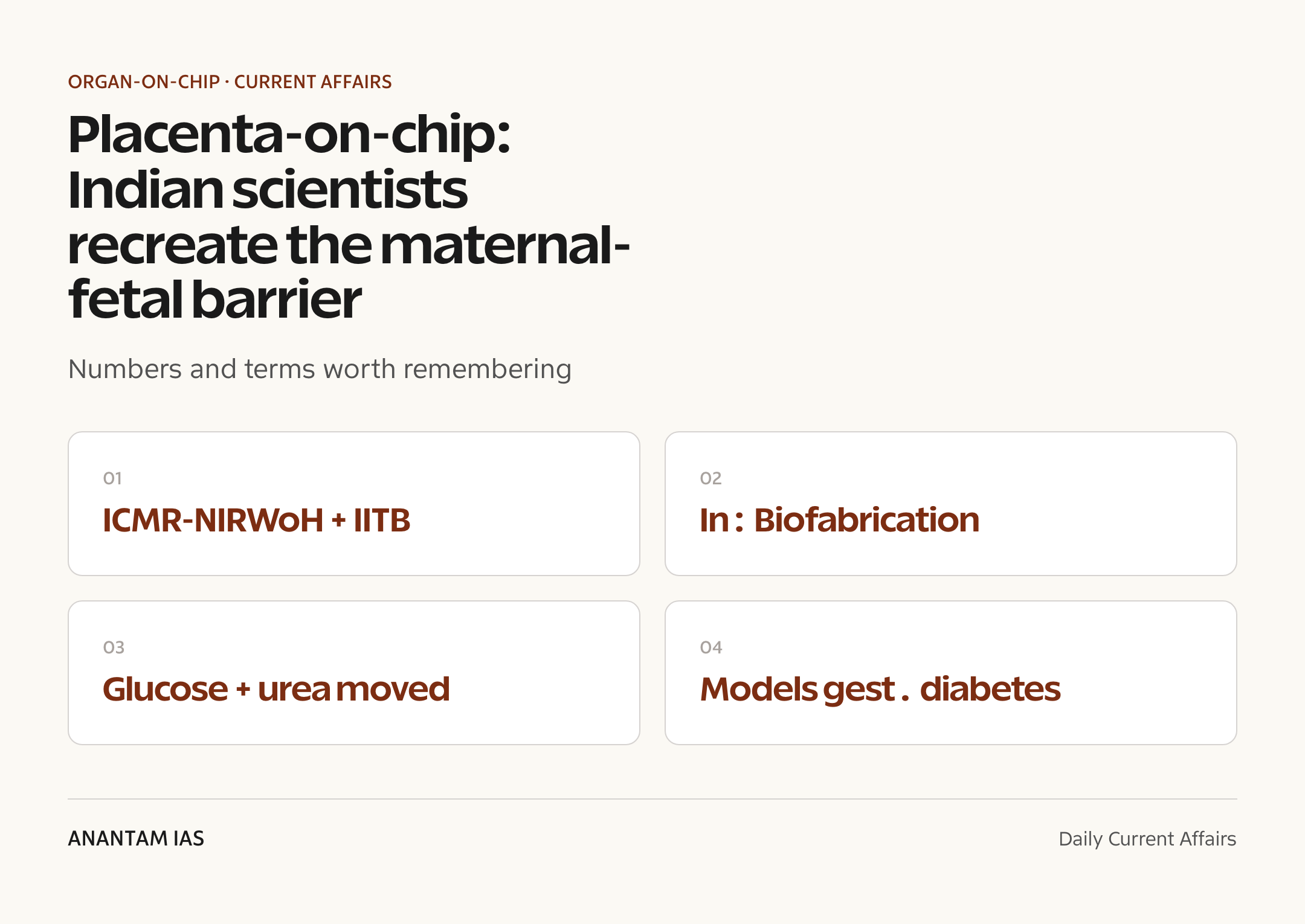
Researchers from the ICMR-National Institute for Research on Women’s Health (ICMR-NIRWoH), Mumbai, with IIT Bombay, have built an indigenous lab-grown placenta-on-chip that recreates key functions of the human placental barrier. The Hindu (PTI) reported the milestone in early July 2026.
The team’s study, published in the journal Biofabrication, describes a microphysiological system that mimics the interface between mother and foetus and reproduces hormone production, nutrient transfer, waste exchange and selective barrier function.
- Built by ICMR-NIRWoH (formerly ICMR-NIRRCH), Mumbai, with the engineering design and fabrication done at IIT Bombay.
- Co-corresponding authors Deepak Modi (ICMR-NIRWoH) and Abhijit Majumder (IIT Bombay); biological validation led by Anshul Bhide.
- The chip produces pregnancy hormones, transports glucose from the maternal to the foetal side and removes waste such as urea.
- It responds to hyperglycaemic conditions resembling gestational diabetes, changing placental transport as a real placenta would.
- Unlike systems needing continuous perfusion, the platform is designed to be simple, scalable and compatible with conventional lab workflows.
The development matters in the context of:
- The placenta is the foetus’s first life-support organ yet one of the least understood, because it is hard to study directly during pregnancy.
- The work strengthens India’s push toward human-relevant models that can complement or replace animal studies in reproductive research.
UPSC Relevance
Prelims Relevance
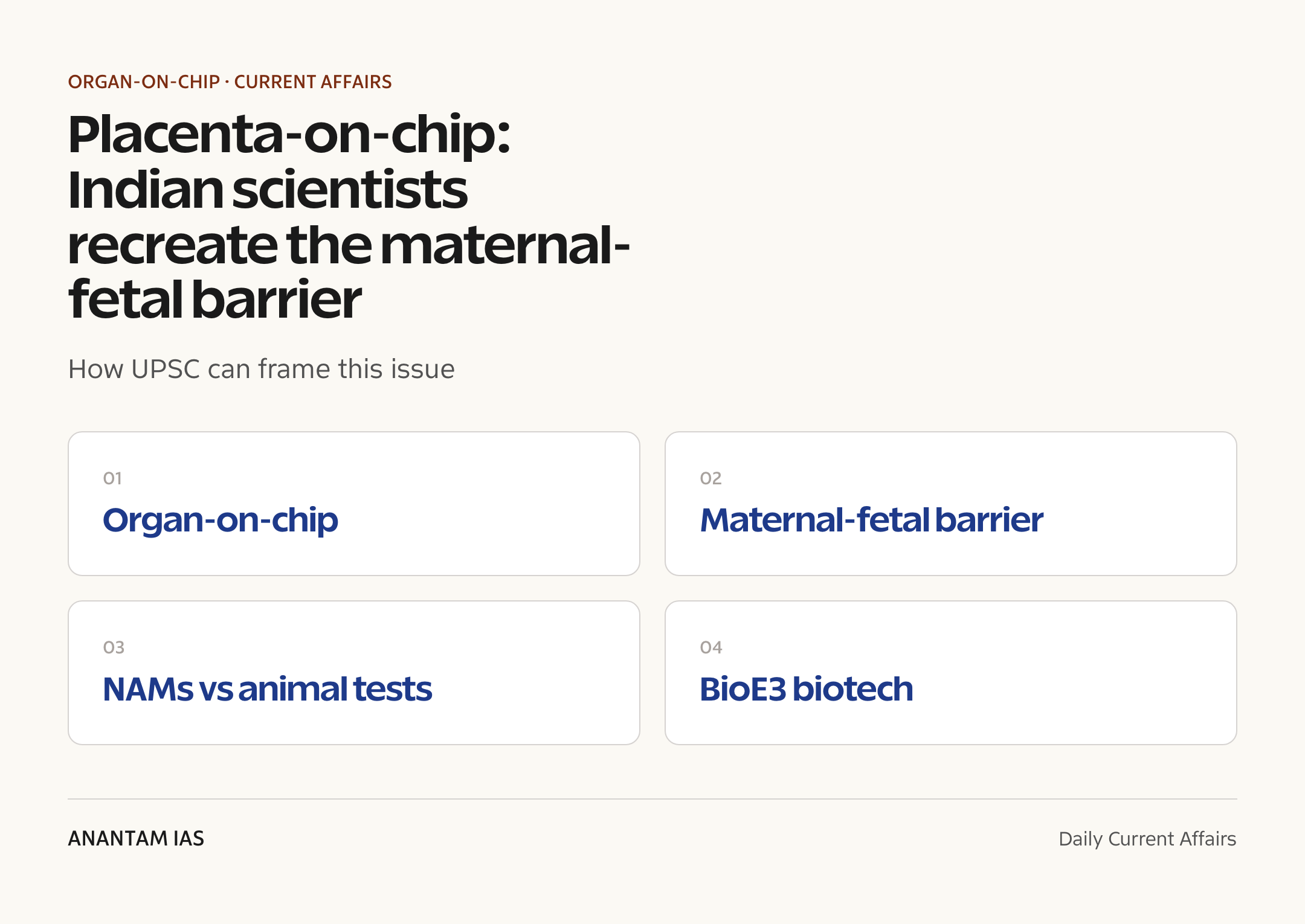
- Placenta-on-chip — an organ-on-chip / microphysiological system
- ICMR-NIRWoH (formerly ICMR-NIRRCH), Mumbai; IIT Bombay
- Journal of publication: Biofabrication
- Maternal-fetal barrier and trophoblast interface
- Functions mimicked: hormone output, glucose transport, urea removal, selective barrier
- Gestational diabetes / hyperglycaemia modelling
- New Approach Methodologies (NAMs) — non-animal test methods
- New Drugs and Clinical Trials (Amendment) Rules, 2023 allowing non-animal drug tests; CDSCO
- BioE3 Policy (Biotechnology for Economy, Environment and Employment)
- Microfluidics and lab-on-chip technology
Mains Relevance
GS Paper 3
- Indigenous organ-on-chip platforms and India’s push for self-reliant biotech R&D.
- Alternatives to animal testing — ethical, scientific and regulatory dimensions of NAMs.
GS Paper 2
- Human-relevant models for maternal and foetal health and pregnancy-disorder research.
Essay
- Science that serves the vulnerable: technology for maternal and reproductive health.
- Ethics of the laboratory — replacing animal experiments with human-relevant models.
Background and Context
What organ-on-chip technology is
The platform belongs to a fast-growing class of miniature living systems.
- An organ-on-chip is a thumb-sized device lined with living human cells that recreates the key functions of an organ under controlled conditions.
- It sits within the field of microphysiological systems — engineered models that reproduce human physiology outside the body.
- Many chips rely on microfluidics: precisely engineered channels that move tiny volumes of fluid to mimic blood flow and nutrient exchange.
- By recreating an organ’s behaviour, such chips let scientists watch biology in real time without opening a living body.
- Global research has already produced lung, liver, gut, kidney and blood-brain-barrier chips; a placenta-on-chip extends the toolkit to reproductive biology.
- The value lies in functional fidelity — a chip is judged by whether it behaves like the organ, not merely by how it looks.
Why the placenta is so hard to study
The placenta is central to pregnancy but has long resisted direct observation.
- It acts as the baby’s first life-support system — delivering oxygen and nutrients, clearing waste, shielding the foetus and making hormones.
- Studying it during pregnancy is difficult and risky, so much of its working stays hidden.
- The maternal-fetal barrier — the selective interface that decides what crosses from mother to baby — is key to healthy development.
- Poorly understood placental function underlies disorders such as pre-eclampsia, foetal growth restriction and gestational diabetes.
What the Indian chip demonstrated
The device reproduced several core placental functions, not just structure.
- It produced pregnancy hormones, showing hormonal activity of the placental interface.
- It transported glucose from the maternal to the foetal side, modelling nutrient transfer.
- It removed waste products such as urea, mirroring the placenta’s clearance role.
- It reproduced selective barrier function — controlling what passes across the interface.
- It modelled hyperglycaemic conditions resembling gestational diabetes and showed altered placental transport in response.
- Crucially, the demonstration is functional: the chip performs placental jobs, rather than only holding placental cells in place.
- That functional read-out is what lets researchers test how the barrier reacts under both healthy and diseased pregnancy conditions.
The indigenous design edge
The team stressed engineering simplicity as much as biological fidelity.
- Fabrication and engineering were led at IIT Bombay, with biological validation at ICMR-NIRWoH.
- Unlike many existing chips that need sophisticated equipment and continuous perfusion, this one avoids that complexity.
- It is designed to be simple, scalable and compatible with standard laboratory infrastructure.
- That lowers the barrier to adoption, so more Indian labs could use it for pregnancy and reproductive-health research.
- It reflects interdisciplinary teamwork across reproductive biology, microengineering and cell biology.
- Wider affordability could spread advanced pregnancy research beyond a few elite labs, an equity gain for domestic science.
Alternatives to animal testing (NAMs)
The chip fits a global and Indian shift away from animal experiments.
- New Approach Methodologies (NAMs) are non-animal methods — organ-on-chip, organoids and computer models — that predict human responses.
- India’s New Drugs and Clinical Trials (Amendment) Rules, 2023 permitted developers to use non-animal and human-relevant methods for drug safety, overseen by the CDSCO.
- Human-cell platforms can avoid the species mismatch that makes animal data an imperfect guide to human biology.
- The approach echoes the long-standing 3Rs principle — replace, reduce and refine the use of animals in research.
- Regulators worldwide, including the US FDA, have begun accepting NAM data for parts of drug safety assessment, signalling a broader shift.
- Researchers frame the chip as a way to complement or replace animal studies in selected reproductive-research applications, where scientifically appropriate.
Where it could be used
Applications range from basic biology to drug safety in pregnancy.
- Studying placental biology and how the barrier behaves in health and disease.
- Investigating pregnancy complications such as pre-eclampsia, foetal growth restriction and gestational diabetes.
- Evaluating how medicines cross the placental barrier, to flag drugs that are safe or unsafe in pregnancy.
- Supporting more predictive, human-relevant research models than animal experiments alone.
- Serving as a low-cost screening tool for maternal-health questions, given India’s high burden of pregnancy complications.
Policy backdrop: BioE3 and indigenous biotech
The advance aligns with India’s stated biotechnology direction.
- The BioE3 Policy (Biotechnology for Economy, Environment and Employment), cleared in 2024, pushes high-performance biomanufacturing and next-generation health solutions.
- Developing advanced human-relevant models within the country strengthens India’s biomedical innovation base.
- It supports the wider self-reliance goal of building critical research tools domestically rather than importing them.
- ICMR-NIRWoH’s Director framed the work as advancing solutions for women’s and reproductive health.
- It aligns with global efforts to develop more predictive alternatives to animal experimentation and to strengthen indigenous biomedical capability.
Way Forward
Validate and standardise
- Benchmark the chip against clinical placental data so results are reproducible across labs.
- Develop shared protocols so a scalable platform becomes a common research standard.
Build the ecosystem
- Fund interdisciplinary engineer-biologist teams that made this project possible.
- Link chips to regulatory acceptance so CDSCO and industry can rely on the data.
Pair indigenous organ-on-chip work with clear ethical and regulatory pathways so human-relevant models steadily reduce, and where possible replace, animal testing in reproductive research.
Conclusion
A placenta on a chip is a small device with an outsized promise: a window into an organ that has stayed opaque through the whole history of medicine. By reproducing hormone output, nutrient transport and barrier function, the ICMR-NIRWoH and IIT Bombay platform turns an inaccessible interface into something scientists can watch and probe.
Its real significance is that it is indigenous, simple and scalable, and points toward safer, more human-relevant testing. For a country balancing maternal-health burdens with the ethics of animal experimentation, that combination matters.
UPSC Practice Questions
Prelims MCQ 1
With reference to the recently developed indigenous placenta-on-chip platform, consider the following statements:
- It was developed by ICMR-NIRWoH, Mumbai, in collaboration with IIT Bombay.
- It reproduces functions including hormone production, glucose transport and waste removal.
- It requires a continuous perfusion system and sophisticated equipment to operate.
How many of the above statements are correct?
(a) Only one (b) Only two (c) All three (d) None
Answer: (b) Only two
Explanation:
Statements 1 and 2 are correct. Statement 3 is wrong: the platform was specifically designed to be simple and scalable, avoiding the continuous perfusion and sophisticated equipment that many existing chips need.
Prelims MCQ 2
“New Approach Methodologies (NAMs)”, recently in the news, are best described as:
(a) Non-animal methods such as organ-on-chip and organoids to predict human responses (b) New accounting methods for public-sector research funding (c) A classification of newly discovered antimicrobial molecules (d) A satellite navigation augmentation system
Answer: (a) Non-animal methods such as organ-on-chip and organoids to predict human responses
Explanation:
NAMs are human-relevant, non-animal test methods (organ-on-chip, organoids, in-silico models). India’s 2023 amendment to the drug rules allowed developers to use such methods for drug testing.
UPSC Mains Questions
- Organ-on-chip platforms are reshaping biomedical research. Discuss how indigenous microphysiological systems such as the placenta-on-chip can advance both India’s biotechnology self-reliance and the ethics of drug testing.
- “Human-relevant models can complement or replace animal experimentation in specific applications.” Examine this statement in the context of New Approach Methodologies and India’s regulatory reforms since 2023.
- The placenta remains one of the least understood human organs. How can new laboratory models improve the study of pregnancy disorders such as pre-eclampsia and gestational diabetes?
Sources: The Hindu (PTI) and Biofabrication (journal).
Frequently Asked Questions
What is a placenta-on-chip?
It is an organ-on-chip: a small device lined with living human cells that recreates key functions of the placenta under controlled lab conditions. The Indian version mimics the maternal-fetal barrier, producing hormones, transporting glucose and removing waste, so scientists can study the placenta without observing it inside a pregnancy.
Who developed the Indian placenta-on-chip?
Researchers at the ICMR-National Institute for Research on Women’s Health (ICMR-NIRWoH, formerly ICMR-NIRRCH), Mumbai, built it with IIT Bombay. Deepak Modi and Abhijit Majumder were co-corresponding authors, and Anshul Bhide led the biological validation. The study appeared in the journal Biofabrication.
What functions does the chip recreate?
It reproduces several core placental functions: producing pregnancy hormones, transporting glucose from the maternal to the foetal side, removing waste such as urea, and maintaining a selective barrier. It also modelled hyperglycaemic conditions resembling gestational diabetes and showed altered transport in response.
Why does this reduce reliance on animal testing?
The placenta-on-chip is a human-relevant model, so it can predict human responses more directly than animal experiments in some applications. It supports New Approach Methodologies (NAMs), the non-animal test methods India’s 2023 drug-rules amendment allowed developers to use, overseen by the CDSCO.
What pregnancy disorders could it help study?
Because it recreates the maternal-fetal interface, the platform can help investigate pre-eclampsia, foetal growth restriction and gestational diabetes. It can also test how medicines cross the placental barrier, helping identify drugs that are safe or unsafe during pregnancy.
How does it link to India’s BioE3 Policy?
Developing advanced human-relevant models within India strengthens the country’s biomedical innovation base, in line with the BioE3 Policy (Biotechnology for Economy, Environment and Employment). Building such critical research tools domestically also supports the wider goal of self-reliance in biotechnology.
Tell Google you want more of this.
Add Anantam IAS as a preferred sourceOne tap, and this site shows up more often in your own Top Stories, AI Overviews and AI Mode. Remove it any time.