Agni-III Missile Test: Strategic Significance for India
Why in News
India successfully test-fired the Agni-III intermediate-range ballistic missile from the Integrated Test Range, Chandipur (Odisha), under the supervision of the Strategic Forces Command (SFC) as part of a routine training exercise to validate operational readiness.
- Strategic Forces Command (SFC) is the tri-services command of India responsible for the management, control and operational deployment of India’s nuclear weapons and strategic missile forces
UPSC Relevance: GS III Science and Technology, Indigenous Technology
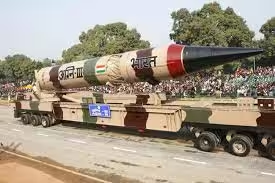
About Agni-III Missile:
- Type: Intermediate-Range Ballistic Missile (IRBM)
- Range: Over 3,000 km
- Fuel: Two-stage, solid-fuelled
- Payload: Capable of carrying conventional and nuclear warheads
- Developer: Defence Research and Development Organisation (DRDO)
- Operational Status: Inducted into Strategic Forces Command in 2011
Key Features
Solid-fuel propulsion:
- Faster launch readiness
- Lower maintenance
- Higher survivability compared to liquid-fuel missiles
Two-stage configuration:
- Enhances range and payload capability
High accuracy and reliability:
- Suitable for strategic deterrence missions
Strategic Importance of the Test
1. Strengthening Credible Minimum Deterrence
- Agni-III is a core pillar of India’s nuclear deterrence posture
- Supports India’s doctrine of:
- No First Use (NFU)
- Credible Minimum Deterrence
Ensures ability to inflict unacceptable damage in case of nuclear aggression
2. Operational Readiness of Strategic Forces Command
- Test conducted as a training exercise
- Validates:
- Missile handling procedures
- Command-and-control systems
- Coordination between DRDO and SFC
Enhances second-strike capability
3. Regional Strategic Balance
- Range covers key strategic regions, contributing to deterrence stability
- Acts as a counterbalance in a complex regional security environment
Reinforces India’s status as a responsible nuclear power
4. Indigenous Defence Capability
- Highlights DRDO’s mastery in solid propulsion, guidance, re-entry technology, and composite materials.
- Reduces import dependence; aligns with Make in India and self-reliance goals in strategic systems. Aligns with Atmanirbhar Bharat in defence manufacturing
Integrated Test Range (ITR), Chandipur
- Located in Balasore district, Odisha (off the Bay of Bengal coast).
- India’s primary facility for testing ballistic missiles, cruise missiles (e.g., BrahMos), anti-ballistic missile systems (e.g., Prithvi Air Defence), and other strategic weapons.
- Equipped with advanced tracking radars, telemetry, electro-optical systems, and mission control centres → Essential for validating missile performance over long ranges.
Practice Question:
With reference to the Agni-III missile, consider the following statements:
- It is a two-stage, solid-fuelled ballistic missile.
- It has a strike range of more than 3,000 km.
- It is capable of carrying both conventional and nuclear warheads.
- It is operated by the Defence Research and Development Organisation (DRDO).
Which of the statements given above are correct?
(a) 1, 2 and 3 only
(b) 1 and 4 only
(c) 2 and 3 only
(d) 1, 2, 3 and 4
Answer: (a) 1, 2 and 3