AI Audit: Payroll fraud detection in Chhattisgarh Police
Why in News?
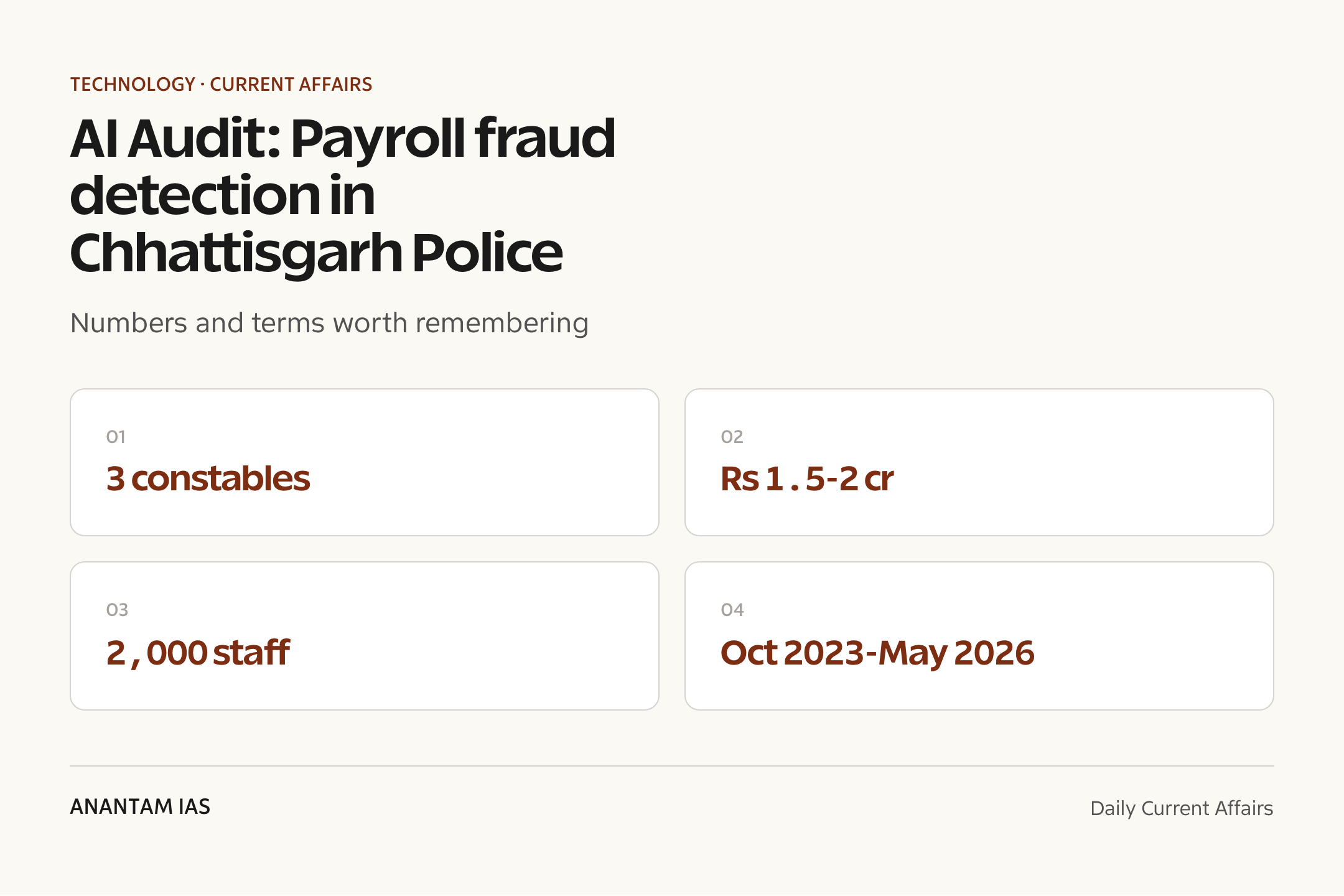
The AI payroll fraud detection case in Chhattisgarh Police came into focus after Indian Express reported that three constables from Bastar were arrested over alleged salary inflation detected during an AI-assisted audit.
The report said auditors analysed salary data for around 2,000 personnel and spotted anomalies in a case where the accused allegedly siphoned off between Rs 1.5 crore and Rs 2 crore from October 2023 to May 2026.
- Place: the alleged manipulation was linked to the office of the Superintendent of Police, Jagdalpur in Bastar district.
- Accused: Indian Express named constables Girish Rai, Rajkumar Katlam and Hemant Mathew as the arrested personnel.
- Modus: investigators said salary soft copies were allegedly edited before processing, raising monthly salary amounts in small increments.
- Detection: auditors used AI tools on voluminous salary data and noticed patterns that routine manual checks had missed.
- Legal action: the report said the accused were booked under the Bharatiya Nyaya Sanhita for offences including cheating, forgery, criminal breach of trust and misappropriation of government funds.
The development matters in the context of:
- Governance angle: payroll fraud is not only a police misconduct issue; it is a public finance control failure inside a state institution.
- Technology angle: the case shows how anomaly detection can flag suspicious patterns in large administrative datasets.
- Safeguards angle: AI can identify risk signals, but disciplinary and criminal action still needs human verification, due process and evidence.
- Internal security angle: integrity of police administration affects public trust, morale and the legitimacy of law-enforcement agencies.
UPSC Relevance
Prelims Relevance
- Artificial Intelligence refers to computer systems performing tasks such as pattern recognition, classification and prediction from data.
- Anomaly detection means identifying data points or transactions that deviate from normal patterns; payroll audits can use it to flag unusual salary jumps.
- Bharatiya Nyaya Sanhita, 2023 replaced the Indian Penal Code as India’s principal criminal code from 1 July 2024.
- Forgery, cheating and criminal breach of trust are classic financial-integrity offences in public administration.
- CAG derives its audit authority from Articles 149-151 of the Constitution, while internal and departmental audits work within the executive chain.
- Audit trail means a traceable record of who changed data, when it was changed and what exactly was changed.
- Digital Personal Data Protection Act, 2023 matters when employee salary and identity data are processed through digital systems.
- False positive in audit analytics means a transaction flagged as suspicious that turns out to be legitimate after verification.
Mains Relevance
GS Paper 2
- Governance: use this case to discuss administrative accountability, internal controls, audit capacity and public trust.
- Polity: connect departmental vigilance with rule of law, due process and the need to avoid punishment by algorithm.
GS Paper 3
- Science and Technology: AI can improve fraud detection, but its design must address bias, explainability, cybersecurity and data quality.
- Internal Security: police integrity is a security concern because corruption inside law-enforcement bodies weakens operational legitimacy.
GS Paper 4
- Ethics: the case is useful for integrity, probity, accountability, misuse of public office and conflict between trust and verification.
Essay
- Technology and trust: digital systems can strengthen governance only when accountability keeps pace with automation.
- Clean government: corruption control needs culture, process and data, not only stricter punishment.
- Human oversight: the state must not outsource moral judgment to machines.
Background and Context
What the case shows
The Chhattisgarh case is a useful micro-example of how routine public expenditure can leak when controls are weak.
- Payroll fraud is often low-visibility because salary bills are recurring, predictable and trusted by default inside departments.
- Indian Express reported that the alleged inflation continued for nearly three years, from October 2023 to May 2026.
- Small monthly increments can avoid attention better than one large withdrawal because the change looks like routine allowance variation.
- Police salary bills are especially complex because transfers, postings and personnel-strength changes can alter expenditure each month.
- Administrative lesson: where process complexity is high, exception reporting should be stronger, not weaker.
- Control failure is the real exam issue: if salary changes can pass for years without reconciliation, the institution has a systems problem beyond the accused officials.
- Public trust suffers because salary fraud turns a routine personnel process into a question about integrity inside the state’s coercive arm.
How AI helps auditors
AI in this context should be read as decision support for auditors, not as an independent judge.
- Anomaly detection can compare monthly salary entries, past payment history, designation, sanctioned pay level and peer-group patterns.
- Outlier analysis can flag employees whose salary growth is inconsistent with increments, allowances, arrears or transfer-linked changes.
- Pattern recognition is useful when the dataset is too large for line-by-line manual checking, as in salary data for around 2,000 personnel.
- Machine-assisted audit reduces search cost; it does not by itself prove criminal intent, mens rea or departmental guilt.
- Human confirmation remains essential through voucher checks, bank-credit verification, digital logs, service records and statement recording.
- Audit triage is the best use case: software can rank suspicious transactions so scarce audit staff spend time on high-risk files first.
- Responsible design should keep the tool explainable enough for finance officers, not only data scientists, because departmental action needs understandable reasons.
Static anchor: public audit
For UPSC, the durable issue is the audit architecture that protects public money.
- Internal audit is the first line of defence inside a department; it checks compliance before small irregularities become systemic.
- External audit, especially through the CAG framework, adds constitutional independence and reporting to the legislature.
- Articles 149-151 place the CAG at the centre of public audit, but day-to-day payroll control also needs treasury, DDO and departmental checks.
- Segregation of duties is critical: the person preparing salary data should not also approve, modify and reconcile the same bill without oversight.
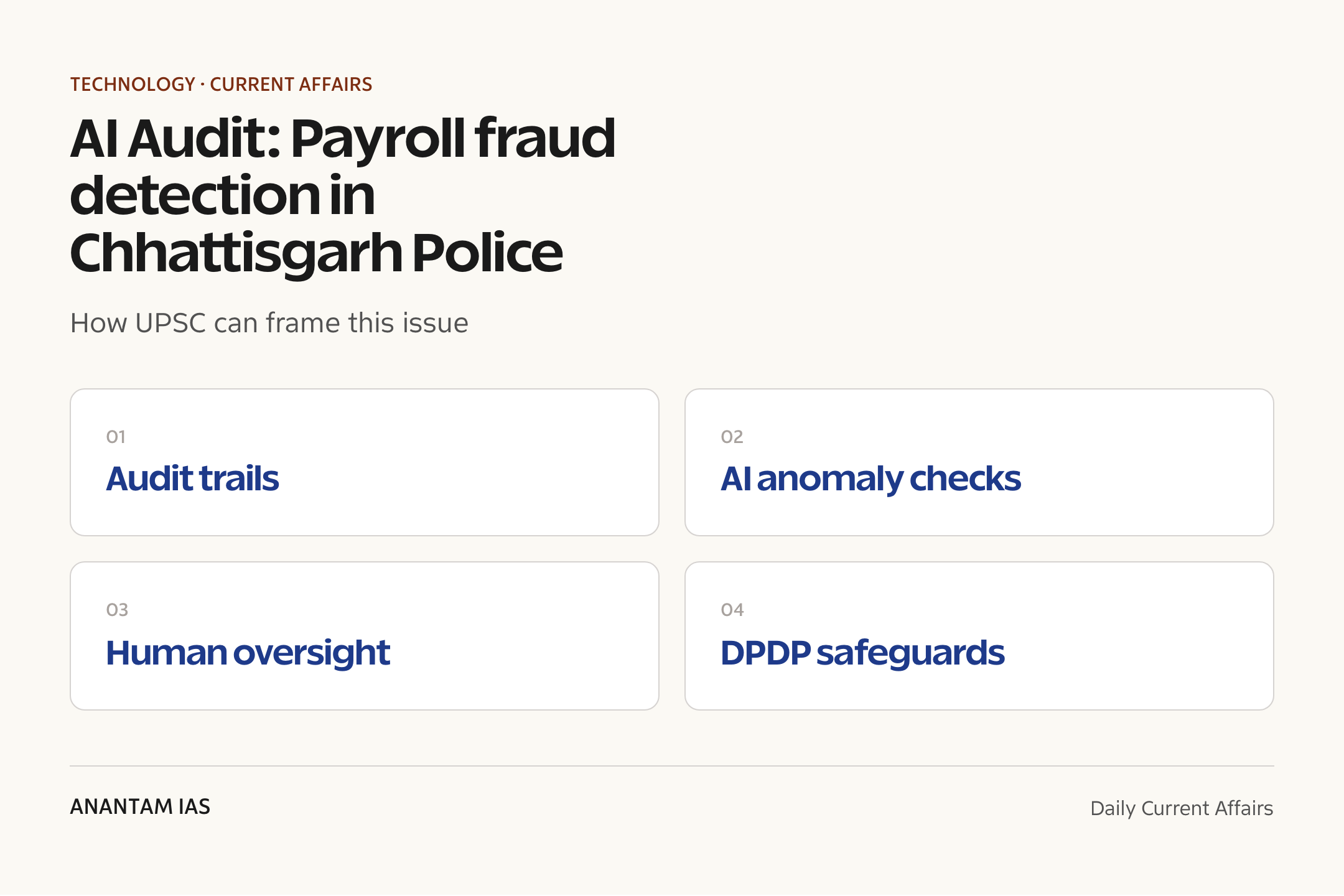
- Audit trails should capture edits to salary files so investigators can trace the user account, timestamp, old value and new value.
- Treasury integration is important because departmental bills, sanctioned posts and bank-credit files should match before money leaves the public account.
- Legislative oversight gains value when audit findings are reported in a form that committees can track across departments, not as one-off scandals.
Law and accountability
The reported offences fall within the classic integrity concerns of public service.
- Cheating involves deception leading to wrongful gain or wrongful loss; payroll manipulation can fit this logic when facts are proved.
- Forgery is relevant when records are altered or created dishonestly to support a false financial claim.
- Criminal breach of trust matters when a person entrusted with official responsibility dishonestly misuses that position.
- Misappropriation of government funds shows why public finance cases should be treated as governance failures, not only individual misconduct.
- Due process still applies: AI flags may justify inquiry, but arrest, charge, departmental action and conviction need legally admissible evidence.
Safeguards for algorithmic governance
The case links directly to India’s wider debate on algorithmic governance and data protection.
- Data minimisation means auditors should process only the employee data necessary for payroll verification, not unrelated personal details.
- Purpose limitation means salary datasets used for fraud detection should not drift into unrelated surveillance without legal authority.
- Explainability matters because an employee should know why a transaction was flagged if disciplinary consequences follow.
- False positives are a real risk; legitimate arrears, court-ordered payments, deputation allowances or back wages can look abnormal.
- Read with algorithmic governance and bias, artificial intelligence in India and the DPDP data-protection framework.
Police administration and internal security
A police payroll case may look administrative, but it has a security and ethics dimension.
- Police legitimacy depends on citizens believing that law-enforcement institutions obey the law internally.
- Bastar is a sensitive internal-security region; financial integrity inside police units matters for morale and operational credibility.
- Corruption risk inside salary sections can weaken trust between field personnel, headquarters and finance staff.
- Cybersecurity becomes part of policing when salary data, service books and payment files move through digital workflows.
- Read with NCRB cybercrime trends to connect fraud, digital records and law-enforcement capacity.
Way Forward
Strengthen payroll controls
- Maker-checker workflow should separate data entry, approval, bill generation and reconciliation across different officials.
- Monthly exception reports should flag sudden salary jumps, duplicate bank accounts, unusual arrears and repeated manual edits.
- Digital signatures and role-based access should make every edit attributable to a named official account.
- Bank reconciliation should compare sanctioned salary, treasury bill and employee bank credit before closing the monthly cycle.
Use AI with guardrails
- Human-in-the-loop audit should make AI a screening tool, with auditors responsible for final findings.
- Explainable models should show why an entry was flagged: amount change, frequency, peer mismatch, duplicate pattern or edit history.
- Model validation should test the tool on known fraud cases and known legitimate salary variations before deployment.
- Independent review should check whether the system is missing fraud in small offices or over-flagging certain units.
Protect rights and records
- DPDP-compliant processing should define purpose, access, retention and deletion rules for employee salary data.
- Grievance channels should allow employees to challenge wrong flags, mistaken recoveries or reputational harm.
- Evidence preservation should secure original files, edit logs and device records before accused officials can alter the trail.
- Audit capacity should be upgraded through training in data analytics, forensic accounting and cyber evidence handling.
Conclusion
The Chhattisgarh Police payroll case is a compact example of how AI-assisted audit can make hidden leakages visible in public administration. Its value for governance lies less in the novelty of AI and more in the reminder that public money needs traceable records, routine exception reports and credible follow-up.
For UPSC answers, the balanced position is clear: AI can improve audit speed and detection, but accountability must remain human, legal and transparent. A good state uses technology to sharpen scrutiny, not to replace due process.
UPSC Practice Questions
Prelims MCQ 1
With reference to AI-assisted payroll audits in public administration, consider the following statements:
- Anomaly detection can flag salary entries that deviate from normal payment patterns.
- An AI-generated flag by itself is enough to establish criminal guilt in a court.
- Audit trails help identify who changed a digital record and when the change was made.
How many of the above statements are correct?
(a) Only one (b) Only two (c) All three (d) None
Answer: (b) Only two
Explanation:
Statements 1 and 3 are correct. Statement 2 is wrong because AI can flag suspicion, but guilt requires legally admissible evidence and due process.
Prelims MCQ 2
In the context of public audit in India, Article 149 of the Constitution is primarily associated with which institution?
(a) Central Vigilance Commission (b) Comptroller and Auditor General of India (c) Finance Commission (d) Public Accounts Committee
Answer: (b) Comptroller and Auditor General of India
Explanation:
Article 149 deals with the duties and powers of the Comptroller and Auditor General in relation to the accounts of the Union, States and other authorities as provided by law.
UPSC Mains Questions
- The Chhattisgarh Police payroll fraud case shows that technology can expose leakages, but cannot substitute for institutional accountability. Discuss the governance lessons for public audit, departmental controls and data-driven administration. (250 words)
- AI-assisted anomaly detection can strengthen public finance management, but it also raises concerns of privacy, false positives and opacity. Examine with suitable examples from public administration. (250 words)
- Police integrity is not only an ethics issue but also an internal-security requirement. Analyse this statement in the context of corruption risks within law-enforcement institutions. (150 words)
Source: Indian Express.
Frequently Asked Questions
What happened in Chhattisgarh Police?
Indian Express reported that three constables from Bastar were arrested after auditors used AI tools to detect alleged salary inflation. The alleged fraud ran from October 2023 to May 2026 and involved between Rs 1.5 crore and Rs 2 crore.
How did AI help the audit?
AI-assisted analysis helped auditors scan salary data for around 2,000 personnel and flag unusual patterns. In such cases, AI works as a screening tool. Auditors and investigators still need to verify records, bank credits, edit logs and intent.
Why is this relevant for UPSC?
The case links GS2 governance with GS3 science and technology. It gives a concrete example for public audit, financial controls, algorithmic governance, data protection, internal security and ethics in public service.
Can AI prove payroll fraud?
No. AI can identify suspicious transactions, but it cannot by itself prove guilt. Criminal action requires admissible evidence, investigation, human judgment, due process and court scrutiny under the applicable law.
What safeguards are needed?
Departments need maker-checker workflows, audit trails, role-based access, monthly exception reports, DPDP-compliant data handling, human review of AI flags and grievance channels for wrongly flagged employees.
Why does police payroll integrity matter?
Police forces depend on public trust and internal morale. If salary systems are manipulated, it weakens institutional credibility, diverts public funds and damages confidence in the same agency expected to enforce the law.