National AI Skilling Drive: Training One Crore Youth in One Year
Why in News?
India’s national AI skilling drive entered the policy agenda on 15 August 2026, when the Prime Minister announced from the Red Fort that one crore youth would be trained in AI skills over the next one year.
- The Prime Minister’s Office release was posted by PIB Delhi at 1:01 p.m. on 15 August 2026 and described the announcement as part of the address on the 80th Independence Day.
- The stated scale is one crore youth, equivalent to 10 million people, within one year.
- The stated purpose is to equip young Indians with the capability to lead in the world of AI as artificial intelligence expands rapidly.
- No official detail in the cited announcement establishes a single course, training duration, delivery platform, eligibility rule or certificate. Those design questions remain open.
- The target concerns skills formation. It is distinct from the National Career Service portal’s use of AI for job matching, recommendations, skill-gap analysis and interview support.
- The target turns AI capacity-building into a mass human-capital challenge: access must be broad, but participation counts alone cannot show whether a learner acquired a useful capability.
- A one-year horizon creates pressure to scale quickly. Public accountability will depend on transparent definitions of trained, assessed, certified and placed rather than treating these terms as interchangeable.
- The policy has a social-justice dimension because device access, connectivity, language, disability, geography, gender and prior education can determine who enters and completes digital training.
UPSC Relevance
Prelims Relevance
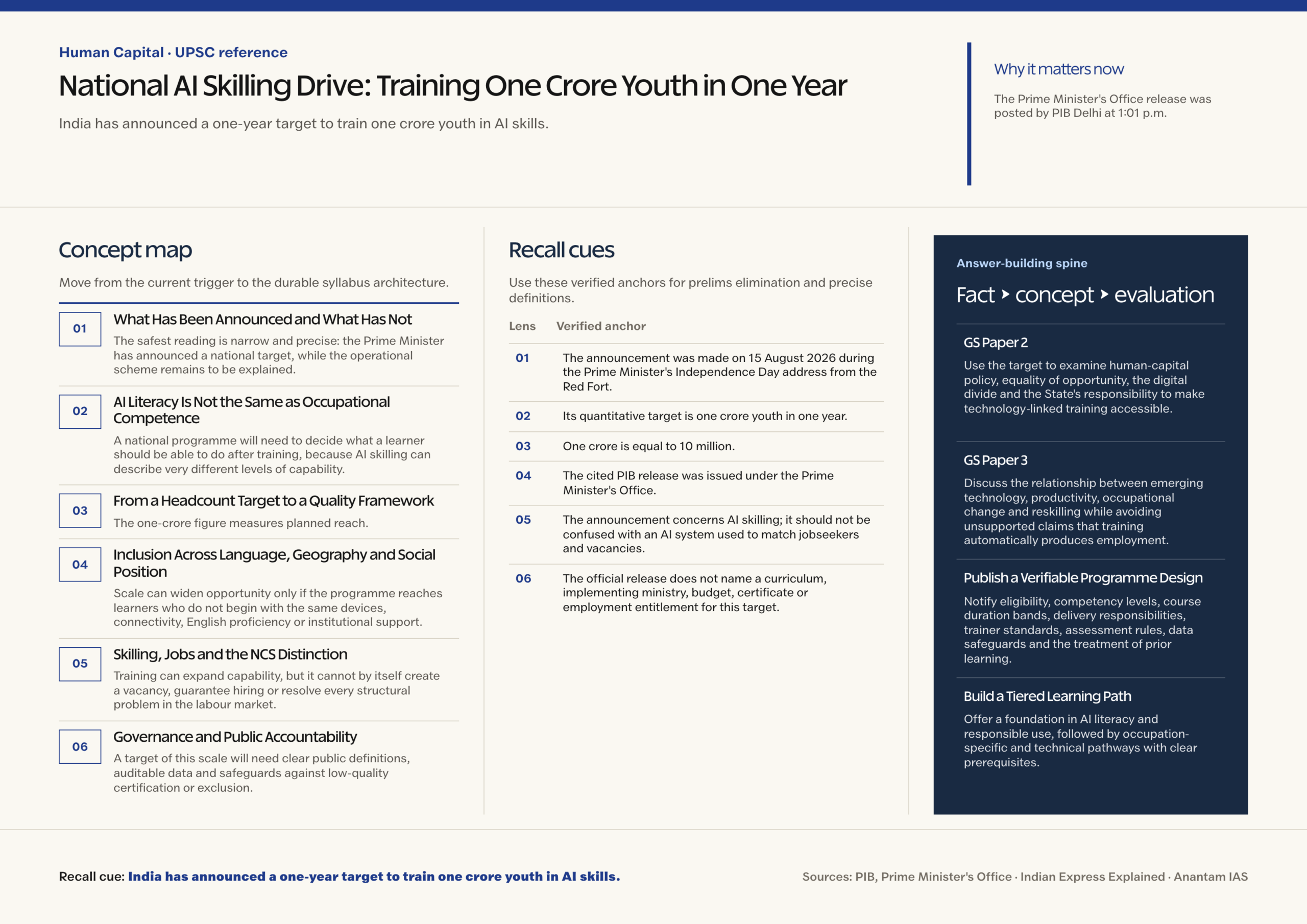
- The announcement was made on 15 August 2026 during the Prime Minister’s Independence Day address from the Red Fort.
- Its quantitative target is one crore youth in one year.
- One crore is equal to 10 million.
- The cited PIB release was issued under the Prime Minister’s Office.
- The announcement concerns AI skilling; it should not be confused with an AI system used to match jobseekers and vacancies.
- The official release does not name a curriculum, implementing ministry, budget, certificate or employment entitlement for this target.
Mains Relevance
GS Paper 2
- Use the target to examine human-capital policy, equality of opportunity, the digital divide and the State’s responsibility to make technology-linked training accessible.
- Assess delivery through a rights-aware lens: multilingual access, disability inclusion, assisted learning, grievance redress and transparent beneficiary data.
GS Paper 3
- Discuss the relationship between emerging technology, productivity, occupational change and reskilling while avoiding unsupported claims that training automatically produces employment.
- Evaluate the design of credible AI skilling through competency levels, practical assessment, instructor capacity, ethical use, data protection and independent outcome measurement.
Essay
- Technology becomes inclusive only when access is converted into usable capability.
Background and Context
What Has Been Announced and What Has Not
The safest reading is narrow and precise: the Prime Minister has announced a national target, while the operational scheme remains to be explained.
- The official commitment contains two measurable elements: a reach of one crore youth and a time horizon of one year.
- The release links the target to the rapid expansion of AI and to building the capability of Indian youth. It does not define what level of proficiency will count as an AI skill.
- No curriculum, delivery platform, ministry, funding amount, trainer standard, assessment body or employment outcome is identified in the cited announcement. Assigning any of these details to the drive would go beyond the evidence.
- This distinction matters for current-affairs writing. An announced target can set policy direction, but a notified scheme normally supplies eligibility, institutional responsibility, financing, implementation and monitoring rules.
- The term youth also needs an operational definition. Different public programmes use different age bands, and the PIB note does not state which band, educational level or employment status applies here.
AI Literacy Is Not the Same as Occupational Competence
A national programme will need to decide what a learner should be able to do after training, because AI skilling can describe very different levels of capability.
- At the foundational level, AI literacy means understanding what AI systems can and cannot do, recognizing unreliable outputs, protecting personal data and using tools responsibly.
- At the applied level, a learner may need to use AI within an occupation such as agriculture, teaching, health administration, manufacturing, accounting or public service. The required competence differs by domain.
- At the technical level, roles may require mathematics, programming, data handling, model evaluation, cybersecurity or system deployment. A short awareness module cannot be counted as equivalent to technical preparation.
- A credible framework should classify learning levels and assess demonstrated tasks. Completion of a video or attendance at a session is an input measure, not proof of competence.
- Occupational modules should connect AI with domain judgment. A health worker, teacher or farm adviser must know when an output is outside the tool’s competence and when professional or local knowledge should prevail.
From a Headcount Target to a Quality Framework
The one-crore figure measures planned reach. Policy quality depends on what sits behind that number and whether the learning remains useful after the course ends.
- A transparent results chain should separate enrolment, participation, completion, assessment, certification, further learning and employment-related outcomes. Publishing only the largest number can hide attrition.
- Assessment should test practical capability: interpreting an output, checking evidence, identifying bias or unsafe use, solving a domain problem and explaining when human oversight is required.
- Quality assurance needs trainer preparation, updated material, accessible labs or devices, secure learning systems and a method to review training providers. These are design requirements, not features confirmed by the announcement.
- Because AI tools change quickly, the most durable curriculum would combine tool use with data literacy, critical thinking, domain knowledge, ethics and the ability to learn again. The final curriculum must still be verified when official.
- Provider incentives should reward verified learning rather than maximum enrolment. If payment or recognition follows headcount alone, the system may encourage brief, low-value modules and repeated counting instead of serious instruction.
Inclusion Across Language, Geography and Social Position
Scale can widen opportunity only if the programme reaches learners who do not begin with the same devices, connectivity, English proficiency or institutional support.
- Multilingual delivery must go beyond translating menus. Training examples, speech systems, technical terms, assessment and help channels need to work in the language a learner actually uses.
- The challenge connects with the wider question of Indian-language AI and digital inclusion: language representation shapes who can participate in an AI economy and whose knowledge becomes visible.
- Rural learners, women with limited time or mobility, persons with disabilities and first-generation digital users may need assisted access, flexible schedules, accessible interfaces and local mentoring.
- Aggregate completion data should be disaggregated by relevant social and geographic categories, with privacy safeguards. Otherwise, a national average can conceal exclusion.
- Online scale and local support are complements. A low-bandwidth course may widen reach, while a school, college, library, training centre or community facilitator can help a learner who lacks a quiet space, device or confident digital.
Way Forward
Publish a Verifiable Programme Design
- Notify eligibility, competency levels, course duration bands, delivery responsibilities, trainer standards, assessment rules, data safeguards and the treatment of prior learning.
- Define trained separately from enrolled, completed, assessed and certified, and publish the denominator behind every rate.
- Set a dated implementation calendar without assuming that the Independence Day announcement itself supplied these details.
- Publish a plain-language learner charter covering fees, data use, certificate status, assessment rights and grievance channels.
Conclusion
- Training one crore youth in AI skills within a year is an ambitious statement of national intent.
- The policy test is simple: learners should be able to use AI critically and safely in contexts that matter to them, while institutions remain honest about what training can and cannot achieve.
UPSC Practice Questions
Prelims MCQ 1
With reference to the AI-skilling announcement made by the Prime Minister on 15 August 2026, consider the following statements:
- It set a target of training one crore youth in AI skills over one year.
- The cited announcement specified a national curriculum and a single certification agency.
- It was the same programme as the National Career Service portal’s AI-enabled job-matching upgrade.
How many of the above statements are correct?
(a) Only one (b) Only two (c) All three (d) None
Answer: (a) Only one
Explanation:
Only Statement 1 is correct. The PIB release announces the one-crore, one-year target but does not specify a curriculum or certification agency. The NCS update concerns employment-service functions and is a separate policy development.
Prelims MCQ 2
Which one of the following would provide the strongest evidence that a mass AI-skilling programme has built usable capability?
(a) The number of promotional messages sent (b) The number of people who opened a course page (c) Practical competency assessments with disaggregated completion and learning outcomes (d) A single national total that combines enrolment and certification
Answer: (c) Practical competency assessments with disaggregated completion and learning outcomes
Explanation:
Practical assessment tests whether learners can apply knowledge, while disaggregated data shows whether access and achievement are fairly distributed. Page views or blended headline counts do not establish competence.
UPSC Mains Questions
- A mass AI-skilling target should be judged by capabilities acquired, not certificates distributed. Discuss the principles that should guide the design and evaluation of India’s one-crore-youth AI-skilling drive. (250 words)
- Digital skilling can deepen inequality when access is treated as identical to inclusion. Examine the measures needed to make AI training accessible across language, gender, disability, geography and educational background. (250 words)
Sources: PIB, Prime Minister's Office and Indian Express Explained.
Frequently Asked Questions
What did the Prime Minister announce about AI skilling?
On 15 August 2026, the Prime Minister announced that one crore youth would be trained in AI skills over the next one year. The PIB release links the target to rapid AI expansion and India’s ambition to build youth capability.
Is the one-crore AI-skilling drive already a fully specified scheme?
Not on the evidence in the cited announcement. The release states the target and time horizon but does not name a curriculum, implementing agency, budget, eligibility rule, course duration or certification framework. Those details should be checked in later notifications.
Does training one crore youth mean creating one crore AI jobs?
No. The announcement is a training target, not an employment guarantee. Jobs depend on labour demand, occupational change, local economies, complementary education and the quality of learning. Evaluation should report employment-related outcomes carefully, with clear denominators and time periods, without.
How is this different from the National Career Service AI update?
The AI-skilling announcement concerns building capabilities among youth. The National Career Service update concerned a public employment platform using AI for functions such as job matching, recommendations, skill-gap analysis and interview support. One operates on the skills-supply side; the other.
What should count as successful AI training?
Success should mean demonstrated capability at a declared level, not mere enrolment or attendance. Useful measures include course completion, practical assessment, safe and critical tool use, further learning, workplace application and equitable outcomes across learner groups. Each measure needs its.