Air India crash inquiry: Why the October draft report will not be public immediately
Why in News?
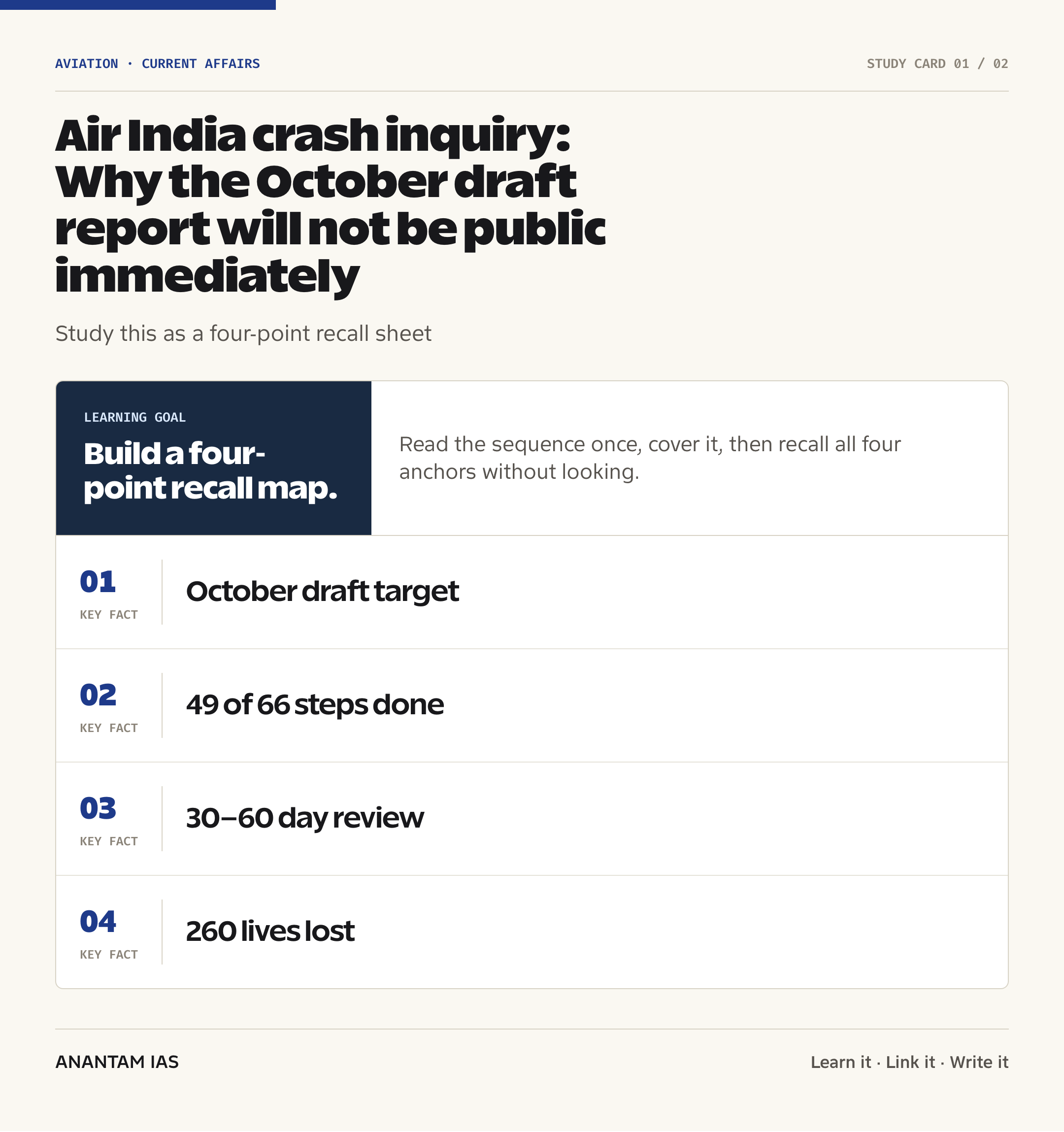
The Aircraft Accident Investigation Bureau (AAIB) told the Supreme Court that investigative activity in the Air India Flight AI171 crash inquiry could be completed in about six weeks, subject to external dependencies, and that a draft final report is expected around October 2026.
The October document will not automatically become a public final report. Under Rule 14 of the Aircraft (Investigation of Accidents and Incidents) Rules, 2025 and ICAO Annex 13, the draft must first go to participating states for significant and substantiated comments. This makes the case a useful study of aviation safety governance, protected evidence and institutional accountability.
- The Hindu reported the timeline from an affidavit filed by the Ministry of Civil Aviation and AAIB in petitions seeking an independent or court-monitored inquiry.
- The affidavit said 49 of 66 mandatory procedural steps had been completed and placed the likely draft-report stage in October 2026.
- The crash occurred on 12 June 2025, when the London Gatwick-bound Boeing 787-8, VT-ANB, went down shortly after take-off from Ahmedabad.
- The accident killed 260 people: 241 of the 242 persons on board and 19 people on the ground; one passenger survived.
- AAIB’s official interim statement of 12 June 2026 said analysis covered aircraft systems, flight-recorder data, engine components, maintenance and operational records, and human factors.
- No final cause has been announced. AAIB has repeatedly asked the public and media to avoid speculation while the evidence is still being integrated.
The development matters in the context of:
- A draft final report is a consultation document, not the same thing as the final report released to the public.
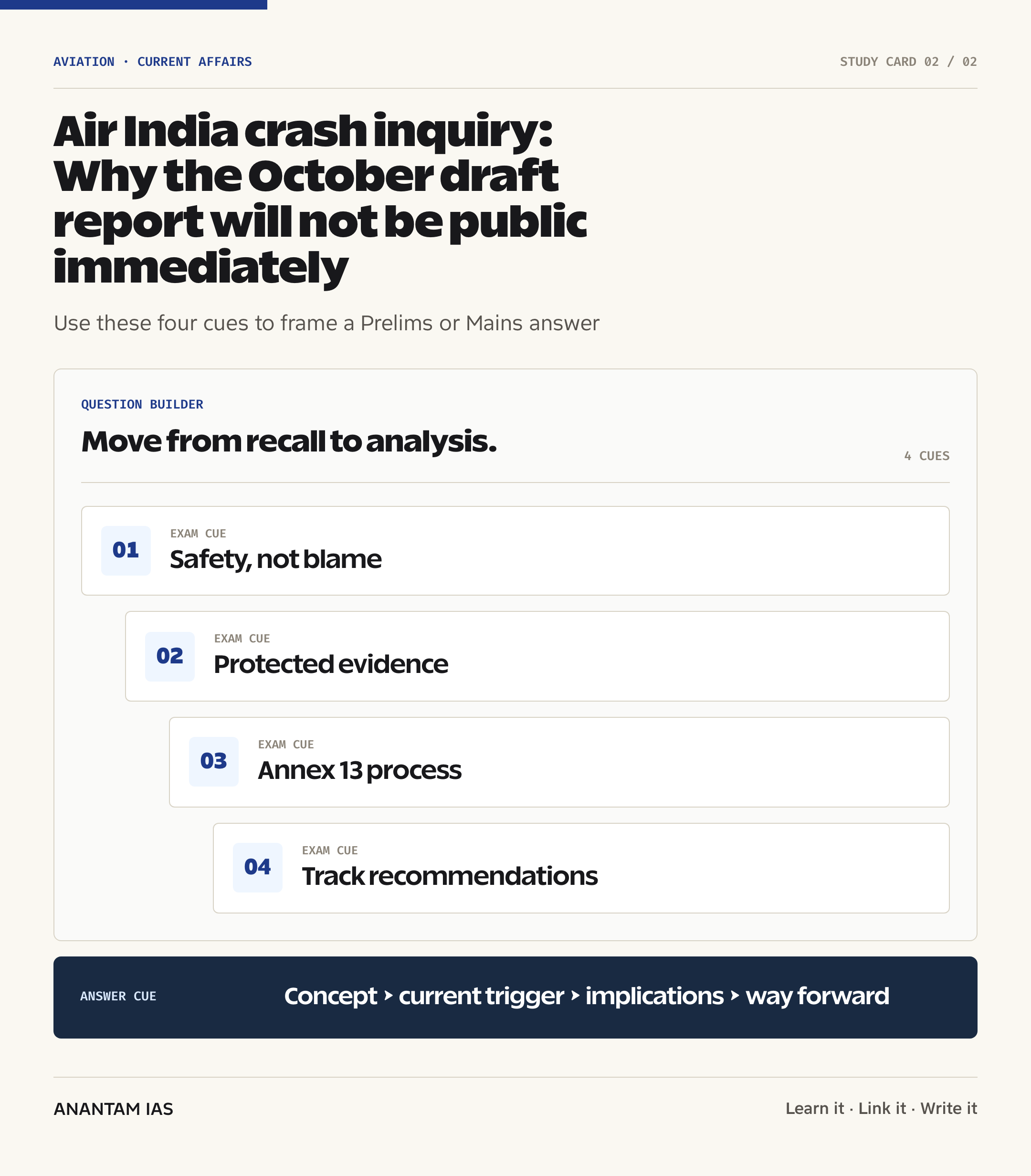
- An Annex 13 investigation seeks prevention and safety learning; it is legally separate from proceedings that determine civil, administrative or criminal liability.
- Confidentiality protects candid testimony and safety analysis, but the final report must still explain causes, contributing factors and safety recommendations well enough to sustain public trust.
- For disaster management, the crash tests the full chain from prevention and emergency response to forensic investigation, regulatory correction and institutional learning.
UPSC Relevance
Prelims Relevance
- The Aircraft Accident Investigation Bureau is India’s designated authority for investigating aircraft accidents and serious incidents.
- AAIB functions under the Ministry of Civil Aviation; the 2025 Rules define it with reference to Section 7 of the Bharatiya Vayuyan Adhiniyam, 2024.
- ICAO is a specialised agency of the United Nations created under the Chicago Convention, 1944; its headquarters is in Montreal, Canada.
- Annex 13 to the Chicago Convention contains international standards and recommended practices for aircraft accident and incident investigation.
- The State of Occurrence normally institutes the investigation; the States of Registry, Operator, Design and Manufacture can participate through accredited representatives.
- Under Rule 14 of the 2025 Rules, the usual consultation period on a draft final report is 30 days and may extend to 60 days when a participating state seeks more time.
- An accident investigation aims to identify causes, contributing factors and safety recommendations, not to assign blame or liability.
- Protected records include witness statements, operational communications, medical or private information, cockpit voice recordings, air-traffic-control recordings and opinions in safety analysis.
- A preliminary report rapidly communicates factual information gathered early in the inquiry; it does not necessarily establish the probable cause.
- AI171 involved a Boeing 787-8 registered VT-ANB and operating from Ahmedabad to London Gatwick.
Mains Relevance
GS Paper 3
- Disaster management: connect prevention, emergency response, forensic investigation, safety recommendations and organisational learning rather than treating an accident as a one-time relief event.
- Science and technology: flight recorders, aircraft-system data, engine examination and human-factors analysis show how multiple evidence streams are integrated in a complex technical inquiry.
- Infrastructure safety: a credible civil-aviation system needs an independent investigation authority, a responsive regulator, trained airport emergency services and measurable implementation of recommendations.
GS Paper 2
- Governance and accountability: examine how statutory independence, judicial scrutiny, confidentiality and public disclosure can coexist in a high-stakes investigation.
- International institutions: ICAO Annex 13 makes accident investigation a cooperative process involving states connected to the aircraft, operator, design and manufacture.
- Rule of law: distinguish a safety inquiry from civil or criminal proceedings so that preliminary technical facts aren’t converted into premature findings of culpability.
Essay
- Trust in institutions depends not only on speed, but on the visible integrity of their method.
- Confidentiality can protect truth-seeking, but secrecy without eventual explanation weakens accountability.
- A disaster becomes a second tragedy when institutions fail to learn from it.
Background and Context
The AI171 accident and the limits of preliminary facts
The preliminary report established a time sequence and evidence trail, but it did not announce a probable cause.
- Air India Flight AI171 was a scheduled passenger service from Ahmedabad to London Gatwick on 12 June 2025, operated by a Boeing 787-8 bearing registration VT-ANB.
- There were 230 passengers and 12 crew members on board. The preliminary report recorded 241 onboard fatalities, one serious injury to the surviving passenger and 19 fatalities on the ground.
- The aircraft lifted off from Runway 23 at about 08:08:39 UTC. The Enhanced Airborne Flight Recorder showed the two engine fuel-control switches transition from RUN to CUTOFF one after the other, with a gap of about one second.
- The switches later returned to RUN and the engines entered relight sequences, but the aircraft had already begun losing altitude. A Mayday transmission was recorded at about 08:09:05 UTC.
- Fuel samples from the bowsers and tanks used to refuel the aircraft were found satisfactory, and the preliminary report observed no significant bird activity near the flight path.
- These are recorded facts, not a finding about why the switch transitions occurred. Treating sequence as causation would go beyond the report.
What AAIB has examined since the crash
A modern accident inquiry combines technical, operational, organisational and human evidence rather than searching for a single dramatic clue.
- AAIB recovered two Enhanced Airborne Flight Recorders (EAFRs). The forward unit yielded about 49 hours of flight data covering six flights and two hours of cockpit audio that included the event flight.
- The official one-year interim statement listed continuing analysis of aircraft systems, flight-recorder data, engine-related components, maintenance records and operational records.
- It also identified human factors and organisational evidence as part of the inquiry. This matters because an accident can emerge from interacting design, maintenance, procedural, environmental and decision-making failures.
- Accredited representatives, technical advisers and subject-matter experts from relevant organisations support the inquiry while the Investigator-in-Charge retains control of the investigation.
- The United States participates because it is the State of Design and Manufacture; its National Transportation Safety Board (NTSB) appointed an accredited representative, supported by advisers from Boeing, GE and the FAA.
- AAIB’s June 2026 statement said additional specialist examinations would continue wherever needed so that findings rest on verified evidence and sound scientific analysis.
AAIB, DGCA and the separation of functions
India’s aviation-safety architecture separates accident investigation from day-to-day regulation, even though both institutions sit within the civil-aviation system.
- The AAIB conducts or controls investigations into accidents and serious incidents to identify safety lessons, causes, contributing factors and recommendations.
- The Directorate General of Civil Aviation (DGCA) is the civil-aviation regulator. It sets and enforces safety requirements, oversees operators and personnel, and acts on regulatory implications emerging from investigations.
- This functional separation reduces the risk of the same body investigating the adequacy of its own regulatory decisions. It also aligns India with the institutional logic of ICAO Annex 13.
- Under the 2025 Rules, AAIB controls relevant evidence and wreckage for the safety inquiry. Parallel judicial or criminal bodies may address liability, but they serve a different legal purpose.
- A safety recommendation does not create a presumption of blame. Its test is whether acting on it could prevent recurrence or reduce the severity of future accidents.
- Students can revise this distinction with the wider prevention-to-recovery framework in Anantam IAS’s GS3 disaster management guide.
How a draft becomes a public final report
The October target marks an important stage, but international consultation stands between a draft and publication.
- A draft final report is the investigators’ report forwarded for consultation under Rule 14; it is not an interim press note or the final public document.
- The draft goes to the State of Registry, State of Operator, State of Design, State of Manufacture and any other state that participated in the investigation under the Rules.
- Those states may submit significant and substantiated comments. The usual consultation window is 30 days and can extend to 60 days when a state notifies that it needs more time.
- The investigator may incorporate the substance of comments or append them when the commenting state requests this. If no comment arrives within the agreed period, the final report may be issued.
- For an aircraft above 5,700 kg, the public final report is also forwarded to ICAO. A Boeing 787-8 is far above this threshold.
- The sequence is worth memorising: investigation → draft final report → state consultation → consideration of comments → public final report → safety follow-up.
Why some investigation records remain protected
Confidentiality is meant to preserve the quality of safety evidence, not to erase the duty to publish defensible findings.
- Rule 17 protects witness statements, communications among persons involved in operating the aircraft, medical and private information, cockpit voice recordings, air-traffic-control recordings and opinions expressed during analysis.
- The logic is a just-culture principle: investigators need candid testimony and unfiltered operational evidence. Automatic public exposure can make witnesses defensive and damage future investigations.
- Cockpit audio itself isn’t disclosed publicly. Relevant information may enter the final report only to the extent needed for analysing the accident, while irrelevant personal material should stay out.
- The final report must not disclose the names of persons involved in the accident. This keeps the safety analysis focused on systems, decisions and contributing conditions rather than public vilification.
- Protection isn’t absolute. The Central Government may determine that disclosure outweighs the adverse domestic and international impact on the present or future investigations.
- The governance challenge is to protect raw records while publishing a sufficiently reasoned final report, clear recommendations and a visible record of corrective action.
Accountability without a premature blame game
The Supreme Court proceedings place two legitimate concerns side by side: investigative integrity and confidence among victims’ families and the public.
- Petitioners have sought an independent or court-monitored inquiry, while the government argues that AAIB is the specialised and legally designated authority under India’s Annex 13 obligations.
- Judicial review can examine whether the statutory process is being followed, whether the authority acts fairly and whether legal duties are discharged. It needn’t substitute judges for technical investigators.
- Families are entitled to timely, accurate information and a final account that addresses evidence-based questions. But a deadline that rewards speed over validation can produce a weaker safety result.
- Investigative independence requires adequate staffing, laboratory capability, budget, freedom from conflicts and transparent handling of comments from manufacturers, operators and foreign authorities.
- Public communication should clearly label preliminary facts, unresolved questions and final conclusions. This prevents news cycles from converting partial data into accusations.
- The best accountability test comes after publication: whether the safety recommendations are assigned, implemented, independently tracked and closed with evidence.
Way Forward
Protect the investigation's technical integrity
- Complete outstanding examinations and resolve external dependencies without announcing a cause before the integrated analysis supports one.
- Maintain a documented chain of custody for wreckage, flight-recorders, laboratory samples and digital evidence.
- Record how substantive comments from participating states were accepted, rejected or appended while preserving the Investigator-in-Charge’s independence.
Communicate the process more clearly
- Publish periodic procedural updates that distinguish completed work, pending work and the next statutory stage without disclosing protected evidence.
- Explain that an October draft isn’t an October public report, and state the 30-to-60-day consultation mechanism in plain language.
- Use a single authoritative information page linking the preliminary report, interim updates, applicable rules and the final report once released.
Turn the final report into measurable safety reform
- Give every recommendation a responsible institution, response deadline and public status such as open, accepted, implemented or closed.
- Require the DGCA, airport operator, airline and manufacturers to publish evidence-backed action taken where recommendations fall within their remit.
- Feed lessons into simulator training, maintenance systems, emergency-response exercises, aircraft certification oversight and India’s wider State Safety Programme.
Strengthen long-term institutional capacity
- Invest in AAIB’s investigator cadre, recorder laboratories, metallurgy and digital-forensics capability, human-factors expertise and international training.
- Create parliamentary and public dashboards for recommendation follow-up without allowing political bodies to rewrite technical findings.
- Revise aviation-safety developments through the current-affairs hub and monthly consolidation at Anantam IAS monthly current affairs.
Conclusion
The October 2026 target matters because it moves the AI171 inquiry toward its decisive analytical stage. It shouldn’t be mistaken for a publication date: the draft must pass through the consultation procedure built into Rule 14 and ICAO Annex 13 before a final report is issued.
The durable UPSC lesson is institutional. Aviation safety improves when investigators can protect sensitive evidence, work free of a blame-first narrative and still produce a transparent final account with trackable recommendations. Independence, scientific rigour and public accountability are complements when the process is designed well.
UPSC Practice Questions
Prelims MCQ 1
With reference to aircraft accident investigations in India, consider the following statements:
- AAIB is India’s designated authority for investigating aircraft accidents and serious incidents.
- The sole objective of an Annex 13 investigation is to determine criminal liability.
- A draft final report is circulated to specified participating states for significant and substantiated comments.
How many of the above statements are correct?
(a) Only one (b) Only two (c) All three (d) None
Answer: (b) Only two
Explanation:
Statements 1 and 3 are correct. AAIB is India’s accident-investigation authority, and Rule 14 provides for consultation with specified states on the draft final report. Statement 2 is incorrect because the inquiry seeks accident prevention and safety learning, not the assignment of blame or criminal liability.
Prelims MCQ 2
Under India’s Aircraft (Investigation of Accidents and Incidents) Rules, 2025, what is the usual consultation period for comments on a draft final report?
(a) 15 days (b) 30 days (c) 90 days (d) 180 days
Answer: (b) 30 days
Explanation:
Rule 14 sets the usual consultation period at 30 days from transmittal. It may extend to 60 days if a state invited to comment notifies that it needs additional time.
UPSC Mains Questions
- Aircraft accident investigation is a safety-learning process rather than a trial for assigning liability. Explain how this distinction shapes the powers, confidentiality rules and final-report procedure of India’s Aircraft Accident Investigation Bureau. (250 words)
- The AI171 inquiry illustrates the tension between investigative confidentiality and public accountability. Suggest an institutional framework that protects sensitive evidence while assuring victims’ families and the public of independence, timeliness and meaningful safety reform. (250 words)
- A final accident report has limited value unless its safety recommendations are implemented and tracked. Examine the roles of AAIB, DGCA, operators and Parliament in closing India’s aviation-safety learning loop. (150 words)
Sources: Aircraft Accident Investigation Bureau, Ministry of Civil Aviation and The Hindu.
Frequently Asked Questions
When will the AI171 draft report be ready?
AAIB told the Supreme Court that investigative activity could finish in about six weeks, subject to external dependencies, and that the draft final report is expected around October 2026. The date is an estimate for the draft stage, not a guaranteed public-release date.
Will the October draft report be public?
Not immediately. Rule 14 requires the draft to be shared with specified participating states for significant and substantiated comments. The usual consultation period is 30 days and may extend to 60 days. A public final report follows consideration of those comments.
What is the role of AAIB?
The Aircraft Accident Investigation Bureau is India’s designated accident-investigation authority. It gathers and analyses evidence, determines causes and contributing factors, and issues safety recommendations. Its inquiry aims to prevent recurrence and is separate from proceedings that decide civil, administrative or criminal liability.
What does ICAO Annex 13 cover?
Annex 13 to the Chicago Convention sets international standards and recommended practices for investigating aircraft accidents and incidents. It covers state responsibilities, participation by accredited representatives, handling of reports, protection of records and the safety-focused objective of investigations.
Has AAIB identified the crash cause?
No final cause has been published. The preliminary report recorded factual evidence, including the flight sequence and fuel-control-switch transitions, while AAIB’s interim statement said technical, operational, organisational and human-factor evidence remained under integrated analysis.
Why are cockpit recordings kept confidential?
Protected records encourage candid cooperation and prevent sensitive personal material from being misused outside the safety inquiry. Relevant information can be reflected in the final analysis, but cockpit audio itself is not released publicly under the 2025 Rules.