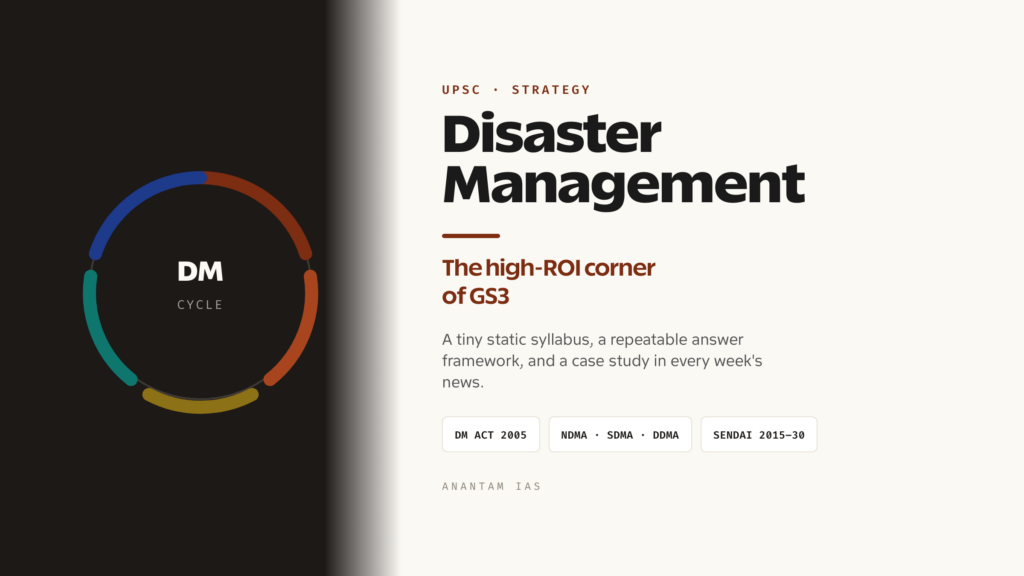
Disaster management is one of the smallest, most self-contained corners of the General Studies Paper 3 syllabus — and one of the most rewarding to prepare. The whole area sits under a single line in the GS3 syllabus, yet it surfaces in the Mains almost every cycle, links directly to the disasters in the day’s headlines, and rewards a candidate who can produce a framework instead of a vague opinion. Few topics give back so much for so little reading.
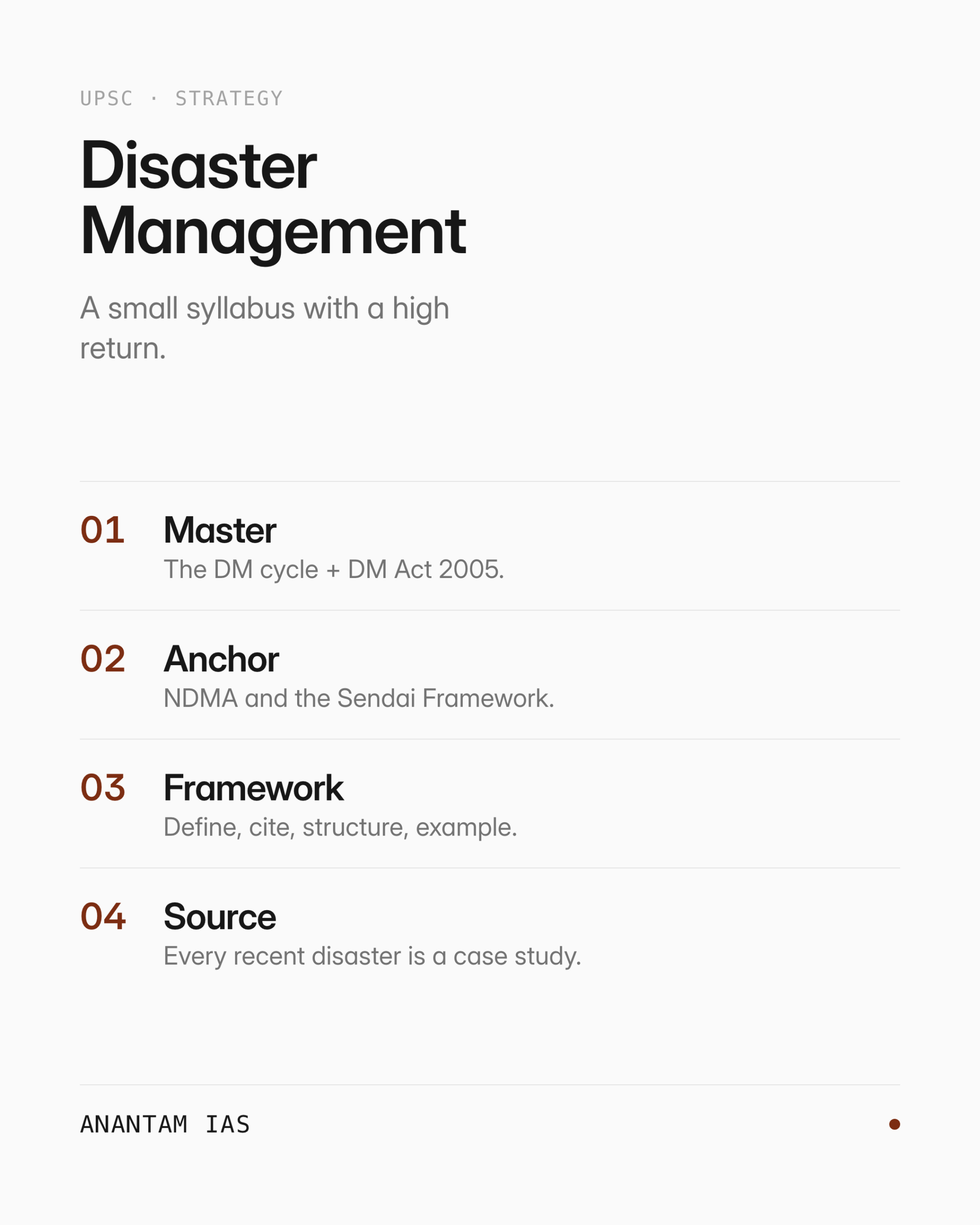
This guide treats disaster management as a strategy problem, not a reading list. It maps the static core worth memorising, hands you a repeatable structure for the answer sheet, and shows how to convert every recent flood, cyclone, or heatwave into a ready case study. The aim is simple — to make this a section you walk into knowing you’ll score, not one you hope to bluff.
Why Disaster Management Is High-ROI in GS3
The case for prioritising disaster management rests on a favourable ratio: a tiny, well-bounded syllabus against a steady stream of marks. The core static content runs to perhaps a dozen pages — one Act, one institutional pyramid, one global framework, and a handful of concepts. Compare that with the open-ended sprawl of economy or internal security, and disaster management starts to look like the best-value real estate in the whole paper.
The second reason is recurrence. Questions on disaster preparedness, the role of community participation, urban flooding, or the response to a named disaster appear in the Mains with a regularity that few GS3 sub-topics match. Examiners like the area precisely because it tests whether a candidate can connect institutions, the law, and a live event into one coherent response — the exact skill the service demands.
The third reason is the current-affairs feed. Disaster management is the rare static topic that refreshes itself for free. Every monsoon delivers fresh floods and landslides, every pre-monsoon season brings heatwaves, the cyclone calendar fills the Bay of Bengal twice a year, and the occasional industrial accident or glacial-lake burst writes its own case study. You don’t have to hunt for examples — the news supplies them, and your job is only to file them against the right framework.
The Static Core You Must Master
Master five blocks of static content and you can answer almost anything this section throws at you. Treat them as the spine onto which current affairs gets grafted.
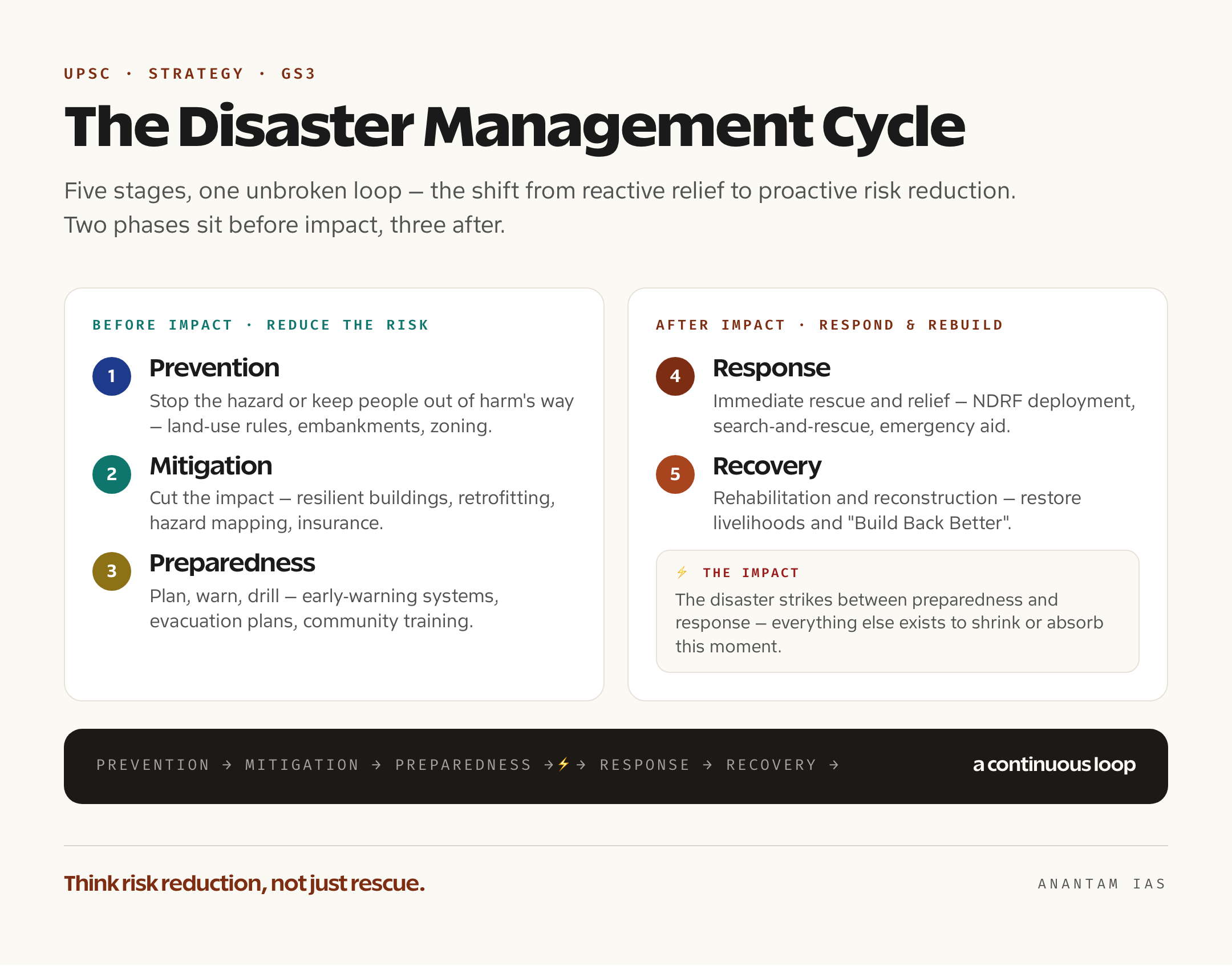
The first is the disaster management cycle — the loop of prevention, mitigation, preparedness, response, and recovery. Prevention and mitigation are the pre-disaster measures that shrink the hazard or the vulnerability; preparedness is the planning, early warning, and drills done before impact; response is the immediate rescue-and-relief phase; and recovery covers rehabilitation and reconstruction afterwards. The single most important idea here is the shift the whole discipline has made — from a reactive, relief-centred model to a proactive, risk-reduction model. An answer that grasps that shift already reads as informed.
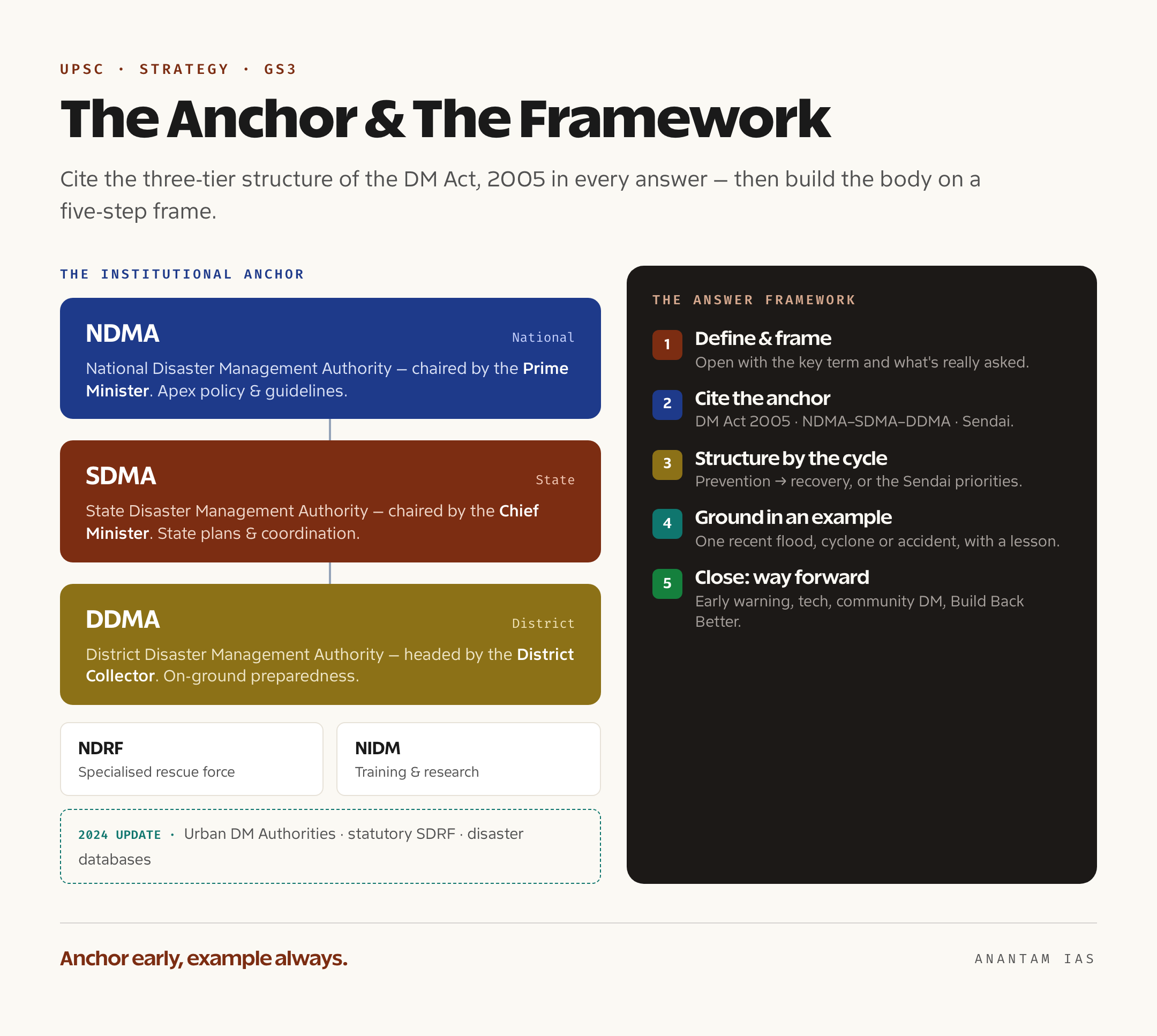
The second is the Disaster Management Act, 2005 and the institutional pyramid it created. The Act set up a three-tier structure: the National Disaster Management Authority (NDMA), chaired by the Prime Minister, at the apex; a State Disaster Management Authority (SDMA) under each Chief Minister; and a District Disaster Management Authority (DDMA) headed by the District Collector or Magistrate. Backing them are the National Disaster Response Force (NDRF) for specialised rescue and the National Institute of Disaster Management (NIDM) for training and research. The Disaster Management (Amendment) Act of 2024-25 updated this architecture — it lets states create dedicated Urban Disaster Management Authorities for big cities, puts the State Disaster Response Force on a statutory footing, mandates national and state disaster databases, and moves the job of writing disaster plans to the NDMA and SDMA themselves. Knowing that update is what separates a current answer from a stale one.
The third is the Sendai Framework for Disaster Risk Reduction (2015-2030), the global agreement India has signed under the UN. Commit its four priorities to memory: understanding disaster risk, strengthening disaster risk governance, investing in disaster risk reduction for resilience, and enhancing preparedness for effective response while choosing to “Build Back Better” in recovery. The framework also carries seven global targets and shifts the world’s focus from managing disasters to managing risk — a phrasing worth quoting verbatim on the sheet.
The fourth is a clean classification of disasters — natural versus human-induced. Natural disasters split into hydro-meteorological (floods, cyclones, droughts, heatwaves), geophysical (earthquakes, landslides, tsunamis), and biological (epidemics, pandemics). Human-induced disasters cover industrial and chemical accidents, fires, oil spills, and nuclear incidents. Many modern disasters are hybrid — a cloudburst (natural) made lethal by unplanned hill construction (human) — and saying so signals nuance.
The fifth is the vocabulary of risk, hazard, vulnerability, and exposure. A hazard is the threatening event; vulnerability is the susceptibility of people and assets to harm; exposure is what lies in harm’s way; and disaster risk is, loosely, hazard multiplied by vulnerability and exposure, divided by capacity. The practical payoff is that you cannot cut the hazard much, but you can cut vulnerability and exposure — which is exactly where good policy and good answers focus.
The Answer-Writing Framework
The reason disaster management is so scorable is that almost every question yields to one repeatable structure. Internalise it and you stop inventing an answer from scratch under time pressure — you fit the question into a frame you already own. Our broader UPSC Mains answer-writing guide explains the underlying mechanics; what follows applies them to this section.
Step one — define and frame. Open by defining the key term, then state what the question is really asking. If the prompt names a disaster type — urban flooding, drought, a heatwave — give it a one-line working definition so the examiner sees you’re anchored. A sharp opening line earns goodwill before the substance even begins.
Step two — cite the anchor. This is the step most candidates miss and the one that lifts a score the fastest. Within the first half of the answer, name the law and the institutions: the Disaster Management Act, 2005, the NDMA-SDMA-DDMA structure, and, where relevant, the Sendai Framework’s four priorities. These are your authority. An answer that says “the government should prepare better” is opinion; an answer that says “under the DM Act’s three-tier structure, the DDMA is the nodal body for district-level preparedness” is analysis.
Step three — structure by the cycle. Use the disaster management cycle as your skeleton. Organise the body around prevention and mitigation, preparedness, response, and recovery — or, where the question asks specifically about reducing future losses, lean on the Sendai priorities instead. Either way you’ve imposed a logical order that a marker can follow at a glance, and you’ve shown you think in terms of risk reduction, not just rescue.
Step four — ground it in an example. Drop in one concrete, recent case study to prove the framework isn’t abstract. A single well-chosen example — a named flood, cyclone, or industrial accident with a one-line lesson — is worth more than a paragraph of generalities. This is where your current-affairs file pays off.
Step five — close with a way forward. Finish with two or three forward-looking measures: better early-warning systems, community-based disaster management, technology such as GIS and remote sensing, climate-resilient infrastructure, or a “Build Back Better” recovery. Tie at least one back to the Sendai Framework or an NDMA guideline so the conclusion lands with authority rather than wishful thinking.
Turning Current Disasters into Case Studies
The fastest way to lift a disaster management answer from average to distinct is a fresh, specific example — and the news hands you a new one every few weeks. The discipline is to file each event the moment it happens, not to scramble for one in the exam hall.
Keep a running one-page log. For every significant disaster, note four things: what happened and where, which institution responded (NDRF, SDMA, the local DDMA), what went wrong or right, and the single lesson it teaches. A heatwave becomes a case for declaring heat a notified disaster and building city heat-action plans. A bout of urban flooding in a metro becomes a case for stormwater drainage, encroached wetlands, and the new Urban Disaster Management Authority idea. A cyclone making landfall on the east coast becomes a case for early warning and zero-casualty evacuation — India’s cyclone response is a genuine success story worth citing. A glacial-lake outburst flood in the Himalaya becomes a case for climate-linked hazard mapping; an industrial gas leak becomes a case for the chemical-accident rules and off-site emergency plans.
The same event can answer several different questions depending on which lesson you pull. One well-understood flood can illustrate urban planning failure, climate adaptation, community resilience, or institutional coordination — so a small, well-curated stock of five or six disasters, each understood deeply, beats a long list skimmed once. For the static foundations behind these examples, our note on disaster management in India is a useful companion to read alongside your current-affairs log.
Common Mistakes in DM Answers
The errors that cost marks here are predictable, which means they’re avoidable. Three recur often enough to flag.
The first is the anchorless answer — pages of sensible-sounding suggestions with no mention of the DM Act, the NDMA structure, or the Sendai Framework. Without that legal-institutional spine, even a well-written answer reads like a newspaper editorial, and it caps your score. Always plant the anchor early.
The second is the example-free answer. A response built entirely on theory, with not a single named disaster, signals that you’ve memorised a textbook but don’t follow events. The fix is mechanical: never finish a disaster management answer without at least one concrete case. The third related slip is the purely reactive answer — one that talks only about rescue and relief and ignores prevention, mitigation, and preparedness. The whole modern discipline has moved toward risk reduction, so an answer that stops at response is answering a question the examiner stopped asking years ago.
A few smaller habits also leak marks: writing in long unbroken paragraphs instead of using the cycle as visible structure, ignoring the climate-change link that now runs through almost every disaster, and forgetting the community and local-government layer where real resilience is built. Sidestep these and the section becomes a reliable scorer. For the wider paper, our GS3 strategy guide places disaster management in context alongside economy, science, and environment.
Frequently Asked Questions
How much of the GS3 syllabus does disaster management actually cover?
It sits under a single line of the official syllabus, yet it punches well above that weight in the Mains, where a question or a sub-part appears in most cycles. In reading terms it’s tiny — the Act, the three-tier institutions, the Sendai Framework, and a few concepts run to roughly a dozen pages — which is exactly why the marks-per-hour return is so high.
What is the single most important framework to memorise for this section?
The disaster management cycle — prevention, mitigation, preparedness, response, recovery — because it works as the skeleton for almost any answer. Pair it with the Sendai Framework’s four priorities and the NDMA-SDMA-DDMA structure from the DM Act, 2005, and you have enough scaffolding to organise any disaster management question into a clear, scorable shape.
Do I need to track current affairs separately for disaster management?
Yes, but it costs you almost nothing. Keep a one-page running log of major disasters — what happened, who responded, what the lesson was — and update it as floods, cyclones, heatwaves, and accidents occur. Five or six disasters understood deeply will cover most questions, and the same event can illustrate several different answers depending on the angle.
What’s the fastest way to improve a disaster management answer?
Add the institutional anchor and a concrete example. Most weak answers fail not on ideas but on missing both — they offer suggestions without citing the DM Act or the NDMA, and they stay abstract without a single named disaster. Plant the Act and one recent case study in every answer and the score moves up immediately.
Tell Google you want more of this.
Add Anantam IAS as a preferred sourceOne tap, and this site shows up more often in your own Top Stories, AI Overviews and AI Mode. Remove it any time.