Bills for removal of PM, CM and Ministers on Arrest

Context:
Opposition and ruling party MPs exchanged barbs in the Lok Sabha on Wednesday over the government’s claim of bringing in political morality through three new Bills allowing the removal of elected representatives arrested on serious criminal charges. The Bills were referred to a Joint Committee after a voice vote.
UPSC Relevance:
GS 2: Structure, Organization and Functioning of the Executive. Salient Features of the Representation of People’s Act.
PYQ 2022:
Consider the following statements:
1. The Constitution of India classifies the ministers into four ranks viz. Cabinet Minister, Minister of State with Independent Charge, Minister of State and Deputy Minister.
2. The total number of ministers in the Union Government, including the Prime Minister, shall not exceed 15 percent of the total number of members in the Lok Sabha.
Which of the statements given above is/are correct?
a) 1 only
b) 2 only
c) Both 1 and 2
d) Neither 1 nor 2
UPSC Mains PYQ 2024:
“The growth of the cabinet system has practically resulted in the marginalisation of the parliamentary supremacy:” Elucidate.
UPSC Mains PYQ 2022:
Discuss the procedures to decide the disputes arising out of the election of a Member of the Parliament or State Legislature under The Representation of the People Act, 1951. What are the grounds on which the election of any returned candidate may be declared void? What remedy is available to the aggrieved party against the decision? Refer to the case laws.
Amendment Proposals:
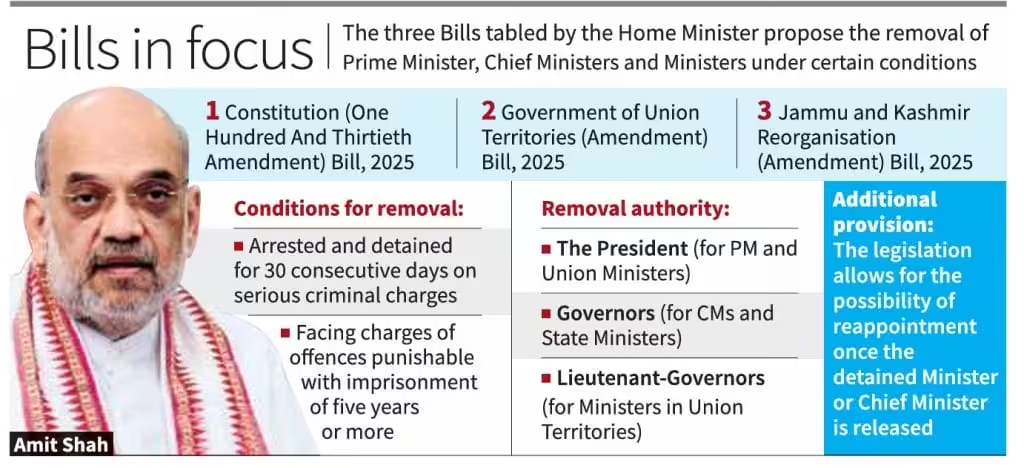
- The Bill proposes amendments to Articles 75, 164, and 239AA of the Constitution, which deal with the Union Council of Ministers, Council of Ministers in the states, and Ministers in Union Territories respectively.
- It seeks to remove a central or state Minister who is facing allegations of corruption or serious offences with provision for imprisonment of 5 years and more and has been detained for at least 30 days consecutively.
- The removal can be reversed when the Minister is released from custody.
- Chief Ministers and the Prime Minister will be in the ambit of the proposed law.
- The constitutional amendment will require a majority of two-thirds of Members present and voting to be passed.
Statement of Objects and Reasons of the Bill – There is a need for a legal framework for the removal of a Minister arrested on serious criminal charges. Ministers facing such allegations “may thwart or hinder the canons of constitutional morality and principles of good governance“, which could “diminish the constitutional trust reposed by people”.
Current Provisions for Removal of Ministers for Criminal offence:
- Section 8 of the Representation of the People Act, 1951, (RPA) – legislators are disqualified from contesting elections or continuing in office upon conviction for certain criminal offences, and being sentenced to imprisonment for at least 2 years.
- If sentenced to only a fine, disqualification lasts for 6 years from the date of conviction.
- If sentenced to imprisonment, disqualification applies from the date of conviction and continues for 6 years after release.
- Even a Minister loses membership of the house or assembly under Section 8. Losing membership under Section 8 due to disqualification means the Minister has ceased to be a member of the legislature, and cannot continue as a Minister without membership.
- The proposed amendment deals with the removal of a Minister after having spent a certain time in custody and not necessarily conviction.
- In the RPA, the yardstick for disqualification is conviction by a court. The disqualification can be stayed if the conviction is stayed by a higher court on appeal.
- In the proposed Bill, the yardstick for removal is 30 consecutive days of being “arrested and detained in custody”. Since arrest and detention are only the preliminary step in a criminal investigation, such a yardstick raises serious questions of due process.
- India’s constitutional scheme envisages the presumption of innocence for the accused, and puts the onus of proving the charges on the prosecution. Police file a chargesheet within 90 days of arrest, after which a court frames the charges. Trial begins after that, and can end in acquittal or conviction.
Debate:
In favour of the Bill:-
- Promote substantive democracy and accountability– Given the serious concerns over the growing criminalisation of politics, a view has gained ground that a legislator must be disqualified even before the stage of conviction.
- The long wait for conviction defeats the purpose of disqualification. Since September 2013, only 27 sitting MPs and MLAs have been disqualified after being convicted of offences.
- 46% members in 18th Loksabha have criminal charges against them.

Against the Bill:
- Violates Natural Justice – Constitutional principles of natural justice require a person to be given a fair opportunity to be heard before consequential action is taken against them.
- Violates Democratic principles – Disqualification impacts not only the rights of the legislator but also the will of the people who have elected the legislator.
- Against Federal Balance – Many politicians, particularly opposition and from states ruled by opposition, apprehend that the provisions may be used to topple governments of Opposition parties in States by deploying Central law enforcement agencies against them.
- The law Commission also did not recommend disqualification before framing of charges.
- According to the Commission, disqualifying a person before the “application of judicial mind” would be “against the principles of natural justice”, and “would mean that a person is penalised without proceed-ings being initiated against him”.
- The Law Commission’s 170th report in 1999 proposed that the framing of a charge for offences punishable by up to five years’ imprisonment should be made an additional ground for disqualification, which should be for five years or until acquittal, whichever was earlier.
- This proposal was reiterated by the Election Commission of India in 2004
- The Law Commission’s 2014 report recommended that a legislator could be disqualified when charges were framed against them by a court, since this showed prima facie judicial satisfaction that there existed sufficient material against a person to put them to trial.
- According to the Commission, disqualifying a person before the “application of judicial mind” would be “against the principles of natural justice”, and “would mean that a person is penalised without proceed-ings being initiated against him”.
Related Judicial Pronouncements:
- Lily Thomas vs. Union of India (2013) – The Supreme Court invalidated Section 8(4), eliminating the protection for convicted lawmakers who had appealed their conviction within 3 months. Hence, disqualification applies immediately from conviction.
- Public Interest Foundation vs Union of India (2018) – The PIL by Public Interest Foundation had sought disqualification at the stage of framing of charges for serious offences.
- The 5 Judge Bench stated that it could not legislate or add new grounds for disqualification beyond what Parliament had provided. It reiterated that the power to make laws on dis-qualification rested solely with Parliament.
- The court recommended that Parliament should enact a “strong law” making it mandatory for political parties to revoke the membership of those against whom charges have been framed for “heinous and grievous offences”, and to not give them tickets to contest elections.
- Manoj Narula v Union of India (2014) – the SC had said that there is no bar against a person with criminal antecedents being appointed as Minister.
- However, the court suggested that as the “repository of constitutional trust”, the Prime Minister should consider not choosing individuals with criminal antecedents, especially if charges have been framed for heinous or serious criminal offences or corruption.
- State v. K Ponmudi (2023) – This case reaffirmed that even fine or imprisonment for a single day under Section 8(1) leads to disqualification, with disqualification lasting for six years from conviction or imprisonment plus six years from release.
SC observations in recent 2 cases
- V Senthil Balaji of Tamil Nadu
- He was arrested by the Enforcement Directorate in 2023 in the alleged cash-for-jobs scam and remained in custody for 14 months. He was dropped as a Minister after pressure from the Governor and the opposition.
- In September 2024, the SC granted Balaji bail because the trial was likely to take several years. Within days of being released, Balaji was reinstated as a Cabinet Minister.
- The ED urged the SC to cancel his bail, arguing that from his position of authority, he might influence the case against him.
- The SC observed that it had not taken into account his ministerial position, as he had resigned before his bail application was heard.
- In April 2025, the court told Balaji to choose between “freedom or post” – he could either resign or risk the cancellation of his bail. Days later, Balaji stepped down, and the court allowed his bail to continue.
- Former Delhi Chief Minister Arvind Kejriwal
- He was granted bail in the alleged liquor policy money laundering case, but the SC barred him from signing official documents, entering government offices, and interacting with witnesses and accessing files connected with the case.
- The court, however, made it clear that it had no jurisdiction to compel an elected leader to step down; whether he should resign was left to Kejriwal’s discretion.
- In September 2024, the court granted him regular bail, noting that prolonged incarceration without progress in the trial would be unjust. It refrained from issuing directions on his continuance in the office. Kejriwal voluntarily resigned soon afterward.
Criminalisation of Politics:
| Causes | Impact | Way Forward |
| 1) Focus on Electoral Dynamics & Vote Bank Politics rather than criminal background. Ability to win elections matters more. | 1) Decline in parliamentary productivity and legislature – quality of deliberation and debate has declined, use of unparliamentary language and frequent disruption and misbehaviour by some MP’s and MLA’s. | 1) ARC and Law Commission– Debar such people from contesting and membership post chargesheet |
| 2) Political Patronage – Criminals are often backed by some influential politician and vice versa. | 2) Undermines Democracy as it prevents good candidates from contesting & prevents discussions and discourse on public’s issues. | 2) ECI – Life time ban for certain heinous offences. |
| 3) Contribution in terms of money power for election expenses by criminals. | 3) Social disharmony – Elected criminals act arbitrarily and cause threat to society. | 3) Criminalising false disclosure under Sec 8 of RPA, 1950. |
| 4) Legal loophole– under (sec 8) false disclosure of criminal background is not criminalised | 4) Compromises on the Morale of Civil Services – well qualified civil servants are supposed to work under alleged criminals. | 4) Follow ups and verification of affidavits submitted by candidates must be done. |
| 5) Political Culture in Country – Apathy and Tolerance to Criminals Electorate focuses more on parochial identities than background of candidate. | 5) Threat to Constitutionalism and constitutional value of Rule of Law. | |
| 6) Vohra Committee – Nexus of Criminal, Politicians, Bureaucrats Acc to CBI, RAW, IB this network runs a parallel govt. virtually. |