BioE3 Policy and National Biofoundry Network 2026: India’s $1 Trillion Bioeconomy Blueprint
Why in News?
On 2 April 2026, Union Minister of State for Science and Technology Dr Jitendra Singh told the Rajya Sabha that India has operationalised six biofoundries and 21 bio-enabler facilities under the National Biofoundry Network, marking the first measurable milestone of the BioE3 Policy approved by the Union Cabinet on 24 August 2024.
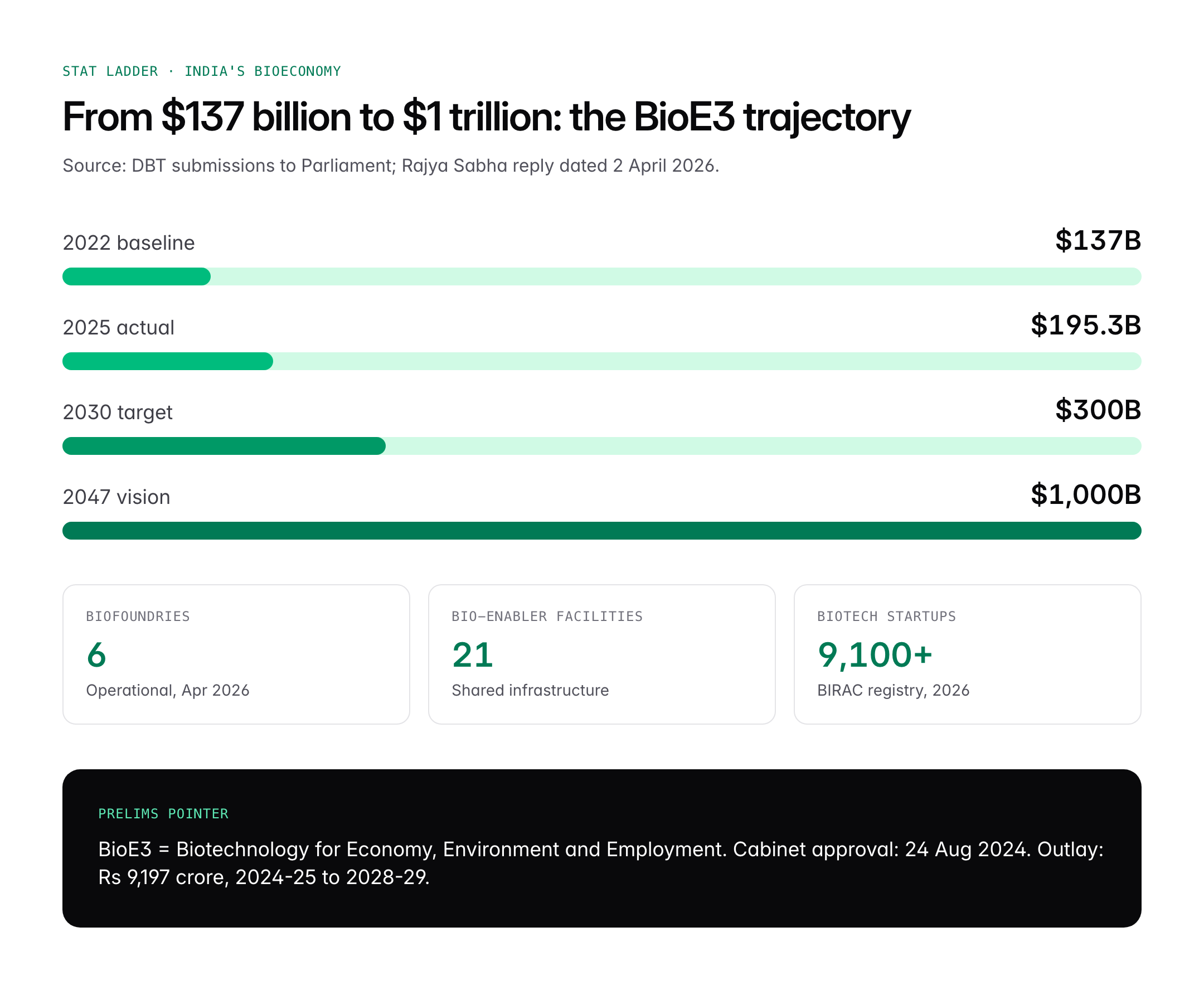
In the same reply, the Department of Biotechnology (DBT) placed India’s bioeconomy at $195.3 billion in 2025, up from $137 billion in 2022, and reiterated the staged target of $300 billion by 2030 and $1 trillion by 2047. India’s position in the global bioeconomy index has moved from 14th in 2022 to 12th in 2026.
The statement frames the biofoundry rollout as the operational arm of BioE3, which is short for Biotechnology for Economy, Environment and Employment. It is the clearest signal yet that DBT is pivoting from a grants-heavy research ministry to an industrial policy actor.
UPSC Relevance at a Glance
| Dimension | Coverage |
|---|---|
| GS Paper | GS3 – Science and Technology, Economy, Environment |
| Prelims | BioE3 Policy, biofoundry, BIRAC, synthetic biology, GEAC, iGEM |
| Mains | Industrial biotech, bioeconomy, employment, biosafety regulation |
| Syllabus Tags | Awareness in biotech, IPR, indigenisation of technology |
Background and Context
India’s biotechnology industry grew on the back of generics, vaccines and agricultural biotech. The first National Biotechnology Development Strategy (2007) and its 2015-20 successor focused on capacity building, human resource and vaccine manufacturing. The DBT was set up in 1986 and the Biotechnology Industry Research Assistance Council (BIRAC) was carved out in 2012 as a public sector enterprise for startup financing.
By 2022, India had over 6,000 biotech startups and a bioeconomy valued at $137 billion, roughly 4.25 percent of GDP. The pandemic demonstrated both the strength of India’s vaccine manufacturing ecosystem and its weakness in upstream synthetic biology, enzymes, specialty chemicals and precision fermentation. Countries like the United States (with its 2022 Executive Order on Biomanufacturing), the United Kingdom (Engineering Biology programme) and China (14th Five Year Plan bioeconomy chapter) began treating engineering biology as strategic infrastructure.
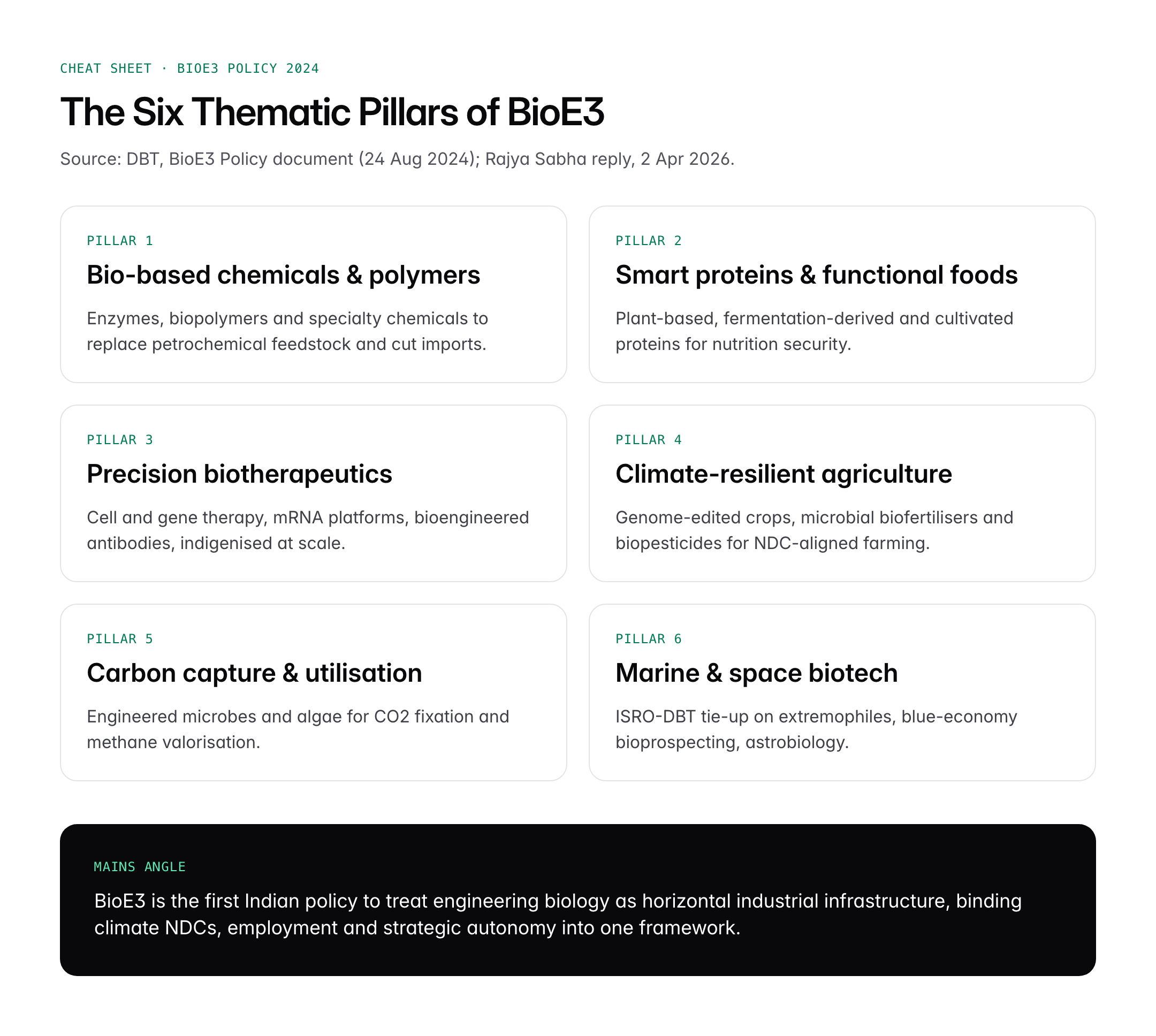
The BioE3 Policy, approved on 24 August 2024, is India’s response. It reframes biotechnology not merely as a health sciences discipline but as a horizontal enabler for the economy, the environment and employment. The policy identifies six thematic sectors: high-value bio-based chemicals, enzymes and biopolymers; smart proteins and functional foods; precision biotherapeutics; climate-resilient agriculture; carbon capture and utilisation; and marine and space biotechnology.
The National Biofoundry Network is the industrial spine that follows the policy. A biofoundry is an automated facility that combines design-build-test-learn cycles for engineered biology: DNA synthesis, robotic liquid handling, high-throughput screening, omics analysis and bioprocess scale-up, which compresses research-to-product cycles from years to months. Six biofoundries and 21 bio-enabler facilities were confirmed operational by the 2 April 2026 Rajya Sabha reply.
This policy also situates India within commitments such as the Convention on Biological Diversity, the Cartagena Protocol on Biosafety and the One Health framework, giving BioE3 a regulatory as well as an economic dimension.
Key Features and Provisions
BioE3 is structured as a mission-mode, inter-ministerial policy anchored in DBT and implemented through BIRAC, CSIR laboratories and academic partners.
Six thematic pillars
- High-value bio-based chemicals, enzymes and biopolymers to replace petrochemical derivatives, with a target of import substitution in specialty chemicals.
- Smart proteins and functional foods, covering plant-based, fermentation-derived and cultivated proteins.
- Precision biotherapeutics, including cell and gene therapies, mRNA platforms and bioengineered antibodies.
- Climate-resilient agriculture, spanning genome-edited crops, microbial biofertilisers and biopesticides.
- Carbon capture and utilisation, using engineered microbes and algae for CO2 fixation and methane valorisation.
- Marine and space biotechnology, with ISRO-DBT collaboration on extremophile research and blue economy bioprospecting.
National Biofoundry Network
- Six operational biofoundries hosted across CSIR-IGIB Delhi, CSIR-IICT Hyderabad, IIT Madras, IIT Bombay, NCBS Bengaluru and IISc Bengaluru, as confirmed by DBT submissions.
- 21 bio-enabler facilities for DNA synthesis, fermentation scale-up, strain engineering and analytics, providing shared infrastructure to startups at concessional rates.
- Each biofoundry integrates AI-driven design tools, robotic automation and standard biological parts libraries aligned with global registries.
- Open-access user time is reserved for startups registered on the BIRAC startup registry, with over 9,100 biotech startups in 2026, up from about 1,000 in 2016.
Financial architecture
- Initial outlay is Rs 9,197 crore under a central sector scheme window from 2024-25 to 2028-29.
- A Bio-Enabler Hub Fund co-invests with state governments and industry.
- Bio-AI fellowships and Biomanufacturing Hubs add a talent layer.
Regulatory and ethics stack
- The Genetic Engineering Appraisal Committee (GEAC) continues to approve genetically modified organism releases under the Environment Protection Act 1986.
- A new BioE3 Regulatory Consultative Group will harmonise synthetic biology oversight across DBT, MoEFCC and ICMR.
- Ethics guidance from the Indian Council of Medical Research applies to human-subject and gene-editing research.
Significance
- The bioeconomy expanded from $137 billion in 2022 to $195.3 billion in 2025, with DBT projecting $300 billion by 2030. At 5.2 percent of GDP in 2025, biotechnology has become macroeconomically material, not a niche research sector.
- India’s rise to 12th in the 2026 global bioeconomy index, from 14th in 2022, reflects improved patent filings, startup density and manufacturing exports, and reduces strategic dependence on imported enzymes and reagents.
- The policy explicitly targets green jobs, with DBT estimating 35 lakh direct and indirect jobs by 2030, addressing a persistent gap in high-skill employment for STEM graduates.
- Biofoundries lower the capital threshold for synthetic biology startups, which typically need Rs 40-80 crore for a wet lab. Shared infrastructure reduces this burden substantially and deepens the startup pipeline.
- The carbon capture and marine pillars align with India’s Nationally Determined Contributions under the Paris Agreement and its commitments at CBD COP15, linking climate policy with industrial policy.
- The National Biofoundry Network gives India sovereign capability in engineered biology, relevant for biosecurity and pandemic preparedness after the COVID-19 experience.
Concerns, Criticisms and Challenges
BioE3 has been received positively by industry, but several concerns have been flagged by researchers and civil society.
- Biosafety governance lag. India’s biosafety rules 1989 and the Environment Protection Act 1986 were written for classical recombinant DNA work. Synthetic biology, gene drives and self-propagating organisms stress the existing GEAC process. A draft Biological Research Authority Bill has been pending since 2013.
- Public trust deficit on GM. The Supreme Court’s 2024 Bt brinjal moratorium extension and the GM mustard litigation show that public and judicial confidence in biotech releases remains fragile. Farmer groups have questioned whether biofoundries will push patented seeds and microbial consortia.
- IPR and access. A 2026 Centre for Science and Environment note warned that without compulsory licensing clauses, BioE3 outputs could be captured by large multinationals, replicating the patent-heavy pattern of precision therapeutics in the United States.
- Skill pipeline. India produces 25 lakh STEM graduates a year, but only around 20,000 are trained in bioinformatics, protein engineering or bioprocess design. Without a focused Bio-AI cadre, biofoundries risk under-utilisation.
- Ethics and dual use. Gene synthesis capability poses biosecurity risk. There is no statutory equivalent of the US Federal Select Agent Programme. DBT’s guidelines remain advisory.
- Regional concentration. All six initial biofoundries are in metro clusters. Northeast India, despite its biodiversity, has none, raising federal and equity concerns.
- Data governance. Biological data sharing across the Network is governed by the Biological Diversity Act 2002, amended in 2023, but implementation rules for digital sequence information remain draft.
Comparative and Historical Perspective
India is a late mover in engineering biology, but the gap is closing.
| Country | Anchor policy | Bioeconomy size 2025 | Biofoundries |
|---|---|---|---|
| United States | 2022 Executive Order on Biomanufacturing, NSCEB report 2024 | $1.1 trillion | 15+ (incl. Ginkgo Bioworks, DOE AgileBioFoundry) |
| China | 14th Five Year Plan Bioeconomy 2022-25 | $800 billion est. | 20+ state-linked facilities |
| United Kingdom | Engineering Biology vision 2023, Rs equivalent of Pound 2 billion | $240 billion | 5 (incl. Earlham, London, Edinburgh) |
| European Union | Bioeconomy Strategy 2018, updated 2022 | $2.4 trillion aggregate | Global Biofoundry Alliance nodes |
| India | BioE3 Policy 2024 | $195.3 billion | 6, with 21 bio-enabler facilities |
India’s per capita bioeconomy remains under $140, compared with over $3,300 in the US, indicating the headroom as well as the execution task.
Way Forward
- DBT and MoEFCC should fast-track a unified Synthetic Biology Regulation, covering gene drives, digital sequence information and dual-use research of concern.
- BIRAC should ring-fence at least 25 percent of biofoundry user time for women-led and northeast-based startups, to counter metro concentration.
- ICMR and DBT should co-issue binding ethics guidelines on heritable gene editing, aligned with the 2023 WHO framework.
- Ministry of Education and AICTE should expand Bio-AI and bioprocess engineering seats by at least 10,000 per year for five years.
- MEA and DBT should sign biofoundry access agreements with the Global Biofoundry Alliance and Quad biotech partners for reagent and standard parts exchange.
- NITI Aayog should build a public biofoundry dashboard with quarterly output, patents, jobs and revenue metrics, to bring accountability to the Rs 9,197 crore outlay.
- SEBI and DPIIT should notify a biotech-specific startup recognition category to enable patient capital and deep-tech listings, following the 2025 DPIIT DeepTech Startup Policy.
Conclusion
BioE3 is among the most ambitious industrial policies of the decade because it treats biology as a platform technology, not a sector. The National Biofoundry Network gives the policy operational credibility by compressing research-to-product cycles, and the 2026 data point of $195.3 billion and rank 12 shows early traction.
The execution risk, however, is regulatory and social, not scientific. If India cannot upgrade its biosafety statute, close the ethics and IPR gaps and distribute infrastructure beyond metros, the $1 trillion bioeconomy target for 2047 will remain an aspiration. A biotechnology policy of this scale is ultimately a test of institutional capacity as much as of laboratory capacity. For further context, see Rashtriya Vigyan Puraskar, India Successfully Demonstrates 1000 km Quantum Communication Network and the debate on Transforming India’s Nuclear Energy Landscape.
Prelims Pointers
- BioE3 Policy was approved by the Union Cabinet on 24 August 2024.
- BioE3 expands to Biotechnology for Economy, Environment and Employment.
- Implementing agencies are DBT and BIRAC.
- Six thematic sectors: bio-based chemicals, smart proteins, precision therapeutics, climate-resilient agriculture, carbon capture, marine and space biotech.
- Six biofoundries and 21 bio-enabler facilities were operational by April 2026.
- India’s bioeconomy stood at $195.3 billion in 2025, a 5.2 percent share of GDP.
- Target: $300 billion by 2030 and $1 trillion by 2047.
- India ranks 12th globally in 2026, up from 14th in 2022.
- Over 9,100 biotech startups are registered with BIRAC in 2026.
- GEAC under MoEFCC regulates genetically modified organism releases.
- iGEM is the International Genetically Engineered Machine competition for synthetic biology teams.
- Initial BioE3 outlay is Rs 9,197 crore for 2024-25 to 2028-29.
Mains Practice Question
Q. Critically examine how the BioE3 Policy and the National Biofoundry Network can help India achieve a $1 trillion bioeconomy by 2047, and identify the governance reforms required to manage biosafety, ethics and equity. (15 marks, 250 words)
- Outline BioE3’s scope – six thematic pillars, biofoundry infrastructure, Rs 9,197 crore outlay, $195.3 billion baseline in 2025.
- Link policy to employment, climate NDCs and strategic autonomy in engineered biology, drawing on 2026 data and global comparators.
- Identify governance gaps – biosafety statute, IPR and access, ethics of heritable editing, regional equity – and propose a reform package across DBT, MoEFCC, ICMR and NITI Aayog.
Frequently Asked Questions
What is the BioE3 Policy?
BioE3 stands for Biotechnology for Economy, Environment and Employment. Approved by the Union Cabinet on 24 August 2024 and implemented by the Department of Biotechnology and BIRAC, it is India’s first industrial policy for engineering biology. It targets six sectors including bio-based chemicals, smart proteins, precision therapeutics, climate-resilient agriculture, carbon capture and marine and space biotechnology.
Why is the BioE3 Policy in news in April 2026?
On 2 April 2026, Union Minister Dr Jitendra Singh told the Rajya Sabha that six biofoundries and 21 bio-enabler facilities under the National Biofoundry Network are now operational. He placed India’s bioeconomy at $195.3 billion in 2025 and reiterated the $300 billion by 2030 and $1 trillion by 2047 targets. India has risen to 12th in the 2026 global bioeconomy index.
What is a biofoundry?
A biofoundry is an automated laboratory that combines DNA synthesis, robotic liquid handling, high-throughput screening, omics and bioprocess scale-up into a design-build-test-learn cycle. It compresses research-to-product timelines in synthetic biology from years to months and lowers the capital barrier for biotech startups by offering shared access to expensive infrastructure.
How many biofoundries are operational in India in 2026?
As of April 2026, six biofoundries and 21 bio-enabler facilities are operational under the National Biofoundry Network. The biofoundries are hosted at CSIR-IGIB Delhi, CSIR-IICT Hyderabad, IIT Madras, IIT Bombay, NCBS Bengaluru and IISc Bengaluru, with shared access for BIRAC-registered startups.
What is the size of India’s bioeconomy?
India’s bioeconomy reached $195.3 billion in 2025, up from $137 billion in 2022, according to DBT data cited by the Minister in April 2026. This is roughly 5.2 percent of GDP. The official trajectory is $300 billion by 2030 and $1 trillion by 2047. India now ranks 12th globally, up from 14th in 2022.
How does BioE3 address biosafety and ethics concerns?
BioE3 continues to use GEAC under the Environment Protection Act 1986 for GMO approvals and proposes a BioE3 Regulatory Consultative Group across DBT, MoEFCC and ICMR. Critics argue that the 1989 biosafety rules are outdated for synthetic biology and gene drives, and that a statutory Biological Research Authority, pending since 2013, should be enacted.
How does this affect UPSC Prelims and Mains?
For Prelims, memorise the 2024 approval date, the six thematic pillars, the DBT and BIRAC anchor roles, the 2026 rank of 12, and the $1 trillion 2047 target. For Mains GS3, BioE3 is a ready case study for science and technology policy, employment generation, industrial policy and climate linked innovation, with a built-in biosafety and ethics critique.
How does India compare with global bioeconomy leaders?
The United States leads with a $1.1 trillion bioeconomy and 15 plus biofoundries, followed by China at about $800 billion. The European Union aggregates to $2.4 trillion. India at $195.3 billion is the fastest growing major bioeconomy but lags in per capita terms at under $140, against over $3,300 in the US, indicating both the headroom and the execution task.