Why in News?
India has successfully demonstrated a 1000-kilometre quantum communication network in less than two years under the National Quantum Mission (NQM).
| UPSC Relevance: GS-3 Science and Technology: Quantum Technology Prelims & Mains: Quantum key distribution (Applications of Quantum Technology) |
National Quantum Mission:
- The Mission aims to accelerate quantum technology-led economic growth and nurture the quantum ecosystem.
- Launched in 2023 with a budget of ~Rs 6000.65 crore for 2023-2031.
- The mission aims to develop:
- Intermediate-scale quantum computers with 50-1000 physical qubits in 8 years.
- Satellite-based secure quantum communications between ground stations over a 2000 kms range within India. Long-distance secure quantum communications with other countries.
- Inter-city quantum key distribution over a 2000 km range. Multi-node quantum network.
- Help develop magnetometers with high sensitivity in atomic systems, and atomic clocks for precision timing, communications and navigation.
- Support design and synthesis of quantum materials (superconductors, novel semiconductor structures) and topological materials for the fabrication of quantum devices.
- Four Thematic Hubs (T-Hubs) to be set up in top academic and National R&D institutes on the domains of ‘quantum computing’, ‘quantum communication’, ‘quantum sensing and metrology’ and ‘quantum materials and devices’.
The Recent Breakthrough:
- India has successfully demonstrated a 1000-kilometre quantum communication network. It represents one of the longest quantum key distribution (QKD) deployments globally.
- Developed using indigenous technology from QNu Labs (a startup).
Quantum Communication:
- Quantum communication uses principles of Quantum Mechanics to enable ultra-secure transmission of information. It mainly relies on Quantum Key Distribution (QKD), where cryptographic keys are exchanged using quantum particles (photons).
What is Quantum Key Distribution?
- Quantum Key Distribution (QKD) is a secure communication method that uses quantum mechanics to exchange (create and distribute) cryptographic keys between two parties to prevent decryption of data, and thus ensure secure communication.
- Principle: QKD operates on principles like the Heisenberg uncertainty principle (observing or measuring the quantum system disturbs it) and the no-cloning theorem.
- Working:
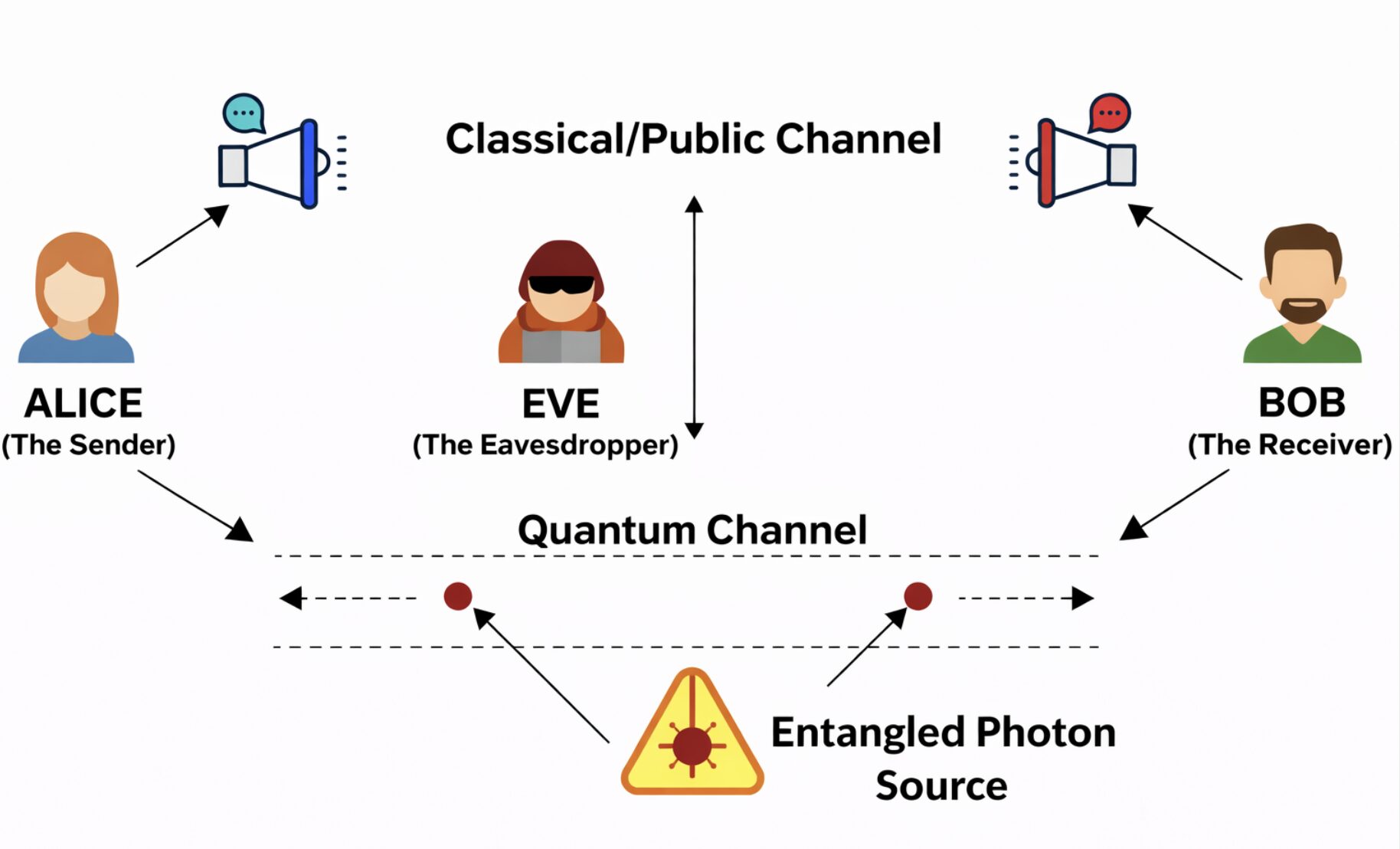
- QKD uses photons (light particles) to securely generate a shared cryptographic key between two parties via an optical fibre or free space.
- The sender encodes information in quantum states of photons, which the receiver measures using randomly chosen bases.
- Any attempt to intercept the photons (by an eavesdropper) disturbs their quantum properties, producing detectable errors. Thus, QKD ensures theoretically secure key exchange based on the laws of quantum mechanics.
- Note: QKD is mainly used for secure key exchange, not for transmitting the actual message.
Benefits of Quantum Communication:
- Ultra-secure encryption: Practically impossible to hack by classical computers. Detects eavesdropping instantly.
- Dual-use technology: Applications in both civilian and strategic sectors, like defence, finance, telecommunications and governance.
Challenges associated with Quantum Communication:
- Quantum decoherence: Qubit systems are very fragile and susceptible to losing their quantum state. Decoherence occurs when the fragile quantum states interact with the environment, losing their quantum properties and becoming useless for key generation. This limits the transmission distances.
- High cost: QKD requires high infrastructure costs, as qubits are only stable at very low temperatures or in a high vacuum or both, which are expensive to maintain.
- Building quantum-resistant cryptography: Present encryption methods can be easily broken (decrypted) by a quantum computer.
The development is expected to strengthen secure communication capabilities across defence, financial systems and critical infrastructure, while advancing India’s broader push towards a secure digital ecosystem.
Practice MCQ:
Q. With reference to Quantum Key Distribution (QKD), consider the following statements:
1. QKD uses quantum states of photons to securely distribute cryptographic keys.
2. Any attempt to measure quantum information disturbs the quantum state, making eavesdropping detectable.
3. Quantum communication eliminates the need for classical communication channels.
Which of the statements given above are correct?
(a) 1 and 2 only
(b) 2 and 3 only
(c) 1 and 3 only
(d) 1, 2 and 3
Answer: (a)
UPSC PYQ 2022:
Q. Which one of the following is the context in which the term “qubit” is mentioned?
(a) Cloud Services
(b) Quantum Computing
(c) Visible Light Communication Technologies
(d) Wireless Communication Technologies
Answer: (b)
Tell Google you want more of this.
Add Anantam IAS as a preferred sourceOne tap, and this site shows up more often in your own Top Stories, AI Overviews and AI Mode. Remove it any time.