Black Sea Shipping: Protecting Indian Seafarers in Conflict Zones
Why in News?
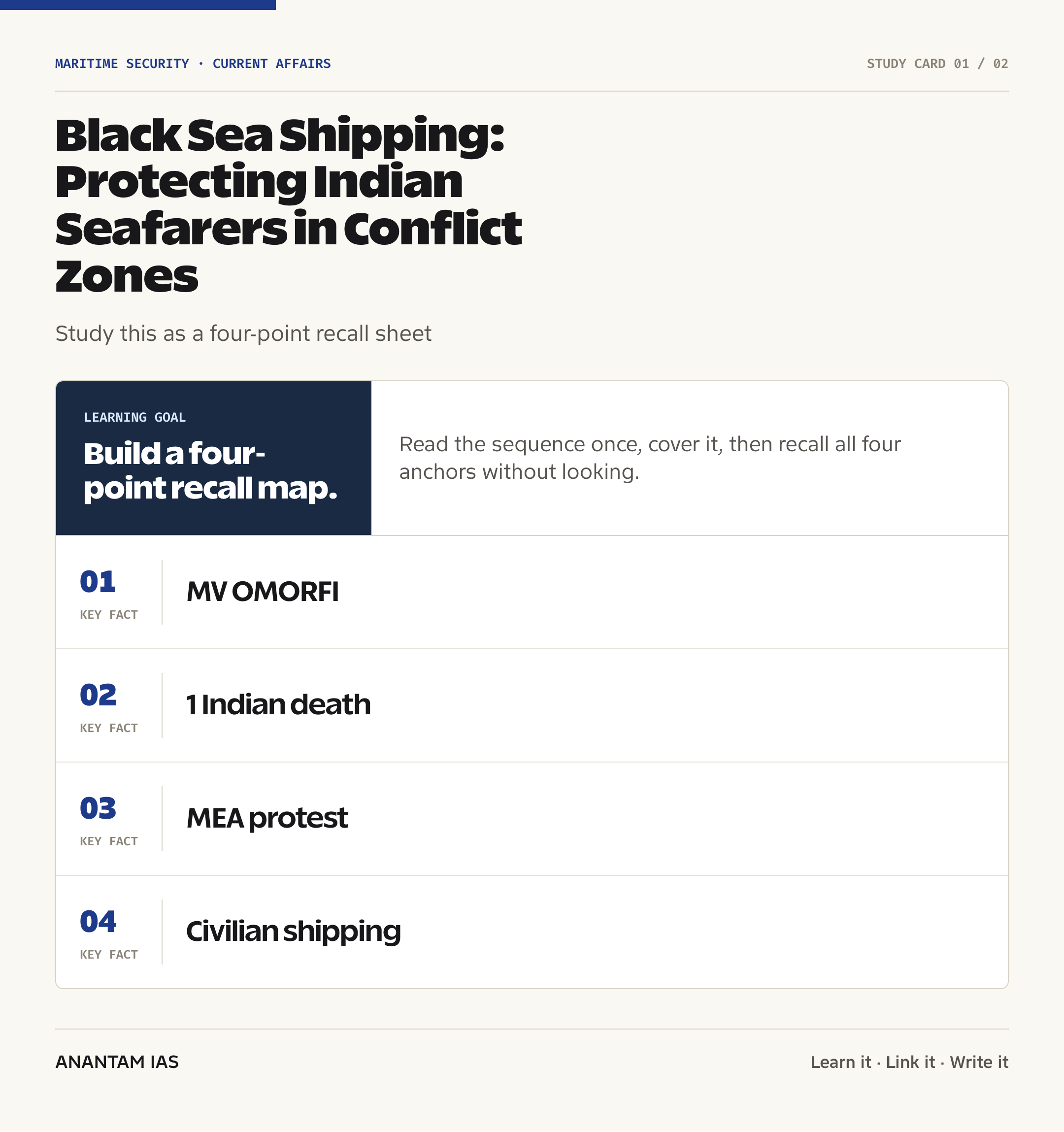
The Ministry of External Affairs summoned Ukrainian Ambassador Dr. Oleksandr Polishchuk after an attack on the commercial vessel MV OMORFI killed an Indian national. The official statement, carried by Akashvani on 27 July, recorded India’s serious concern and its condemnation of attacks on commercial shipping.
India asked the envoy to convey its concerns to the Ukrainian authorities and stressed that attacks endangering civilian seafarers damage maritime safety, freedom of navigation and international commerce. The statement confirmed the death and diplomatic action, but did not publish the weapon used, precise coordinates, vessel status or a detailed legal finding on responsibility.
- Confirmed officially: one Indian national died in the attack on MV OMORFI.
- Diplomatic step: India summoned Ukraine’s Ambassador and asked him to convey New Delhi’s concerns.
- Policy language: the MEA called the targeting of commercial vessels and risks to innocent civilian crews unacceptable.
- Reported detail: The Hindu described the incident as an attack linked to Ukraine; that attribution is a news-source claim, not a substitute for a completed investigation.
- Exam focus: separate the protection of civilian shipping from claims about the belligerent responsible for a particular strike.
The development matters in the context of:
- The incident matters in the context of India’s large overseas seafaring workforce, whose safety depends on flag States, shipowners, coastal States and Indian consular authorities acting together.
- It tests whether navigation rights, humanitarian safeguards and commercial risk controls can operate when a regional war spills into merchant-shipping lanes.
- It also shows how India can use diplomatic protection, consular coordination and maritime advisories without prejudging disputed operational facts.
UPSC Relevance
Prelims Relevance
- International Maritime Organization is a specialised agency of the United Nations responsible for the global regulatory framework for shipping.
- UNCLOS Article 87 includes freedom of navigation among the freedoms of the high seas.
- UNCLOS Article 17 recognises innocent passage through the territorial sea, subject to the conditions in the Convention.
- UNCLOS Article 94 requires a flag State to exercise jurisdiction and control over ships flying its flag in administrative, technical and social matters.
- SOLAS, 1974 is the principal treaty concerned with the safety of merchant ships; its security architecture includes the ISPS Code.
- The ISM Code requires a safety-management system and structured management of shipboard operational risks.
- The Maritime Labour Convention, 2006 sets minimum working and living standards for seafarers and provides a framework for health, welfare and repatriation duties.
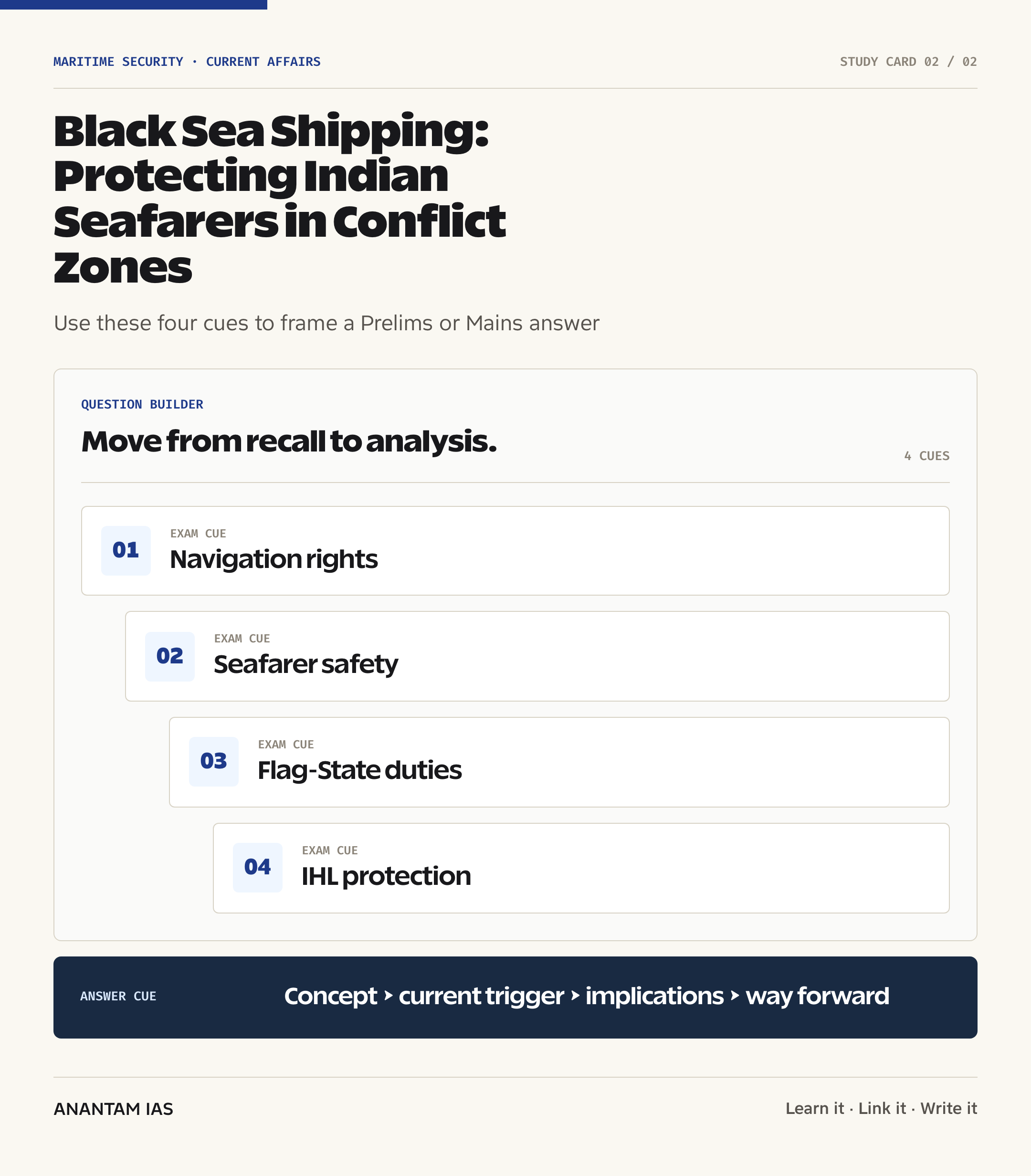
- International humanitarian law, rather than UNCLOS alone, supplies the core distinction, proportionality and precaution rules for attacks connected with an armed conflict.
- A merchant ship is normally a civilian object; its legal protection turns on the facts and is not decided merely by its flag, cargo label or location.
- The Montreux Convention, 1936 regulates passage of warships through the Turkish Straits; it should not be confused with the ordinary commercial-navigation regime.
Mains Relevance
GS Paper 2
- India’s use of a diplomatic summons, formal protest and consular engagement to protect nationals abroad.
- The interaction among UNCLOS, the law of armed conflict, flag-State duties and international institutions.
- Balancing relations with belligerents while maintaining a consistent civilian-protection principle.
GS Paper 3
- Maritime-security threats to merchant shipping, global supply chains, ports and crew welfare.
- Risk assessment, voyage planning, insurance, distress response and search-and-rescue coordination in conflict-affected waters.
- Protection of Indian human capital in a globally distributed shipping industry.
Essay
- Global commerce is only as resilient as the safety of the civilian workers who keep it moving.
- Freedom of navigation requires legal rules, credible restraint and practical protection at sea.
- Strategic autonomy is tested by the consistency with which a State defends civilian life.
Background and Context
What the official record establishes
A sound UPSC answer should begin with confirmed facts and keep source claims in separate boxes.
- The official Akashvani account attributes the statement to the External Affairs Ministry and confirms the summons of Ambassador Polishchuk.
- It names the affected commercial vessel as MV OMORFI and confirms the death of one Indian national.
- It records three Indian concerns: safety of maritime navigation, freedom of navigation and international commerce.
- It says the envoy was asked to convey India’s concern about the targeting of commercial vessels to the Ukrainian authorities.
- It does not provide a public forensic account of the munition, launch platform, ship’s cargo, exact position or sequence of events.
- A diplomatic summons is a formal way to demand an explanation or register protest. It signals seriousness, but it is neither a criminal judgment nor conclusive proof of every operational claim surrounding the incident.
- The Hindu reported a Ukrainian connection to the attack. That can be cited as a reported attribution, while responsibility and the incident’s legal character require verified evidence.
Freedom of navigation is a layered legal idea
Navigation rights vary with the maritime zone, and they do not remove the separate rules applicable during armed conflict.
- On the high seas, UNCLOS Article 87 recognises freedom of navigation for all States, exercised with due regard for the interests of others.
- In a territorial sea, foreign ships enjoy innocent passage under Articles 17 to 19, provided passage is continuous, expeditious and not prejudicial to the coastal State’s peace, good order or security.
- Straits used for international navigation may carry a transit-passage regime under UNCLOS Part III, while treaty-specific arrangements can also matter.
- The Turkish Straits connect the Black Sea with the Mediterranean system; the Montreux Convention is especially important for warships and belligerent naval access.
- UNCLOS defines maritime entitlements and navigation regimes, but it does not by itself answer whether a particular vessel was lawfully targeted during an armed conflict.
- The phrase freedom of navigation should not be used as though every ship has an identical right in every maritime zone. High-seas freedom, innocent passage and transit passage have different legal conditions.
- For a related foundation, the UNCLOS and High Seas Treaty explainer distinguishes maritime zones, jurisdiction and high-seas governance.
Civilian merchant ships under armed-conflict law
The central rule is distinction: parties must distinguish military objectives from civilian objects.
- A merchant vessel is presumptively civilian; being commercially active in a belligerent’s economy does not automatically settle its target status.
- A civilian object may lose protection from attack only when, on the facts, its nature, location, purpose or use makes an effective contribution to military action and its destruction offers a definite military advantage.
- Even when an object qualifies as a military objective, attackers remain bound by proportionality and feasible precautions to reduce expected civilian harm.
- Crew members do not become combatants merely because their ship trades in a conflict-affected area. Their conduct and the vessel’s verified function matter.
- Warnings, identification, route information and the reliability of intelligence can be important to the precaution assessment, but the available public record here is too limited for a legal verdict.
- The proportionality rule asks whether expected incidental civilian harm would be excessive compared with the concrete and direct military advantage anticipated. It does not permit a simple exchange of civilian lives for economic pressure.
- A post-strike inquiry should preserve voyage data, bridge records, communications, cargo papers and damage evidence. Without that material, confident claims about target status, intent or weapon origin can outrun the facts.
- An exam answer should reject two shortcuts: calling every merchant ship immune regardless of use, or treating every ship trading with a belligerent as a lawful target.
Who protects a seafarer at sea?
Protection is distributed across several actors rather than resting with the seafarer’s home State alone.
- The flag State must exercise jurisdiction and control over the ship and enforce applicable safety, labour and security standards.
- The shipowner and company must run a functioning safety-management system, assess route risks, brief crews and support emergency response.
- The master has operational responsibility for the vessel and needs timely threat information, reliable communications and authority to prioritise safety.
- A coastal or port State may provide navigation warnings, port controls, medical aid, casualty response and search-and-rescue coordination within its competence.
- The seafarer’s State of nationality can provide consular assistance, seek information, liaise with families, support repatriation and make diplomatic representations.
- The IMO does not command navies or investigate every strike as a criminal court. It develops shipping rules, convenes States, circulates safety information and supports coordinated action for navigation and crew protection.
- Insurers and protection and indemnity clubs support liabilities, claims and incident coordination, but insurance pricing cannot replace a decision about whether a voyage is acceptably safe.
Safety, security and labour instruments
Different treaties address different parts of the risk, so they should not be collapsed into one rule.
- SOLAS establishes core ship-safety standards, including navigation, communications, life-saving appliances and emergency arrangements.
- The ISPS Code, linked to SOLAS, provides a ship-and-port security framework based on security assessments, plans and designated officers.
- The ISM Code focuses on safe management and pollution prevention through documented company systems, reporting and continuous improvement.
- The STCW Convention sets international standards for seafarer training, certification and watchkeeping, including competence needed for emergencies.
- The Maritime Labour Convention covers conditions of employment, medical care, welfare and repatriation standards; applicable contracts and collective agreements may add war-risk rights.
- Some international labour instruments recognise repatriation when a ship is bound for a war zone without a seafarer’s consent. The exact entitlement depends on ratification, flag law, contract and collective agreement, so it should not be stated as a universal automatic right.
Why Indian seafarers need a protection chain
Indian workers may serve on foreign-flagged ships operated through multinational ownership and crewing arrangements.
- A ship’s flag, beneficial owner, operator, manager and crewing agency may be connected to different jurisdictions, complicating accountability after an incident.
- Before deployment, workers need a clear seafarer employment agreement, verified employer details, insurance information and emergency contacts.
- Recruitment channels should communicate designated high-risk or warlike-area terms, additional compensation and refusal or repatriation clauses where applicable.
- The Directorate General of Shipping can issue safety advice, regulate Indian recruitment-and-placement channels within its remit and coordinate with other authorities.
- Indian missions need an up-to-date crew manifest and direct links to the shipowner, flag State and local authorities; missing or delayed crew data weakens consular response.
- A workable crew-protection protocol needs contact details for the vessel, company security officer, flag administration, nearest rescue coordination centre and Indian mission before the ship enters a high-risk route.
- After a casualty, families need a single verified information channel. Unchecked names, casualty figures and location claims can compound harm and complicate next-of-kin notification.
- Students can connect this issue with the maritime distress-signals guide, which explains Mayday, urgency messages and rescue communication.
Strategic and economic significance
Attacks on merchant shipping convert a military confrontation into a wider human-security and trade problem.
- Higher war-risk premiums, crew costs and security expenses raise freight rates even for ships that are not attacked.
- Route cancellations and port avoidance can disrupt grain, energy and bulk-cargo flows, affecting prices beyond the immediate region.
- Repeated incidents may reduce the supply of willing crews and create unequal pressure on workers with fewer employment alternatives.
- Threats to Global Navigation Satellite Systems, communications and port infrastructure can multiply accident risk alongside direct attack risk.
- India’s interest is not limited to one bilateral relationship; it includes safe commerce, worker protection and a consistent rule against endangering civilian crews.
- A recurring attack pattern can create a risk-transfer problem: cargo owners retain the commercial benefit while crews, often recruited across borders, bear the most immediate physical danger.
- The Hormuz shipping-security note offers a comparative case on convoy proposals, navigation rights and the limits of militarised protection.
Way Forward
Build a verified maritime-threat picture
- India should combine embassy reporting, DG Shipping advisories, flag-State notices and IMO information into timely, route-specific guidance.
- Incident reports should separate confirmed facts, party claims and unresolved questions to prevent misattribution during a fast-moving conflict.
- Operators should update voyage risk assessments before entering affected waters and after any material change in the threat.
Put informed crew consent at the centre
- Crewing agencies and shipowners should disclose the route, threat level, insurance cover and applicable war-risk clauses before assignment.
- Contracts should state refusal, substitution, additional-pay and repatriation rules in language the seafarer can understand.
- No commercial schedule should override the master’s safety judgment or a worker’s rights under applicable law and agreement.
Strengthen consular readiness
- Indian missions should maintain 24-hour maritime contacts and pre-agreed channels with local rescue services, hospitals and port authorities.
- A verified crew database should help authorities locate Indian nationals quickly without exposing personal data publicly.
- Family liaison, medical evacuation, compensation support and repatriation should be treated as one continuous response.
Use multilateral maritime institutions
- India can support IMO-led deconfliction, navigation warnings, incident reporting and practical safe-passage arrangements acceptable to relevant parties.
- Flag States should investigate casualties promptly and share safety findings without waiting for political disputes to end.
- Belligerents should protect civilian shipping, respect international law and keep humanitarian rescue channels insulated from escalation.
Keep India's diplomacy principle-based
- New Delhi should apply the same test to every party: commercial vessels and innocent crews must not be endangered.
- Formal protests should seek facts, accountability, compensation where legally due and guarantees against recurrence.
- Cautious attribution protects credibility; restraint in language does not weaken a clear demand for seafarer safety.
Conclusion
The MV OMORFI incident is not only a bilateral diplomatic episode. It exposes the gap between the global dependence on merchant shipping and the fragmented protection available to civilian crews when war reaches commercial sea lanes.
India’s strongest response combines verified attribution, consistent diplomacy, enforceable employment safeguards and multilateral maritime coordination. The durable principle is simple: navigation rights and international commerce cannot be defended while treating seafarers as expendable risk.
UPSC Practice Questions
Prelims MCQ 1
With reference to international maritime law, consider the following statements:
- UNCLOS recognises freedom of navigation on the high seas.
- The flag State must exercise jurisdiction and control over ships flying its flag in administrative, technical and social matters.
- UNCLOS alone contains the complete legal rules for deciding whether a merchant vessel may be attacked during an armed conflict.
How many of the above statements are correct?
(a) Only one (b) Only two (c) All three (d) None
Answer: (b) Only two
Explanation:
Statements 1 and 2 reflect UNCLOS Articles 87 and 94. Statement 3 is incorrect because international humanitarian law supplies key targeting rules in armed conflict; UNCLOS does not by itself decide the legality of an attack.
Prelims MCQ 2
Which one of the following best describes the International Safety Management Code?
(a) A tariff code for cargo moving through international straits (b) A framework for safe ship operation and pollution-prevention management (c) A treaty that fixes maritime boundaries between coastal States (d) A convention governing only the passage of warships through Turkish Straits
Answer: (b) A framework for safe ship operation and pollution-prevention management
Explanation:
The ISM Code requires companies to establish safety-management systems for the safe operation of ships and prevention of pollution. It operates through the SOLAS framework.
UPSC Mains Questions
- Attacks on merchant vessels in conflict-affected waters expose the limits of treating freedom of navigation as a purely legal entitlement. Examine the responsibilities of belligerents, flag States, shipowners and States of nationality in protecting civilian seafarers.
- India’s protection of nationals at sea requires more than diplomatic protests after casualties. Discuss how consular preparedness, DG Shipping oversight, contractual safeguards, threat intelligence and multilateral maritime coordination can form an effective seafarer-protection architecture.
Sources: Ministry of External Affairs statement carried by Akashvani and The Hindu.
Frequently Asked Questions
What did India officially confirm?
The External Affairs Ministry confirmed that MV OMORFI was attacked, an Indian national died, and Ukraine’s Ambassador was summoned. It condemned attacks on commercial shipping and highlighted risks to navigation and commerce. The public statement did not provide a full forensic account or a detailed legal determination of responsibility.
Is every merchant ship immune from attack?
A merchant ship is normally a civilian object, but protection is assessed under international humanitarian law. A vessel may become a military objective only if strict factual tests are met. Even then, proportionality and feasible precautions remain mandatory. A ship’s flag or commercial label alone does not settle the question.
What does freedom of navigation mean?
Freedom of navigation is a set of navigation rights whose form depends on the maritime zone. UNCLOS protects high-seas navigation, innocent passage in territorial seas and transit passage in qualifying straits. During armed conflict, these rules operate alongside international humanitarian law and relevant security restrictions.
Who is responsible for seafarer safety?
Responsibility is shared. The flag State regulates the ship, the company manages operational risk, the master controls voyage safety, coastal States support warnings and rescue, and the seafarer’s country provides consular help. Labour contracts, insurers and recruitment agencies also shape protection and compensation.
Can a seafarer refuse a war-zone voyage?
The answer depends on the applicable flag law, employment agreement, collective bargaining terms and international instruments in force. Some labour standards recognise war-zone refusal or repatriation situations, but the entitlement is not identical for every worker. The route and contractual rights should be disclosed before assignment.
Why is the Black Sea important for UPSC?
The region links international relations, maritime law, food and energy trade, human security and India’s diaspora protection. It also tests a candidate’s ability to separate UNCLOS navigation rights from armed-conflict targeting rules and to propose practical protection for civilian shipping without speculative attribution.