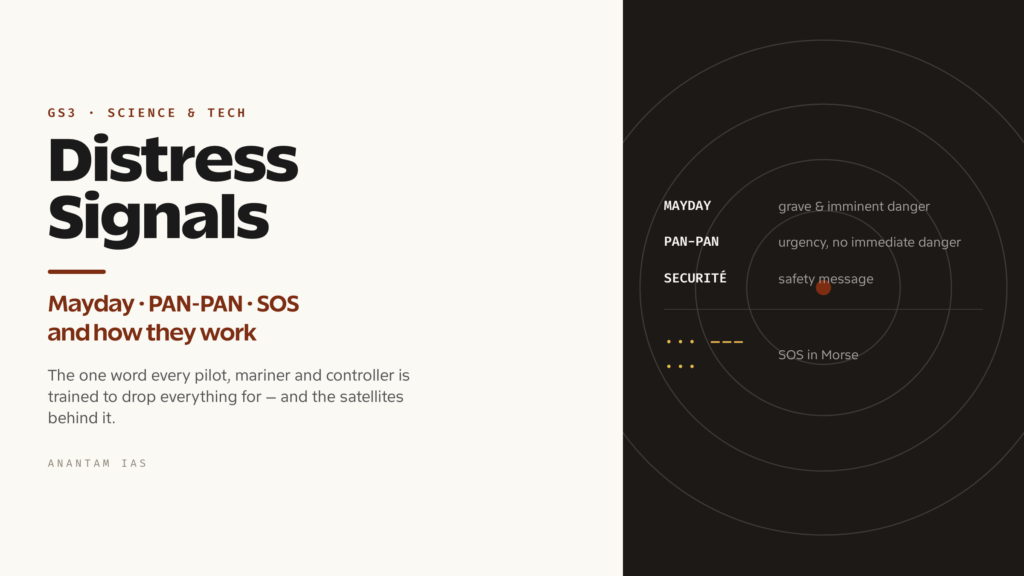
When an aircraft loses an engine over open water or a ship starts taking on water in a storm, the first thing the crew reaches for is not a lifeboat or a fire extinguisher — it’s a word. A single spoken word, repeated three times, that every pilot, mariner, coast guard and air traffic controller on Earth has been trained to drop everything for: “Mayday, Mayday, Mayday.” It is one of the few pieces of language that means exactly the same thing in every country, on every frequency, in every cockpit and on every bridge. And behind that one word sits an entire layered system of signals, radio frequencies, satellites and beacons, built over more than a century so that a cry for help can never be lost in translation.
These distress systems show up in the news every time there’s a serious maritime or aviation incident, which makes them an easy and rewarding topic to understand. They sit squarely in Science and Technology — radio communication, satellite networks and safety engineering — but they also touch internal security and disaster management. The good news is that the whole architecture is logical once you see how it’s tiered: spoken signals for humans, coded tones for machines, and satellites to make sure the message gets out even when no one is listening. This explainer walks through every layer, from the French phrase behind “Mayday” to the 406-megahertz beacons that talk to spacecraft.
The Three Spoken Signals: Mayday, PAN-PAN and Securité
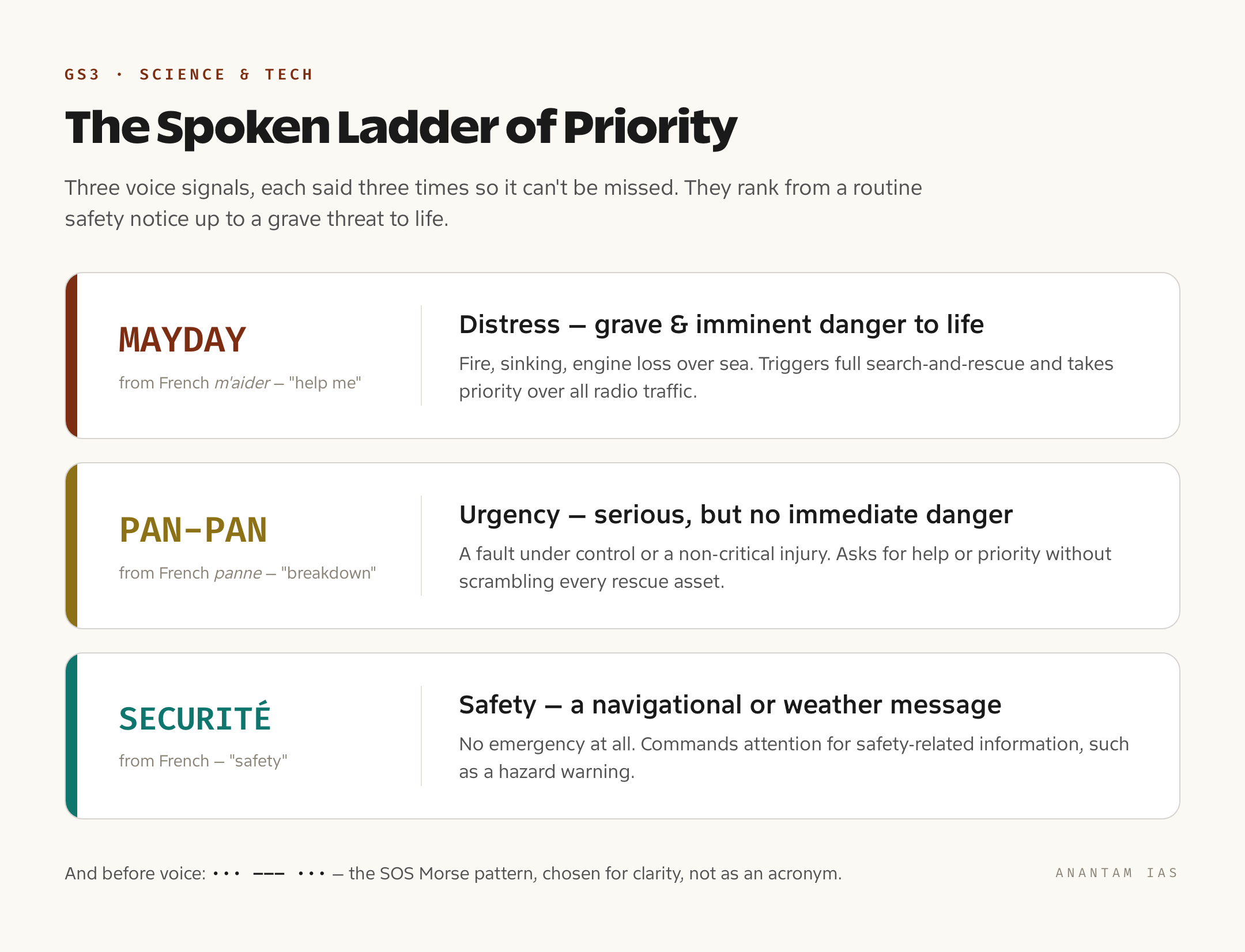
The voice signals are the oldest and most human layer of the system, and they form a clean three-step ladder of seriousness that every aspirant should be able to recite. At the top sits Mayday, the international radiotelephone distress call. It’s used only when a vessel or aircraft faces grave and imminent danger to life and needs immediate assistance — a fire, a sinking, an engine failure over the sea, a medical emergency that threatens lives. The word comes from the French “m’aider”, a shortening of “venez m’aider”, meaning “come help me”. It was proposed in 1923 by a London airport radio officer named Frederick Stanley Mockford, who needed a word that would sound clear over a crackling radio and be understood by both English and French crews on the busy Croydon-to-Paris air route. It’s always spoken three times — “Mayday, Mayday, Mayday” — so that it can’t be mistaken for part of an ordinary transmission or lost to static, and a Mayday call legally takes priority over all other radio traffic.
One rung down is PAN-PAN, the urgency signal. It tells everyone listening that the caller has a serious problem but no immediate threat to life — a mechanical fault that’s under control, a single injured person who isn’t in danger of dying, a loss of navigation that hasn’t yet become a hazard. The phrase comes from the French “panne”, meaning a breakdown or failure, and like Mayday it’s spoken three times: “PAN-PAN, PAN-PAN, PAN-PAN”. The distinction matters operationally. A Mayday triggers a full search-and-rescue response and clears the airwaves; a PAN-PAN alerts authorities and asks for help or priority without scrambling every available rescue asset. Knowing which to send is part of a crew’s training, because crying Mayday when you mean PAN-PAN wastes scarce rescue resources, and the reverse can cost lives.
The third signal is Securité (pronounced “say-cure-i-tay”, from the French for safety), spoken three times to introduce a safety message — a navigational warning, a weather alert, a notice that a large vessel is manoeuvring in a narrow channel. It carries no emergency at all; it simply commands attention for safety-related information. Together these three form a deliberate hierarchy of priority on the radio: Securité for safety, PAN-PAN for urgency, Mayday for distress, each more pressing than the last. There’s a fourth procedural word worth knowing too — when a caller wants to reach a specific medical authority, “PAN-PAN MEDICO” was historically used, but the core three are what examiners and editorials reach for.
SOS and the Morse Era: Where Distress Signalling Began
Before there were voices on the radio, there was Morse code, and that’s where the most famous distress signal of all was born. SOS is not, contrary to popular belief, an abbreviation for “Save Our Souls” or “Save Our Ship” — those are later inventions. It was chosen in 1906 and adopted internationally in 1908 purely because its Morse pattern is unmistakable and easy to send: three dots, three dashes, three dots, sent as one continuous string with no gaps — …—… It was picked precisely because that rhythm is hard to confuse with anything else and simple enough to tap out even by someone in a panic. The letters S-O-S are just the closest plain-language way to describe the pattern; the signal is the rhythm, not the words. The arrival of voice radio didn’t retire the idea behind SOS so much as upgrade it — first into the spoken Mayday, then into the automated and satellite layers that follow.
Calling for Help: The Distress Frequencies
A signal is only as good as the channel it travels on, so the world has set aside specific radio frequencies that are kept clear and continuously monitored for emergencies. In aviation, the international civil distress frequency is 121.5 megahertz, sometimes called “Guardian”, a VHF channel that civil aircraft and air traffic facilities keep watch on; the military equivalent is 243.0 MHz. A pilot in trouble who can reach any station tunes to 121.5 and makes the voice call.
At sea, the picture is a little richer because water and curvature of the Earth shape how far a signal travels. For short-range voice work, the international maritime distress, calling and safety channel is VHF Channel 16, which sits at 156.8 MHz — the channel every ship and coast station monitors for Mayday calls within roughly line-of-sight range, typically a few dozen nautical miles. For longer distances, beyond the horizon, ships fall back on medium and high frequency: 2182 kHz is the historic international distress and calling frequency on medium wave, able to bounce far across the ocean at night. Alongside the voice channels sits a digital one — VHF Channel 70 (156.525 MHz) is reserved exclusively for Digital Selective Calling, a system where a ship sends an automated, coded distress alert at the push of a button rather than relying on someone hearing a spoken call. The split is worth remembering: 121.5 MHz for aviation, Channel 16 for maritime voice, 2182 kHz for long-range, Channel 70 for the digital alert.
The GMDSS: Automating the SOS at Sea
The trouble with a spoken Mayday is obvious — someone has to be listening, in range, at the exact moment it’s sent. For a ship sinking alone in mid-ocean at three in the morning, that’s a fragile assumption, and history is full of disasters where a distress call simply wasn’t heard. The answer, agreed internationally and made mandatory for most large commercial ships, is the Global Maritime Distress and Safety System, or GMDSS — a worldwide safety net that came fully into force in 1999 under the International Maritime Organization’s SOLAS (Safety of Life at Sea) convention.
The core idea of the GMDSS is to take the responsibility for raising the alarm off the human ear and put it on automatic equipment and satellites. Instead of hoping a nearby ship hears your voice, a GMDSS-equipped vessel can send a digital distress alert by Digital Selective Calling, by satellite, or automatically through a beacon, and the alert reaches shore-based rescue coordination centres whether or not any ship is within earshot. The system divides the world’s oceans into sea areas — A1 close to shore covered by VHF, A2 a little further out on medium frequency, A3 the vast mid-latitudes covered by satellites, and A4 the polar regions — and a ship must carry the right equipment for the areas it sails. The GMDSS also bundles in the broadcast of maritime safety information, like weather and navigation warnings, so it’s both a distress system and a safety-information system. In effect, it does for the whole ocean what Channel 16 does for the local harbour: it guarantees that a cry for help gets out and gets answered.
Beacons and Satellites: EPIRBs, ELTs and Cospas-Sarsat
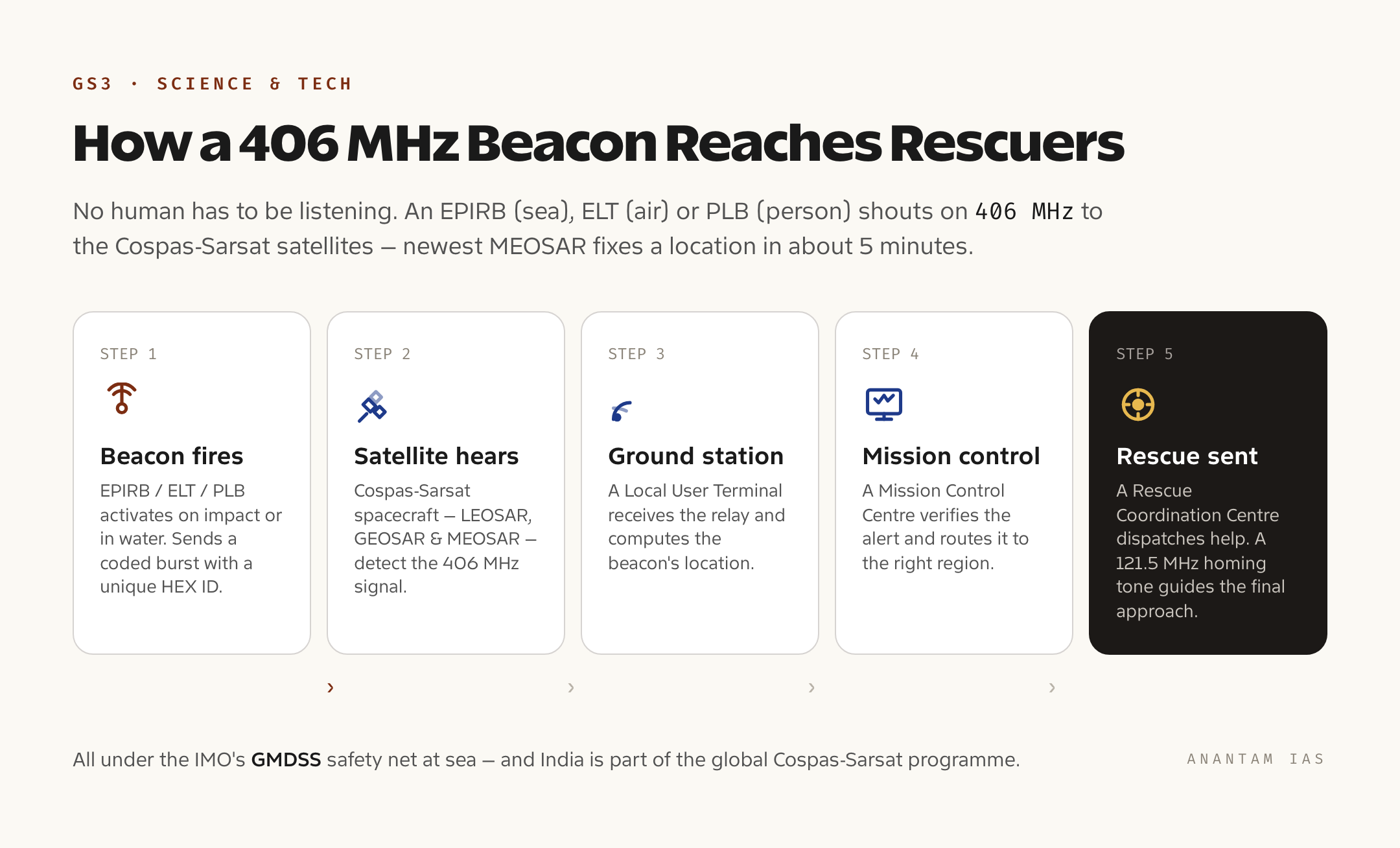
The most powerful layer of the entire architecture is the one that needs no human at all — the emergency beacon talking directly to satellites. At sea, the device is an EPIRB, an Emergency Position-Indicating Radio Beacon; in aircraft, it’s an ELT, an Emergency Locator Transmitter; carried by an individual, it’s a PLB, a Personal Locator Beacon. All three do the same job: when a vessel sinks, an aircraft crashes or a person is in mortal danger, the beacon activates — automatically when submerged in water or on heavy impact, or manually by a switch — and starts shouting for help on a frequency that satellites are listening to.
That frequency is 406 megahertz, and the network behind it is Cospas-Sarsat, an international satellite-based search-and-rescue system founded in 1979 by Canada, France, the United States and the Soviet Union. A 406 MHz beacon transmits a short digital burst roughly every 50 seconds, and crucially that burst carries a unique identifier — a coded HEX ID registered to a specific ship, aircraft or person — so rescuers know not just that someone is in trouble but who, what vessel, and whom to contact. Many beacons also carry a built-in GPS receiver, so the burst can include the survivor’s exact coordinates. The satellites pick up the signal and relay it to a ground station, called a Local User Terminal, which passes it to a Mission Control Centre and on to the relevant Rescue Coordination Centre that dispatches help. The same beacons also emit a low-power 121.5 MHz “homing” signal that rescue aircraft and ships use to pinpoint the survivor in the final approach.
Cospas-Sarsat has grown through three generations of satellites, and the newest is the reason rescues are faster than ever. The original LEOSAR used low-Earth-orbit satellites that calculated a beacon’s position by the Doppler shift in its signal but could take an hour or more for a satellite to pass overhead. GEOSAR added geostationary satellites for instant detection but no location fix on their own. The latest, MEOSAR, places search-and-rescue receivers on the medium-orbit navigation constellations — including instruments on satellites of systems like GPS, Galileo and GLONASS — and can detect a 406 MHz beacon and fix its location almost in real time, typically within about five minutes and with high accuracy even when the beacon has no GPS of its own. As the Cospas-Sarsat programme describes it, MEOSAR brings near-instantaneous, global, redundant coverage — turning what was once an hours-long wait into a matter of minutes. India participates in this global system and operates its own ground-segment infrastructure, with the Indian Space Research Organisation and the Airports Authority of India among the agencies involved in the country’s search-and-rescue ground stations.
The Silent Alarm: Transponder Squawk Codes
There’s one more channel of distress in aviation that never says a word out loud, and it’s the one people often confuse with Mayday. Every aircraft carries a transponder that broadcasts a four-digit code, called a squawk code, to air traffic control radar. Three of those codes are reserved worldwide as emergency signals, set down in the International Civil Aviation Organization’s Annex 10 and unchanged since the 1960s. Squawking 7700 declares a general emergency — any serious situation, from engine failure to fire to a medical crisis — and instantly flags the aircraft on controllers’ screens. Squawking 7600 signals a radio communications failure, telling controllers the crew can’t talk but is still flying, so they clear a path. And squawking 7500 is the unlawful-interference code — the hijack code — letting a crew silently alert the ground to a hijacking or threat without saying anything aloud that an attacker in the cockpit might overhear.
It’s worth being precise here, because this is exactly where popular understanding goes wrong. A squawk code is not the same as a Mayday call, and neither one is an automated engine-warning system or a fixed coast-guard-only weather frequency. The squawk is a silent, coded radar signal; the Mayday is a spoken voice call; the beacon is an automatic satellite burst. Each is a different tool for a different situation, and a well-trained crew knows which to use — sometimes all three at once. Understanding that these are distinct, complementary layers, rather than synonyms, is the single most useful thing to carry away from the whole topic.
For Your Mains Answer
This topic maps cleanly onto GS Paper 3, which covers science and technology developments and their applications, as well as disaster management and aspects of internal security. Questions on emergency communication technology, satellite-based services, the safety architecture of civil aviation and shipping, or the role of systems like Cospas-Sarsat in disaster response can all draw on this material. The examiner’s reward goes to the candidate who shows the layered logic of the system — voice signals, frequencies, automated alerts and satellites — rather than reciting one definition in isolation.
How to Build the Answer
Move from the human layer outward. Start with the spoken hierarchy (Securité, PAN-PAN, Mayday), explain what each means and why Mayday tops the ladder, then introduce the frequencies that carry them (121.5 MHz in aviation, Channel 16 at sea). Next, explain why voice alone is fragile and how the GMDSS and 406 MHz beacons automate the alarm through Cospas-Sarsat satellites. Finish with the squawk codes as the silent aviation layer. That sequence — voice, frequency, automation, satellite, transponder — gives a complete, well-organised answer that mirrors how the real system is built.
Common Mistakes to Avoid
Don’t say SOS stands for “Save Our Souls” — it’s a Morse pattern (…—…), chosen for clarity, not an abbreviation. Don’t call Mayday a frequency or a transponder code; it’s a spoken voice signal. Don’t muddle the three squawk codes — 7700 emergency, 7600 radio failure, 7500 hijack. And don’t treat PAN-PAN and Mayday as interchangeable; the distinction between urgency and grave danger is the point.
A Compact Answer Spine
Spoken ladder: Securité (safety) → PAN-PAN (urgency, from French “panne”) → Mayday (grave and imminent danger, from French “m’aider”), each said thrice → SOS = Morse …—…, not an acronym → frequencies: 121.5 MHz aviation, VHF Ch 16 (156.8 MHz) maritime voice, 2182 kHz long-range, Ch 70 digital → GMDSS automates the sea alarm under IMO SOLAS → 406 MHz EPIRB/ELT/PLB beacons + Cospas-Sarsat satellites (LEOSAR/GEOSAR/MEOSAR, near-real-time fix, HEX ID) → squawk 7700/7600/7500 = silent aviation codes.
Diagram or Flowchart Idea
Sketch a simple flow: beacon (EPIRB/ELT) → 406 MHz burst → Cospas-Sarsat satellite → ground station (LUT) → Mission Control Centre → Rescue Coordination Centre → rescue dispatched. Beside it, a small three-step ladder of the spoken signals ranked by priority. The two visuals together capture the automated and human halves of the system at a glance.
A Balanced-Conclusion Line
A line that lands the marks: “From a single French phrase to a constellation of satellites, the world’s distress architecture is built on one principle — that a call for help must reach a rescuer even when no one is listening, the message is garbled, or no one is left to speak at all.”
How to Use Data Without Cramming
You need only a handful of anchors: the three voice signals and their meanings, the SOS pattern (…—…), the key frequencies (121.5 MHz, Channel 16, 406 MHz), and the three squawk codes (7700/7600/7500). Attribute the system plainly — “under the IMO’s GMDSS” or “through the international Cospas-Sarsat programme” — rather than listing numbers without their framework.
FAQ
What is the difference between Mayday and PAN-PAN? Mayday is the distress signal, used only when there is grave and imminent danger to life requiring immediate assistance — a fire, a sinking, an engine failure over the sea. PAN-PAN is the urgency signal, used for a serious situation that is not yet life-threatening, such as a mechanical fault under control or a single non-critical injury. Both are spoken three times, but a Mayday triggers a full search-and-rescue response and takes priority over all other radio traffic, while a PAN-PAN asks for help or priority without scrambling every rescue asset.
Does SOS stand for “Save Our Souls”? No. SOS was adopted internationally in 1908 simply because its Morse code pattern — three dots, three dashes, three dots, sent as one continuous group (…—…) — is unmistakable and easy to send. The letters are just the nearest plain-language label for that rhythm. “Save Our Souls” and “Save Our Ship” are later popular inventions, not the origin.
What are the emergency distress frequencies? In aviation, the international civil emergency frequency is 121.5 MHz (with 243.0 MHz for the military). At sea, VHF Channel 16 (156.8 MHz) is the international voice distress and calling channel for short range, 2182 kHz serves longer-range medium-frequency calls, and VHF Channel 70 carries automated Digital Selective Calling alerts. Modern emergency beacons transmit on 406 MHz to Cospas-Sarsat satellites, with a 121.5 MHz homing signal for the final search.
What do the transponder codes 7700, 7600 and 7500 mean? They are the three worldwide aviation emergency squawk codes. 7700 declares a general emergency of any kind; 7600 signals a radio communications failure; and 7500 is the unlawful-interference or hijack code, letting a crew silently alert air traffic control without speaking aloud. They are set in ICAO Annex 10 and have been standard since the 1960s.
Practice Questions
Prelims MCQs
- The term “Mayday”, used in maritime and aviation communication, refers to which of the following?
(a) An automated system that alerts nearby vessels of engine failure
(b) An internationally recognised voice distress signal indicating grave and imminent danger to life
(c) A fixed radio frequency used only by coast guards for weather warnings
(d) An encrypted transponder code for signalling a hijack
Answer: (b) Mayday is the standard international voice distress call, from the French “m’aider”, repeated three times, used when life is in grave and imminent danger. - With reference to distress and urgency signals, which of the following is correctly matched?
(a) PAN-PAN — grave and imminent danger to life
(b) Securité — a hijack in progress
(c) PAN-PAN — urgency, a serious problem without immediate danger to life
(d) Mayday — a routine safety message
Answer: (c) PAN-PAN is the urgency signal for a serious situation that is not yet life-threatening; Mayday is for grave danger and Securité introduces safety messages. - The signal “SOS” was adopted as an international distress signal mainly because
(a) it stands for “Save Our Souls”
(b) its Morse code pattern (…—…) is unmistakable and easy to transmit
(c) it could only be sent by trained naval officers
(d) it was the first word spoken over radio
Answer: (b) SOS was chosen for the clarity of its continuous Morse pattern of three dots, three dashes and three dots; the “Save Our Souls” meaning is a later invention. - The Cospas-Sarsat system, associated with search and rescue, works primarily by
(a) monitoring VHF Channel 16 from coast stations
(b) detecting 406 MHz distress beacons through satellites and relaying alerts to rescue centres
(c) broadcasting weather warnings to all ships
(d) tracking aircraft transponder squawk codes from the ground
Answer: (b) Cospas-Sarsat is a satellite-based system that detects 406 MHz signals from EPIRBs, ELTs and PLBs and relays the alert, with location, to rescue coordination centres. - In aviation, the transponder squawk codes 7700, 7600 and 7500 respectively indicate
(a) general emergency, radio failure, and unlawful interference (hijack)
(b) hijack, fire, and medical emergency
(c) radio failure, general emergency, and weather hazard
(d) low fuel, engine failure, and navigation loss
Answer: (a) 7700 is a general emergency, 7600 a communications failure, and 7500 unlawful interference or hijacking, as standardised in ICAO Annex 10.
Mains Practice Questions
- Explain the layered architecture of distress and emergency signalling in aviation and maritime communication, from spoken voice signals to satellite-based beacons. How does this layering improve the reliability of a call for help? (15 marks, 250 words)
- The Global Maritime Distress and Safety System (GMDSS) was designed to “take the alarm off the human ear.” Discuss its objectives, components and significance for safety of life at sea. (15 marks, 250 words)
- Describe how the Cospas-Sarsat satellite system detects and locates emergency beacons. How have successive generations of satellites, especially MEOSAR, improved the speed and accuracy of search and rescue? (15 marks, 250 words)
- Distinguish between a voice distress call, a digital selective calling alert and a transponder squawk code as means of declaring an emergency. Why does modern practice rely on all three rather than any one alone? (10 marks, 150 words)
- Emergency communication technology sits at the intersection of science, disaster management and internal security. Examine this statement with reference to distress signals, locator beacons and hijack-alert codes. (15 marks, 250 words)
Tell Google you want more of this.
Add Anantam IAS as a preferred sourceOne tap, and this site shows up more often in your own Top Stories, AI Overviews and AI Mode. Remove it any time.