BRICS Opposes EU CBAM: Carbon Borders and Adaptation Finance
Why in News?
The 12th BRICS Environment Ministers’ Meeting, held in New Delhi on 18 August 2026 under India’s chairship, opposed the EU carbon border tax and pressed developed countries for adaptation finance.
- Ministers adopted a consensual Joint Ministerial Statement. It is political consensus, not a treaty and not a repeal of CBAM.
- They opposed what they called unilateral, punitive, discriminatory and protectionist climate measures, including the EU Carbon Border Adjustment Mechanism.
- The EU mechanism entered its definitive phase on 1 January 2026 after a reporting-only phase from 1 October 2023.
- Iron and steel are about 90% of India’s CBAM-exposed EU exports, not of all India-EU trade.
- They urged delivery of the COP30 Belem pledge to triple adaptation finance to developing countries by 2035.
- The statement sits beside an India-EU FTA track. Carbon compliance is a separate instrument from tariff cuts.
- A same-day Commerce session on CBAM reporting shows India is preparing exporters even as BRICS objects.
- Adaptation has historically received a smaller share of climate finance than mitigation.
UPSC Relevance
Prelims Relevance
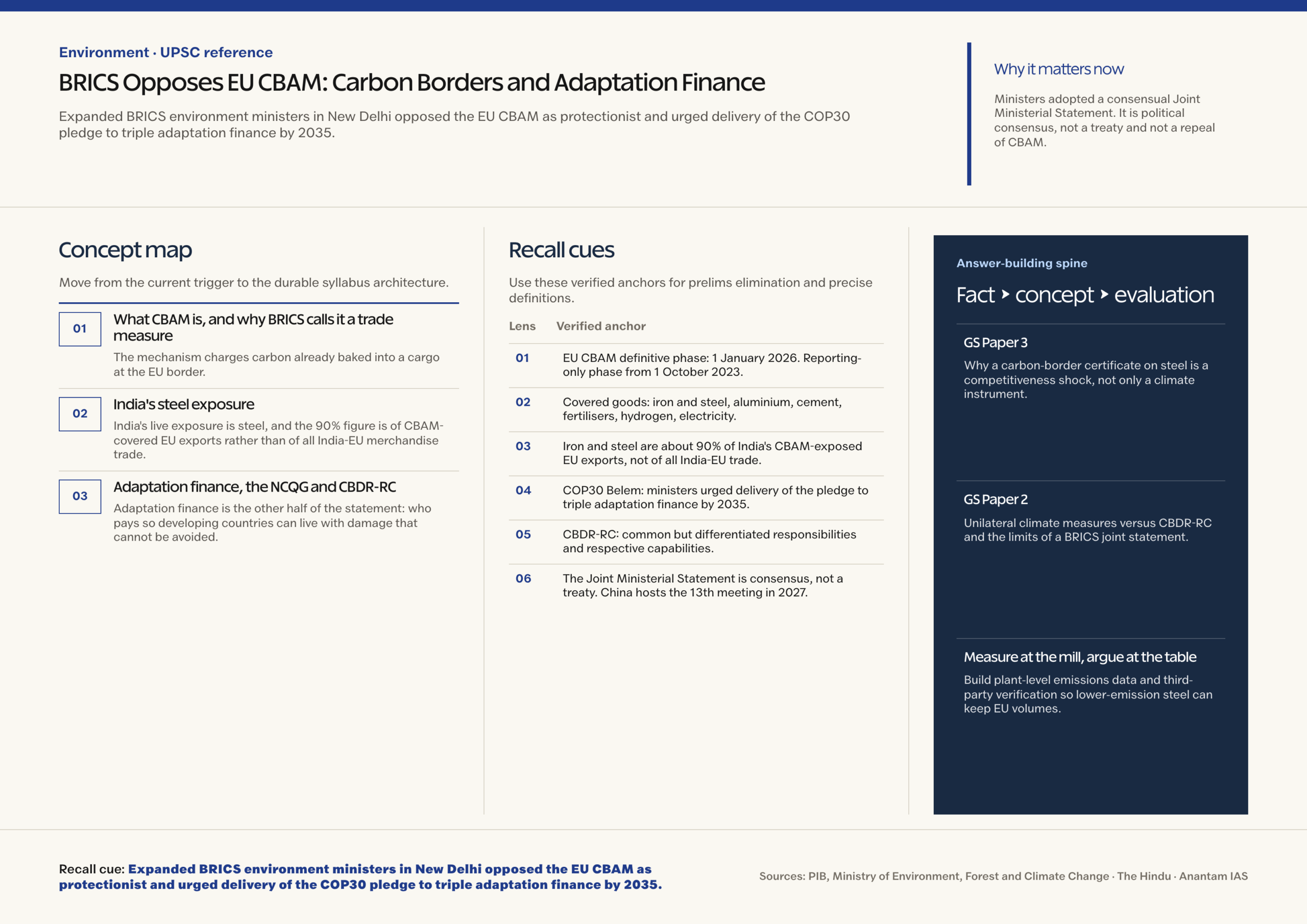
- EU CBAM definitive phase: 1 January 2026. Reporting-only phase from 1 October 2023.
- Covered goods: iron and steel, aluminium, cement, fertilisers, hydrogen, electricity.
- Iron and steel are about 90% of India’s CBAM-exposed EU exports, not of all India-EU trade.
- COP30 Belem: ministers urged delivery of the pledge to triple adaptation finance by 2035.
- CBDR-RC: common but differentiated responsibilities and respective capabilities.
- The Joint Ministerial Statement is consensus, not a treaty. China hosts the 13th meeting in 2027.
Mains Relevance
GS Paper 3
- Why a carbon-border certificate on steel is a competitiveness shock, not only a climate instrument.
- How adaptation finance differs from mitigation finance, and why the NCQG triple-by-2035 pledge matters.
GS Paper 2
- Unilateral climate measures versus CBDR-RC and the limits of a BRICS joint statement.
- How an India-EU FTA and CBAM can run on the same cargo as two different instruments.
Essay
- A climate rule that only works at someone else’s border is a trade rule.
Background and Context
What CBAM is, and why BRICS calls it a trade measure
The mechanism charges carbon already baked into a cargo at the EU border, which is why BRICS reads it as trade policy rather than shared climate law.
- From 1 January 2026, EU importers of iron and steel, aluminium, cement, fertilisers, hydrogen and electricity must account for embedded production emissions. The legal duty sits on the importer in Europe, not on New Delhi.
- A reporting-only phase ran from 1 October 2023. In the definitive phase from 1 January 2026, importers purchase and surrender certificates tied to carbon emissions embedded in each listed cargo.
- The EU says the levy prevents carbon leakage: carbon-intensive plants leaving the bloc because climate rules are cheaper elsewhere, then selling the same goods back into Europe without paying the EU carbon price.
- The Hindu and Indian Express report that ministers called such measures unilateral, punitive, discriminatory and protectionist, and said they are not in line with international law. That wording is political, not a repeal.
- They said carbon borders can undermine developing countries’ climate and resilience efforts. Treat that as a trade-measure claim, not a science dispute, as in our note on carbon rules as trade rules.
India's steel exposure
India’s live exposure is steel, and the 90% figure is of CBAM-covered EU exports rather than of all India-EU merchandise trade. That distinction is the usual trap.
- The 90% share is of India’s CBAM-exposed EU exports. Treat any answer that applies that share to all India-EU merchandise trade as an exam trap, not a rounding issue.
- A June 2026 analysis in Nature Climate Change matched shipment-level EU trade data with facility-level emissions estimates for Indian steel, and found the reporting phase already moved export volumes and revenues.
- In that reporting phase, high-emission Indian steel firms cut EU export quantities and revenues. Lower-emission firms held volumes, so the border was already sorting plants before certificates began in January.
- The India-EU FTA is a parallel track, not the same instrument. Tariff cuts on a steel cargo do not cancel the need to surrender CBAM certificates at the European border.
- Commerce held a same-day exporter session on embedded-emissions data and verification. Objection in BRICS and mill-level compliance are running together, as with other non-tariff barriers India already faces.
Adaptation finance, the NCQG and CBDR-RC
Adaptation finance is the other half of the statement: who pays so developing countries can live with damage that cannot be avoided, without taking on more debt.
- Adaptation pays to cope with unavoidable impacts on water, agriculture, infrastructure, disaster systems and livelihoods. Mitigation pays to cut greenhouse gases. Do not treat the two as synonyms.
- Adaptation has historically received a smaller share of climate finance than mitigation, even as India’s requirement is increasingly for heat, flood, drought and erratic-rainfall protection rather than only for energy projects.
- Ministers said support should be new, additional, predictable, adequate and accessible, given as grants and concessional finance that does not raise developing-country debt vulnerability, with delivery tracked.
- They urged developed countries to deliver the COP30 Belem NCQG commitment to triple adaptation finance to developing countries by 2035. This is a delivery demand, not a new BRICS fund.
- The statement invoked CBDR-RC: common but differentiated responsibilities and respective capabilities. Cooperation stays voluntary, operational texts are not a treaty, and China hosts the next meeting in 2027.
Way Forward
Measure at the mill, argue at the table
- Build plant-level emissions data and third-party verification so lower-emission steel can keep EU volumes.
- Keep the FTA and CBAM as separate files. Tariff cuts do not retire certificates.
- Press developed countries on NCQG adaptation delivery without turning BRICS into a substitute fund.
- Use CBDR-RC to reject unilateral border taxes while still cutting process emissions at home.
Conclusion
- BRICS has named CBAM a trade measure and asked for adaptation money. The New Delhi text is consensus among ministers, not a rewrite of European carbon-border law.
- For India the live file is steel emissions at the mill and verification of those numbers, not a slogan against every carbon price.
- In an answer, keep the steel-share trap, the certificate phase, the NCQG triple-by-2035 pledge, and CBDR-RC in their correct legal boxes.
UPSC Practice Questions
Prelims MCQ 1
With reference to the 12th BRICS Environment Ministers’ Meeting, consider the following statements:
- The meeting adopted a consensual Joint Ministerial Statement opposing unilateral carbon-border measures such as the EU CBAM.
- Iron and steel account for about 90% of all of India’s exports to the European Union.
- The ministers urged developed countries to meet the COP30 commitment to triple adaptation finance to developing countries by 2035.
How many of the above statements are correct?
(a) Only one (b) Only two (c) All three (d) None
Answer: (b) Only two
Explanation:
Statements 1 and 3 are correct. Statement 2 is not: the 90% share is of India’s CBAM-exposed EU exports, not of all India-EU trade. The New Delhi text is political consensus, not a treaty.
Prelims MCQ 2
The EU Carbon Border Adjustment Mechanism, in its definitive phase beginning 1 January 2026, primarily requires:
(a) Developing-country governments to pay a United Nations levy on steel and aluminium exports (b) EU importers of specified carbon-intensive goods to account for embedded production emissions (c) BRICS members to adopt a common carbon price before trading with Europe (d) India to suspend iron and steel exports to the European Union
Answer: (b) EU importers of specified carbon-intensive goods to account for embedded production emissions
Explanation:
CBAM is an EU importer obligation covering iron and steel, aluminium, cement, fertilisers, hydrogen and electricity. It is not a UN levy, and the BRICS statement created neither a common carbon price nor an export ban.
UPSC Mains Questions
- The EU Carbon Border Adjustment Mechanism is presented as a climate tool and opposed as a trade measure. Examine this tension with reference to India’s steel exports. (250 words)
- Why has adaptation finance lagged mitigation finance, and how does the COP30 pledge to triple adaptation support by 2035 matter for developing countries? (150 words)
Sources: PIB, Ministry of Environment, Forest and Climate Change and The Hindu.
Frequently Asked Questions
What is the EU CBAM?
The Carbon Border Adjustment Mechanism makes EU importers account for greenhouse gases embedded in specified carbon-intensive goods. After a reporting-only phase from October 2023, certificates apply from 1 January 2026.
Why does BRICS call CBAM protectionist?
Ministers said unilateral carbon-border measures can punish developing-country exporters and undermine climate and resilience efforts. They treat CBAM as a trade barrier dressed as climate policy, not as a shared UN rule.
Did the BRICS statement repeal or suspend CBAM?
No. The New Delhi text is a joint ministerial statement. It records political consensus. It does not bind the European Union or create a legal repeal.
What adaptation finance did the ministers ask for?
They wanted new, additional, predictable, adequate and accessible support through grants and concessional finance that does not raise debt. They urged delivery of the COP30 pledge to triple adaptation finance by 2035.
What is CBDR-RC?
Common but differentiated responsibilities and respective capabilities. All countries share the climate problem, but duties and cooperation stay calibrated to national circumstances. BRICS used it to keep commitments voluntary.