Why in News?
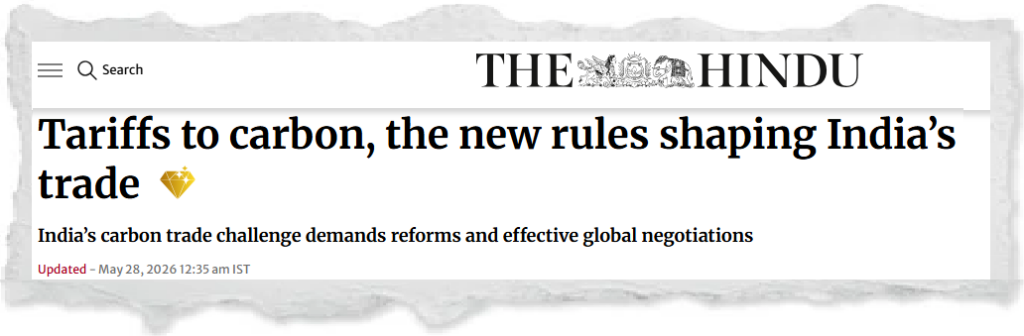
The European Union’s Carbon Border Adjustment Mechanism (CBAM), proposed in 2021, entered its definitive phase from January 1, 2026. The mechanism imposes carbon-linked charges on imports based on the emissions generated during production. The development is significant for India because carbon-intensive sectors such as steel, aluminium, cement and fertilizers may face higher export costs in European markets despite ongoing India–EU trade negotiations.
UPSC Relevance
Prelims: Carbon Border Adjustment Mechanism (CBAM), carbon leakage, carbon pricing, non-tariff barriers, Soil Health Card Scheme.
Mains:
GS II – India-EU relations, international trade negotiations;
GS III – Climate change, industrial policy, energy transition, trade competitiveness, agriculture and fertilizer security.
Background/Context
Global trade is increasingly being shaped not only by tariffs and traditional trade barriers but also by climate-related regulations. Developed economies are gradually integrating carbon-emission considerations into trade policies as part of their climate commitments.
The European Union’s CBAM represents one of the most significant examples of this transition. The mechanism seeks to ensure that imported products face carbon costs similar to those imposed on European producers under the EU’s domestic climate regulations.
For developing countries such as India, this signals a structural shift in global trade rules where market access increasingly depends upon carbon efficiency alongside price competitiveness.
What is the Carbon Border Adjustment Mechanism (CBAM)?
Carbon Border Adjustment Mechanism is a carbon pricing tool designed by the European Union to prevent “carbon leakage”.
What is carbon leakage?
Carbon leakage occurs when industries shift production from countries with strict climate regulations to countries with weaker environmental standards in order to reduce costs. This may undermine global climate goals by merely relocating emissions rather than reducing them.
CBAM seeks to address this issue by imposing carbon-linked charges on imports entering the EU market.
Sectors Covered Under CBAM
Initially, CBAM applies to carbon-intensive sectors such as: Steel, Cement, Aluminium, Fertilizers, Electricity, Hydrogen.
These sectors are considered highly emission-intensive and vulnerable to carbon leakage risks.
How CBAM Functions
Unlike conventional tariffs, CBAM directly links import costs to embedded carbon emissions generated during production.
Key features
- EU importers must report embedded emissions in imported goods.
- Importers may need to purchase CBAM certificates linked to carbon prices.
- Products produced through carbon-intensive methods become relatively more expensive.
Thus, market access increasingly depends on the carbon footprint of production processes.
Difference Between CBAM and Traditional Non-Tariff Measures
CBAM differs structurally from conventional non-tariff measures (NTMs).
| Traditional NTMs | CBAM |
|---|---|
| Focus on product standards and regulations | Focus on carbon emissions embedded in production |
| Often qualitative and compliance-based | Price-based and quantifiable |
| Product quality determines access | Carbon efficiency influences competitiveness |
| Usually sector-specific regulations | Linked to broader climate policy |
This marks a major shift from “product-based trade regulation” to “process-based trade regulation”.
What is its Impact on India?
Impact on steel and aluminium exports
India’s steel and aluminium sectors are expected to face immediate challenges because they are relatively carbon-intensive and depend significantly on export markets.
European buyers may increasingly prefer suppliers with lower carbon footprints. As a result, Indian firms may either:
- absorb additional compliance costs,
- or invest heavily in cleaner technologies to remain competitive.
In the short run, this may reduce export profitability despite ongoing India–EU Free Trade Agreement negotiations.
Impact on fertilizer imports and agriculture
India may also face indirect effects through higher global fertilizer prices. Major fertilizer-exporting countries such as Egypt, Russia, Morocco and China may pass on carbon compliance costs to importing countries.
Since India remains a large fertilizer importer, rising global prices may:
- increase the fertilizer subsidy burden,
- affect farm profitability,
- and contribute to food inflation.
Thus, CBAM has implications not only for trade but also for agricultural sustainability and inflation management.
Broader trade implications
CBAM reflects a larger transformation in global trade governance. Other developed countries may adopt similar carbon-linked border measures in the future.
This may create:
- reduced market access for developing economies,
- pressure to decarbonise industries rapidly,
- and new forms of green protectionism.
Carbon Efficiency as a New Comparative Advantage
Traditionally, comparative advantage depended upon:
- labour costs,
- resource availability,
- and production efficiency.
However, under emerging carbon-linked trade systems, carbon efficiency is becoming equally important. Countries with cleaner production systems may gain trade advantages even if their production costs are relatively higher.
This represents a transition from “cost competitiveness” to “carbon competitiveness”.
What are India’s Domestic Challenges?
High dependence on fossil fuels
A significant share of India’s industrial production continues to depend on coal-based energy systems, particularly in steel and heavy manufacturing sectors.
Cost of green transition
Transitioning toward cleaner production technologies requires substantial investment in:
- renewable energy,
- green hydrogen,
- low-carbon industrial infrastructure,
- and technological modernisation.
These transitions may impose heavy short-term costs on developing economies.
Technology and financing constraints
Many developing countries lack affordable access to advanced green technologies and climate finance needed for industrial decarbonisation.
India’s Policy Response
Domestic reforms
India needs to strengthen domestic carbon efficiency through:
- greater investment in renewable energy,
- promotion of energy-efficient technologies,
- stricter environmental compliance mechanisms,
- and industrial decarbonisation strategies.
Reducing fertilizer vulnerability
To reduce dependence on expensive imports, India must improve domestic fertilizer efficiency through better implementation of the Soil Health Card Scheme and promotion of balanced fertilizer usage.
International negotiations
India must continue negotiating for:
- equitable treatment for developing countries,
- phased implementation mechanisms,
- technology transfer,
- climate finance support,
- and transitional flexibility under trade agreements.
Challenges and Criticisms of CBAM
Concerns of green protectionism
Developing countries argue that CBAM may function as a disguised trade barrier under the pretext of climate policy.
Unequal burden on developing economies
Countries with limited historical responsibility for climate change may face disproportionate adjustment costs.
WTO compatibility concerns
Questions remain regarding whether carbon border taxes fully comply with World Trade Organization principles of non-discrimination and fair trade.
Risk to global trade equity
Carbon-linked trade systems may widen inequalities between technologically advanced economies and developing countries.
Way Forward
Accelerate clean industrial transition
India should expand investments in renewable energy, green hydrogen and low-carbon manufacturing ecosystems.
Develop carbon accounting systems
Robust carbon measurement and reporting systems are necessary for maintaining export competitiveness.
Strengthen strategic trade diplomacy
India must build coalitions with developing countries to ensure fair climate-trade frameworks at global forums.
Promote circular economy approaches
Greater recycling, resource efficiency and sustainable production systems can help reduce industrial emissions.
Conclusion
The emergence of CBAM marks a significant transformation in the global trading system where climate policy and trade policy are becoming deeply interconnected. For India, the challenge is not only to adapt to carbon-constrained trade regimes but also to ensure that the green transition remains compatible with economic growth, industrial development and social equity. The future of international competitiveness may increasingly depend not just on how efficiently countries produce goods, but also on how sustainably they produce them.
Practice Questions
Prelims Question 1 (Inference-based)
Consider the following statements with reference to the European Union’s Carbon Border Adjustment Mechanism (CBAM):
I. CBAM links market access for certain imported products to the carbon emissions generated during their production.
II. Carbon-intensive sectors in developing countries may face higher export costs even if they satisfy conventional product quality standards.
III. Countries with cleaner production systems may gain a competitive advantage under emerging carbon-linked trade regimes.
Which of the following relationships among the above statements is/are correct?
- Statement II validates the idea reflected in Statement I that trade competitiveness is increasingly linked to carbon efficiency.
- Statement III extends the implications of Statement I by indicating a structural shift in the basis of comparative advantage in global trade.
- Statement I contradicts Statement II because carbon-linked measures replace all conventional trade regulations.
(a) 1 only
(b) 1 and 2
(c) 2 and 3
(d) 3 only
Answer: (b)
Explanation: Statement II reflects how carbon-linked trade measures affect exporters even when traditional standards are met. Statement III further extends this logic by showing that comparative advantage is increasingly shaped by carbon efficiency. Statement 3 is incorrect because CBAM supplements rather than replaces conventional trade regulations.
Prelims Question 2 (Match the Following)
Match List I with List II:
| List I | List II |
|---|---|
| A. Carbon leakage | 1. Emissions linked to imported products |
| B. CBAM | 2. Shift of production to countries with weaker climate regulations |
| C. Soil Health Card Scheme | 3. Promotion of balanced fertilizer application |
Select the correct answer using the code given below:
(a) A-2, B-1, C-3
(b) A-1, B-2, C-3
(c) A-2, B-3, C-1
(d) A-3, B-1, C-2
Answer: (a)
Explanation: Carbon leakage refers to relocation of production to countries with weaker environmental regulations. CBAM imposes carbon-linked measures on imports, while the Soil Health Card Scheme promotes balanced and need-based fertilizer use.
Mains Questions
- Discuss the implications of the European Union’s Carbon Border Adjustment Mechanism (CBAM) for India’s trade competitiveness and industrial transition.
- “Climate policy is increasingly shaping the future of international trade.” Examine with reference to carbon border taxes and developing economies.
Tell Google you want more of this.
Add Anantam IAS as a preferred sourceOne tap, and this site shows up more often in your own Top Stories, AI Overviews and AI Mode. Remove it any time.