BRICS Transport Ministers’ Meeting: Nagpur Declaration under India’s Chairship 2026
Why in News?
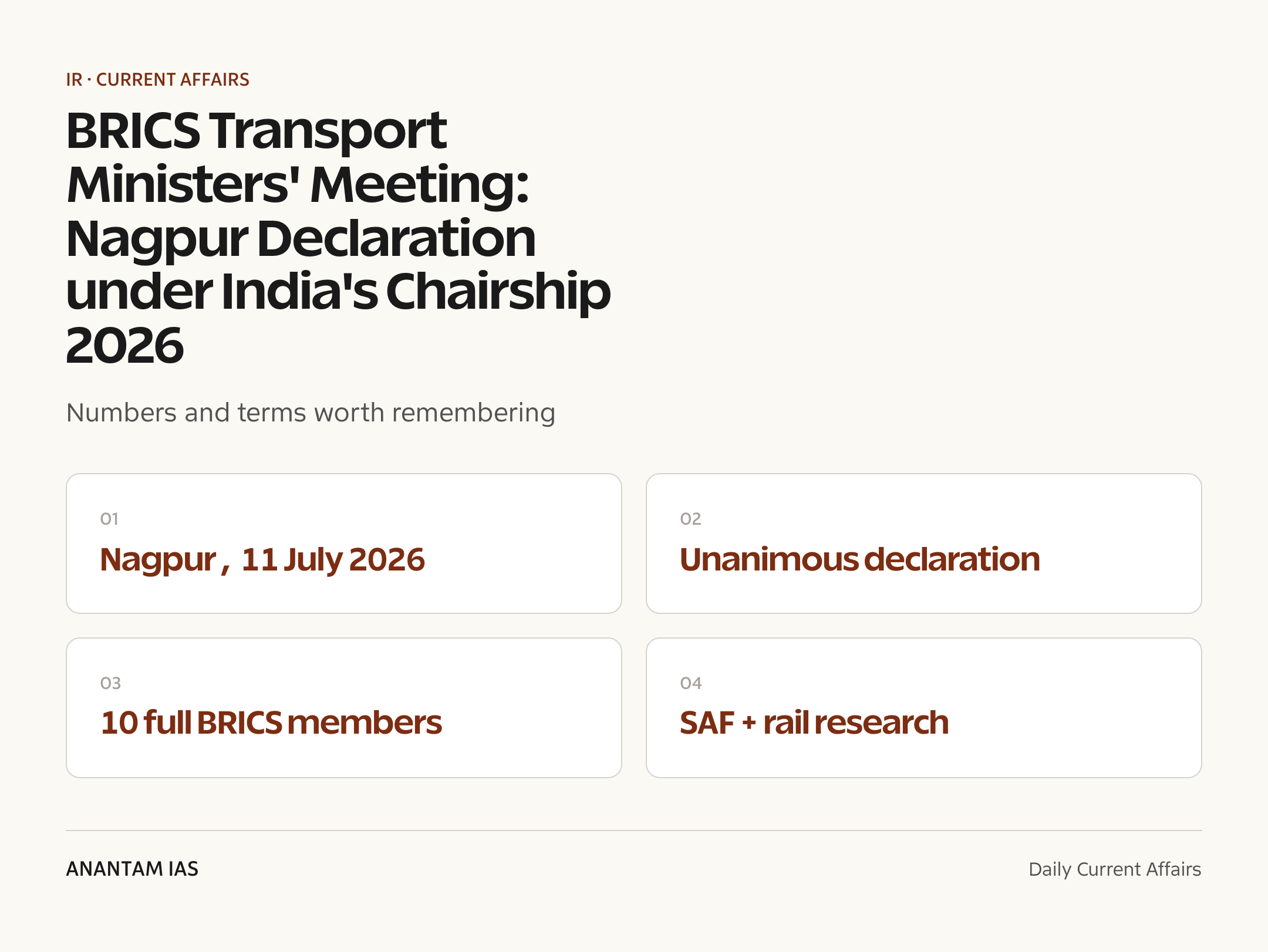
PIB confirmed that the 3rd BRICS Transport Ministers’ Meeting concluded in Nagpur, Maharashtra, on 11 July 2026 — the first transport-ministerial outcome of India’s BRICS Chairship 2026. The meeting was hosted by the Ministry of Road Transport & Highways, with Union Minister Nitin Gadkari thanking delegations for a consensus outcome.
Ministers unanimously adopted a Ministerial Declaration setting a shared framework across six areas: circularity in infrastructure, Sustainable Aviation Fuel (SAF), transport decarbonisation, an Urban Mobility Hub, logistics supply-chain cooperation and a BRICS Railway Research Network.
- The Ministerial Meeting of 11 July 2026 was preceded by the 3rd BRICS Transport Working Group (TWG) Senior Officials’ Meeting on 9–10 July 2026, where officials finalised the agenda outcomes and the draft declaration.
- The declaration was adopted unanimously — PIB noted the deliberations reflected the BRICS spirit of mutual respect, equality and consensus.
- The four-day programme combined the officials’ meeting, the ministerial and bilateral engagements on the sidelines.
- India committed to a smooth transition of these initiatives to the successive BRICS Chairship, signalling continuity beyond 2026.
The development matters in the context of:
- The expanded BRICS speaks for close to half of the world’s population, so even a sectoral transport declaration carries real economic weight.
- For India, the Nagpur outcome links external connectivity diplomacy with domestic reforms — PM Gati Shakti and the National Logistics Policy — making the chairship agenda credible.
- Sector-specific ministerials like this one are how plurilateral groupings move from declaratory summitry to functional cooperation — a recurring GS2 mains theme.
UPSC Relevance
Prelims Relevance
- 3rd BRICS Transport Ministers’ Meeting — Nagpur, Maharashtra; ministerial on 11 July 2026; TWG Senior Officials’ Meeting on 9–10 July 2026.
- Host ministry: Ministry of Road Transport & Highways (Union Minister Nitin Gadkari); held under India’s BRICS Chairship 2026.
- Declaration’s six pillars: circularity in infrastructure, SAF, transport decarbonisation, Urban Mobility Hub, logistics supply-chain cooperation, BRICS Railway Research Network.
- BRIC acronym coined by Jim O’Neill (Goldman Sachs, 2001); first summit at Yekaterinburg, Russia (2009); South Africa joined in 2010.
- Expansion: Egypt, Ethiopia, Iran and the UAE joined on 1 January 2024; Indonesia was admitted in January 2025, taking BRICS to ten full members (Saudi Arabia is invited but yet to formally join).
- The partner-country category was created at the 16th summit at Kazan, Russia (2024).
- New Development Bank — set up by the Fortaleza Declaration (2014), headquartered in Shanghai; the Contingent Reserve Arrangement pools $100 billion.
- India hosts the 18th BRICS Summit in 2026 — its fourth turn at the helm after the 2012 (New Delhi) and 2016 (Goa) summits and the virtual 2021 chairship.
- SAF context: India targets 1% SAF blending in jet fuel for international flights by 2027 and 2% by 2028 (National Biofuel Coordination Committee, November 2023).
Mains Relevance
GS Paper 2
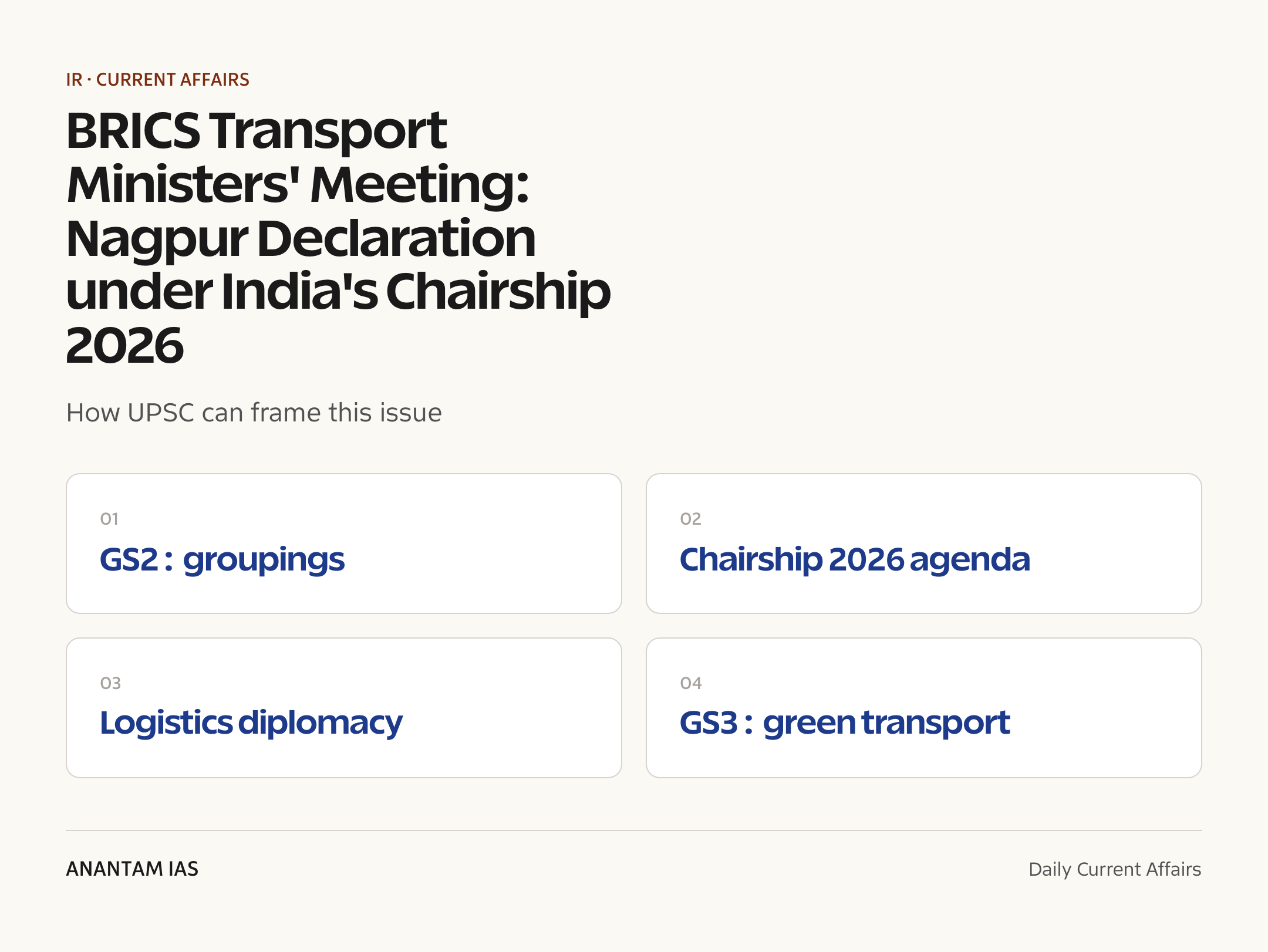
- Groupings and agreements involving India: BRICS as a Global South platform and what sectoral ministerials add to its institutional depth.
- India’s BRICS Chairship 2026 — agenda-setting power, consensus-building among a heterogeneous ten-member grouping, and handover continuity.
- Connectivity as foreign policy: how transport and logistics cooperation complements initiatives like the INSTC and the India–Middle East–Europe Economic Corridor.
GS Paper 3
- Infrastructure and logistics: aligning BRICS cooperation with PM Gati Shakti, the National Logistics Policy and India’s Logistics Performance Index climb.
- Green transport transition: SAF economics, transport decarbonisation and circular use of construction materials in roads and railways.
Essay
- Multipolarity is built brick by brick — sectoral cooperation as the quiet engine of a new world order.
- Connectivity is the geopolitics of the 21st century: whoever moves goods fastest shapes the rules.
Background and Context
BRICS in brief: from acronym to expanded grouping
BRICS began as an investment-bank acronym and has grown into the Global South’s most-watched plurilateral platform.
- The term BRIC was coined by Goldman Sachs economist Jim O’Neill in 2001 to describe fast-growing emerging economies; the first leaders’ summit was held at Yekaterinburg, Russia, in 2009.
- South Africa joined in 2010, making it BRICS; the grouping works by consensus and has no permanent secretariat — the rotating chair drives each year’s agenda.
- From 1 January 2024, Egypt, Ethiopia, Iran and the UAE joined as full members; Indonesia followed in January 2025, taking membership to ten. Saudi Arabia has been invited but hasn’t formally confirmed.
- The Kazan Summit (2024) added a partner-country tier — states like Belarus, Kazakhstan, Malaysia, Thailand and Nigeria engage without full membership.
- Institutional anchors: the New Development Bank (Fortaleza Declaration, 2014; HQ Shanghai) and the Contingent Reserve Arrangement ($100 billion currency-swap safety net).
- The expanded grouping speaks for close to half of humanity, so even sectoral cooperation is consequential.
India's BRICS Chairship 2026
The Nagpur ministerial is an early, concrete deliverable of India’s year in the BRICS chair.
- India took over the rotating chair for 2026 and will host the 18th BRICS Summit — its fourth time leading the grouping after 2012, 2016 and the virtual 2021 summit.
- At the Rio de Janeiro summit (July 2025), PM Modi said India’s presidency would work to redefine BRICS as “Building Resilience and Innovation for Cooperation and Sustainability” — a people-centric framing.
- Sectoral ministerials are where a chair converts themes into work programmes; the transport track is among the first to deliver a signed outcome in 2026.
- PIB reported India’s commitment to a smooth transition of the Nagpur initiatives to the next chairship — continuity is the test of any BRICS outcome.
What the Nagpur Ministerial Declaration covers
The declaration, finalised by senior officials and adopted unanimously by ministers, sets a six-part cooperation framework.
- Circularity in infrastructure — reusing and recycling construction materials in roads, bridges and rail, cutting the sector’s raw-material and carbon footprint.
- Sustainable Aviation Fuel (SAF) — cooperation on jet fuel made from feedstocks like used cooking oil and agricultural residue, which can cut aviation’s lifecycle emissions sharply.
- Transport decarbonisation — transport accounts for roughly 14% of India’s energy-related CO2 emissions, road transport being the dominant share; electrification and modal shift are the levers.
- Urban Mobility Hub — a platform for sharing city-transport solutions across BRICS megacities, from metro networks to bus electrification.
- Logistics supply-chain cooperation — smoothing customs, documentation and multimodal linkages among economies that together handle a large slice of world trade.
- BRICS Railway Research Network — a proposed research linkage among member-country rail institutions on technology, safety and freight efficiency.
- The meeting brought together ministers, senior officials and technical experts from member countries.
Why Nagpur: geography meets logistics
The venue choice is itself a statement about India’s logistics ambitions.
- Nagpur hosts the colonial-era Zero Mile Stone, long treated as the geographical centre of India — a symbolic fit for a connectivity summit.
- The city anchors MIHAN (Multi-modal International Cargo Hub and Airport at Nagpur), one of India’s largest integrated cargo-hub and SEZ projects.
- It sits at the crossroads of the Mumbai–Kolkata and Delhi–Chennai corridors, and the 701-km Samruddhi Mahamarg expressway links it to Mumbai’s ports.
- Showcasing a tier-2 logistics hub, rather than Delhi or Mumbai, signals that India’s connectivity story now runs through its hinterland.
The domestic anchor: India's logistics and green-transport stack
India negotiates from a stronger position because its own logistics reform has visible momentum.
- PM Gati Shakti National Master Plan (October 2021) puts all infrastructure ministries on one GIS-based planning platform to end siloed project design.
- The National Logistics Policy (September 2022) targets cutting logistics costs to global benchmarks and lifting India into the top 25 of the World Bank’s Logistics Performance Index by 2030.
- India climbed to 38th of 139 countries in the LPI 2023, up from 44th in 2018 — proof the reforms register externally.
- Dedicated Freight Corridors shift bulk cargo to rail, and electric-mobility schemes push demand-side decarbonisation — see our explainer on electric vehicles in India.
- On SAF, India’s indicative blending targets — 1% for international flights by 2027, 2% by 2028 — dovetail with ICAO’s CORSIA scheme, whose mandatory phase begins in 2027.
- These domestic pieces make the BRICS transport agenda an extension of India’s own connectivity diplomacy, alongside projects like the India–ASEAN connectivity corridors.
Significance — and the sceptic's view
A unanimous declaration is an achievement, but its worth depends on what happens after the photo-op.
- Functional tracks like transport give BRICS practical depth — the same logic that produced the New Development Bank in finance.
- Consensus matters because BRICS is heterogeneous: India–China strategic mistrust, differing rail gauges and standards, and members at very different income levels all complicate delivery.
- Ministerial declarations are non-binding; without funded work plans, a Railway Research Network or Urban Mobility Hub can remain a paper entity.
- The grouping’s cohesion has been tested before — we examined the strains in BRICS without a joint statement — which is exactly why a unanimous sectoral outcome under India’s chair is being read as a course correction.
- For India, the win is agenda ownership: the declaration’s pillars mirror India’s domestic priorities, so implementation abroad reinforces reform at home.
Way Forward
Institutionalise the outcomes
- Give the Transport Working Group a standing work plan with timelines, and anchor the BRICS Railway Research Network in a named host institution with seed funding.
- Fold the Nagpur pillars into the 18th BRICS Summit declaration so leaders, not just ministers, own the agenda.
Harmonise standards and finance
- Work towards mutual recognition of customs and e-documentation, green-corridor protocols and interoperable logistics data standards among members.
- Tap the New Development Bank for green-transport lending — SAF plants, rail electrification and urban mobility projects need patient capital.
Deliver at home
- Accelerate National Logistics Policy execution and SAF production scale-up so India’s chairship claims stay backed by domestic performance.
- Use the Urban Mobility Hub to import best practices for Indian cities — bus electrification, transit-oriented development and last-mile integration.
Conclusion
The Nagpur meeting shows what a chairship can do when it plays to national strength. India didn’t just host a BRICS event; it steered ten diverse economies to a unanimous declaration on an agenda — logistics, SAF, decarbonisation, rail research — that reads like an internationalised version of its own reform programme.
The harder test begins now. Declarations don’t move freight; work plans, standards and finance do. If the Transport Working Group converts the six pillars into funded projects before the chairship passes on, Nagpur will be remembered as the moment BRICS transport cooperation became real rather than rhetorical.
For aspirants, the takeaways are twin-track: a dated, name-the-city prelims fact, and a mains-ready case study of sectoral diplomacy giving a grouping functional depth.
UPSC Practice Questions
Prelims MCQ 1
With reference to the 3rd BRICS Transport Ministers’ Meeting (2026), consider the following statements:
- It was held in Nagpur, Maharashtra, under India’s BRICS Chairship 2026.
- The Ministerial Declaration was adopted unanimously and covers Sustainable Aviation Fuel and a BRICS Railway Research Network.
- The meeting was hosted by the Union Ministry of Ports, Shipping and Waterways.
How many of the above statements are correct?
(a) Only one (b) Only two (c) All three (d) None
Answer: (b) Only two
Explanation:
Statements 1 and 2 are correct: the ministerial was held in Nagpur on 11 July 2026 and adopted a unanimous declaration covering SAF, transport decarbonisation, logistics cooperation and a BRICS Railway Research Network. Statement 3 is wrong — the host was the Ministry of Road Transport & Highways under Nitin Gadkari.
Prelims MCQ 2
With reference to the BRICS grouping, which one of the following statements is correct?
(a) BRICS has a permanent secretariat headquartered in Shanghai. (b) Egypt, Ethiopia, Iran and the UAE joined BRICS as full members in January 2024. (c) The New Development Bank was established by the Kazan Declaration of 2024. (d) India is chairing a BRICS summit for the first time in 2026.
Answer: (b) Egypt, Ethiopia, Iran and the UAE joined BRICS as full members in January 2024.
Explanation:
BRICS has no permanent secretariat — Shanghai hosts the New Development Bank, which was created by the Fortaleza Declaration (2014), not Kazan. India chaired BRICS earlier in 2012, 2016 and 2021, so 2026 is its fourth turn. The 2024 expansion added Egypt, Ethiopia, Iran and the UAE; Indonesia joined in January 2025.
UPSC Mains Questions
- The value of plurilateral groupings such as BRICS increasingly lies in functional, sector-specific cooperation rather than declaratory summitry. Discuss with reference to the outcomes of the 3rd BRICS Transport Ministers’ Meeting held under India’s Chairship in 2026.
- India’s external connectivity diplomacy is only as credible as its domestic logistics reform. Examine this statement in the light of the PM Gati Shakti National Master Plan, the National Logistics Policy and the transport agenda of India’s BRICS Chairship 2026.
Source: PIB, Ministry of Road Transport & Highways.
Frequently Asked Questions
What was the 3rd BRICS Transport Ministers’ Meeting?
It was a meeting of BRICS transport ministers held in Nagpur, Maharashtra, on 11 July 2026 under India’s BRICS Chairship 2026. It concluded a four-day programme that began with the Transport Working Group Senior Officials’ Meeting on 9–10 July and ended with a unanimously adopted Ministerial Declaration.
What does the Nagpur Ministerial Declaration cover?
The declaration sets a shared framework across six areas: circularity in infrastructure, Sustainable Aviation Fuel (SAF), transport decarbonisation, an Urban Mobility Hub, logistics supply-chain cooperation and a BRICS Railway Research Network. PIB confirmed it was adopted unanimously by all member delegations, reflecting the BRICS practice of consensus-based decision-making.
Who hosted the meeting for India?
The Ministry of Road Transport & Highways hosted the meeting, with Union Minister Nitin Gadkari thanking delegations for the consensus outcome. India also reaffirmed its commitment to ensuring a smooth transition of the initiatives launched at Nagpur to the country that takes over the BRICS chairship after 2026.
Who are the current full members of BRICS?
BRICS now has ten full members: Brazil, Russia, India, China, South Africa, Egypt, Ethiopia, Iran, the UAE and Indonesia. The first four new members joined on 1 January 2024 and Indonesia in January 2025. Saudi Arabia has been invited but is yet to formally confirm. A separate partner-country tier was created at the 2024 Kazan Summit.
Why is India’s BRICS Chairship 2026 significant?
India holds the rotating chair for 2026 and will host the 18th BRICS Summit — its fourth time leading the grouping after 2012, 2016 and the virtual 2021 summit. The chair sets the year’s agenda, and India has framed its presidency around resilience, innovation, cooperation and sustainability, with sectoral ministerials like Nagpur delivering early outcomes.
What is the BRICS Railway Research Network?
It’s a cooperation platform proposed in the Nagpur declaration to link railway research institutions across BRICS countries. The idea is to share work on rail technology, safety and freight efficiency among members that operate some of the world’s largest rail networks. Its real-world impact will depend on follow-up work plans, a host institution and funding.