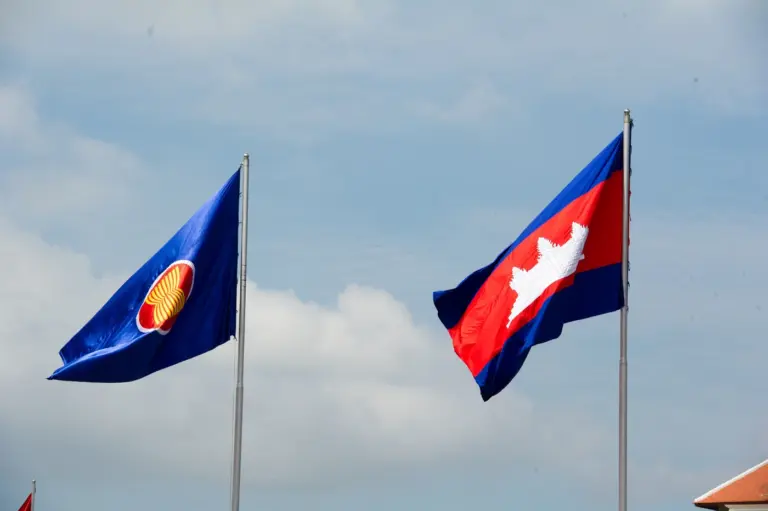
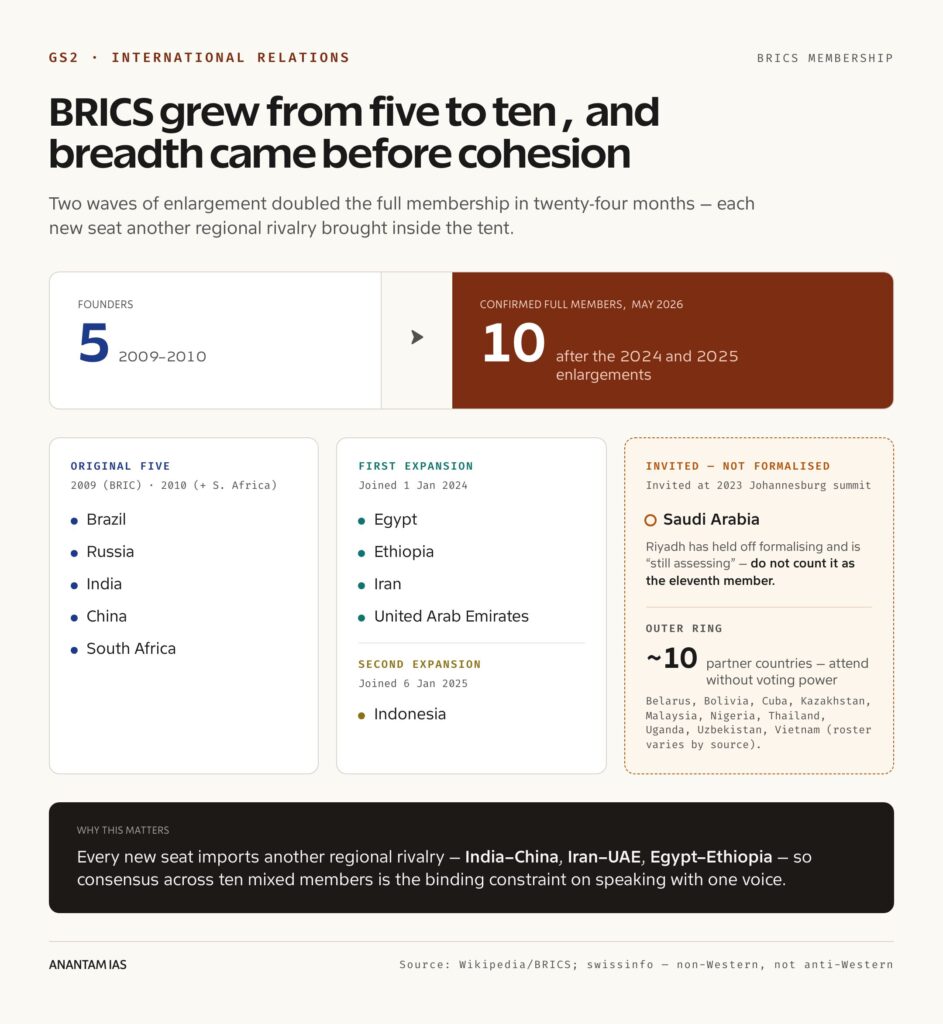
BRICS is the acronym for Brazil, Russia, India, China and South Africa — its five founding members (South Africa joined in 2010). It is now a ten-member grouping of major emerging economies, after Egypt, Ethiopia, Iran and the UAE joined in January 2024 and Indonesia in January 2025; Saudi Arabia has been invited but has not yet formalised membership. The bloc casts itself as the institutional voice of a multipolar world and the Global South, working by consensus — every member must agree before it can speak as one.
A bloc that speaks for more than half the planet’s people met in New Delhi in mid-May 2026 and couldn’t agree on a single sentence about the biggest war of the year. The foreign ministers came, they talked for two days, and they left without a joint statement. Iran wanted the group to condemn the United States and Israel. The UAE refused, and accused Iran of attacking it instead. So India, holding the chair this year, did the only thing a host can do when consensus collapses: it issued its own Chair’s Statement and Outcome Document, and quietly noted that members held “differing views” on West Asia.
That non-event is the whole topic. Because the moment a grouping that calls itself the voice of a multipolar world can’t produce common language on a hard case, you have to ask the uncomfortable question. Does the multipolarity BRICS claims to embody actually have a core, or is it a flexible platform where ten countries pursue parallel national interests under one banner? That’s not a gotcha. It’s the most important analytical question you can carry into a GS2 answer on global groupings, and the May 2026 meeting handed it to you on a plate.
The Issue, Framed
The argument here isn’t whether BRICS exists or whether it has weight. It plainly does. The argument is about cohesion: whether a bloc this large and this mixed can act as one when the stakes are real, or whether it’s strongest precisely when it asks the least of its members.
Let’s fix the vocabulary first, because most confusion about BRICS comes from people using big words loosely. BRICS began as an acronym, Brazil, Russia, India, China, and (from 2010) South Africa, and it’s now a self-described grouping of emerging economies that wants a bigger say in how the world is run. Multipolarity means a world order with several major centres of power rather than one dominant superpower (unipolarity) or two rival blocs (bipolarity). BRICS markets itself as the institutional face of that idea. The Global South is the loose shorthand for the developing world, the countries of Asia, Africa, and Latin America that feel under-represented in bodies like the UN Security Council and the IMF. And the consensus principle is BRICS’s working method: nothing speaks for the bloc unless every member agrees to it. No majority votes, no outvoting a dissenter. That last word does a lot of heavy lifting, as the May meeting showed.
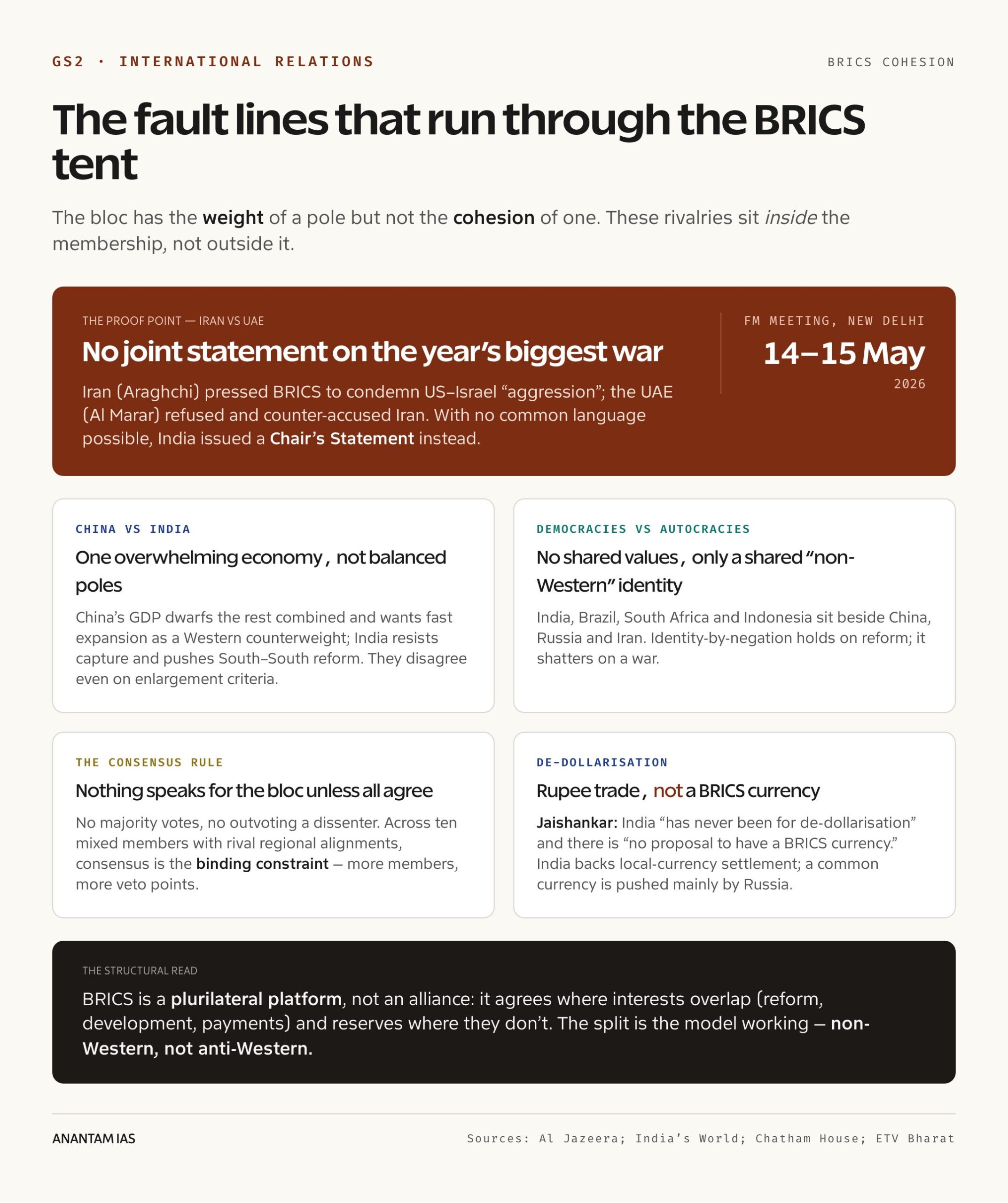
Now the peg. The BRICS foreign ministers met in New Delhi on 14-15 May 2026 under India’s 2026 chairmanship, a curtain-raiser to the Delhi summit later in the year. The two-day meeting ended without a joint statement, which is unusual for the bloc. The rupture was specific: Iran’s foreign minister Abbas Araghchi pressed members to condemn “unlawful aggression” by the US and Israel; the UAE’s minister Khalifa bin Shaheen Al Marar rejected that and accused Iran of attacking Gulf states. With no common language on West Asia possible, India issued a Chair’s Statement and Outcome Document, and EAM S. Jaishankar acknowledged “differing views among some members regarding the situation in West Asia.”
Here’s what makes it a clean teaching case, though. The bloc didn’t fall apart. It still produced an outcome document that, by India’s account, carried agreement on UN Security Council reform, food security, Digital Public Infrastructure, disaster management, and terrorism. So the split was surgical. BRICS held together on its development-and-reform agenda and broke only on a live security question where members sit on opposite sides. That pattern, cohesion on the soft agenda and paralysis on the hard one, is the thing to explain.
What the Data Says
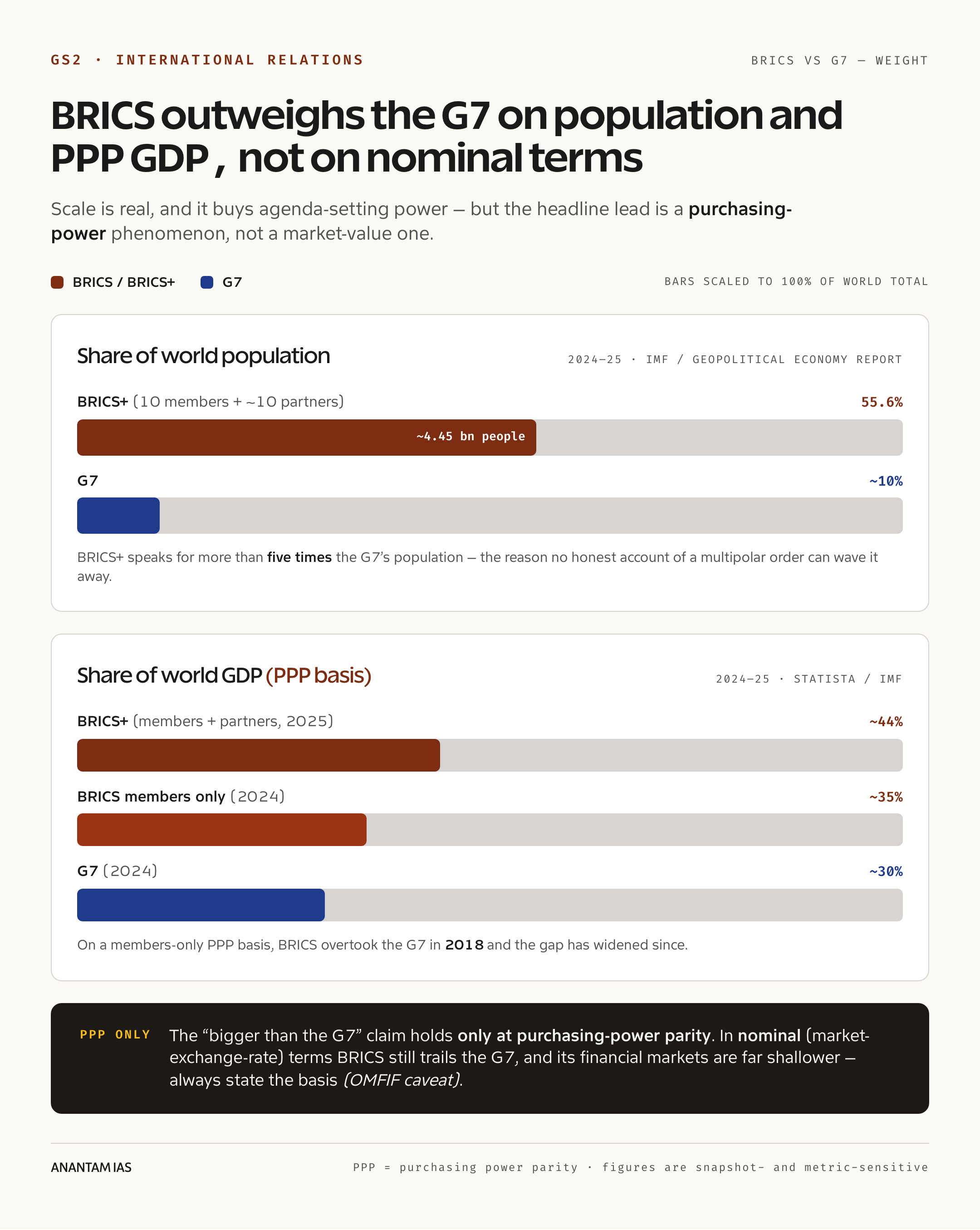
Start with the scale, because the numbers are why nobody can simply wave BRICS away. BRICS plus its partner countries covers roughly 4.45 billion people, about 55.6% of the world’s population, and around 44% of global GDP measured at purchasing power parity (IMF figures, July 2025). Put the comparison in front of you: the G7, the club of rich Western economies plus Japan, holds about 10% of the world’s people. A grouping that speaks for more than five times the G7’s population isn’t a sideshow in any honest account of a multipolar order.
But you have to handle the GDP claim carefully, because this is where weak answers overreach. PPP means purchasing power parity, a way of comparing economies that adjusts for how much a rupee or a yuan actually buys at home rather than at the market exchange rate. On that PPP measure, BRICS members alone were about 35% of world GDP in 2024 against the G7’s roughly 30%, and the bloc overtook the G7 on PPP terms back in 2018, with the gap widening since. So far, so impressive. The catch: in nominal terms, valued at market exchange rates, BRICS still trails the G7, and its financial markets are far shallower. The “bigger than the G7” line is true only on PPP. State that caveat in your answer and you sound like an analyst. Drop it and you sound like a brochure.
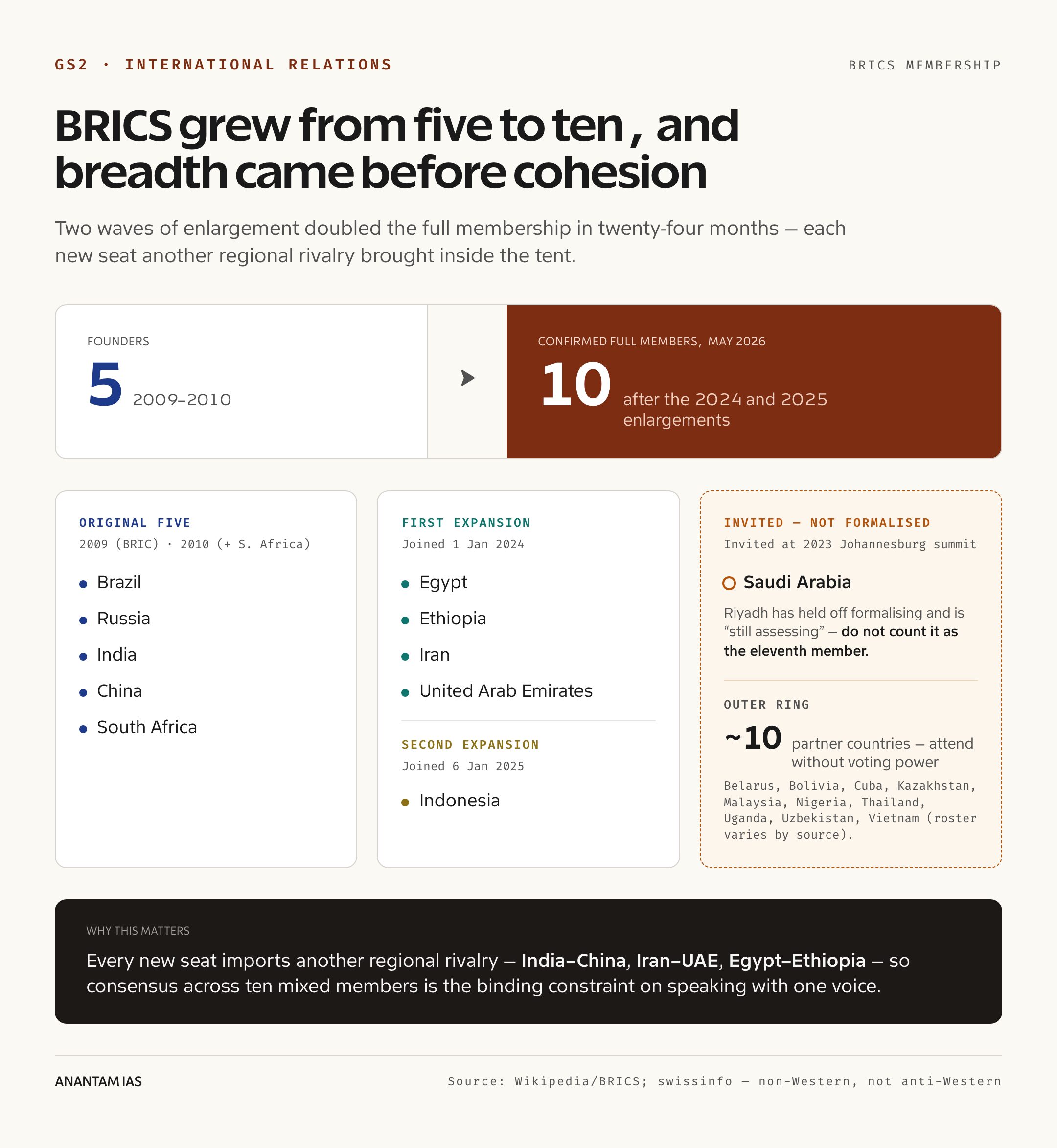
Now the membership, where precision separates a sharp answer from a sloppy one. As of May 2026, BRICS has ten confirmed full members: the original five (Brazil, Russia, India, China, South Africa), plus Egypt, Ethiopia, Iran, and the UAE who joined in January 2024, plus Indonesia from January 2025. Saudi Arabia is the trap. It was invited at the 2023 Johannesburg summit, and several guides list it as a member, but Riyadh has held off formalising, reportedly to avoid antagonising the US, and is “still assessing.” So the disciplined line is ten full members, with Saudi Arabia invited but not formalised. Beyond them sits an outer ring of around ten “partner countries” that attend meetings without voting power.
And there’s the de-dollarisation point, which trips up more aspirants than any other. De-dollarisation means reducing reliance on the US dollar in trade and reserves. Western commentary often paints BRICS as an anti-dollar bloc plotting a common currency, and US tariff threats have leaned on that framing. India’s position is the opposite, and you must attribute it precisely. Jaishankar has said India “has never been for de-dollarisation,” that there is “no proposal to have a BRICS currency,” and that India has “absolutely no interest in undermining the dollar at all.” MEA spokesperson Randhir Jaiswal put it flatly: “De-dollarisation is not part of India’s financial agenda.” What India backs is rupee internationalisation and local-currency settlement, paying for some bilateral trade in rupees, dirhams, or roubles to de-risk, not a single anti-dollar currency. As a bloc, BRICS has moved on local-currency lending through the New Development Bank and a cross-border payments initiative, but it has adopted no common currency, and that idea remains aspirational, pushed mainly by Russia.
One last data point ties the thesis together. The Chair’s Statement reportedly ran to dozens of paragraphs, with a couple carrying footnoted reservations and one openly recording the West Asia disagreement. The shape matters more than the arithmetic: the bloc agreed on most of the page and fenced off the part it couldn’t.
The Case For
The case that BRICS matters is genuinely strong, and a lazy answer that dismisses the bloc as a talking shop will lose marks. So let’s state it at full strength.
It’s the institutional voice of the Global South. No other grouping puts Brazil, India, Egypt, Ethiopia, Indonesia, and South Africa at one table with a shared demand: more representation for Africa, Asia, and Latin America in global decisions. Even after the May 2026 rupture, the outcome document carried stronger language on UN Security Council reform, food security, and Digital Public Infrastructure. The agenda survived the disagreement, which tells you the bloc has a real centre of gravity that isn’t the West Asia fight.
The demographic and economic weight is real, in PPP terms. More than half the world’s population and around 44% of PPP GDP isn’t a rounding error in any multipolar story. When a grouping this size demands IMF quota reform or a bigger UN Security Council, the demand can’t be brushed aside the way a single middle power’s could be. Scale buys agenda-setting power even when it doesn’t buy unity.
It pushes reform from outside the Western-built order. The New Development Bank (NDB), BRICS’s own multilateral lender, offers development finance without the Bretton Woods-style conditions the IMF and World Bank attach, and it’s working toward lending a chunk of its money in members’ local currencies. That’s a concrete alternative, not a slogan, and a second door for developing countries to knock on.
It’s a hedging platform, and that’s a feature, not a bug. For a middle power like India, BRICS is useful precisely because it asks little and offers options. You can use it to court the Global South, press for institutional reform, and de-risk trade, all without joining anyone’s military bloc. So the flexibility critics mock is the same flexibility that keeps India, Brazil, and others inside the tent. A tighter bloc would fit the very countries that give BRICS its credibility far worse.
And the de-risking agenda is substantive. Local-currency trade and interoperable cross-border payments are real tools to cut exposure to a single currency and to sanctions, distinct from the overhyped “BRICS currency” that keeps not arriving.
The Case Against
Here’s what the optimistic case walks past. A grouping is tested not by what it agrees on when agreement is cheap, but by what it can do when members want different things. On that test, May 2026 was a failing grade, and the failure was structural, not a bad day.
The collapsed joint statement is the proof point. On the single hardest live issue in front of the bloc, the Iran war, BRICS could not write one shared sentence. Iran wanted condemnation of the US and Israel; the UAE refused and counter-accused Iran. There was no common language to be had, so India substituted a Chair’s Statement. When a bloc’s defining moment is the host papering over a hole, the multipolar “core” looks thin.
There are no shared values holding it together. BRICS yokes democracies (India, Brazil, South Africa, Indonesia) to authoritarian states (China, Russia, Iran). The only common thread is a “non-Western” identity, a shared sense of being outside the club the West built. That’s enough to agree on reforming the IMF. It’s nowhere near enough to agree on a war. Identity-by-negation holds on soft questions and shatters on hard ones, which is exactly what the data showed.
The economic gravity is lopsided. China’s GDP dwarfs every other member’s combined, and analysts have long warned that India must resist BRICS turning into a vehicle for China’s geopolitical agenda. A multipole, by definition, has several roughly comparable poles. A bloc with one overwhelming economy and nine others isn’t a balanced multipole; it’s one big country and a coalition of the rest. Beijing and New Delhi don’t even agree on how fast the bloc should expand.
The internal rivalries sit inside the tent, not outside it. India and China spar over the border and the Indo-Pacific. Iran and the Gulf states distrust each other on regional security. Egypt and Ethiopia argue over the Nile. These aren’t frictions BRICS manages from a distance; they’re between its own members. As one analysis put it, consensus across so many members with rival regional alignments is “the binding constraint” on the bloc’s ability to speak as one. Add members and you add veto points.
And enlargement made it worse, not better. Going from five members to ten, with Saudi Arabia possibly to come, bought breadth at the direct cost of cohesion. Every new member is another regional rivalry imported, another reservation footnoted, another reason the next communiqué is thinner than the last. The risk isn’t that BRICS dies. It’s that it keeps growing while quietly losing the ability to mean anything on contested questions.
The Deeper Structural Read
Step back from the headline and the real fault line shows up. The question isn’t “is BRICS strong or weak?” It’s “what kind of thing is BRICS, and are we judging it by the right standard?”
The mistake most commentary makes is to grade BRICS as if it were trying to be an alliance, like NATO, with a shared enemy and a command structure. It was never that. BRICS is closer to what scholars call a plurilateral or minilateral platform, a coalition of states cooperating on the specific issues where their interests overlap, without surrendering autonomy on the issues where they don’t. Read that way, the May 2026 outcome isn’t a failure of the model. It’s the model working as designed: agree where you can (reform, development, payments), reserve where you can’t (West Asia). The Chair’s Statement with footnoted reservations is the system functioning, not breaking.
But here’s the harder truth that belongs in your answer. That same flexibility caps how far the bloc can ever embody “multipolarity” in the strong sense. A genuine pole needs the capacity to act collectively, to project a shared position and back it. BRICS has the weight of a pole, more than half the world’s people, but not the cohesion of one. So it can set agendas and pressure institutions, but it can’t deliver a unified line on security. Multipolarity, as BRICS practises it, has a real core, shared grievances about Western dominance and shared interests in development. What it lacks is a shared strategy. Those are different things, and the examiner wants you to know the difference.
There’s a layer below that, too, and it’s where India’s role becomes the analytical key. India is suited to the consensus-manager job precisely because it refuses the framing both extremes want. Russia, and at times China, want BRICS to be sharply anti-Western. PM Modi’s line at Kazan in 2024 was the opposite: the bloc must “be careful to ensure that this organization does not acquire the image of one that is trying to replace global institutions.” India’s settled formulation, that BRICS is “non-Western, not anti-Western,” does real strategic work. It lets India use BRICS for Global South leverage while keeping its parallel ties with the US, the EU, Israel, and the Gulf fully intact. So when the bloc couldn’t agree on the Iran war, India didn’t force a fake unity. It registered the disagreement and protected the rest. That’s not weakness. It’s a balancing state choosing platform over bloc, on purpose.
Which leaves you with the structural verdict. BRICS is best understood as evidence that the world is becoming multipolar, not as the organising centre of that multipolarity. The order has many poles now; this grouping is one expression of that fact, not its command room. Mistaking the symptom for the structure is the most common error in writing about BRICS, and avoiding it is how you signal real understanding.
What Should Be Done
So what should India actually do with a platform that has enormous weight and limited cohesion? Not a vague plea to “engage constructively,” but a set of choices you could defend in front of an examiner. Six of them, and none requires India to either inflate or abandon the bloc.
- Use BRICS for agenda-setting, not bloc-building. India’s revealed preference, visible in the 2026 chairmanship and the Delhi outcome document, is to keep the bloc focused on development, connectivity, Digital Public Infrastructure, food security, and economic governance, the areas where consensus is achievable. Don’t drag it onto security confrontations it structurally can’t resolve. Play to the platform’s strengths and stop expecting it to behave like an alliance.
- Push reform of the UN Security Council and IMF, not their replacement. This is Modi’s Kazan line in policy form. India should keep channelling BRICS weight into reforming global institutions, expanding the Security Council, fixing IMF quotas, rather than building parallel ones that would isolate the bloc and spook the very Global South partners it courts. Reform is credible; replacement is a slogan that frightens fence-sitters.
- Hold the “non-Western, not anti-Western” line, publicly and consistently. This single distinction protects India’s multi-alignment, the practice of keeping working relationships with rival power centres at once. It’s what lets India sit in BRICS and the Quad in the same week without contradiction. Surrender that framing and India loses the flexibility that makes the bloc useful in the first place.
- Resist Chinese capture and unmanaged expansion. Keep the NDB rules-based, insist on equitable representation, and treat further enlargement cautiously. Every rushed admission is another rivalry imported and another reservation footnoted. Breadth without cohesion is how a platform talks itself into irrelevance.
- Champion local-currency trade, and disown the anti-dollar bloc story. Continue rupee internationalisation and bilateral local-currency settlement to de-risk, while saying plainly, as Jaishankar and the MEA already do, that India isn’t pursuing de-dollarisation or a BRICS currency. The economic substance is real; the anti-dollar framing is a liability India is right to reject.
- Play the consensus-manager, and accept the limits of the role. The Delhi handling, bilateral consultations, a softened West Asia paragraph, a Chair’s Statement that let members register reservations, is the template. Keep the platform functional on shared interests, and let members dissent on contested ones rather than forcing a unity that doesn’t exist. Managing disagreement honestly is more durable than manufacturing agreement that collapses on contact.
Do all six and India keeps the upside of BRICS, Global South credibility, reform leverage, a hedge, without buying the downside, a confrontation it doesn’t want and a cohesion the bloc can’t supply.
For Your Mains Answer
This is a high-value GS2 topic because it lets you discuss global groupings, multipolarity, India’s strategic autonomy, and the architecture of global governance in one frame, with a live, datable peg.
GS paper mapping: GS2 International Relations: bilateral, regional and global groupings and agreements involving India; effect of policies of developed and developing countries on India’s interests; important international institutions and their structure and mandate. It also feeds GS3 (external sector, local-currency trade, energy security) and the Essay (multipolarity, the Global South, the limits of solidarity).
Likely question frames:
- “BRICS has the weight of a pole in the international system but not the cohesion of one.” Critically examine in light of recent developments in the grouping.
- A multipolar world order is emerging, but BRICS is its symptom rather than its organising centre. Discuss with reference to India’s role in the bloc.
- Examine how India balances its membership of BRICS with its partnerships across the Western and Gulf worlds, and assess the sustainability of this multi-alignment.
Quotable data points:
- The BRICS foreign ministers’ meeting in New Delhi (14-15 May 2026) ended without a joint statement; India, as chair, issued a Chair’s Statement and Outcome Document instead.
- Jaishankar acknowledged “differing views among some members regarding the situation in West Asia”.
- BRICS plus partners ≈ 4.45 billion people, about 55.6% of world population, and ≈ 44% of global GDP at PPP (IMF, July 2025).
- BRICS members ≈ 35% of world GDP (PPP) versus G7 ≈ 30% (2024); BRICS overtook the G7 on PPP GDP in 2018 – PPP only; in nominal terms BRICS still trails the G7.
- Ten confirmed full members in 2026 (original five + Egypt, Ethiopia, Iran, UAE, Indonesia); Saudi Arabia invited but not formalised.
- Jaishankar: India “has never been for de-dollarisation,” “no proposal to have a BRICS currency,” “no interest in undermining the dollar”; MEA’s Randhir Jaiswal: “De-dollarisation is not part of India’s financial agenda”.
- Modi (Kazan 2024): BRICS must not “acquire the image of one that is trying to replace global institutions”.
Keywords to use: multipolarity, plurilateralism, minilateralism, consensus principle, Global South, de-dollarisation, local-currency trade, rupee internationalisation, UN Security Council reform, IMF quota reform, strategic autonomy, multi-alignment, hedging, New Development Bank.
Syllabus linkages: regional and global groupings involving India; international institutions, their structure and mandate; effect of developed- and developing-country policies on India’s interests; India’s strategic autonomy and multi-alignment.
Balanced conclusion line: BRICS proves the world has become multipolar; it doesn’t prove that multipolarity has a single core, and India’s smartest play is to use the bloc’s weight for reform and leverage while refusing to pretend it can carry a cohesion it was never built to hold.
How to Build the Answer
Open with the conflict, not a definition. The sharpest first line states the paradox: a bloc speaking for over half the world couldn’t agree on one sentence about the year’s biggest war. That tells the examiner you’ve grasped both the scale and the cohesion problem at once. The definitions of multipolarity and the consensus principle can follow in the next sentence. Never open with a glossary; open with the tension the glossary then explains.
Bring data in early, but ration it. A strong first body paragraph carries three figures and no more: 55.6% of world population, 44% of PPP GDP, ten full members. Then say what they prove, that scale is real but cohesion is not. UPSC rewards the move from fact to inference, so the number is the anchor and the “this means” is the mark.
The second body paragraph should steelman the side you’ll eventually qualify. If your stance is that BRICS lacks a core, first state honestly why the bloc matters, the Global South voice, the NDB, the reform agenda. An answer that only attacks reads as one-sided; an answer that concedes the strong version of the other case before qualifying it reads as judgment.
Group the way forward; don’t scatter it. Cluster India’s choices: agenda over bloc, reform over replacement, non-Western over anti-Western, resist capture, local-currency over de-dollarisation, manage consensus honestly. Use the topic’s own vocabulary, plurilateralism, multi-alignment, hedging, so the answer reads as IR analysis rather than a news recap.
Close on the structural verdict, not a restatement. The reliable pattern is “BRICS is X, not Y”, multipolar evidence, not multipolar command room. That single distinction is the most examiner-pleasing line you can write, because it shows you can separate a symptom from a structure.
Common Mistakes to Avoid
- Don’t call BRICS an anti-Western bloc. India explicitly rejects that framing. Attribute the de-dollarisation and “BRICS currency” stories to whoever is pushing them, and note India’s contrary position.
- Don’t state the PPP figure without the word PPP. The “bigger than the G7” claim is PPP-only; in nominal terms BRICS trails. Dropping the caveat is a factual error, not a stylistic one.
- Don’t list Saudi Arabia as a member. Ten full members in 2026; Saudi Arabia was invited but has not formalised. Precision here signals current, careful reading.
- Don’t predict BRICS’s collapse. The bloc held its agenda together even as it split on West Asia. The honest verdict is limited cohesion, not imminent demise.
- Don’t forget India’s agency. The topic isn’t only about BRICS; it’s about what India does with it. An answer that never names India’s consensus-manager role misses the GS2 point.
A Compact Answer Spine
- Introduction: Open with the no-joint-statement paradox in one line; define multipolarity and the consensus principle in the next.
- Evidence: Two or three attributed figures (population, PPP GDP, membership), each tied to an inference about scale versus cohesion.
- Arguments: The case that BRICS matters (Global South voice, NDB, weight), then the case that it lacks a core (failed statement, no shared values, China’s gravity, internal rivalries).
- Structural diagnosis: BRICS is a plurilateral platform, not an alliance; it has the weight of a pole but not the cohesion of one.
- Way forward: Four to six grouped choices for India, each with a clear logic, agenda-setting, reform, non-Western framing, local-currency trade, consensus management.
- Conclusion: Adapt the balanced line to the exact question, BRICS proves multipolarity exists, not that it has one core.
Diagram or Flowchart Idea
For a 15-marker, draw one causal chain rather than a decorative web: expansion (5 to 10 members) → more rival regional alignments inside the tent → consensus harder on hard cases → no joint statement on West Asia → Chair’s Statement with reservations → agenda preserved, cohesion limited. The examiner reads that logic in seconds.
For a 10-marker, skip the flowchart and use a two-column table instead: “What BRICS has” (population, PPP GDP, Global South voice, NDB) against “What BRICS lacks” (shared values, balanced poles, security cohesion). Faster to draw, faster to mark.
Ethics and Governance Angle
Even an IR answer can carry one line on the governance of global institutions, and it strengthens the conclusion. The deeper claim under the BRICS reform agenda is fairness: the post-1945 order under-represents the countries where most of humanity now lives. A bloc holding 55.6% of the world’s population but a fraction of the votes at the IMF and the UN Security Council is a legitimacy problem for global governance, not just a grievance.
Then convert that into a design point rather than a complaint. The mature position isn’t “tear down the Western order”; it’s “reform it so it reflects today’s distribution of people and economic weight.” That’s Modi’s Kazan line, and it’s the difference between a revisionist posture and a reformist one. UPSC rewards the reformist framing because it treats institutions as things to fix, not trophies to capture.
A portable sentence: “The grouping’s aim, fairer representation in global governance, is legitimate; its method matters, and reform earns more than replacement.” It accepts the goal without endorsing confrontation, which is exactly the balance an examiner wants on a contested-grouping question.
How to Use Data Without Sounding Mechanical
Use fewer numbers than you know. Three well-explained figures beat ten dumped in a row. Lead with one big scale number (55.6% of world population), use a second for contrast (44% PPP GDP versus the G7’s 30%), and use a third to puncture the hype (ten members, not eleven; Saudi Arabia not formalised). One scale figure, one contrast, one precision check is plenty.
Never leave a statistic standing alone. Follow it with “this means” or “the implication is.” The PPP figure means weight; the failed statement means the weight doesn’t convert into a unified voice. That tiny move turns a fact sheet into analysis, which is the whole difference between recall and judgment.
Finish by asking one question of your own draft: can a tired examiner follow this in a single pass? If a sentence needs rereading, cut it. Short introduction, data early, two sides marked cleanly, a grouped way forward, a verdict that separates symptom from structure. For UPSC, clarity is how depth becomes visible. Be specific, attribute the contested claims, and let the judgment carry the marks.
FAQ
Why did the BRICS meeting in May 2026 end without a joint statement?
The foreign ministers couldn’t agree on how to describe the US-Israel war on Iran. Iran’s minister wanted BRICS to condemn US and Israeli “aggression”; the UAE refused and accused Iran of attacking Gulf states. With no common language on West Asia possible, India, as chair, issued a Chair’s Statement and Outcome Document instead of a consensus communiqué, noting that members held differing views.
Does BRICS want to replace the US dollar?
Not as a unified bloc, and India explicitly rejects that goal. Jaishankar has said India “has never been for de-dollarisation” and that there is “no proposal to have a BRICS currency.” What BRICS pursues is local-currency trade and cross-border payment links to de-risk, while a common currency remains an aspiration pushed mainly by Russia, not an adopted policy.
How many members does BRICS have in 2026?
Ten confirmed full members: Brazil, Russia, India, China, and South Africa (the original five), plus Egypt, Ethiopia, Iran, and the UAE (joined January 2024) and Indonesia (joined January 2025). Saudi Arabia was invited in 2023 but has not formalised its membership, so it shouldn’t be counted as a full member. An outer ring of around ten partner countries attends without voting power.
Is BRICS bigger than the G7?
On population and on GDP measured at purchasing power parity, yes: BRICS plus partners holds about 55.6% of the world’s people and around 44% of PPP GDP, and BRICS members overtook the G7 on PPP GDP in 2018. But in nominal terms, at market exchange rates, BRICS still trails the G7, and its financial markets are far shallower. The “bigger than the G7” claim holds only on the PPP measure.
Tell Google you want more of this.
Add Anantam IAS as a preferred sourceOne tap, and this site shows up more often in your own Top Stories, AI Overviews and AI Mode. Remove it any time.