Buxa Tiger Reintroduction: Habitat Readiness Before Release
Why in News?
West Bengal has announced a plan to introduce a tigress into Buxa Tiger Reserve in north Bengal on October 2, according to The Hindu. The date is a proposed operational target, not proof that donor selection, statutory clearances and field-readiness checks have all been completed.
The proposal brings attention to a difficult conservation question: moving a tiger can begin a recovery programme, but it can’t substitute for adequate prey biomass, secure habitat, compatible genetics, low conflict risk and sustained monitoring.
- The announcement was made by West Bengal Environment and Forest Minister Manoj Oraon on July 24, 2026.
- The Hindu reported that officials were considering a tigress from Valmiki Tiger Reserve in Bihar and were also examining options in Assam.
- The reported donor options remain proposals; the final animal and source population must pass NTCA, ecological, veterinary and genetic scrutiny.
- Officials ruled the Sundarban out as an obvious donor because its mangrove-adapted tigers belong to a distinctive ecological setting.
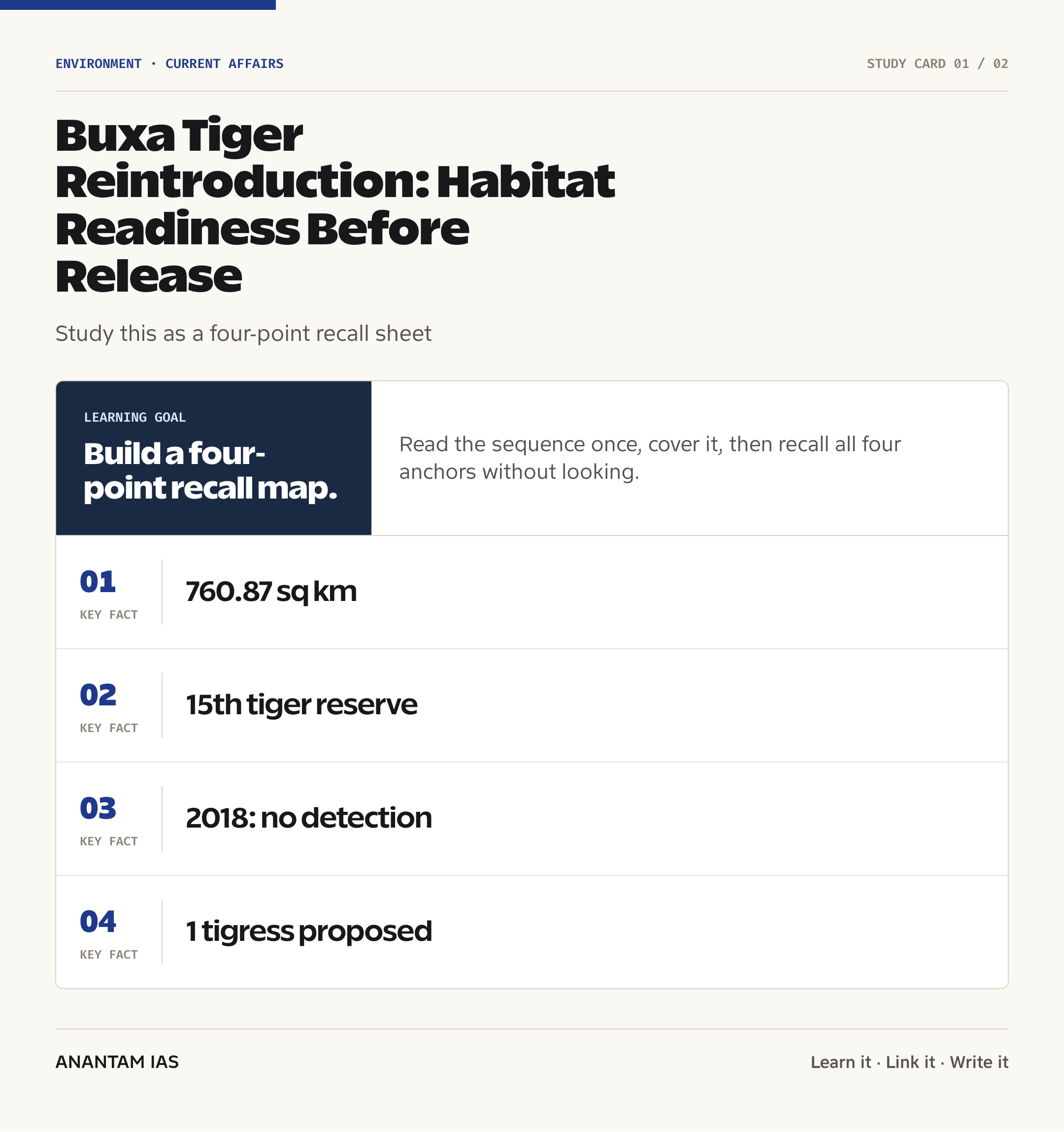
- Buxa had no tiger detection in the 2018 All India Tiger Estimation, though an adult male was camera-trapped in the reserve in December 2021.
The development matters in the context of:
- The proposal matters in the context of recovering a tiger population in a reserve where abundance is far below the habitat’s assessed carrying capacity.
- It tests the difference between animal translocation and full species reintroduction, which seeks a viable, free-ranging population in former range.
- It connects Project Tiger with prey restoration, corridor security, community rights, human-wildlife conflict management and conservation genetics.
- It also shows why a launch date should remain conditional on measurable readiness rather than becoming the main measure of success.
UPSC Relevance
Prelims Relevance
- Buxa Tiger Reserve is in the Dooars region of northern West Bengal, near the international boundary with Bhutan.
- Buxa became India’s 15th tiger reserve under Project Tiger in 1983.
- The WII Management Effectiveness Evaluation portal records a total area of 760.87 sq km, including a 390.58 sq km core or Critical Tiger Habitat.
- The reserve lies where the Lower Gangetic Plains, Central Himalaya and Brahmaputra Valley biogeographic zones meet.
- Important forest formations include Eastern Bhabar and Terai Sal, moist mixed deciduous, sub-montane semi-evergreen and wet hill forests.
- Buxa’s identified linkages include the Buxa-Titi, Buxa-Chilapata and Buxa-Ripu at Sankosh corridors.
- Section 38V of the Wild Life (Protection) Act, 1972 requires a Tiger Conservation Plan for a tiger reserve.
- The NTCA is a statutory body under the Wild Life (Protection) Act and guides tiger-reserve management, reintroduction and monitoring.
- Soft release keeps a translocated animal temporarily in an in-situ enclosure before release; it is preferred in the NTCA active-management SOP.
- Phase IV monitoring uses camera traps for annual tiger monitoring in source areas, while M-STrIPES supports patrolling and ecological records.
Mains Relevance
GS Paper 3
- Biodiversity conservation through Project Tiger, habitat restoration, prey-base assessment and landscape connectivity.
- Scientific and ethical requirements for reintroduction, including genetic compatibility, veterinary screening and post-release telemetry.
- Managing human-wildlife conflict, linear infrastructure, poaching risks and pressures on forest resources.
GS Paper 2
- Centre-State coordination among the NTCA, State Forest Department, source state and reserve authorities.
- Balancing conservation with due process, community participation and rights under the Forest Rights Act, 2006.
GS Paper 1
- Dooars geography, Terai-Bhabar ecology and the role of transboundary linkages between India and Bhutan.
Essay
- Conservation succeeds when an ecosystem is repaired, not when an animal is merely relocated.
- Large carnivores turn administrative borders into ecological questions of cooperation.
Background and Context
What Reintroduction Actually Means
A successful reintroduction is a population-recovery project, not a one-day release event.
- The NTCA defines tiger reintroduction as establishing a population in an area within the species’ historical range where it has become locally extinct.
- Its principal aim is a viable, free-ranging population capable of performing its ecological and evolutionary role with minimal long-term management.
- A translocation is the physical movement of an animal; reintroduction is the wider ecological programme covering feasibility, release stock, social conditions, release and long-term follow-up.
- A single tigress may function as a cautious first phase, but one animal can’t by itself create a breeding population; later decisions must be based on survival, settlement, prey use and risk data.
- Reintroduction differs from population reinforcement, where animals are added to an existing resident population. Buxa’s uncertain and very low baseline makes that distinction dependent on fresh field evidence, not labels used in a public announcement.
- India’s experience includes recovery at Sariska and Panna, while problems at Satkosia show that biological, administrative and social preparedness can decide outcomes.
Buxa's Geography and Ecological Position
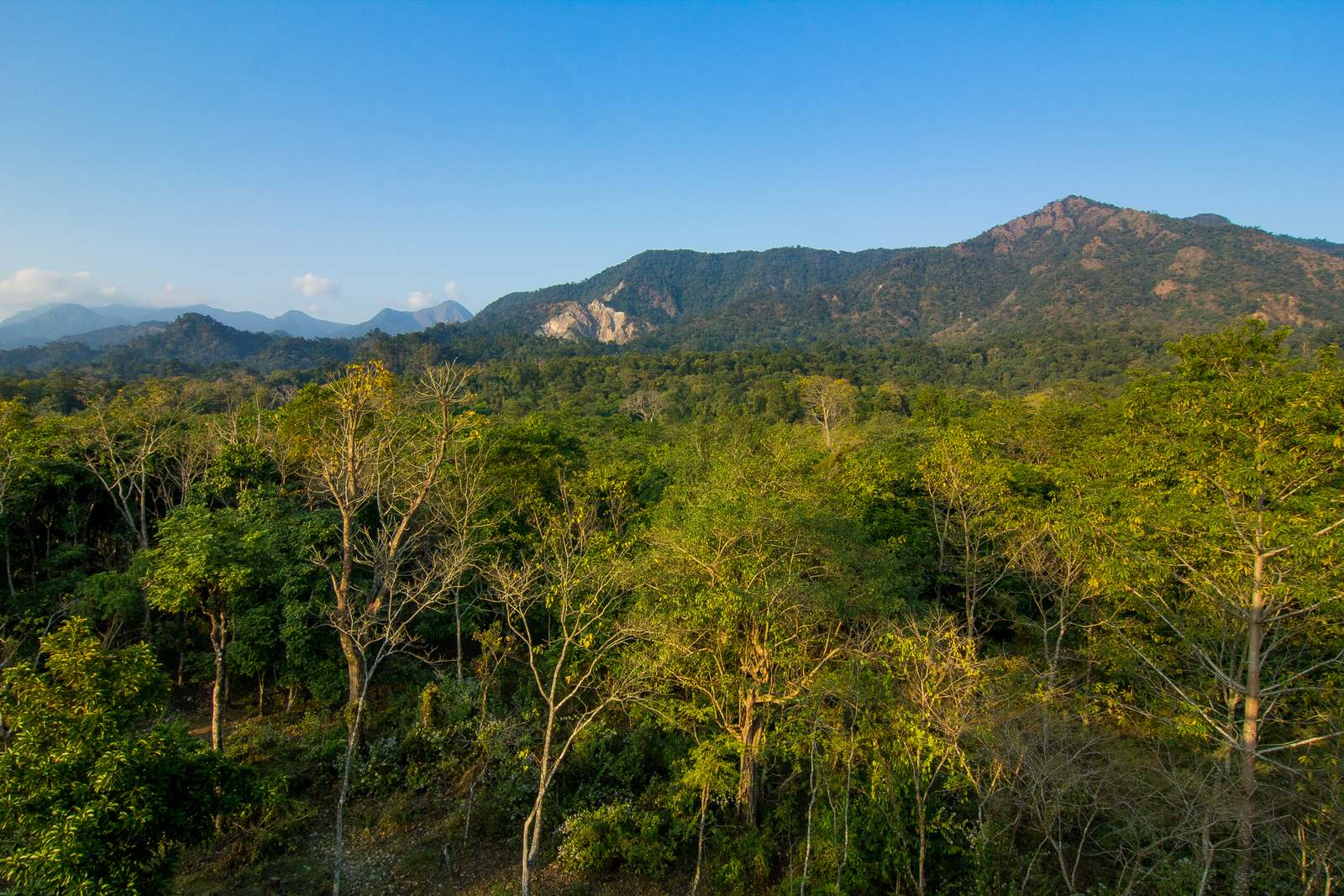
Buxa occupies a biologically rich transition zone at the Himalayan foothills and the eastern edge of the Dooars.
- The reserve is in Alipurduar in northern West Bengal and extends towards the Bhutan border across hill, foothill, riverine and alluvial habitats.
- The WII portal places it at the meeting point of three biogeographic zones: Lower Gangetic Plains, Central Himalaya and Brahmaputra Valley.
- Its mosaic of Terai Sal, semi-evergreen, moist deciduous, savannah woodland and wet hill forest can support diverse prey and co-predators if disturbance is controlled.
- Recorded fauna include tiger, leopard, clouded leopard, elephant and gaur, showing that Buxa is more than a single-species conservation unit.
- Rivers, foothills and forest transitions can create productive habitat, but they also make patrol access, flood-season monitoring and animal movement uneven. A site-level release range must be assessed more precisely than the reserve-wide habitat label.
- The reserve’s 760.87 sq km area must be read as core plus buffer; ecological viability also depends on connected habitat beyond the legal boundary.
Tiger History and the Readiness Gap
Past tiger records show historical use, but they don’t remove the need for a current, transparent baseline.
- The WII assessment records minimum estimates of 12 tigers in 2007, 15 through DNA analysis in 2010 and 20 through a 2011 DNA analysis with a strongly male-skewed result.
- No tiger was recorded in Buxa during the 2018 AITE; an adult male later appeared on a camera trap in East Damanpur Range in December 2021.
- An occasional camera-trap record can show presence or dispersal, but it isn’t equivalent to evidence of a resident breeding population.
- WII links Buxa’s low tiger density to anthropogenic pressure and a reduced prey population, and records grassland work and the release of chital as prey-restoration measures.
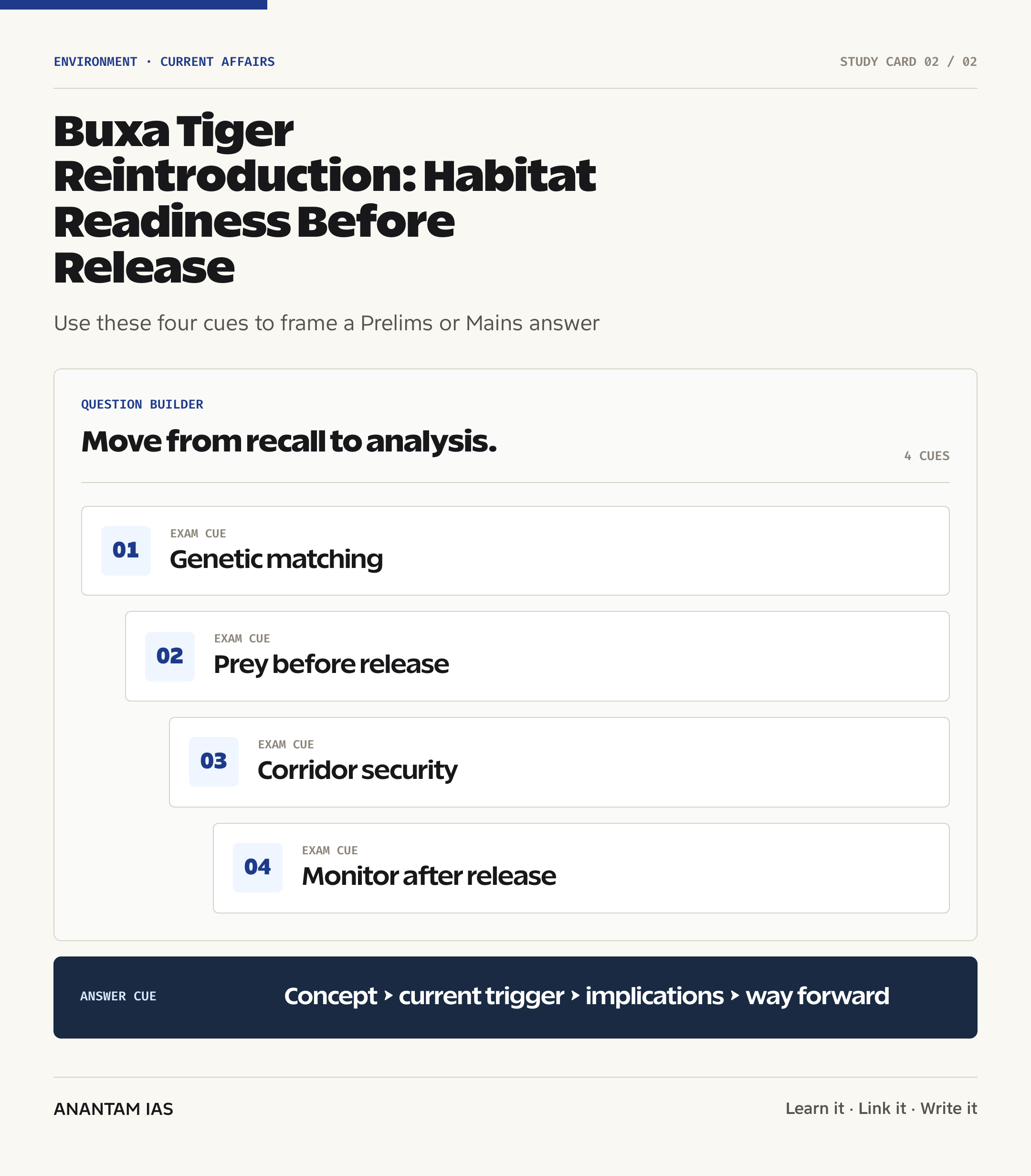
- Before release, managers need current estimates of prey density, competing carnivores, livestock use, water, disturbance, disease exposure, poaching risk and carrying capacity.
- Prey augmentation isn’t just the number of animals released. Managers must measure survival, breeding and distribution of wild prey and avoid disease transfer, over-browsing or dependence on repeated stocking.
- The case should be studied alongside the wider logic of Project Tiger, where habitat and protection are the foundation and animal movement is only one tool.
Choosing a Donor Population
The source tiger must fit the receiving landscape genetically, ecologically and behaviourally.
- The Hindu reported that Valmiki Tiger Reserve was under consideration and that Assam was another possible source; neither report should be treated as a final donor decision.
- The NTCA’s active-management SOP places Buxa in its Northeast Hills and Brahmaputra Floodplains Cluster I with Kaziranga, Manas, Orang, Nameri, Jaldapara and other landscapes.
- That SOP identifies Kaziranga and Orang as source populations in the cluster and lists Buxa among possible low-density recipient areas, subject to protection readiness.
- The same SOP places Valmiki in the Shivalik Hills and Gangetic Plains landscape, so a Valmiki proposal calls for explicit, updated genetic and ecological justification rather than an assumption based on state proximity.
- The SOP treats Sundarban tigers as phenotypically distinctive and adapted to mangrove habitat; it says they shouldn’t be introduced into other clusters.
- A donor reserve also needs a defensible demographic surplus. Removing a breeding-age female from a small or vulnerable population can shift risk from the recipient landscape back to the source.
- Final selection should consider relatedness, sex, age, health, behaviour, conflict history and the donor population’s own demographic needs.
Release Protocol and Monitoring
Field protocol converts a transport operation into a controlled conservation intervention.
- The NTCA SOP requires the receiving site’s field protection and prey base to be ascertained before translocation.
- It prefers soft release, which uses an in-situ enclosure with natural prey to let the tiger acclimatise before entering the open landscape.
- A translocated tiger should be radio-collared for close monitoring of movement, settlement, kills, proximity to settlements and possible attempts to return towards the source.
- Veterinary work should cover capture fitness, injuries, pathogens, parasites, transport stress and emergency-response arrangements without turning routine intervention into excessive handling.
- Camera traps, telemetry and M-STrIPES patrol data should be combined under clear thresholds for intervention, recapture or conflict response.
- Monitoring data should be reviewed by a named technical group and released in periodic summaries. This separates a genuine adaptive-management programme from a sequence of unverified claims about sightings or settlement.
- Success should be assessed over years through survival, reproduction, prey response, conflict trends and habitat use, not through the release ceremony.
Corridors, Communities and Conflict
A tiger will use a lived landscape, so ecological connectivity and human safety must be planned together.
- WII identifies the Buxa-Titi, Buxa-Chilapata and Buxa-Ripu at Sankosh corridors as important wildlife linkages.
- These connections link Buxa with landscapes towards Manas, Jaldapara and Phipsoo Wildlife Sanctuary in Bhutan, giving the reserve transboundary importance.
- The same assessment records villages, tea gardens, grazing and forest-resource dependence in and around Buxa, along with gaps in prey and staffing.
- Any relocation from critical habitat must be voluntary, rights-compliant, adequately compensated and livelihood-secure; coercion would be legally and socially damaging.
- Corridor governance reaches beyond forest departments because roads, rail lines, tea estates and settlements affect permeability. District administration and infrastructure agencies must keep risky bottlenecks from becoming ecological traps.
- Conflict preparation needs rapid compensation, livestock-protection support, local warning systems, trained response teams and trusted communication before a tiger is released.
- The broader framework is explained in human-wildlife conflict management, where prevention and community confidence matter as much as emergency capture.
Law, Institutions and Accountability
Tiger recovery is governed through a statutory framework rather than an isolated state-level announcement.
- The Wild Life (Protection) Act, 1972 gives the NTCA statutory functions and requires tiger-reserve notification and planning under Chapter IVB.
- Under Section 38V, a Tiger Conservation Plan must address core protection, prey and co-predators, buffer management, compatible land use and corridors.
- The Chief Wildlife Warden, Buxa field management, West Bengal Forest Department, donor-state authorities, veterinarians, scientists and NTCA each carry distinct responsibilities.
- The legal setting, including protected-area categories and wildlife schedules, can be revised through Wild Life (Protection) Act provisions and amendments.
- Inter-state movement requires a documented chain of custody, veterinary certification and coordination between the source and recipient authorities. Those records protect animal welfare and allow later evaluation of what worked or failed.
- Public accountability needs a dated readiness note covering prey, protection, source selection, community consultation, animal health, release method and contingency arrangements.
- If the readiness evidence isn’t complete by October 2, postponement would be a conservation safeguard rather than a policy failure.
Way Forward
Make the Date Conditional
- Treat October 2 as a target subject to written readiness gates, not an irreversible deadline.
- Publish a concise pre-release assessment and record the NTCA approvals, donor-state consent and reasons for source selection.
Prove Habitat and Prey Readiness
- Complete seasonal prey-density, water, livestock, carnivore, disease and human-disturbance baselines in the proposed release range.
- Link prey augmentation to native habitat restoration and scientific monitoring; avoid manipulating habitat only to meet a release calendar.
Use Genetics to Select the Source
- Compare candidate tigers and populations through genetic affinity, demographic surplus and ecological suitability.
- Explain any departure from the NTCA’s published landscape-cluster guidance with updated evidence and expert review.
Build a Long Monitoring Window
- Use soft release, a radio collar, camera traps and round-the-clock field capacity during the high-risk settling period.
- Predefine triggers for veterinary intervention, conflict response, recapture and independent review.
Put Communities Inside the Plan
- Complete rights recognition, voluntary relocation processes and livelihood safeguards before creating new restrictions.
- Fund rapid compensation, livestock security, local response teams and corridor-compatible land use so nearby residents share both safety and conservation benefits.
Conclusion
The proposed Buxa tiger reintroduction is ecologically significant because it could restore a top predator to a landscape where tiger abundance has collapsed. But the quality of the programme will be measured by habitat, prey, genetics, protection and public trust, not by whether a release occurs on a symbolic date.
A phased, evidence-led approach can turn Buxa into a test of modern landscape conservation. The sound policy is simple: release only when the receiving ecosystem and surrounding institutions are ready to keep both the tiger and people safe.
UPSC Practice Questions
Prelims MCQ 1
With reference to Buxa Tiger Reserve, consider the following statements:
- It is located in northern West Bengal near the Bhutan border.
- It lies at the meeting point of the Lower Gangetic Plains, Central Himalaya and Brahmaputra Valley biogeographic zones.
- No tiger was recorded there during the 2018 All India Tiger Estimation.
How many of the above statements are correct?
(a) Only one (b) Only two (c) All three (d) None
Answer: (c) All three
Explanation:
All three statements are correct. Buxa is in the Dooars of northern West Bengal, occupies a three-zone biogeographic junction, and had no tiger detection in the 2018 AITE. An adult male was camera-trapped later, in December 2021.
Prelims MCQ 2
Which source populations did the NTCA active-management SOP identify for the Northeast cluster containing Buxa?
(a) Corbett and Dudhwa (b) Kaziranga and Orang (c) Ranthambore and Sariska (d) Kanha and Bandhavgarh
Answer: (b) Kaziranga and Orang
Explanation:
The SOP lists Kaziranga and Orang as source populations producing dispersing tigers in Northeast Cluster I. It includes Buxa among possible recipient areas, subject to adequate protection.
UPSC Mains Questions
- Tiger reintroduction is an ecosystem-restoration programme, not merely the translocation of an individual animal. Discuss with reference to habitat readiness, prey density, conservation genetics and post-release monitoring in Buxa Tiger Reserve.
- Examine how corridors, community rights and human-wildlife conflict preparedness shape the prospects of recovering a viable tiger population in the transboundary landscape around Buxa Tiger Reserve.
- Symbolic deadlines can weaken evidence-led wildlife management. Suggest an accountable decision framework for selecting a donor population and deciding when a tiger should be released into a low-density reserve.
Sources: National Tiger Conservation Authority and Wildlife Institute of India and The Hindu.
Frequently Asked Questions
Where is Buxa Tiger Reserve?
Buxa Tiger Reserve lies in the Dooars of northern West Bengal, in Alipurduar, close to Bhutan. It occupies a transition among the Lower Gangetic Plains, Central Himalaya and Brahmaputra Valley biogeographic zones and is linked with other protected landscapes through wildlife corridors.
When is the Buxa tiger release planned?
West Bengal announced October 2 as the target for introducing a tigress. The date should be read as a proposal because final release depends on donor selection, NTCA and inter-state processes, habitat and prey readiness, veterinary screening, community safeguards and operational preparedness.
Why not move a Sundarban tiger?
The NTCA SOP treats Sundarban tigers as phenotypically distinctive and specially adapted to the mangrove landscape. It advises that they remain within the Sundarban cluster and that tigers from other clusters not be introduced there, protecting ecological adaptation and genetic integrity.
Which source population suits Buxa?
The reported options include Valmiki and reserves in Assam, but no final donor was confirmed. The NTCA’s published cluster guidance places Buxa with Northeast landscapes and identifies Kaziranga and Orang as source populations. Any choice needs updated genetic, ecological, demographic and veterinary evidence.
What makes reintroduction successful?
Success needs adequate wild prey, secure and connected habitat, a suitable donor animal, soft-release capacity, radio-collar and camera-trap monitoring, trained protection and conflict teams, rapid compensation, community trust and enough follow-up to show survival, settlement and reproduction.
What is soft release?
Soft release means holding a translocated tiger temporarily in a secure in-situ enclosure with natural conditions and prey before releasing it into the wider reserve. The NTCA SOP prefers this method because it allows acclimatisation and reduces some risks associated with immediate hard release.