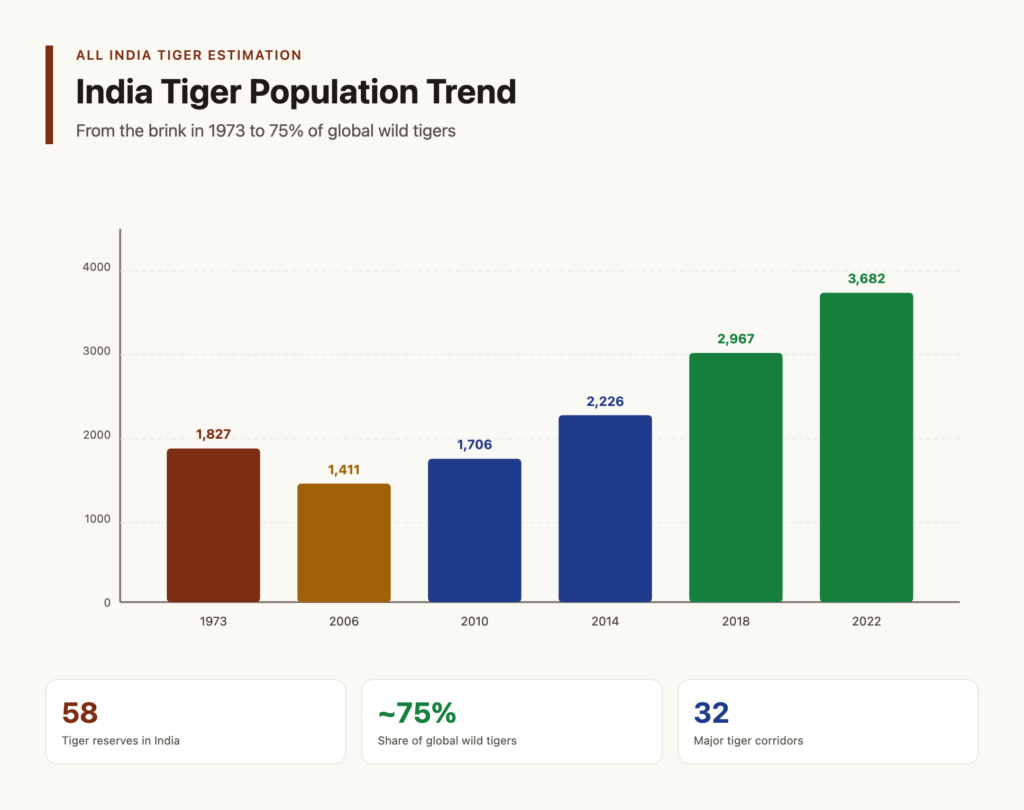
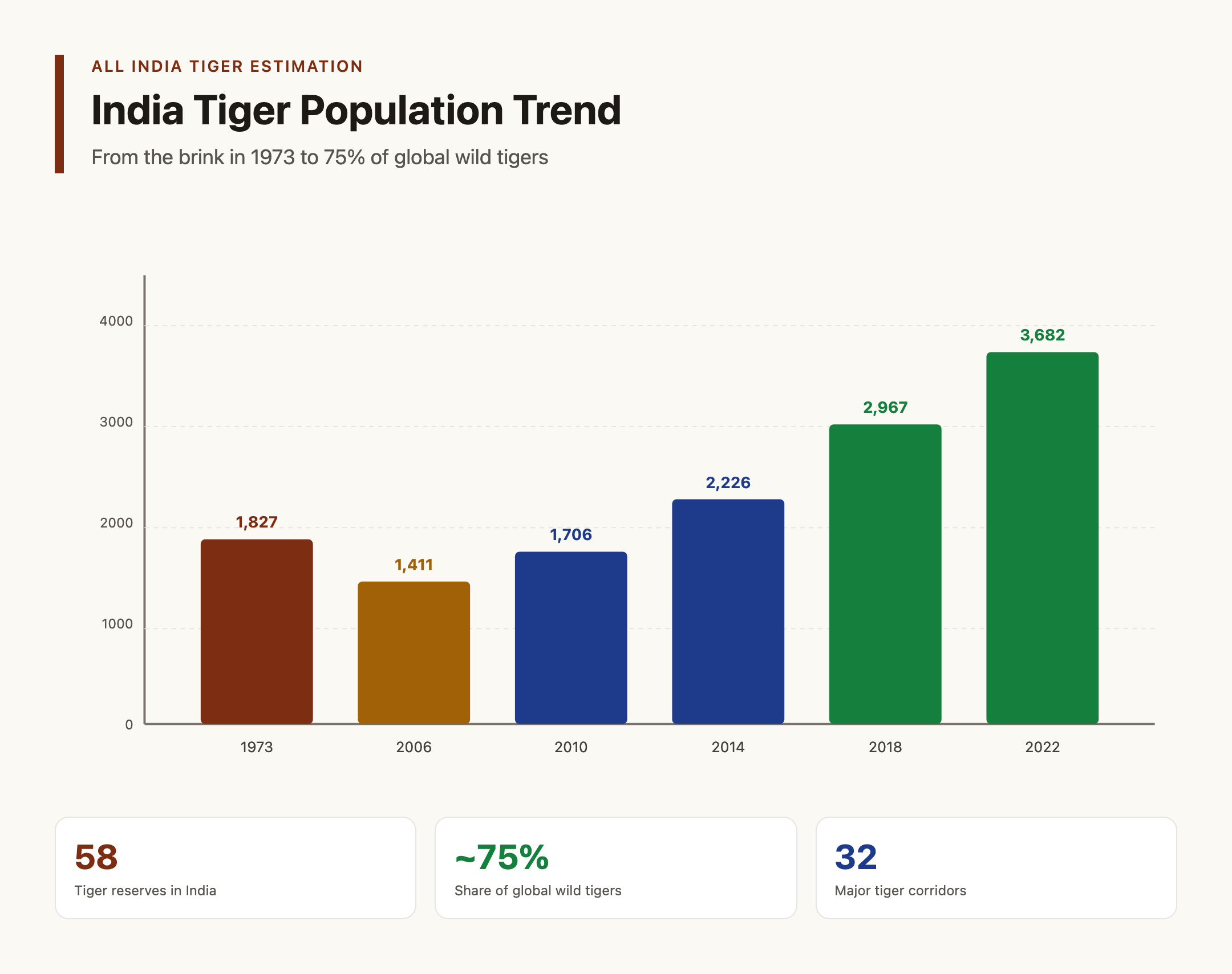
Project Tiger is the longest-running and most studied wildlife conservation programme in India. Launched on 1 April 1973 from Jim Corbett National Park, it has shaped how the country thinks about protected areas, statutory authorities, and the politics of coexistence between people and predators. Today, it covers 58 tiger reserves and an estimated tiger population of 3,682, which means India hosts roughly three out of every four wild tigers on Earth.
That headline number is the easy part. The harder part is what the programme actually does. Project Tiger pioneered the core-buffer model that became the template for tiger reserves in Asia. It pulled tiger conservation out of state forest departments and gave it a national authority with statutory powers. It also exposed the deep tensions between strict protection, tribal rights, and tourism that every conservation question in India eventually circles back to.
This guide walks through the programme as it actually exists in 2026, the institutional architecture under the Wildlife (Protection) Act, the science behind the four-yearly All India Tiger Estimation, and the policy debates that keep showing up in mains papers.
Quick Facts: Project Tiger
- Year of launch: 1 April 1973 from Jim Corbett National Park, Uttarakhand
- Nature of scheme: Centrally Sponsored Scheme of the Ministry of Environment, Forest and Climate Change
- Implementing authority: National Tiger Conservation Authority (NTCA), constituted in 2006
- Number of tiger reserves: 58 as of 2026 (Madhav, Madhya Pradesh, notified in March 2025, is the 58th)
- Latest declared reserves: 55th Dholpur-Karauli (Rajasthan), 56th Guru Ghasidas-Tamor Pingla (Chhattisgarh), 57th Ratapani (Madhya Pradesh), 58th Madhav (Madhya Pradesh)
- Estimated tiger population in India: 3,682 as per the 2022 estimation cycle
- India’s share of global wild tigers: approximately 75 per cent
- Strategy: core-buffer model with a strictly protected, inviolate Critical Tiger Habitat surrounded by a multiple-use buffer
- Major tiger corridors: 32 identified by NTCA and the Wildlife Institute of India
- Statutory backing: Sections 38L to 38X of the Wildlife (Protection) Act, 1972, inserted by the 2006 amendment
What Project Tiger Is and Why It Was Created
Project Tiger is best understood as a conservation programme that became a statutory regime. When it began in 1973, India had only nine tiger reserves and an estimated 1,827 tigers, down from a population that may once have crossed 40,000. The trigger was a 1969 IUCN warning that the Bengal tiger was sliding toward extinction in its largest range state. The Indian Board for Wildlife endorsed the project, the Wildlife (Protection) Act of 1972 created the legal scaffolding, and the programme was formally launched the next year.
The original idea was practical. Pick representative tiger landscapes across India, give them strict legal protection, manage their core areas as inviolate spaces, and surround those cores with buffer zones where regulated human use could continue. That blueprint was new for India and became influential across the tiger range.
What changed in 2006 was the institutional layer. Following the Sariska crisis, where tigers vanished from the reserve due to poaching and management failure, Parliament amended the Wildlife (Protection) Act to create the National Tiger Conservation Authority. NTCA gave Project Tiger statutory teeth, a permanent secretariat, and binding power to issue directions to states.
Background and Historical Context
The colonial period treated the tiger as a trophy and a threat. Hunting records from princely states and viceregal shoots routinely list double-digit kills in a single tour. Bounties on tigers continued into the 1950s. By independence, range maps showed serious contraction in central India, the terai, and the Western Ghats.
The 1969 IUCN General Assembly in New Delhi formally placed the tiger on the endangered list, which jolted the Indian Board for Wildlife into action. Indira Gandhi’s government created a Task Force in 1970, and its 1972 report became the design document for Project Tiger. The first nine reserves were Corbett, Manas, Ranthambore, Palamau, Bandipur, Similipal, Sundarbans, Kanha, and Melghat. They covered roughly 14,000 square kilometres and represented the major tiger habitat types in India.
The next two decades produced uneven results. Estimation methodology relied heavily on pugmark tracing, which generated inflated numbers and masked local extinctions. The 2005 Sariska shock, where the WII confirmed that the reserve had lost all its tigers, forced a methodological reset. The 2006 amendment, the Tiger Task Force report, and the rollout of the camera-trap based All India Tiger Estimation in 2006 together rebuilt the programme on more rigorous foundations.
Key Provisions and Institutional Architecture
The legal home of Project Tiger today is Chapter IV-B of the Wildlife (Protection) Act, 1972, which lays down the powers of the NTCA, the procedure for declaring a tiger reserve, the concept of Critical Tiger Habitat, and the rehabilitation provisions for villages inside cores.
The National Tiger Conservation Authority is chaired by the Union Minister for Environment, Forest and Climate Change. It approves Tiger Conservation Plans submitted by states, lays down standards and guidelines for tiger conservation, evaluates management effectiveness, and disburses central funds. It also maintains the official tiger database and publishes the Status of Tigers report every four years.
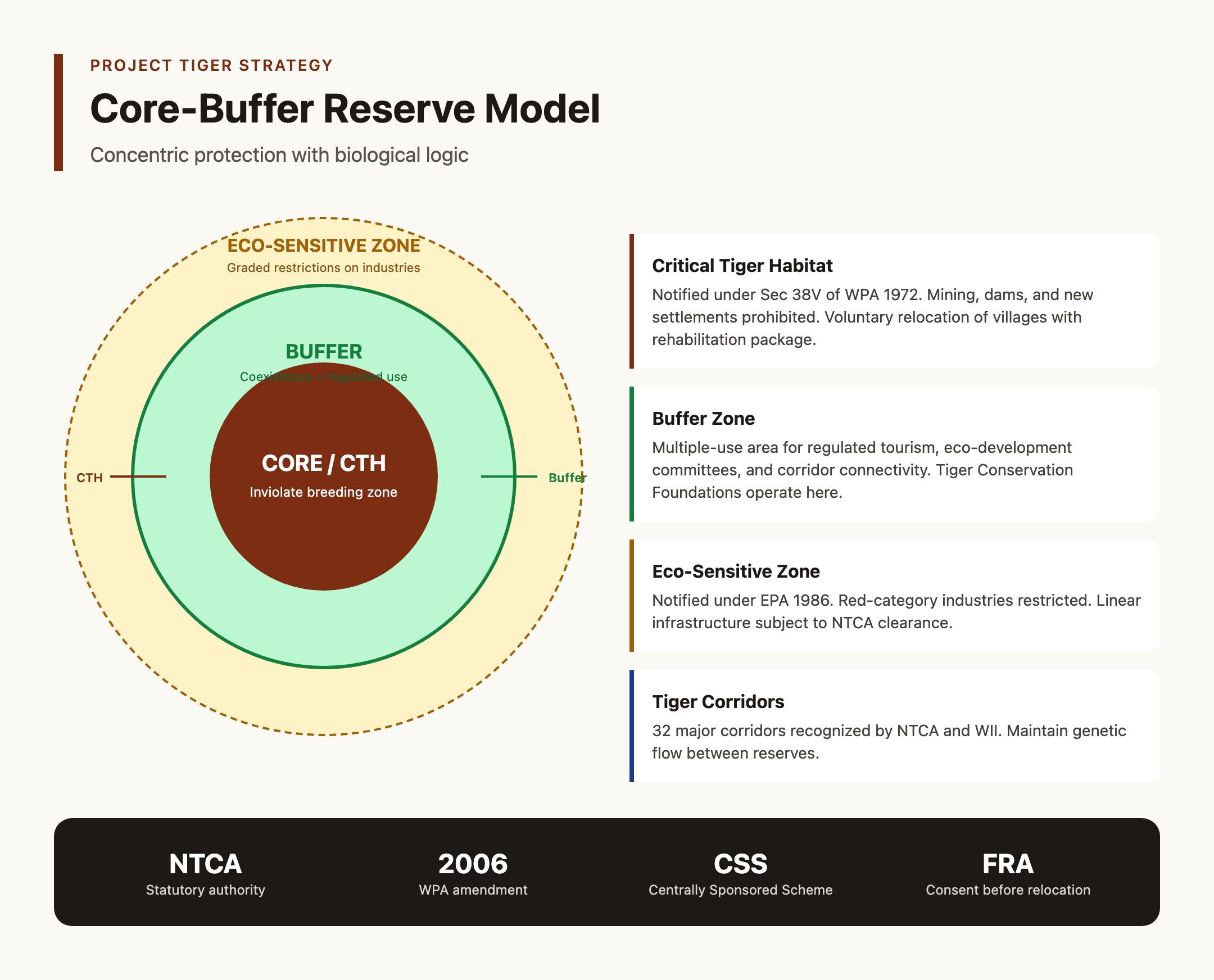
Each reserve has a two-zone structure. The Critical Tiger Habitat, also called the core, is notified after a scientific assessment and is meant to be kept inviolate from human settlement. The buffer surrounds the core and is managed for coexistence, regulated tourism, and sustainable livelihoods. Voluntary, fully compensated relocation from the core is the standard policy, and rehabilitation packages are revised periodically.
Tiger Conservation Foundations, set up at the reserve level, bring together state forest officers, panchayat representatives, and community members for day-to-day governance. The Tiger Strike Force in many states focuses on anti-poaching operations.
Why Project Tiger Matters
The programme is the rare conservation intervention that delivered measurable population recovery while building institutions that outlasted political cycles. The tiger functions as an umbrella species, which means protecting its landscapes also protects co-predators like leopard and dhole, large prey like sambar and gaur, and the broader forest community including pollinators, soil microbes, and watershed services.
For UPSC mains, Project Tiger is also a case study in cooperative federalism. Wildlife is in the Concurrent List, and tiger reserves sit within state forest territories, but a central authority sets standards, releases funds, and has the power to direct states under the Wildlife (Protection) Act. The programme also intersects with Forest Rights Act jurisprudence, the eco-sensitive zone notification regime, and the EIA process for projects in tiger landscapes.
Detailed Analysis: The Core-Buffer Strategy
The core-buffer model is the operational heart of Project Tiger. Its logic is biological rather than administrative. Tigers need large, undisturbed prey-rich areas to breed and rear cubs. They also need connectivity to neighbouring populations so that genetic diversity does not collapse and dispersing sub-adults find new territories.
The Critical Tiger Habitat is the breeding zone. Notification follows a scientific committee process and requires recognition of forest rights under the FRA before any rights are modified. Once notified, the CTH is closed to mining, dams, commercial forestry, and new settlement. Existing rights-holders can opt for voluntary relocation, and as per latest available data the standard package is around fifteen lakh rupees per family along with land or housing alternatives.
The buffer is where the politics happens. It accommodates village commons, regulated tourism, eco-development, and corridor management. Buffer notifications are negotiated with panchayats and frequently litigated, because they trigger restrictions on land use without conferring relocation benefits. The buffer’s success depends on Tiger Conservation Foundations, eco-development committees, and partnerships with district administrations.
Around the formal reserve, the eco-sensitive zone notified under the Environment (Protection) Act extends a graded buffer of restrictions on red and orange category industries. Beyond that, NTCA-designated tiger corridors connect reserves across landscapes such as the Central Indian, Western Ghats, Sivalik-Terai, North-Eastern Hills, and Sundarbans clusters.
Tiger Census Methodology and Population Trends
The All India Tiger Estimation, conducted every four years by NTCA in partnership with the Wildlife Institute of India and state forest departments, has been the world’s largest wildlife survey since 2006. It combines double-sampling with sign surveys across the entire forested landscape, camera-trap based capture-recapture sampling in tiger-occupied areas, and statistical modelling to produce population estimates with confidence intervals.
The 2006 cycle estimated 1,411 tigers, 2010 estimated 1,706, 2014 estimated 2,226, 2018 estimated 2,967, and 2022 estimated 3,682. The trend is positive, but the gains are not uniform. Central India and the Western Ghats have driven most of the growth. Some reserves in the North-East, in eastern Maharashtra, and in parts of Odisha continue to face poaching pressure, prey depletion, and weak protection.
Comparative Perspective: Major Species-Specific Programmes in India
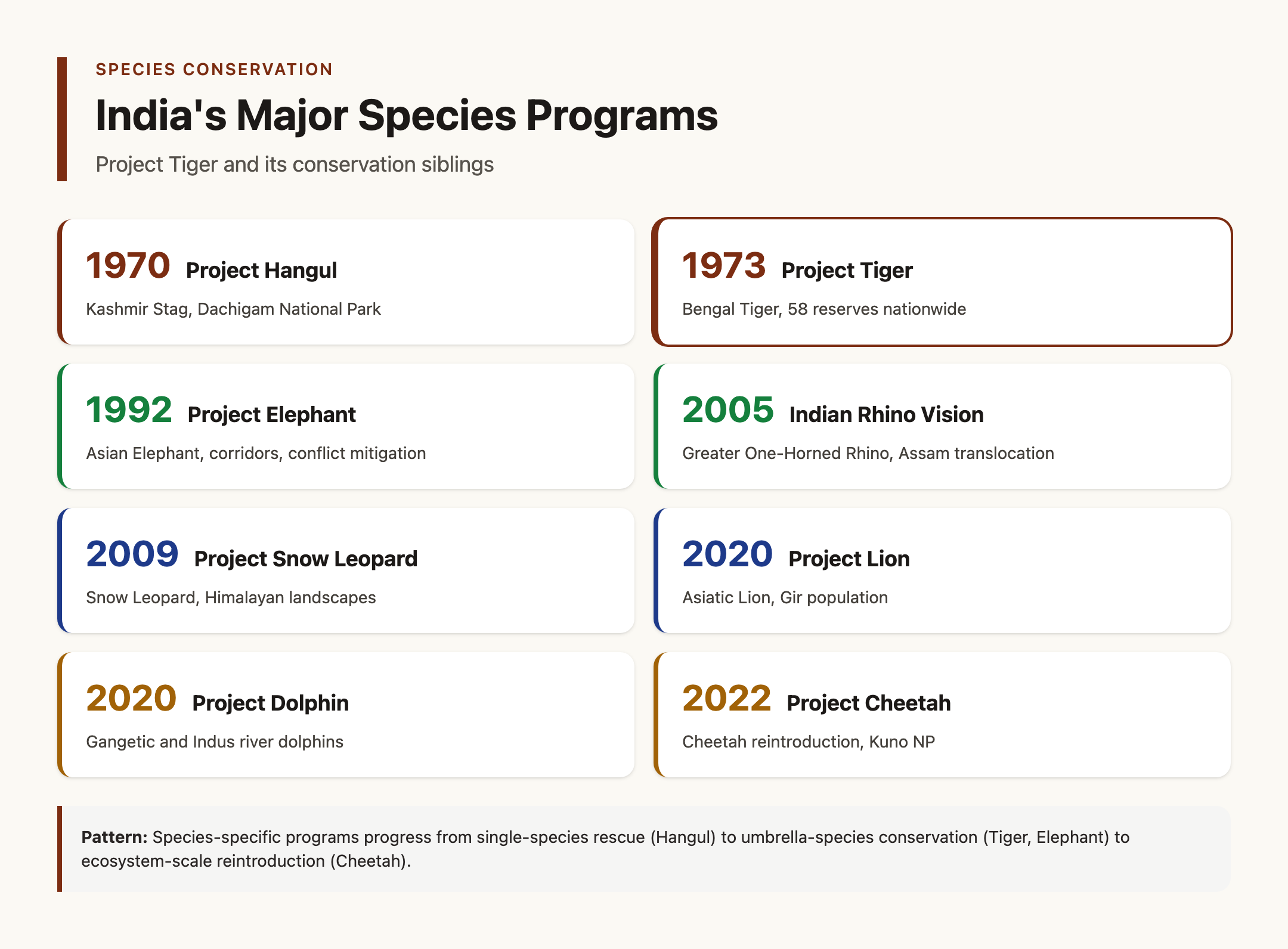
| Programme | Launch Year | Target Species | Core Objective |
|---|---|---|---|
| Project Tiger | 1973 | Bengal Tiger | Conserve viable tiger populations through tiger reserves and the core-buffer model |
| Project Hangul | 1970 | Kashmir Stag | Habitat restoration in Dachigam National Park |
| Project Elephant | 1992 | Asian Elephant | Protect elephants, corridors, and mitigate human-elephant conflict |
| Indian Rhino Vision 2020 | 2005 | Greater One-Horned Rhino | Translocation and population spread across Assam |
| Project Snow Leopard | 2009 | Snow Leopard | Community-based conservation in Himalayan landscapes |
| Project Lion | 2020 | Asiatic Lion | Holistic conservation of the Gir population |
| Project Dolphin | 2020 | Gangetic and Indus River Dolphins | Riverine habitat restoration |
| Project Cheetah | 2022 | Cheetah | Reintroduction starting at Kuno National Park |
Challenges Facing Project Tiger
Despite the population recovery, structural challenges persist. Habitat fragmentation outside reserves keeps shrinking corridors, and linear infrastructure such as highways, railways, and canals continues to bisect tiger movement routes. Several reserves report saturation, where the carrying capacity is reached and dispersing tigers spill into human-use landscapes, driving up conflict.
Poaching for skin, bone, and traditional Asian medicine remains a persistent threat, even though the trade has shifted online and now relies on encrypted communication. Protection capacity is uneven, with some reserves operating well below sanctioned strength and many forest guards working with outdated equipment.
The relocation of villages from cores has made progress but remains incomplete. Implementation has sometimes failed to follow the Forest Rights Act process, drawing litigation and tribal community resistance. Tourism pressure in flagship reserves has pushed core-zone safari capacity to the edge of what NTCA permits. Climate change is now adding a new layer, with shifting rainfall patterns affecting prey distribution and water availability in many reserves.
Prelims Pointers on Project Tiger
- Launched on 1 April 1973 from Jim Corbett National Park.
- It is a Centrally Sponsored Scheme administered by MoEFCC.
- The National Tiger Conservation Authority was created in 2006 by amending the Wildlife (Protection) Act, 1972.
- A tiger reserve has two zones, a Critical Tiger Habitat or core and a buffer.
- India hosts about 75 per cent of global wild tigers.
- The All India Tiger Estimation is conducted every four years by NTCA and WII.
- India has 58 tiger reserves as of 2026, with Madhav in Madhya Pradesh (notified March 2025) as the 58th and most recent addition.
- 32 major tiger corridors are recognized by NTCA and WII.
- Sariska crisis of 2005 triggered the 2006 statutory reform.
Mains Practice Questions
- (GS-III) Project Tiger is often cited as a successful conservation programme. Critically evaluate its achievements and the structural challenges that constrain further progress.
- (GS-III) Discuss the significance of the core-buffer strategy in tiger conservation. How has the National Tiger Conservation Authority operationalized this strategy?
- (GS-II) Examine the role of cooperative federalism in the implementation of Project Tiger, with reference to the Wildlife (Protection) Act, 1972.
- (GS-III) The recovery of tiger numbers in India has not been uniform across landscapes. Identify the factors driving regional variation and suggest a policy framework to address them.
Way Forward
Project Tiger needs a corridor-first agenda for its next decade. Securing the 32 tiger corridors through smart green infrastructure such as overpasses, eco-bridges, and underpasses on national highways can reduce roadkill and maintain genetic flow. Empowering Tiger Conservation Foundations with predictable budgets and panchayat representation will strengthen the buffer governance that core protection ultimately depends on. Modernization of anti-poaching units with thermal cameras, drone surveillance, and trained sniffer-dog squads is overdue in the high-pressure reserves of Central India and the North-East. Convergence with the Forest Rights Act, transparent voluntary relocation processes, and credible livelihoods packages will reduce conflict around cores. Finally, integrating climate adaptation into Tiger Conservation Plans through water-source augmentation, prey base monitoring, and fire management will protect the gains of the past five decades.
Frequently Asked Questions
When was Project Tiger launched and from which reserve?
Project Tiger was launched on 1 April 1973 from Jim Corbett National Park in Uttarakhand. The programme started with nine tiger reserves covering roughly 14,000 square kilometres of representative tiger habitat.
How many tiger reserves does India have today?
India has 58 tiger reserves as of latest available data. The four most recently declared reserves are Dholpur-Karauli in Rajasthan, Guru Ghasidas-Tamor Pingla in Chhattisgarh, Ratapani in Madhya Pradesh, and Madhav in Madhya Pradesh.
What is the latest tiger population in India?
The 2022 cycle of the All India Tiger Estimation reported an estimated 3,682 tigers, which represents about 75 per cent of the global wild tiger population. The estimate uses camera-trap based capture-recapture sampling combined with sign surveys across forested landscapes.
What is the difference between core and buffer in a tiger reserve?
The core, formally called the Critical Tiger Habitat, is notified for inviolate breeding habitat and is closed to most human activity. The buffer surrounds the core and is managed for coexistence, regulated tourism, eco-development, and corridor connectivity.
What is the National Tiger Conservation Authority?
NTCA is a statutory authority created in 2006 by amending the Wildlife (Protection) Act, 1972. It is chaired by the Union Environment Minister and is responsible for approving Tiger Conservation Plans, releasing central funds, evaluating management effectiveness, and conducting the All India Tiger Estimation.
Why was the Sariska crisis a turning point for Project Tiger?
The 2005 confirmation that Sariska had lost all its tigers exposed serious management and protection failures. It led directly to the 2006 amendment that created NTCA, the constitution of the Tiger Task Force, and the rollout of camera-trap based estimation methods.
What is a Critical Tiger Habitat?
A Critical Tiger Habitat is the core of a tiger reserve notified after a scientific committee process under Section 38V of the Wildlife (Protection) Act. It is to be kept inviolate, and any modification of rights or relocation of villages must follow the Forest Rights Act and the rehabilitation procedure prescribed in the Wildlife Act.
How does Project Tiger interact with the Forest Rights Act?
The two regimes operate together. Before any rights inside a Critical Tiger Habitat are modified or before a village is relocated, the rights of forest dwellers under the Forest Rights Act must first be recognized and the Gram Sabha must give free, prior, and informed consent in writing to the rehabilitation package.
What are tiger corridors?
Tiger corridors are forested or mixed land-use strips that connect two or more tiger habitats and allow tigers and prey to disperse between them. NTCA and the Wildlife Institute of India have identified 32 major tiger corridors across India.
Which species other than tigers benefit from Project Tiger?
Because tigers are an umbrella species, protecting their landscapes also protects co-predators like leopards and dholes, ungulates like sambar and gaur, smaller carnivores, birds, pollinators, and the watershed services those forests provide.
Tell Google you want more of this.
Add Anantam IAS as a preferred sourceOne tap, and this site shows up more often in your own Top Stories, AI Overviews and AI Mode. Remove it any time.