Campus Biodiversity Registers: Turning Universities into Living Observatories
Why in News?
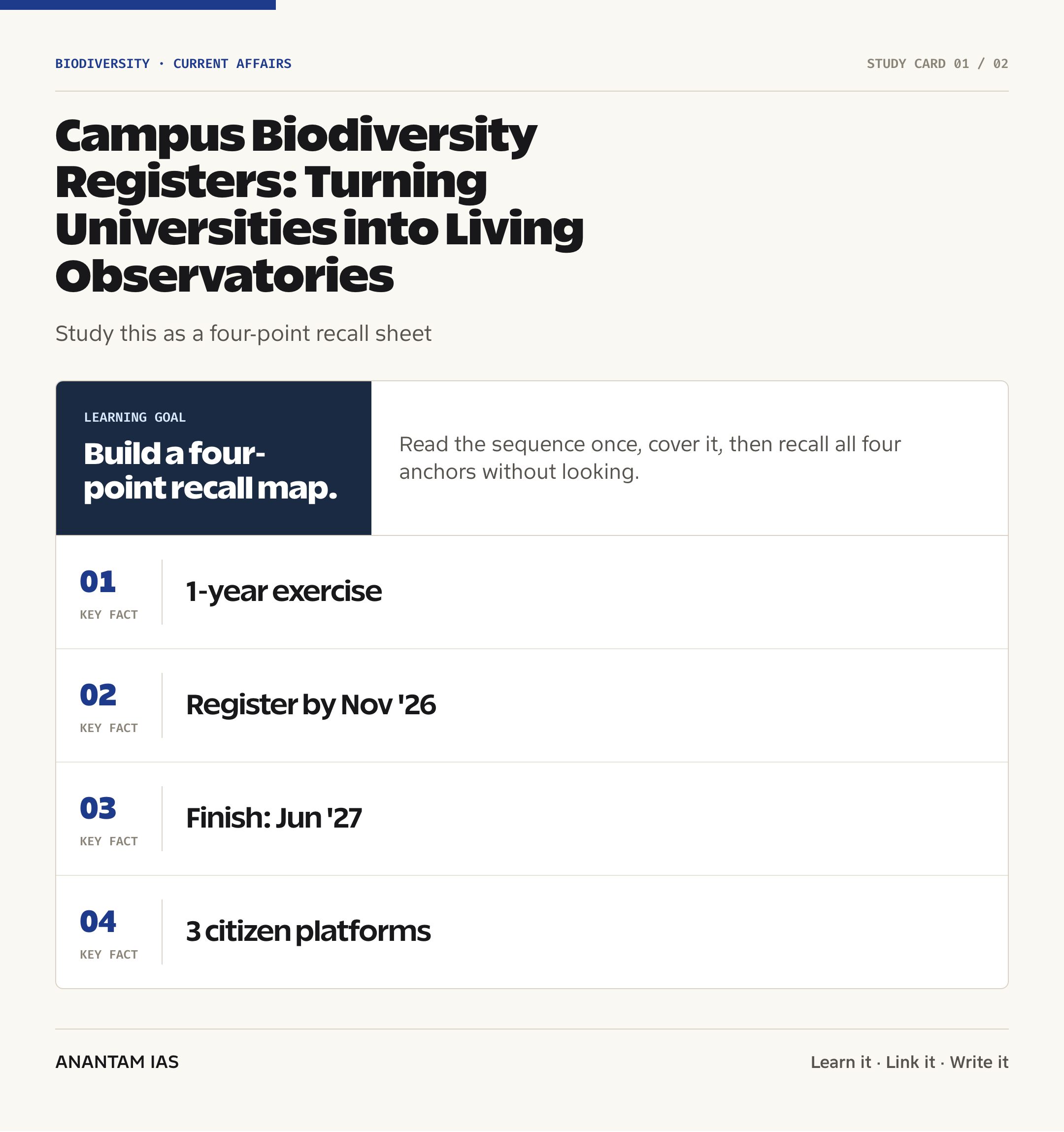
The National Biodiversity Authority (NBA) and the Mysuru-based Nature Conservation Foundation (NCF) have launched a nationwide initiative to help colleges and universities prepare a Campus Biodiversity Register (CBR) for each participating institution. The Hindu reported the launch on 22 July 2026.
The year-long exercise will turn campuses into local observation sites where students, faculty and staff record plants, animals, fungi and other life forms. Institutions may register until November 2026, and the documentation phase is expected to conclude in June 2027.
- The initiative is inspired by the People’s Biodiversity Register (PBR), but its immediate unit of documentation is an educational campus rather than the jurisdiction of a local body.
- Participants will use iNaturalist, eBird and SeasonWatch, along with organised surveys, campus walks and routine observations.
- The project treats college and university grounds as possible urban biodiversity refuges for trees, birds, butterflies, insects, reptiles, mammals, fungi and other organisms.
- The observations are expected to support wider biodiversity databases and give institutions a baseline for campus planning and conservation.
- NCF programme manager Devica Ranade framed the exercise as a way to notice easily overlooked campus life, from wall geckos and moths to ants and other small organisms.
The development matters in the context of:
- India’s urban expansion can fragment habitats, while older and less intensively built campuses may retain tree cover, water bodies, scrub, soil biota and ecological corridors.
- A species list becomes useful only when observations are georeferenced, dated, verified and repeated; a one-time inventory can’t reveal ecological change by itself.
- Campus participation can widen biodiversity literacy, but the data must connect with statutory local institutions if it is to strengthen decentralised biodiversity governance.
UPSC Relevance
Prelims Relevance
- The National Biodiversity Authority is a statutory body under the Biological Diversity Act, 2002 and functions at the national level.
- India’s biodiversity-governance structure operates through the NBA, State Biodiversity Boards or Union Territory Biodiversity Councils, and local Biodiversity Management Committees.
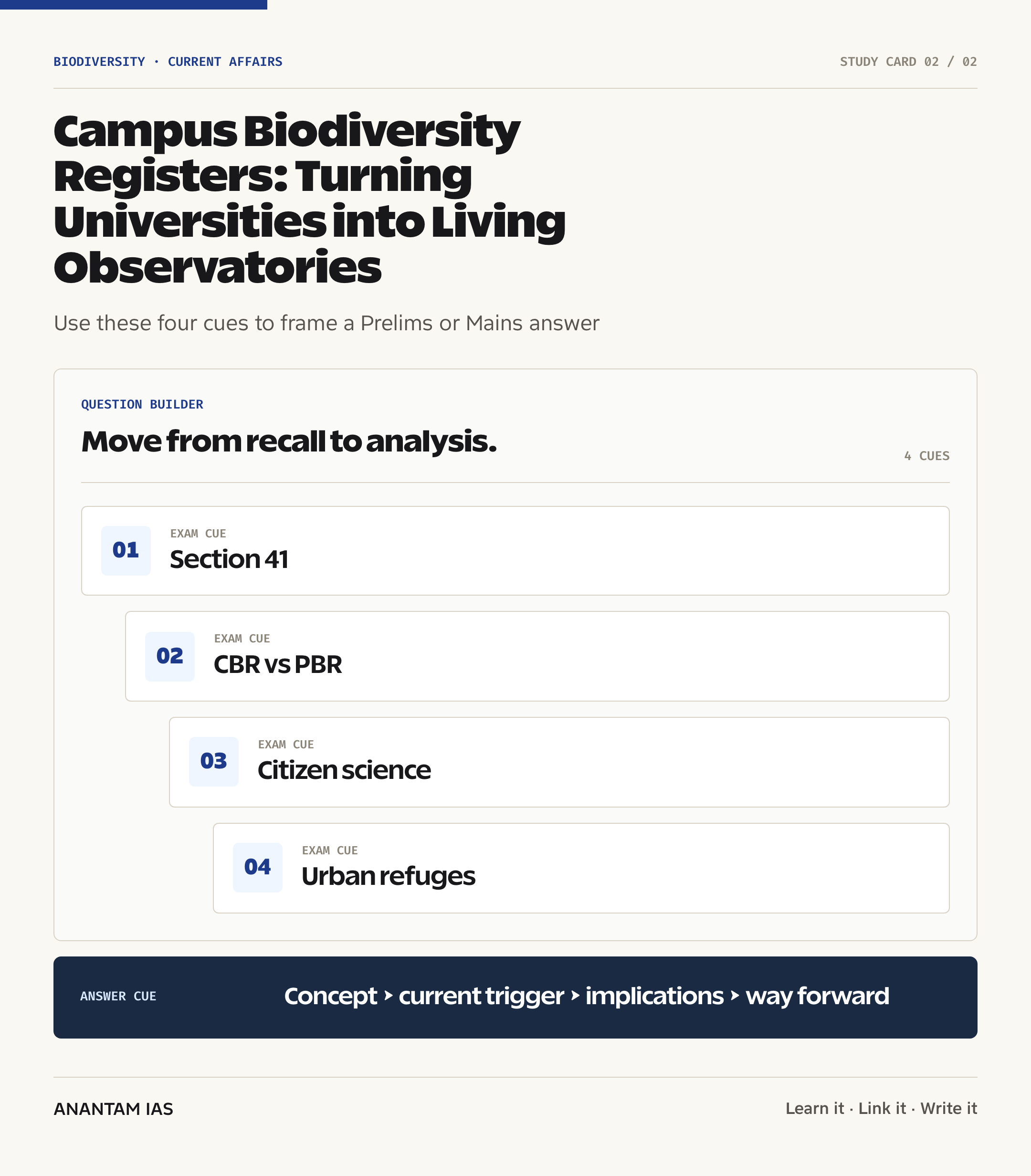
- Under Section 41 of the amended Act, specified rural and urban local bodies must constitute Biodiversity Management Committees for conservation, sustainable use and documentation of biological diversity.
- A People’s Biodiversity Register records biological resources and associated traditional knowledge within a geographic jurisdiction; it is prepared through the BMC framework.
- The Biological Diversity Rules, 2024 empower the NBA to specify electronic or manual PBR formats and procedures for documentation, periodic updating, secure maintenance and information sharing.
- A Campus Biodiversity Register is an institutional citizen-science inventory inspired by the PBR model; it shouldn’t automatically be treated as a statutory PBR.
- eBird focuses on bird observations, SeasonWatch tracks seasonal changes in trees, and iNaturalist supports observations across many taxonomic groups.
- Citizen science involves public participation in scientific observation or data collection, usually under shared protocols and with expert or community validation.
Mains Relevance
GS Paper 3
- Biodiversity conservation: campuses as small urban habitats, ecological stepping stones and long-term monitoring sites.
- Environmental governance: the relationship between national guidance, State Biodiversity Boards, BMCs, PBRs and voluntary institutional inventories.
- Science and technology: citizen-science platforms, open biodiversity data, validation, geospatial records and responsible data governance.
- Urban ecology: using baseline evidence to guide landscaping, construction, lighting, pesticide use, water-body management and habitat restoration.
GS Paper 2
- Participatory governance: educational institutions can connect young citizens with local bodies and public conservation institutions.
- Institutional capacity: clear protocols, training and accountability are needed so participation produces credible evidence rather than a ceremonial green audit.
Essay
- What citizens learn to notice, institutions become more capable of protecting.
- A university can be both a place of formal learning and a long-term observatory of ecological change.
Background and Context
What a Campus Biodiversity Register Records
A CBR is a structured inventory of life within an institution’s grounds, supported by evidence that can be revisited and updated.
- The basic record should identify the species or taxon, observation date, location, habitat and observer, along with a photograph, sound or other supporting evidence where feasible.
- Coverage can include trees, shrubs, herbs, birds, mammals, reptiles, amphibians, insects, spiders, fungi and less visible groups, rather than only ornamental plants and conspicuous birds.
- Habitat information matters as much as a species name. A pond edge, old tree, unmanaged patch, garden, wall crevice and leaf-litter bed support different ecological communities.
- Repeated observations can show seasonality, breeding, migration, flowering and fruiting, while a single checklist supplies only a baseline snapshot.
- The project can also record pressures such as invasive alien species, pesticide use, excessive night lighting, tree removal, waste, traffic, feral animals and shrinking water bodies.
- A credible register should distinguish native, introduced, cultivated, invasive and unidentified organisms and retain uncertainty instead of forcing doubtful species-level identifications.
The Statutory PBR Framework
The campus project borrows its decentralised spirit from PBRs, whose legal home is the Biological Diversity Act rather than a university’s internal administration.
- The Biological Diversity Act framework creates national, state and local institutions to pursue conservation, sustainable use and fair sharing of benefits arising from biological resources.
- Section 41 of the Act requires Biodiversity Management Committees at the specified local-body levels and assigns them conservation, sustainable-use and documentation functions.
- The statutory scope includes habitats, landraces, folk varieties, cultivars, domesticated animal breeds, aquatic life, microorganisms and traditional knowledge associated with biodiversity.
- The Biological Diversity Rules, 2024 replaced the 2004 central rules and authorise the NBA to set PBR formats, updating procedures, secure maintenance and information-sharing processes.
- The Rules also assign the NBA a support role for the preparation, validation and maintenance of biodiversity registers through State Boards or UT Councils, or directly where required.
- A local PBR is connected to consultation and access-and-benefit-sharing institutions. A campus list doesn’t acquire that status merely because it uses similar fields or citizen-science observations.
CBR and PBR: Similar Method, Different Authority
The distinction prevents a useful education project from being overstated and helps channel campus data into the correct public system.
- Both registers favour place-based documentation, participation, local observation and periodic revision rather than biodiversity knowledge held only in distant expert databases.
- A CBR is centred on the grounds and community of a college or university; a statutory PBR covers the territory and community knowledge linked to a competent local-body BMC.
- Campus students and experts can contribute observations to a PBR process, but the BMC and relevant State Board or UT Council retain their prescribed public roles.
- Sensitive information needs care. Precise locations of threatened species, nesting sites or valuable biological resources may invite disturbance, collection or commercial interest if released without safeguards.
- Associated traditional knowledge can’t be treated as free, anonymous data. Documentation should respect prior informed consent, attribution and benefit-sharing safeguards.
- The most productive model is a documented pathway through which verified campus observations can inform local BMC updates without collapsing institutional and statutory registers into one another.
How Citizen-Science Platforms Help
Digital platforms can standardise submissions and connect local observations with larger datasets, but they don’t remove the need for survey design and verification.
- iNaturalist accepts observations across many groups and supports community identification; photographs and metadata can make records auditable.
- eBird structures bird checklists by place, time and effort, which can support distribution and seasonal analyses when observers follow its protocols.
- SeasonWatch, an NCF citizen-science programme, tracks leafing, flowering and fruiting in common trees and can reveal changes in phenology over time.
- Platform records can suffer from spatial bias, uneven observer effort, duplicate observations and a preference for attractive or easily identified species.
- A campus should combine open participation with fixed routes, repeat counts, seasonal sampling and expert review so data become comparable across months and years.
- Students must be trained in ethical field practice: don’t handle wildlife unnecessarily, disturb nests, damage plants, trespass or share sensitive coordinates casually.
Why Campuses Matter in Urban Ecology
Campuses can’t replace large natural ecosystems, yet they can protect small habitats and connections within heavily built landscapes.
- Mature trees, wetlands, grass patches and low-disturbance corners can provide food, shelter, nesting sites and movement routes for urban-adapted and visiting species.
- The value of a campus depends on its surrounding landscape. A green patch near a lake, ridge, river, forest remnant or park may function as an ecological stepping stone.
- Species-rich landscaping is not the same as planting many ornamental trees. Native vegetation, structural diversity, soil health and water availability often matter more than a raw plantation count.
- A CBR can make routine decisions evidence-based: retaining old trees, controlling invasive plants, reducing pesticides, shielding lights, restoring ponds and timing maintenance outside breeding seasons.
- Students can compare local observations with the broader idea of India’s biodiversity hotspots, while recognising that a campus isn’t called a global hotspot merely because it supports many species.
- The register can also strengthen climate adaptation by identifying shade, permeable ground, water-retaining habitats and vegetation that moderates heat without reducing biodiversity to carbon storage alone.
Risks That Can Turn a Register into a Token Exercise
The project will matter only if institutions treat the register as a recurring management tool rather than a one-time publication for accreditation or publicity.
- A long species list can conceal weak evidence, taxonomic errors and repeated entries. Quality assurance should record who verified each identification and at what confidence level.
- Observer participation may decline after launch. Credit-bearing field projects, nature clubs, faculty coordinators and annual handovers can protect continuity as student cohorts change.
- Comparisons among campuses can be misleading when area, habitat, season and survey effort differ. Reporting should include sampling effort and campus context, not rank institutions by species totals alone.
- Data collection without management response breeds cynicism. Every register should identify a few measurable actions, responsible offices, timelines and follow-up indicators.
- Construction and landscaping decisions can still override biodiversity evidence unless the register is linked to estate planning, procurement, environmental committees and approval processes.
- Open data should follow a graded-access approach so general records remain useful while ecologically or culturally sensitive information receives stronger protection.
From Inventory to Long-Term Monitoring
A register becomes scientifically valuable when later cohorts can repeat the work and distinguish ecological change from changes in observer effort.
- Each campus should first map broad habitat units such as built areas, gardens, woodland, scrub, grass, water bodies and unmanaged patches, then sample every unit instead of surveying only pleasant walking routes.
- A fixed seasonal calendar can combine monsoon, winter and summer surveys. The timing should reflect local ecology because breeding, flowering, migration and insect activity don’t peak in the same month everywhere.
- Permanent photo points, tree tags and repeatable transects can show habitat change even when a species is missed. Records of absence require special care because failure to detect isn’t proof that a species has disappeared.
- Institutions should preserve original photographs, audio, checklists and verification notes with stable identifiers. A polished report without its underlying evidence can’t be audited or reliably updated.
- Baseline indicators may include native-species richness, invasive cover, canopy continuity, pond condition, nesting activity and pesticide exposure. Indicators should guide action without reducing a complex ecosystem to one score.
- Partnerships with nearby colleges, natural-history groups, taxonomists and the State Biodiversity Board can fill expertise gaps, especially for fungi, insects, grasses and other groups often overlooked in popular surveys.
- An annual public summary can explain what changed, what remains uncertain and which management decisions followed. This closes the loop between observation, interpretation and conservation action.
Way Forward
Adopt a Common Minimum Protocol
- Define mandatory metadata, taxonomic confidence, habitat categories, survey effort and update frequency while allowing campuses to add locally relevant fields.
- Publish a clear note explaining the CBR-PBR distinction and the route for sharing validated observations with BMCs and State Boards.
Build Scientific and Institutional Continuity
- Train faculty coordinators and rotating student teams in identification, field ethics, data cleaning and repeatable survey design.
- Create annual audits that report both ecological trends and actions taken, with raw claims traceable to observations.
Turn Records into Campus Decisions
- Require biodiversity evidence before tree felling, major construction, wetland alteration, pesticide procurement and large lighting changes.
- Set practical habitat targets such as retaining old trees, restoring native understorey, reducing invasive species and protecting nesting seasons.
Protect Knowledge and Sensitive Species
- Use consent and attribution safeguards for community knowledge, and restrict precise locations where publication could increase ecological harm.
- Let BMCs and State Boards guide any transfer of campus records into statutory databases and access-related decisions.
Conclusion
Campus Biodiversity Registers can make conservation concrete by turning ordinary places into living observatories. Their strongest contribution will be a generation of students trained to notice patterns, verify evidence and connect ecological knowledge with everyday institutional choices.
But participation alone isn’t enough. The initiative needs repeatable protocols, taxonomic review, sensitive-data safeguards and a formal bridge to BMCs and PBR processes. A campus inventory should complement statutory biodiversity governance, not impersonate it.
If institutions update the register and act on its findings, the project can move beyond species counting towards long-term stewardship of urban habitats and ecological change.
UPSC Practice Questions
Prelims MCQ 1
With reference to biodiversity registers in India, consider the following statements:
- Biodiversity Management Committees are constituted under Section 41 of the Biological Diversity Act, 2002.
- The National Biodiversity Authority may specify electronic or manual formats for People’s Biodiversity Registers.
- Every Campus Biodiversity Register automatically has the legal status of a People’s Biodiversity Register.
How many of the above statements are correct?
(a) Only one (b) Only two (c) All three (d) None
Answer: (b) Only two
Explanation:
Statements 1 and 2 are correct. Statement 3 is incorrect: a CBR is an institution-focused citizen-science inventory, while a statutory PBR belongs to the BMC-led local governance framework. Campus data can support that process but doesn’t acquire statutory status automatically.
Prelims MCQ 2
Which one of the following correctly matches the citizen-science platform with its principal use?
(a) eBird – recording only flowering and fruiting in trees (b) SeasonWatch – monitoring seasonal changes in trees (c) iNaturalist – recording only bird migration (d) PBR – a global mobile application for species photographs
Answer: (b) SeasonWatch – monitoring seasonal changes in trees
Explanation:
SeasonWatch tracks tree phenology, including leafing, flowering and fruiting. eBird is structured around bird observations, while iNaturalist supports observations across many groups. A PBR is a biodiversity-governance record, not a global observation app.
UPSC Mains Questions
- Campus Biodiversity Registers can broaden citizen science and improve urban ecological management, but they shouldn’t be confused with statutory People’s Biodiversity Registers. Examine their respective roles and suggest a mechanism for credible data-sharing between universities and Biodiversity Management Committees. (250 words)
- Educational campuses can function as biodiversity refuges within expanding cities, yet species documentation alone doesn’t ensure conservation. Discuss the scientific, institutional and ethical safeguards needed to convert campus inventories into long-term ecological stewardship. (250 words)
Sources: National Biodiversity Authority and The Hindu.
Frequently Asked Questions
What is a Campus Biodiversity Register?
A Campus Biodiversity Register is a structured record of plants, animals, fungi and other organisms observed within a college or university campus. It can include dates, locations, habitats, photographs and repeat observations. Its purpose is to build a baseline for education, monitoring and better campus management.
Who launched the nationwide CBR initiative?
The National Biodiversity Authority and the Mysuru-based Nature Conservation Foundation launched the nationwide initiative. The Hindu reported it on 22 July 2026. The exercise is designed for colleges and universities across India and will involve students, faculty and staff in documenting campus biodiversity.
What is the project timeline?
Educational institutions can register until November 2026. The year-long documentation exercise is expected to conclude in June 2027. Participating campuses will use organised surveys, nature walks and everyday observations to build the skills and information required to compile their own registers.
Is a CBR the same as a PBR?
No. A CBR focuses on an educational campus and is a citizen-science and management tool inspired by the PBR model. A People’s Biodiversity Register belongs to the statutory BMC-led framework for a local-body jurisdiction and also covers biological resources and associated traditional knowledge.
Which platforms will participants use?
The project identifies iNaturalist, eBird and SeasonWatch. iNaturalist supports observations across many biological groups, eBird structures bird records, and SeasonWatch tracks seasonal changes in trees. Campuses still need common survey protocols and expert review because platform uploads alone don’t guarantee representative or accurate data.
How can a register improve campus conservation?
A regularly updated register can identify important trees, ponds, nesting areas, native vegetation, invasive species and ecological pressures. Institutions can use this evidence when planning construction, lighting, pesticide use and landscaping. The key test is whether observations lead to assigned actions, timelines and repeat monitoring.