Cardamom Hill Reserve: Kerala HC PIL on Tree-Felling
Why in News?
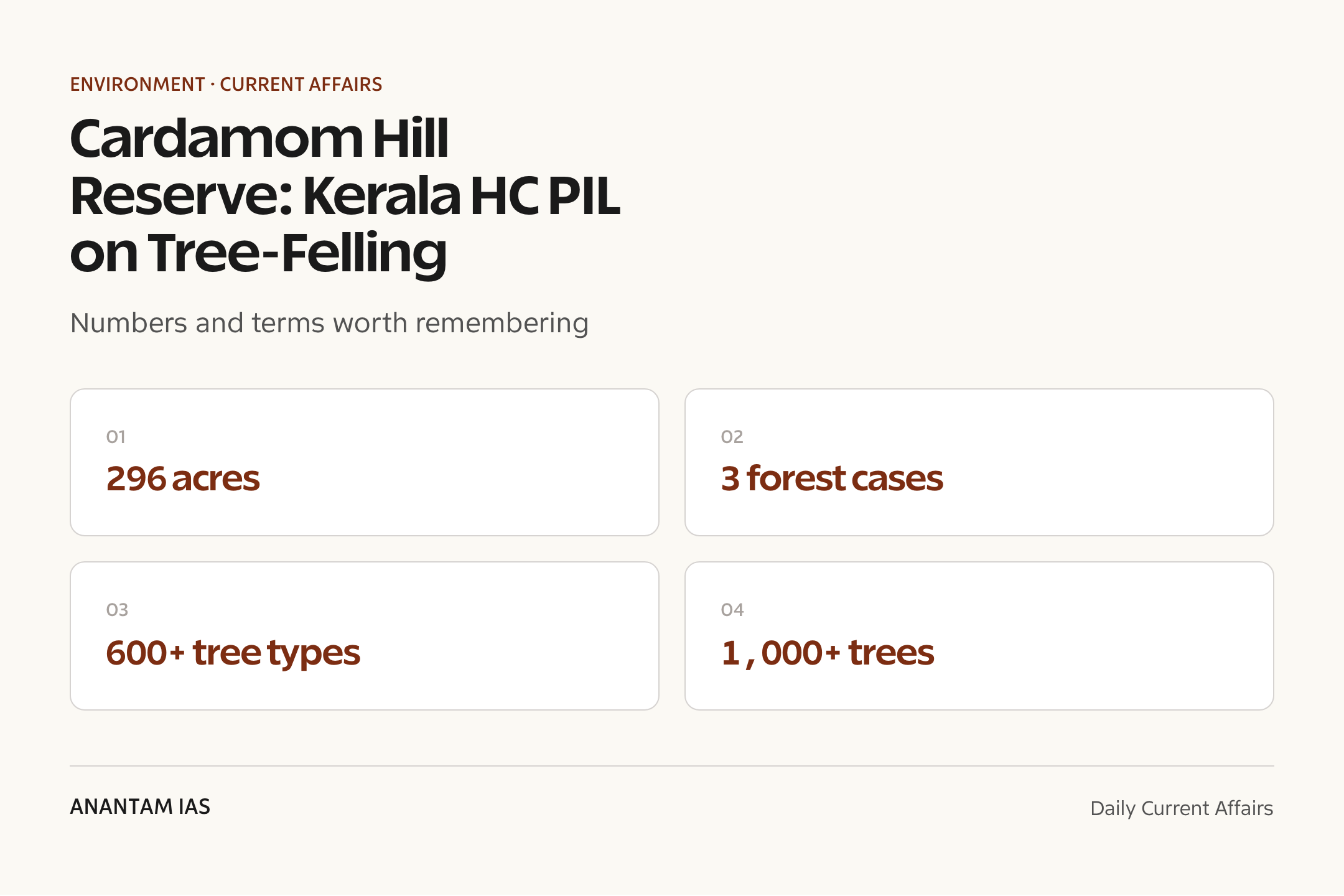
The Hindu reported that the Kerala High Court registered a suo motu PIL on July 1, 2026 over alleged large-scale tree-felling and unauthorized construction on about 296 acres of cardamom title land at Gudanpara Estate in Idukki.
The case places the Cardamom Hill Reserve in focus because it raises exam-relevant questions on forest land, land records, judicial oversight, biodiversity protection and governance of ecologically sensitive Western Ghats landscapes.
- Location: Gudanpara Estate, Idukki, under the Ponmudi Forest Section of the Devikulam Range.
- Allegation: tree-felling and unauthorized construction were reported on around 296 acres of cardamom title land.
- Forest action: the report said three cases had been registered by the Forest Department over felling of rare tree species.
- Government parties: the Chief Secretary, Forest and Revenue departments, Chief Conservator of Forest, DFO Devikulam and District Collector Idukki were impleaded.
- Ecological claim: the estate was described as sharing a boundary with Tamil Nadu and containing more than 600 varieties of trees.
- Recent context: another CHR tree-felling case was reported last year at Uchilukuth in Santhanpara, where over 1,000 indigenous trees were felled on 40 acres.
The development matters in the context of:
- Forest governance is tested when land is legally sensitive, privately claimed, leased, cultivated and ecologically valuable at the same time.
- Judicial oversight through PIL can force administrative departments to explain records, permissions, enforcement gaps and restoration steps.
- Western Ghats ecology makes local tree-felling more than a property dispute because it affects biodiversity, slope stability, water catchments and habitat connectivity.
- UPSC linkage: the issue connects GS3 environment with GS2 courts, federal administration and Article 226 remedies.
UPSC Relevance
Prelims Relevance
- Cardamom Hill Reserve is located in Idukki district of Kerala in the southern Western Ghats.
- CHR notification: Kerala Forest Department’s archived record traces the C.H. Reserve notification to the Travancore Government Gazette of August 24, 1897.
- Kerala High Court can entertain PILs and writ petitions under Article 226 of the Constitution.
- Suo motu means a court takes cognisance on its own motion without waiting for a formal petitioner to move it.
- Forest (Conservation) Act, 1980 is relevant where forest land is diverted or used for non-forest purposes.
- Kerala Preservation of Trees Act, 1986 is relevant to tree growth in private forests, Cardamom Hill Reserve and cardamom-cultivated areas.
- T.N. Godavarman case expanded the operational meaning of forest for conservation law to include dictionary forests and government-recorded forests.
- Western Ghats is one of India’s major biodiversity hotspot regions and has repeated conflicts over development, plantations and ecologically sensitive areas.
- Forest and Revenue departments often share responsibility in such cases because titles, leases, plantations, tree permissions and enforcement sit in different offices.
Mains Relevance
GS Paper 3
- Environment and ecology: forest conservation, biodiversity loss, habitat fragmentation, ecological sensitivity of Western Ghats and restoration after illegal felling.
- Disaster link: tree cover in high-range slopes affects soil erosion, landslide risk, water regulation and catchment stability.
GS Paper 2
- Judiciary: PIL, suo motu cognisance, Article 226, continuing mandamus and court-monitored environmental governance.
- Governance: coordination failures between Forest, Revenue, district administration and local enforcement machinery.
GS Paper 1
- Geography: Western Ghats high ranges, plantation landscapes, rain-shadow transitions, catchments and state-border ecological corridors.
Essay
- Environmental rule of law begins with land records, local enforcement and credible restoration, not only national targets.
- Courts and ecology show how constitutional remedies can protect public goods when ordinary administration is slow.
- Development versus conservation becomes sharper in landscapes where livelihoods, plantations and forests overlap.
Background and Context
What the PIL Covers
The case is about alleged damage to a sensitive high-range landscape, not a routine local land dispute.
- The Hindu reported that the Kerala High Court registered the case as a suo motu PIL after a report on destruction of forest land in the name of cardamom cultivation.
- Gudanpara Estate is the immediate site, with the allegation centred on around 296 acres of cardamom title land.
- Forest Department cases have reportedly been registered in relation to felling of rare tree species.
- Unauthorized construction is part of the allegation, which widens the issue from tree offences to land-use change.
- Officials impleaded include senior State, Forest, Revenue and district authorities, signalling that the court wants institutional answers.
What is Cardamom Hill Reserve?
Cardamom Hill Reserve is a legally and ecologically important landscape in Kerala’s high ranges.
- Cardamom Hill Reserve lies in Idukki district and forms part of the southern Western Ghats landscape.
- Kerala Forest Department hosts an archived C.H. Reserve notification from the Travancore Government Gazette, dated August 24, 1897.
- Official notification language recorded the specified tracts as reserved forests under the then Travancore forest regulation framework.
- Cardamom cultivation created a special governance history: plantations, lease claims, tree shade, forest protection and revenue records overlap.
- Static geography can be revised through Cardamom Hills, which places the hills within the wider Western Ghats frame.
Why the Western Ghats Angle Matters
Tree-felling in CHR has larger ecological consequences because the Western Ghats is a fragile mountain ecosystem.
- Western Ghats influence monsoon rainfall, river catchments, hill-slope stability and species movement across peninsular India.
- Idukki high ranges contain plantations, forests, reservoirs, steep slopes and settlements, making land-use decisions ecologically sensitive.
- Tree cover in such terrain regulates runoff, reduces soil erosion and protects slope stability during intense rainfall.
- Biodiversity loss is a direct concern because The Hindu report described the estate as habitat for several wildlife species.
- ESA debates around the Ghats can be connected with Western Ghats ESA for the development-versus-ecology governance context.
Legal Framework Around Tree-Felling
The legal lens depends on whether the land is forest land, cardamom reserve land, private claim land or a mix of these categories.
- Forest (Conservation) Act, 1980 restricts de-reservation and non-forest use of forest land without the required central approval.
- Kerala Forest Act, 1961 provides the State-level forest law framework for forest offences and enforcement.
- Kerala Preservation of Trees Act, 1986 is relevant because it protects tree growth in private forests, CHR and cardamom-cultivated areas.
- Environment Protection Act, 1986 works as an umbrella law for environmental protection; revise the statutory frame through Environment Protection Act 1986.
- Wildlife Protection Act, 1972 becomes relevant if habitat disturbance affects protected fauna; compare the protected-area basics with National Park vs Wildlife Sanctuary.
Why PIL is Relevant Here
Environmental PIL allows courts to treat ecological damage as a public injury rather than a private grievance.
- Suo motu PIL is especially important when affected ecosystems, future generations or local communities may not have direct access to litigation.
- Article 226 gives High Courts wide writ jurisdiction against State authorities and other bodies performing public functions.
- Continuing mandamus can help courts monitor compliance through status reports, inspections, restoration plans and departmental accountability.
- Natural justice still matters because owners, claimants, officials and affected communities may need hearings before final directions.
- PIL evolution can be revised through Public Interest Litigation in India for the GS2 polity angle.
Forest-Revenue Governance Problem
CHR cases often become difficult because the ecological unit and the administrative records do not always move together.
- Revenue records decide title, lease, possession and land assignment questions.
- Forest records decide reserve status, tree permissions, offences, ecological sensitivity and conservation enforcement.
- Plantation claims complicate enforcement when cardamom cultivation is used as the stated reason for clearing tree growth.
- Inter-departmental delay can allow irreversible damage before record verification, field inspection and enforcement action converge.
- District administration is crucial because land-use change, construction, access roads, local policing and restoration need district-level coordination.
Exam Pointers from the Case
For UPSC, treat this as a compact case study on environmental rule of law.
- Prelims hook: CHR, Idukki, Western Ghats, Kerala HC, PIL, Article 226 and forest laws.
- Mains hook: illegal tree-felling shows the gap between legal protection and field-level enforcement.
- Governance hook: overlapping authority can weaken accountability unless records, inspections and penalties are coordinated.
- Ethics hook: ecological trusteeship requires officials to protect public resources even when local pressure favours short-term land conversion.
- Answer value: use this case to connect biodiversity, disaster resilience, land governance and judicial review in one example.
Way Forward
Verify Land and Forest Records
- Revenue and Forest departments should jointly map title, lease, reserve notification, tree permissions and construction status for the disputed parcel.
- Digital land records should be cross-checked with old gazette notifications, forest maps, settlement records and field boundaries.
- Public record disclosure can reduce repeat disputes where land status is used to justify tree removal.
Stop Damage and Secure Evidence
- Status quo orders and site sealing may be needed where fresh felling or construction is continuing.
- Geo-tagged inspection, drone imagery and stump enumeration can create reliable evidence for prosecution and restoration.
- Chain of custody for seized timber, machinery and field records is essential for successful enforcement.
Restore the Landscape
- Ecological restoration should use native species suited to the high-range landscape, not cosmetic plantation targets.
- Slope safety, drainage, soil stabilization and invasive-species control should be built into the restoration plan.
- Community monitoring can help report fresh encroachment, illegal transport and construction activity before damage spreads.
Fix Institutional Accountability
- Time-bound reports from Forest, Revenue and district officials should identify who approved, ignored or failed to prevent the activity.
- Penalty and restoration costs should reflect ecological damage, not only the market value of felled timber.
- Western Ghats governance needs routine coordination among land, forest, disaster management and local-body authorities.
Conclusion
The Cardamom Hill Reserve PIL is useful for exam preparation because it shows how a local tree-felling allegation can open larger questions of forest law, land records, biodiversity and judicial review.
The main lesson is that environmental governance cannot rely only on old notifications or courtroom concern. It needs verified land records, quick field enforcement, credible restoration and clear accountability across departments.
UPSC Practice Questions
Prelims MCQ 1
With reference to the Cardamom Hill Reserve issue, consider the following statements:
- Cardamom Hill Reserve is located in Idukki district of Kerala.
- The Kerala High Court took suo motu cognisance of alleged tree-felling on CHR land.
- Article 226 is relevant because High Courts have writ jurisdiction under it.
How many of the above statements are correct?
(a) Only one (b) Only two (c) All three (d) None
Answer: (c) All three
Explanation:
All three statements are correct. The reported issue concerns CHR land in Idukki, a suo motu PIL by the Kerala High Court and the wider Article 226 writ-jurisdiction frame.
Prelims MCQ 2
Which one of the following best explains the term suo motu in judicial proceedings?
(a) A case transferred from a lower court by appeal (b) Cognisance taken by a court on its own motion (c) A petition filed only by the Union government (d) A dispute that cannot be heard by a High Court
Answer: (b) Cognisance taken by a court on its own motion
Explanation:
Suo motu means the court acts on its own motion. In this case, the High Court registered a PIL after taking note of reported environmental concerns.
UPSC Mains Questions
- The Cardamom Hill Reserve tree-felling PIL shows how forest conservation problems often arise from weak land records and departmental overlap. Discuss with reference to Western Ghats ecology, forest law and district-level governance.
- Environmental PILs can strengthen administrative accountability, but they cannot replace routine field enforcement. Examine this statement using the Kerala High Court’s suo motu PIL on alleged tree-felling in CHR land.
- Illegal tree-felling in ecologically sensitive hill landscapes has consequences beyond biodiversity loss. Explain how such activity affects disaster risk, water security, land governance and public trust.
Sources: The Hindu and Kerala Forest Department CHR notification.
Frequently Asked Questions
What is Cardamom Hill Reserve?
Cardamom Hill Reserve is a high-range landscape in Idukki district, Kerala, associated with cardamom cultivation and forest protection in the southern Western Ghats. Its legal history includes an 1897 Travancore-era reserve notification, and its present governance involves forest, revenue and land-record questions.
Why is CHR in the news?
The Kerala High Court registered a suo motu PIL after reports of alleged large-scale tree-felling and unauthorized construction on about 296 acres of cardamom title land at Gudanpara Estate in Idukki. The case also involves biodiversity and forest-law concerns.
What is a suo motu PIL?
A suo motu PIL is a public interest matter taken up by a court on its own motion. It is useful in environmental cases because forests, wildlife and future generations may suffer damage even when no individual petitioner immediately approaches the court.
Which laws are relevant?
Forest (Conservation) Act, 1980, Kerala Forest Act, 1961, Kerala Preservation of Trees Act, 1986, Environment Protection Act, 1986 and Wildlife Protection Act, 1972 can become relevant depending on land status, tree permission, habitat damage and construction activity.
Why does this matter for Western Ghats?
Western Ghats landscapes support high biodiversity, water catchments and slope stability. Tree-felling in high-range areas can affect habitats, increase erosion, disturb wildlife corridors and worsen landslide or runoff risks during heavy rainfall.
What should administrators do next?
Forest and Revenue departments should verify land status, freeze further damage, secure evidence, identify officials responsible for lapses and prepare ecological restoration. A court-monitored process can help, but routine field enforcement remains the real test.