Catch the Rain: Renewed National Call for Water Conservation
Why in News?
The Ministry of Jal Shakti, through a 19 July 2026 PIB backgrounder, renewed the national call to conserve rainwater. It placed a focused nationwide mobilisation running from 4 July to 4 August 2026 at the centre of efforts on rainwater harvesting, groundwater recharge, restoration of traditional water bodies, plantation and public participation.
The immediate mobilisation followed the call made during the 135th Mann Ki Baat episode on 28 June 2026. The backgrounder also explained the larger institutional shift: Jal Sanchay Jan Bhagidari: Catch the Rain, launched on 1 June 2026, expands JSJB and integrates it with Jal Shakti Abhiyan: Catch the Rain.
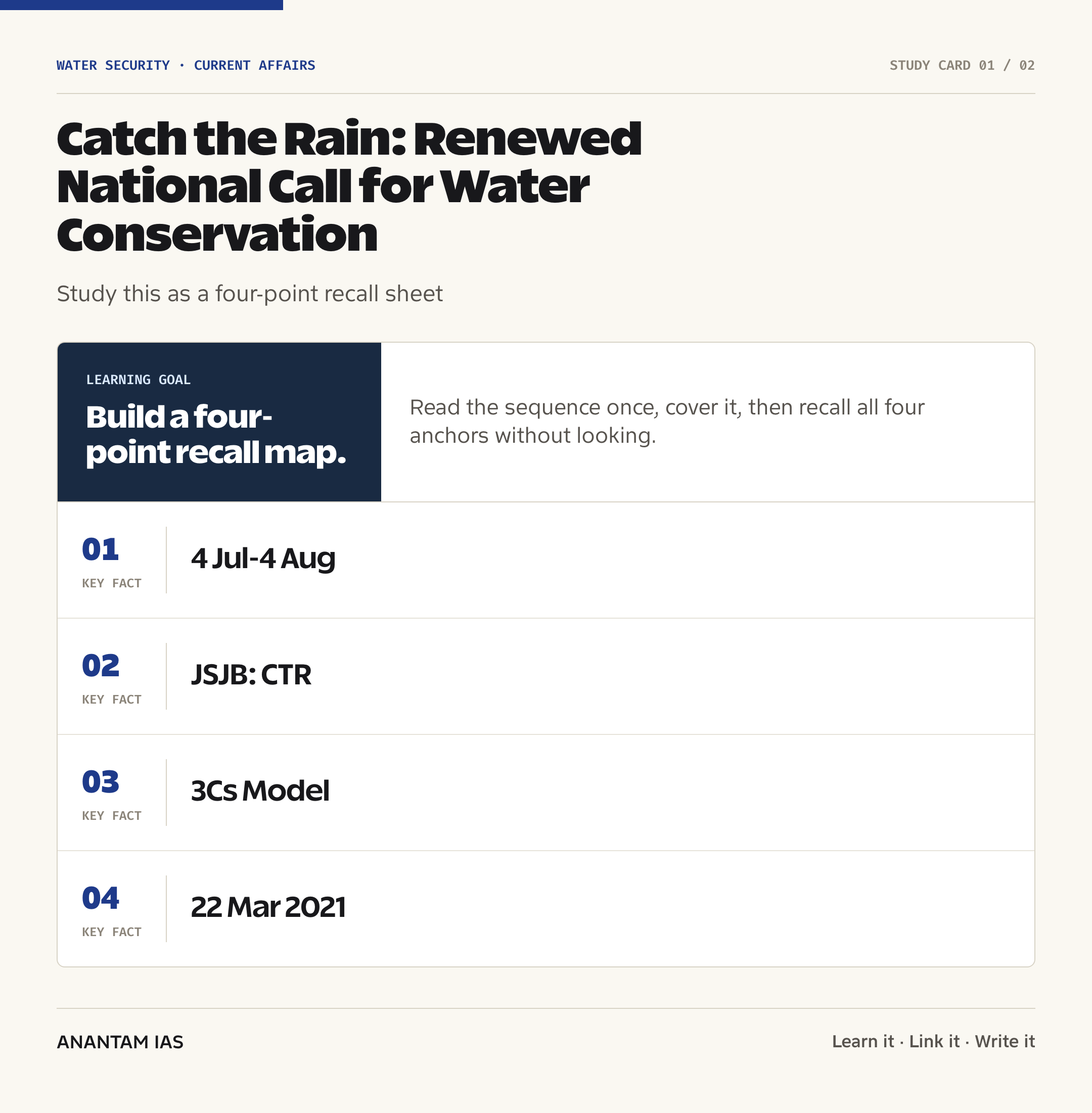
- The focused campaign period is 4 July to 4 August 2026; it is a time-bound national mobilisation, not a new report of completed structures.
- JSJB: CTR was launched on 1 June 2026 by widening Jal Sanchay Jan Bhagidari and integrating it with the older Catch the Rain campaign.
- The action menu covers rooftop harvesting and recharge structures, revival of wells and baolis, desilting of ponds and reservoirs, plantation and citizen participation.
- The programme favours low-cost, locally appropriate interventions supported by community action, government convergence and Corporate Social Responsibility.
- PIB presents the campaign as a route to climate resilience, stronger agriculture, rural livelihoods and sustainable water security.
The development matters in the context of:
- Monsoon concentration makes the timing, storage and infiltration of rainfall as important as the annual rainfall total.
- Groundwater stress cannot be solved by adding structures alone; recharge, extraction, water quality and maintenance must be managed together.
- Decentralised governance matters because catchments, aquifers, land use and demand differ across villages, wards and districts.
- Climate adaptation becomes durable when communities help plan, monitor and maintain water assets instead of receiving one-time construction works.
UPSC Relevance
Prelims Relevance
- Jal Shakti Abhiyan began in 2019 in 1,592 water-stressed blocks across 256 districts.
- JSA: Catch the Rain was launched on World Water Day, 22 March 2021, with the theme Catch the Rain, where it falls, when it falls.
- Jal Sanchay Jan Bhagidari was launched on 6 September 2024 in Surat, Gujarat.
- The JSJB model rests on the 3Cs: Community, Corporate Social Responsibility and Cost.
- JSJB: CTR was launched on 1 June 2026 and integrates JSJB with JSA: CTR.
- Jal Shakti Kendras function as district-level knowledge and facilitation centres for water conservation.
- Campaign convergence includes PMKSY components, CAMPA, Finance Commission Grants, VB-G RAM-G and State schemes.
- Artificial recharge means deliberately increasing the movement of suitable surface water into an aquifer through structures such as recharge pits, shafts and wells.
Mains Relevance
GS Paper 3
- Environment conservation and water security: connect rainwater harvesting, aquifer recharge, restoration of water bodies and climate adaptation.
- Agriculture and irrigation: assess groundwater dependence, source sustainability, demand management and the role of local water budgets.
- Disaster resilience: explain how watershed treatment, retention and recharge can reduce drought vulnerability while moderating runoff.
GS Paper 2
- Government policies and interventions: examine scheme convergence, measurable outcomes and the gap between reported structures and verified functionality.
- Devolution and participatory governance: evaluate the roles of Panchayati Raj Institutions, Urban Local Bodies, women’s groups and civil society.
Essay
- Water security is built locally even when policy and finance are organised nationally.
- People’s participation turns conservation infrastructure into a maintained public asset.
- Climate resilience depends on aligning ecological limits with development choices.
Background and Context
Read the July Trigger Correctly
Two related updates sit close together, but the exam-ready distinction is straightforward.
- The earlier Anantam IAS note on 1.5 crore recharge and storage structures covered the reported output of JSJB 2.0. That June development is background, not the new July trigger.
- The new July development is the focused mobilisation from 4 July to 4 August 2026, designed to intensify harvesting, recharge, restoration, plantation and public participation during the monsoon window.
- A separate institutional change preceded it: JSJB: CTR began on 1 June 2026, expanding JSJB and integrating it with Jal Shakti Abhiyan: Catch the Rain.
- PIB says the more than 1.5 crore structures reported against the JSJB 2.0 target are undergoing physical verification and field validation. Reported construction must not be written as independently verified performance.
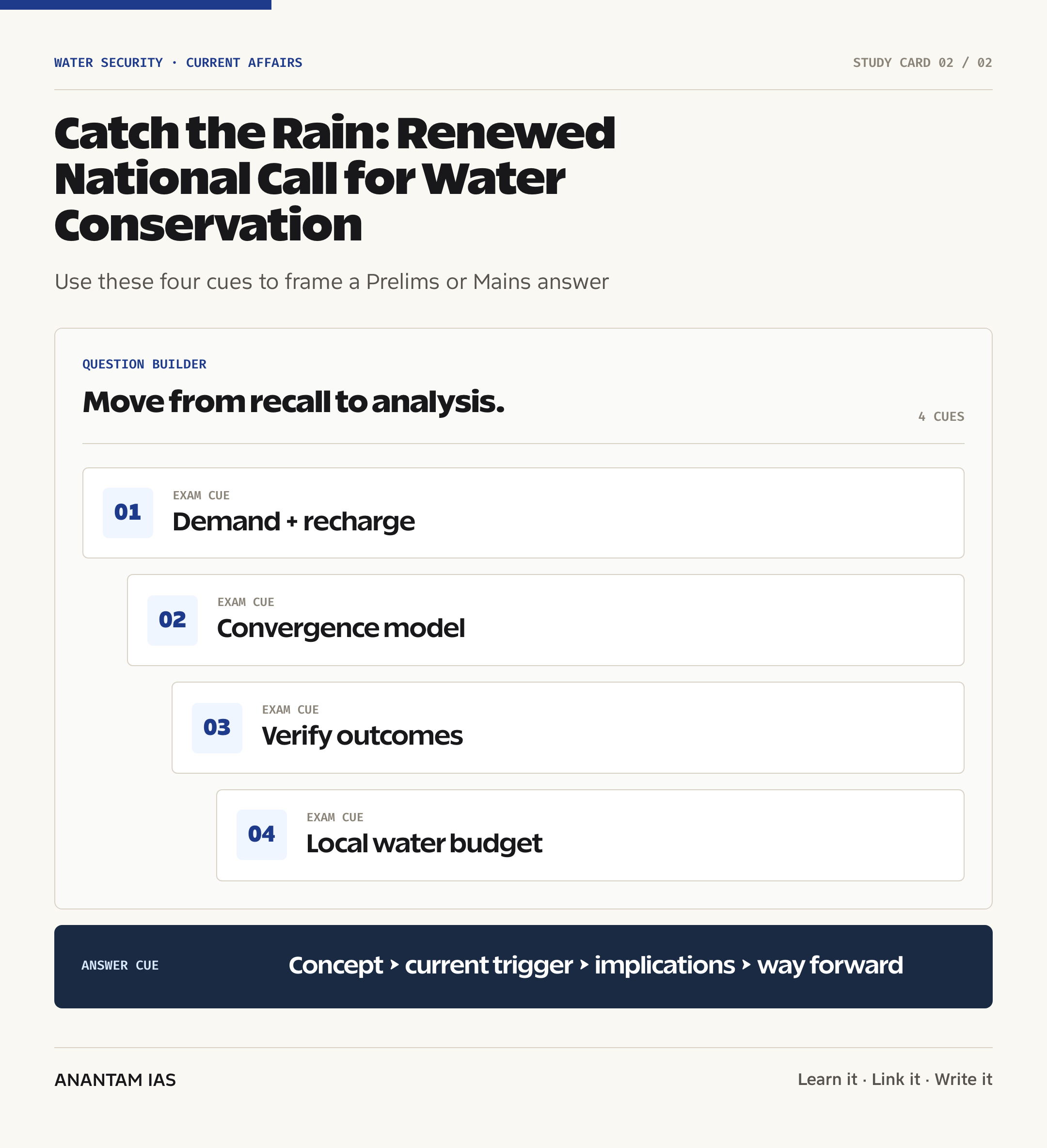
- For answers, separate assets reported from assets that are functional, hydrogeologically suitable, maintained and producing measurable recharge. The second category is the policy outcome that matters.
- This distinction also prevents current-affairs duplication: use the June article for the output figure and artificial-recharge background, and use this July note for mobilisation, integration, local water planning and climate resilience.
From Jal Shakti Abhiyan to an Integrated Campaign
The present campaign is the latest layer in an evolving water-conservation architecture.
- Jal Shakti Abhiyan 2019 targeted 1,592 water-stressed blocks in 256 districts and combined rainwater harvesting, groundwater recharge, watershed development, water-body rejuvenation and afforestation through a Jan Andolan approach.
- On World Water Day 2021, the nationwide JSA: Catch the Rain campaign carried the memorable principle of catching rain where it falls and when it falls.
- The 2021 phase added geo-tagging of water bodies, scientific planning, district Jal Shakti Kendras and awareness activities to the construction and conservation agenda.
- The 2022 phase widened attention to traditional water bodies, watersheds, wetlands, rivers, springsheds and catchment protection, recognising that recharge starts across a landscape.
- The 2023 phase focused on source sustainability in 150 water-stressed districts, linking drinking-water reliability with groundwater recharge, field monitoring and community participation.
- The 2024 phase, themed Nari Shakti se Jal Shakti, emphasised women-led action, desilting, revival of abandoned borewells and afforestation. JSJB: CTR now brings the participation and campaign tracks together.
How Jal Sanchay Jan Bhagidari Works
JSJB treats groundwater conservation as a shared local task backed by converged finance and institutions.
- Jal Sanchay Jan Bhagidari was launched on 6 September 2024 in Surat, Gujarat, with a focus on low-cost recharge and storage structures, revival of defunct borewells and locally suitable designs.
- Its 3Cs model combines Community, Corporate Social Responsibility and Cost. Community identifies and maintains assets, CSR can add institutional support, and low cost aims to make interventions replicable.
- The model uses a Whole-of-Government and Whole-of-Society approach: departments and schemes converge while Panchayats, urban bodies, institutions, businesses and citizens share implementation responsibility.
- JSJB 1.0, implemented from 1 April 2024 to 31 May 2025, crossed a target of at least 10 lakh structures, with more than 27 lakh artificial recharge structures reported.
- JSJB 2.0 began on 1 June 2025 with special attention to Over-Exploited and Critical districts. Against a one-crore target by 31 May 2026, more than 1.5 crore structures were reported.
- The 2026 integrated version shifts attention from a stand-alone structure drive toward a broader monsoon strategy that combines harvesting, recharge, storage, participation and climate resilience.
- Recognition through the 6th National Water Awards in November 2025 shows how the programme also uses public recognition to reward exemplary participation, though awards can’t replace outcome verification.
What the Focused Campaign Asks Communities to Do
The July mobilisation turns the national call into a practical five-part local action menu.
- Adopt rainwater-harvesting systems in homes, housing societies and workplaces so roof runoff can be stored or directed to suitable recharge arrangements.
- Install recharge pits and shafts at appropriate sites and repair unused borewells for recharge, with filtration and water-quality safeguards to prevent contaminants from being carried underground.
- Restore baolis, wells and traditional water bodies. These assets often combine storage, infiltration, local knowledge and cultural stewardship, but revival must include catchment protection and maintenance.
- Remove silt from ponds and reservoirs where scientific assessment supports it. Desilting can improve retention capacity, but excavated material, inflow channels and downstream effects also need a plan.
- Expand tree and green cover in water-retention areas. Vegetation can slow runoff and improve soil structure, but species, location and local hydrogeology decide the actual water benefit.
Aquifer Recharge and Local Water Budgeting
A structure becomes useful only when it fits the aquifer, the catchment and the local balance between supply and demand.
- An aquifer is a permeable geological formation that stores and transmits groundwater. Recharge is the movement of water into that formation, naturally through infiltration or deliberately through suitable structures.
- Artificial recharge doesn’t create water. It changes the route and timing of available runoff so more suitable water enters storage underground instead of leaving the area rapidly as surface flow.
- A local water budget compares expected rainfall, runoff, storage and recharge with household, farm, livestock, institutional and ecological demand at village, ward or aquifer scale.
- The budget exposes the key limitation of supply-only policy: new recharge works can be cancelled out by uncontrolled extraction, water-intensive cropping, leakage or paved recharge zones.
- Useful planning links ridge-to-valley treatment, water-body restoration, rooftop harvesting, soil-moisture conservation and efficient irrigation. Each intervention handles a different part of the same water cycle.
- Because aquifers cross administrative boundaries, hydrogeological information and cooperation between neighbouring local bodies are essential. A successful pit in one location isn’t a universal design template.
- In cities, the same budget should connect stormwater drainage and recharge. Capturing clean roof runoff can support recharge, while contaminated road runoff may need treatment or safe conveyance instead.
Convergence and Institutional Architecture
Convergence means aligning existing programmes, grants, technical staff and community effort around one local water plan.
- PIB lists VB-G RAM-G among the convergence routes, allowing employment and livelihood works to support water conservation where approved under the programme’s design.
- Under PMKSY, Per Drop More Crop addresses efficient on-farm water use, while Repair, Renovation and Restoration of Water Bodies supports the revival of storage and recharge assets.
- CAMPA, Finance Commission Grants, State schemes and CSR can support catchment treatment, plantation, local infrastructure and maintenance, reducing dependence on a single budget line.
- Panchayati Raj Institutions and Urban Local Bodies are critical because they can connect land-use decisions, asset registers, community priorities, local finance and routine upkeep.
- Women’s groups, youth, educational institutions and civil society widen participation beyond contractors and departments. Their role can include mapping, awareness, monitoring, water budgeting and maintenance.
- Jal Shakti Kendras serve as district knowledge and facilitation hubs. They disseminate techniques, guide communities and administrations, and support scientific planning and implementation.
- Convergence works only with a shared local plan and clear accounts. Otherwise, the same asset may be counted under several schemes while responsibility for maintenance remains unclear.
Climate Value, Limits and Measurement
Catch the Rain is best understood as climate adaptation with a demanding implementation test.
- Stored surface water and recharged aquifers can create a buffer against dry spells, support irrigation and drinking-water sources, and reduce the vulnerability of rural livelihoods to variable monsoons.
- Slower runoff, healthier catchments and revived water bodies may also reduce erosion and local flood peaks, but benefits depend on basin position, soil, slope, drainage and maintenance.
- India’s wider groundwater crisis makes demand management unavoidable. Recharge without extraction discipline can encourage a rebound in pumping and leave water levels unchanged.
- A high structure count measures administrative output; functionality, water quality, storage created, recharge achieved, seasonal water-level change and beneficiary equity measure outcomes.
- The PIB caveat on physical verification and field validation should shape evaluation. Geo-tagged completion records need site inspections and hydrogeological evidence before performance claims are final.
- Equity also matters: landless households, downstream users and drinking-water needs can be missed when benefits are judged only through private wells or irrigated acreage.
- A credible programme needs an asset-life-cycle view: design, construction, pre-monsoon preparation, monsoon performance, post-monsoon verification, routine maintenance and correction of failed or unsafe structures.
Way Forward
Plan by Aquifer and Catchment
- Use aquifer maps, rainfall records and catchment surveys before selecting pits, shafts, ponds or borewell-recharge sites; reject one-design-fits-all construction targets.
- Protect recharge zones and inflow channels through land-use controls, permeable surfaces, soil conservation and pollution safeguards.
- Require pre-treatment and water-quality checks before routing runoff into shafts or defunct borewells.
Pair Recharge with Demand Management
- Prepare a public village or ward water budget before each monsoon and revise it after rainfall and water-level observations.
- Link conservation assets with micro-irrigation, crop choices, leakage control and reuse so new recharge isn’t erased by higher withdrawals.
- Reserve a clear share of planning attention for drinking water and ecosystem needs, not only irrigation output.
Measure Outcomes, Not Only Structures
- Publish geo-tagged asset records with verification status, design, cost, maintenance owner and pre-monsoon and post-monsoon observations.
- Track functionality, storage, recharge and water quality over several seasons instead of treating construction completion as the final result.
- Use independent field audits and social audits to test reported numbers, identify failed designs and repair assets quickly.
Make Participation Operational
- Give local bodies and user groups defined roles in site selection, procurement oversight, upkeep and conflict resolution.
- Use Jal Shakti Kendras and educational institutions to translate technical guidance into local-language training and citizen monitoring.
- Create an operation and maintenance fund for every asset so desilting, filters, inlets and protective works don’t fail after the launch period.
Conclusion
Catch the Rain provides a useful national frame: conserve rainfall close to where it falls, restore local storage and make water security a shared public responsibility. The integrated JSJB: CTR model adds community participation and scheme convergence to that frame.
Its credibility will rest on the step after construction. Verified recharge, restrained extraction, safe water quality and maintained assets must replace structure counts as the measure of success. Local water budgets can connect those pieces into one defensible climate-resilience strategy.
UPSC Practice Questions
Prelims MCQ 1
With reference to Jal Sanchay Jan Bhagidari: Catch the Rain, consider the following statements:
- It was launched on 1 June 2026.
- It integrates Jal Sanchay Jan Bhagidari with Jal Shakti Abhiyan: Catch the Rain.
- Its implementation is restricted to Urban Local Bodies.
How many of the above statements are correct?
(a) Only one (b) Only two (c) All three (d) None
Answer: (b) Only two
Explanation:
Statements 1 and 2 are correct. The integrated initiative began on 1 June 2026. It mobilises rural and urban local bodies, women’s groups, youth, institutions, civil society and communities, so Statement 3 is incorrect.
Prelims MCQ 2
Which option best describes the 4 July to 4 August 2026 Catch the Rain campaign?
(a) A declaration that 1.5 crore structures had completed independent field validation (b) A replacement for Jal Shakti Abhiyan: Catch the Rain (c) A focused nationwide mobilisation for harvesting, recharge, restoration, plantation and public participation (d) A programme restricted only to Over-Exploited groundwater districts
Answer: (c) A focused nationwide mobilisation for harvesting, recharge, restoration, plantation and public participation
Explanation:
Option (c) is correct. The July campaign is a time-bound nationwide mobilisation. The 1.5 crore figure belongs to the earlier JSJB 2.0 update and remained subject to physical verification and field validation.
UPSC Mains Questions
- Rainwater harvesting can strengthen climate resilience only when recharge is linked with demand management. Discuss the role of aquifer-based planning, local water budgets and community institutions in making the Catch the Rain campaign ecologically and socially effective. (15 marks, 250 words)
- The success of water-conservation programmes should be judged by verified hydrological outcomes, not the number of structures reported. Critically examine this statement in the context of JSJB: Catch the Rain and suggest an outcome-based monitoring framework. (15 marks, 250 words)
- Scheme convergence can pool finance and institutions, but it can also blur accountability. Analyse how Panchayati Raj Institutions, Urban Local Bodies, Jal Shakti Kendras, CSR and community groups can share clear responsibility under Catch the Rain. (10 marks, 150 words)
Source: PIB, Ministry of Jal Shakti.
Frequently Asked Questions
What is Catch the Rain?
Jal Shakti Abhiyan: Catch the Rain is a national water-conservation campaign launched on World Water Day, 22 March 2021. Its guiding idea is to capture rainfall where and when it falls through harvesting, recharge, restoration of water bodies, watershed work, scientific planning, district Jal Shakti Kendras and community participation.
What is new in July 2026?
The July 2026 trigger is a focused nationwide mobilisation from 4 July to 4 August. It intensifies rainwater harvesting, recharge, revival of traditional water bodies, desilting, plantation and public participation. It should be distinguished from the earlier JSJB 2.0 report of more than 1.5 crore structures.
What does JSJB: CTR integrate?
JSJB: CTR, launched on 1 June 2026, expands Jal Sanchay Jan Bhagidari and integrates it with Jal Shakti Abhiyan: Catch the Rain. The combination joins JSJB’s low-cost local structures, 3Cs model and community ownership with the nationwide monsoon campaign, scientific planning and institutional network of Catch the Rain.
What does the 1.5 crore figure show?
It refers to more than 1.5 crore recharge structures reported nationwide under JSJB 2.0 against a target of at least one crore by 31 May 2026. PIB explicitly states that the reported structures are undergoing physical verification and field validation, so the number isn’t the same as verified recharge performance.
What is a local water budget?
A local water budget compares available rainfall, runoff, surface storage and groundwater recharge with demand from households, farms, livestock, institutions and ecosystems. Prepared at village, ward or aquifer scale, it helps communities choose suitable works, set priorities and see when extraction exceeds the water likely to be replenished.
Why does aquifer recharge build resilience?
Aquifer recharge stores suitable water underground, where it can support wells, irrigation and drinking-water sources during dry periods. But recharge is only one part of resilience. Water quality, extraction limits, crop choices, land-use protection and asset maintenance decide whether the added storage produces a lasting local buffer.