
Why in News?
Over 1.5 crore artificial groundwater recharge and water storage structures have been created across India under the Jal Sanchay Jan Bhagidari (JSJB) initiative. These assets were primarily developed through community participation, corporate contributions, and government convergence.
| UPSC Relevance: GS-1 Geography: Changes in critical geographical features; GS-3 Environment and Biodiversity: Conservation Prelims: Jal Sanchay Jan Bhagidari (JSJB) Initiative Mains: Groundwater Depletion and Management: Challenges & Policies |
Groundwater comprises nearly 99% of Earth’s liquid freshwater. In India, groundwater is the primary source of agricultural activity and drinking water, meeting nearly 62% of irrigation needs, 85% of rural consumption, and 50% of urban demand.
Why is Groundwater Management critical for India?
India is the world’s largest user of groundwater, extracting more groundwater annually than China and the United States combined.
1. Over-Exploitation of Groundwater:
- Increasing agricultural demand has resulted in excessive pumping.
- Free or subsidised electricity has encouraged indiscriminate extraction.
- Falling water tables are reported in several regions of Punjab, Haryana, Rajasthan, Gujarat, Karnataka, and parts of Uttar Pradesh.
2. Groundwater Quality Degradation:
- Anthropogenic Sources: Industrial effluents, Mining activities, Agricultural chemicals & Urban wastewater.
- Natural Contaminants: Arsenic (Gangetic Plains), Fluoride (Rajasthan, Telangana, Andhra Pradesh), Iron and salinity in several regions.
- Consequences include Fluorosis, Arsenicosis, reduced agricultural productivity and Public health burden.
3. Climate Change and Water Security:
- Climate change is altering Rainfall intensity, Monsoon patterns, Recharge cycles and Drought frequency. Groundwater serves as India’s most reliable climate adaptation resource.
4. Urbanisation-Induced Stress:
Rapid urban expansion has:
- Reduced natural recharge zones.
- Increased concretisation.
- Enhanced groundwater extraction.
- Caused urban flooding alongside groundwater depletion.
The sharp increase in groundwater extraction has been driven by the availability of affordable drilling techniques and pumping technologies, enabling even small farmers and low-income households to construct and operate private tube wells.
As per the United Nations Educational, Scientific and Cultural Organisation (UNESCO), effective groundwater management needs 4 key priorities to ensure sustainable and balanced use of groundwater resources:
- Maintaining a dynamic water cycle to support natural recharge
- Balancing ecological and human needs to ensure environmental protection
- Preserving reserve supplies to safeguard against droughts
- Aligning use with quality requirements so that groundwater quality matches its purpose
What is Artificial Recharge, and why is it required?
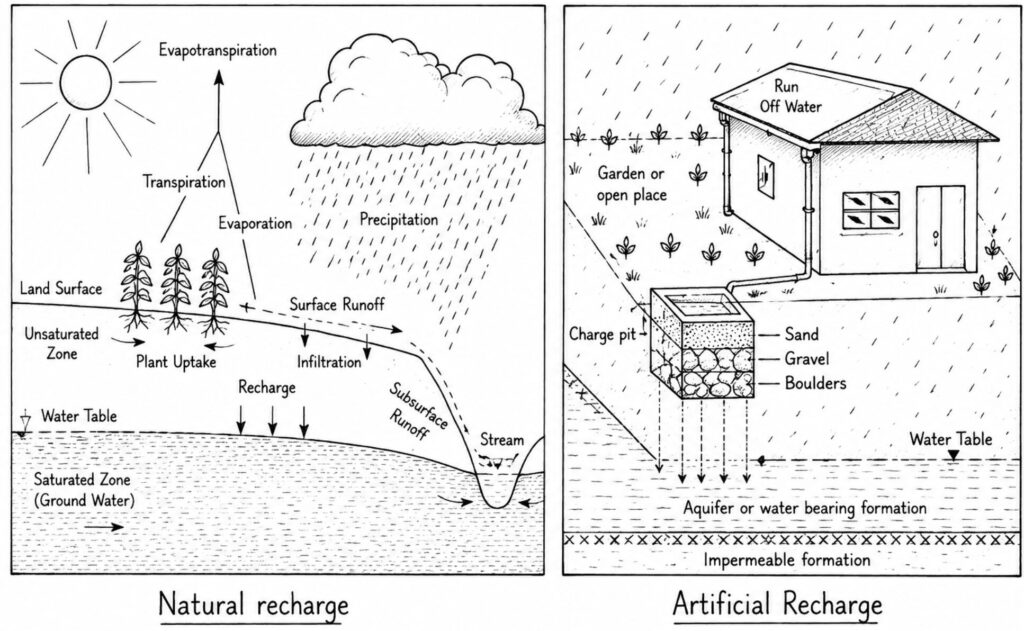
- Natural recharge is the process by which water from rainfall seeps downward from the ground and is stored in aquifers. The amount of water that can be naturally recharged depends on land slope, water retention time, geographic location, and the availability of recharge areas.
- In many cases, adequate recharge does not occur due to unfavourable natural conditions. Human activities, urbanisation, and concretisation result in a reduction in rechargeable area.
- Further, natural recharge may not be sufficient to compensate for the increasing abstraction of groundwater. It is possible to increase recharge by constructing suitable structures. This process of increasing recharge is called artificial recharge.
Artificial Recharge has the following Advantages:
- Arrest the decline in groundwater levels
- Enhance the availability of groundwater
- Sustain drinking water sources
- Improve the yields of irrigation wells
- Increase recharge in urban areas, which has decreased drastically due to paving
- Prevent urban flooding
- Improve groundwater quality by dilution
- Restrict sea-water ingress.
Various Techniques or Methods of Artificial Recharge:
Artificial recharge techniques can be broadly categorised into three categories: surface, subsurface and combination techniques.
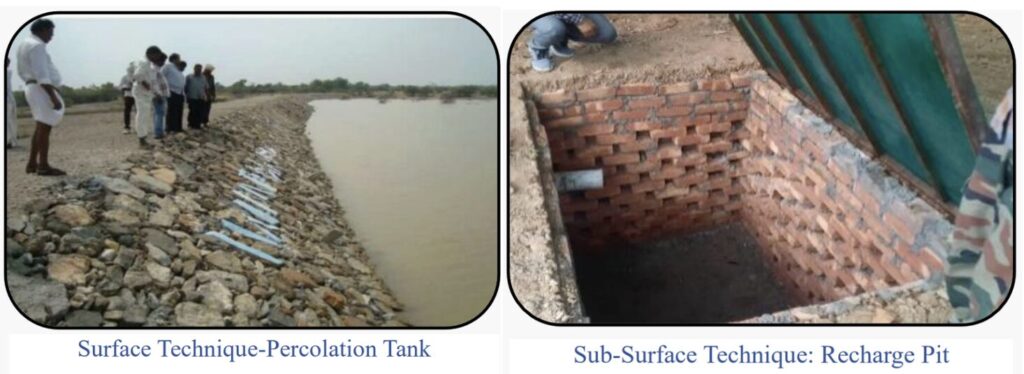
i. Surface Techniques: This is done by restricting the surface flow, impounding water on the surface or by spreading (also called flooding). Major variants are Percolation Tanks, Check Dams, Ditch and furrow system, Flooding and over Irrigation.
ii. Subsurface Techniques: This is done by putting water directly into the aquifers, and the variants include Recharge pits, Recharge shafts, recharge wells or Injection wells, etc.
iii. Combination of Surface-Subsurface Techniques: The surface and subsurface techniques can also be combined to get more out of the recharge interventions. One such example is a recharge well within a percolation tank.
Jal Sanchay Jan Bhagidari (JSJB) Initiative:
- The Jal Sanchay Jan Bhagidari (JSJB) initiative was launched under the Jal Shakti Abhiyan: Catch the Rain campaign in 2024.
- Launched by the Ministry of Jal Shakti to transform water conservation into a mass movement by strengthening community and private sector participation in water conservation.
- Objective: To tackle declining groundwater levels at the local level by combining scientific technology with traditional storage methods.
- It focuses on the construction of low-cost artificial recharge structures, including rooftop rainwater harvesting, recharge pits/shafts, and the revival of defunct borewells.
- The initiative functions on the 3Cs mantra (Community, Corporate Social Responsibility, and Cost). The 3Cs Framework:
- Community: Emphasises Jan Bhagidari (public participation) to drive voluntary labour and community-led water conservation.
- Corporate Social Responsibility (CSR): Engages private industries and businesses to fund water security projects.
- Cost: Focuses on low-cost, decentralised, and scalable infrastructure models.
- It works through the convergence of government schemes like MGNREGA and the District Mineral Fund, and philanthropic resources.
- The program integrates community action with official JSJB portals and monitoring systems to measure the impact of groundwater replenishment and ensure sustainable water use.
The growing groundwater crisis has strengthened the Government’s commitment to effective management, reaffirmed by India’s COP 21 commitment to climate resilience and long-term growth. Effective groundwater management is vital for achieving the Sustainable Development Goals, especially SDG 6, SDG 11, and SDG 12.
Tell Google you want more of this.
Add Anantam IAS as a preferred sourceOne tap, and this site shows up more often in your own Top Stories, AI Overviews and AI Mode. Remove it any time.