Restaurant Service Charge: CCPA Acts Against 41 Establishments
Why in News?
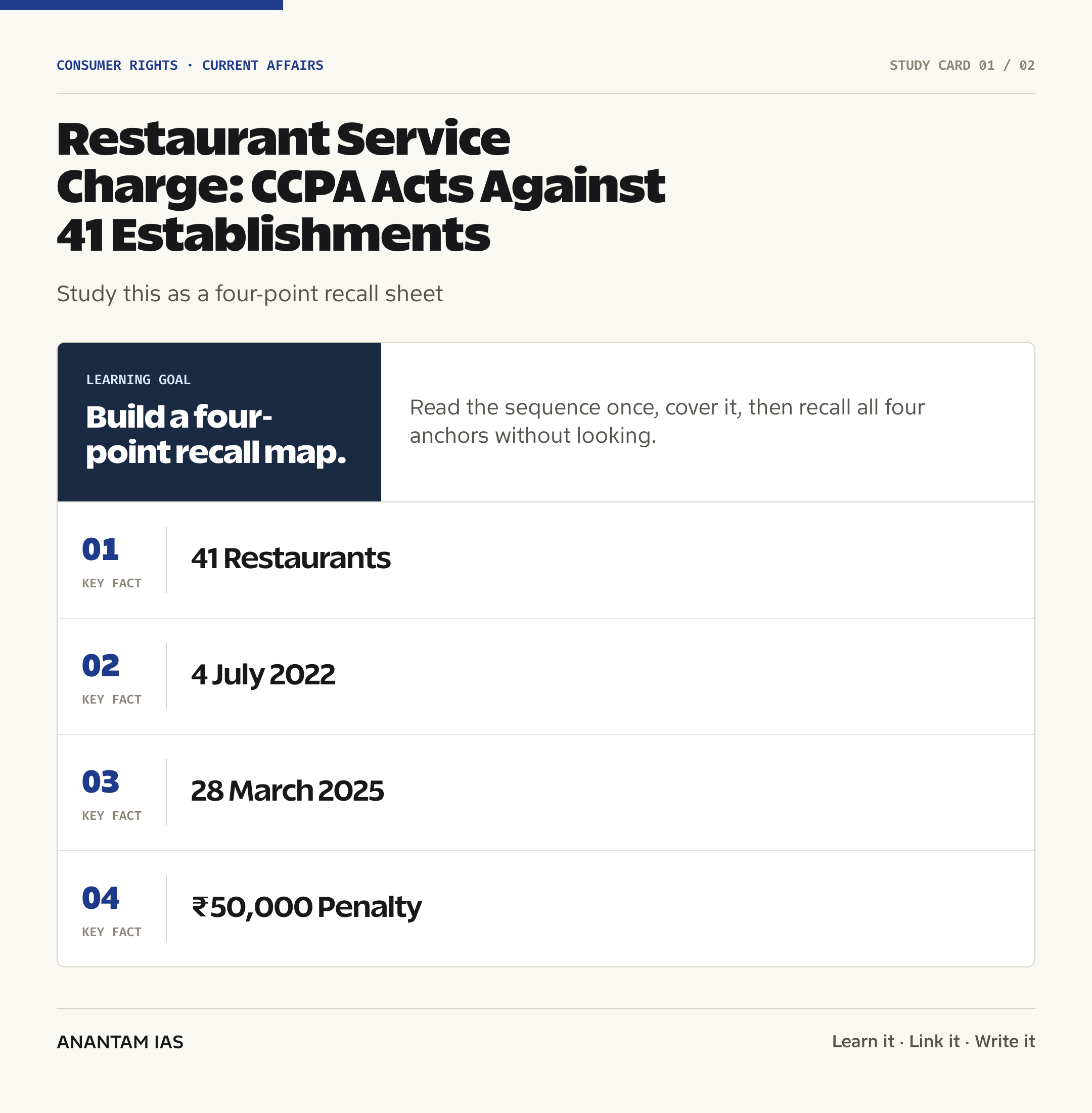
The Central Consumer Protection Authority (CCPA) initiated suo motu action against 41 restaurants across India for adding service charge to bills by default. A PIB release dated 19 July 2026 said complaints received through the National Consumer Helpline were supported by invoices showing that the charge had been added without the consumer’s explicit consent.
The action enforces the CCPA service-charge guidelines of 4 July 2022 and the Consumer Protection Act, 2019. It also follows the Delhi High Court’s 28 March 2025 judgment upholding the guidelines and holding that a restaurant tip or service contribution must remain voluntary.
- Default billing: CCPA investigations found that service charge was being placed automatically on restaurant invoices instead of being left to the diner’s choice.
- Legal classification: The Authority treated the practice as an unfair trade practice under Section 2(47) of the Consumer Protection Act, 2019.
- Final orders: PIB named seven establishments against which final orders had been passed, while proceedings continued in other examined complaints.
- Chaayos order: CCPA imposed a ₹50,000 penalty, ordered reimbursement to the complainant, and directed modification of software-generated billing across all outlets.
- Complaint channel: Consumers were asked to report default service charges to the National Consumer Helpline at 1915 or through its online platform.
The development matters in the context of:
- Informed choice: A small line item on a bill tests whether consent is real or merely presumed by the seller.
- Regulatory design: Individual invoices collected by a pre-litigation helpline can reveal a class-wide market practice and trigger central enforcement.
- Digital compliance: When a billing system adds a charge automatically, consumer protection requires a software-level correction, not only a refund in one case.
UPSC Relevance
Prelims Relevance
- CCPA is a statutory authority established under Section 10 of the Consumer Protection Act, 2019.
- Section 18 empowers CCPA to protect consumer rights as a class, investigate unfair trade practices suo motu or on complaint, and issue preventive guidelines.
- Section 2(47) defines an unfair trade practice in relation to goods as well as the provision of services.
- The service-charge guidelines were issued on 4 July 2022 and apply to hotels and restaurants.
- A restaurant cannot add service charge automatically or by default, collect the same charge under another name, or force a customer to pay it.
- A customer cannot be denied entry or service merely for refusing to pay a voluntary service charge.
- The guidelines state that service charge should not be added to the food bill and GST should not be levied on that amount.
- The National Consumer Helpline is a pre-litigation grievance mechanism of the Department of Consumer Affairs; it is not a Consumer Commission.
- The Delhi High Court upheld the CCPA guidelines on 28 March 2025 in the restaurant associations’ challenge.
Mains Relevance
GS Paper 2
- Statutory regulation: Role of CCPA in enforcing class-wide consumer rights and curbing unfair trade practices.
- Citizen-centric governance: Converting complaints, documentary evidence, helpline data, investigation and final orders into an enforcement chain.
- Judicial review: Balancing freedom of trade under Article 19(1)(g) with lawful consumer-interest regulation.
GS Paper 3
- Digital markets: Compliance by design in point-of-sale software and the risks created by default settings.
- Formalisation: Transparent invoices, visible prices and grievance data improve accountability in the services economy.
GS Paper 4
- Ethics of consent: A consumer’s silence cannot be converted into agreement through an automatically selected charge.
- Public service values: Responsiveness, transparency and proportional enforcement in consumer administration.
Essay
- Choice architecture: Freedom of choice is weakened when the default option benefits the stronger party in a transaction.
- Everyday constitutionalism: Rights become meaningful when public institutions make routine market transactions fair and intelligible.
- Technology and accountability: Software can scale an unfair practice, but it can also make compliance consistent across every outlet.
Background and Context
What the 2022 Guidelines Require
The CCPA guidelines of 4 July 2022 make consent, price transparency and non-coercion the core rules for restaurant service charges.
- No automatic addition: A hotel or restaurant cannot place service charge on a food bill automatically or by default. The customer shouldn’t have to discover the charge only after the invoice is generated and then ask for its removal.
- No relabelling: The same compulsory amount cannot be collected under another name. Changing the label while retaining an automatic or forced payment would preserve the substance of the unfair practice.
- Voluntary payment: Restaurants must clearly inform customers that any service contribution is optional and entirely at the consumer’s discretion. A freely chosen tip after service remains lawful.
- No denial of service: An establishment cannot condition entry, seating, food service or another facility on the customer’s willingness to pay a service charge.
- Invoice and tax: The guidelines state that service charge should not be added to the food bill and that GST should not be levied on that amount.
- Practical distinction: A restaurant may price menu items to cover wages, rent and service costs. It cannot convert a separate tip-like amount into an unavoidable levy after advertising menu prices.
- Consumer action: A diner may ask the establishment to remove the charge and can retain the menu and final invoice as evidence if the request is refused.
Consumer Protection Act and the CCPA
The enforcement action rests on the institutional framework explained in the Consumer Protection Act, 2019, which separates class-wide regulation from individual dispute adjudication.
- Section 10: The Act establishes CCPA to regulate violations of consumer rights, unfair trade practices and false or misleading advertisements that harm public and consumer interests.
- Rights as a class: CCPA’s mandate is broader than resolving one bill dispute. It can address a recurring practice affecting consumers across establishments, cities or digital systems.
- Section 18: The Authority must prevent unfair trade practices and may initiate an inquiry suo motu, act on a complaint, or proceed on directions from the Central Government.
- Guideline-making power: Section 18(2)(l) authorises CCPA to issue necessary guidelines that prevent unfair trade practices and protect consumer interests. This provision was central to the Delhi High Court’s ruling.
- Investigation route: Under Section 19, a prima facie case can be referred to the Director-General or District Collector for investigation, and relevant documents or records can be required.
- Corrective orders: Section 20 permits orders including reimbursement and discontinuation of practices that are unfair and prejudicial to consumer interests, after giving the affected person an opportunity to be heard.
- Consumer rights: Section 2(9) includes the rights to information, to be heard, to seek redressal and to consumer awareness. A hidden or confusing bill item engages several of these rights at once.
- Study link: The official text of the Consumer Protection Act, 2019 should be read with the CCPA guidelines for the full legal chain.
Why Default Service Charge Is an Unfair Practice
The problem isn’t a voluntary tip; it is the conversion of consumer inertia, social pressure or confusion into a compulsory payment.
- Section 2(47): An unfair trade practice includes an unfair, deceptive or misleading method used in supplying goods or providing services. The definition covers representations about price and service.
- Presumed consent: A pre-filled charge treats failure to object as agreement. Genuine consent requires a clear option that the consumer can accept or reject without penalty or embarrassment.
- Tax-like appearance: The expression “service charge” can appear official beside CGST and SGST. A diner may wrongly assume that the amount is a government levy rather than a private, optional contribution.
- Information asymmetry: The restaurant controls the menu, billing interface and payment moment. A consumer typically encounters the extra amount when the transaction is nearly complete and social pressure is highest.
- Dark-pattern logic: Automatic addition resembles a preselected add-on. The broader problem of interface-driven manipulation is explained in Anantam IAS notes on dark patterns.
- Class-wide impact: Even a small per-bill amount can affect many diners when deployed through standard billing software across several outlets. That scale supports regulatory intervention beyond one refund.
- Not a wage-policy substitute: Staff welfare is important, but businesses must meet employment obligations through transparent pricing and lawful arrangements rather than a compulsory charge presented as a tip.
Delhi High Court's 2025 Ruling
In National Restaurant Association of India and others v. Union of India and another, the Delhi High Court upheld the CCPA guidelines and clarified the legal status of mandatory service charge.
- Regulatory competence: The Court held that CCPA is fully empowered under the 2019 Act and that issuing consumer-interest guidelines is an essential function under Section 18(2)(l).
- Article 19(1)(g): The guidelines don’t unlawfully curtail the freedom to practise a profession or carry on trade because they are lawful measures serving the larger interest of consumers.
- Voluntary tip: A customer may choose to reward good service. But the amount cannot be compulsory, cannot be placed on the invoice by default, and must remain within the customer’s discretion.
- Three defects: The Court identified compulsion, misleading nomenclature and lack of transparent visibility as the main defects in mandatory collection.
- Unfair contract: It rejected the claim that merely entering a restaurant after seeing a menu creates a voluntary contract to pay service charge; an onerous condition can fall within Section 2(46).
- Business freedom retained: Establishments remain free to set menu prices that reflect their costs. The restriction applies to the coercive, separate collection of a tip-like amount.
- Enforceability: The Court dismissed the petitions, upheld the guidelines, required restaurant establishments to follow them, and confirmed that CCPA could enforce them in accordance with law.
What the July 2026 Action Shows
The latest action demonstrates how complaint evidence can move from a helpline docket to investigation, a class-wide compliance direction and a software correction.
- Evidence-led trigger: Consumers supplied invoices showing that service charge had been added without explicit consent. Documentary proof made the billing practice verifiable rather than anecdotal.
- Forty-one establishments: CCPA initiated suo motu proceedings against 41 restaurants across India instead of treating each invoice only as an isolated private disagreement.
- Named final orders: PIB listed Cafe Blue Bottle, China Gate Restaurant, Fiesta Barbeque Nation, FOO Ahmedabad Restaurant, L’Opera French Bakery, Zorro and Chaayos among establishments facing final orders.
- Chaayos remedy: CCPA imposed a ₹50,000 penalty, directed reimbursement of the service charge collected from the complainant and required the company to change its software-generated billing system across all outlets.
- Systemic compliance: Editing the default configuration is significant because a manual instruction may be forgotten, while a corrected point-of-sale system prevents the charge from appearing on each new invoice.
- Proceedings continue: PIB said further proceedings were underway against other restaurants where complaints had been received and examined. Initiation of action shouldn’t be confused with a final finding in every case.
- Proportionate response: The order combines individual restitution, deterrence and process reform. This mix can correct the immediate harm while reducing repeat violations.
National Consumer Helpline and Redress Path
The National Consumer Helpline (NCH) is a central pre-litigation grievance mechanism, while Consumer Commissions provide the formal adjudicatory route under the Act.
- First response: A consumer can ask the restaurant to remove the default charge before paying. The request should focus on the automatic nature of the charge, not on whether the customer liked the service.
- Preserve evidence: Keep the menu, invoice, payment receipt and any written refusal. The 2026 action itself relied on bills that showed the charge had been inserted without explicit consent.
- Multiple channels: NCH accepts grievances through toll-free numbers 1915 and 1800-11-4000, its web portal, WhatsApp, SMS, the NCH app and the UMANG app.
- Docket and forwarding: A registered grievance receives a unique docket number and is forwarded to the relevant company, agency, regulator or ombudsman for action and tracking.
- Pre-litigation role: NCH seeks quick resolution before litigation, but registration doesn’t guarantee complete relief. A dissatisfied consumer may approach the appropriate Consumer Commission.
- Adjudicatory structure: District, State and National Consumer Commissions hear disputes within the statutory framework. Anantam IAS’s NCDRC explainer covers the national body’s role and powers.
- Regulatory intelligence: Aggregated helpline complaints can reveal repeated conduct across firms. The same grievance system can support both individual resolution and evidence for CCPA’s class-wide action.
Governance Significance and Remaining Gaps
The case offers a compact example of responsive regulation, but lasting compliance depends on clearer invoices, better awareness and credible follow-through.
- Responsive state: The enforcement chain begins with ordinary consumers and their bills, not only with inspection from above. It makes complaint systems part of regulatory monitoring.
- Rule clarity: The legal position is narrow and workable: tips may be voluntary, menu prices may cover service costs, and a separate tip-like amount cannot be imposed by default.
- Awareness gap: Many diners may still confuse a private service charge with GST or another tax. Short notices at menus and payment points can reduce that confusion.
- Implementation gap: A rule can exist on paper while old billing templates continue adding the amount. Compliance audits must test the actual invoice generated at the point of sale.
- Worker concerns: Removing compulsory service charge doesn’t settle debates about wages or tip distribution. Restaurants should use transparent pay policies and clearly voluntary tip systems.
- Data use: Public reporting on complaint trends, disposal, repeat offenders and compliance outcomes can improve deterrence without prejudging pending cases.
- Cooperative enforcement: CCPA, District Collectors, Consumer Commissions, state authorities and businesses need interoperable complaint and follow-up processes for a national services market.
Way Forward
Make Consent Explicit
- Opt-in design: Billing software should begin with no service contribution selected and add one only after an affirmative customer choice.
- Plain language: Menus and digital payment screens should distinguish taxes, menu prices and a voluntary tip without legal jargon or misleading labels.
- No friction: Refusing or removing a tip must not trigger delay, embarrassment, reduced service or repeated persuasion.
Strengthen Compliance Systems
- Software audit: Restaurant chains should test point-of-sale templates across outlets and retain change logs showing that default additions are disabled.
- Staff training: Managers and servers need a simple protocol for voluntary tips, invoice correction and complaint escalation.
- Board oversight: Large hospitality businesses should treat consumer-law defaults as a compliance risk, with periodic internal review and accountable ownership.
Improve Public Enforcement
- Complaint analytics: NCH data should be used to identify clusters, repeat behaviour and high-impact practices while protecting complainant information.
- Reasoned disclosure: CCPA can publish accessible summaries of final orders, remedies and compliance directions so businesses understand expected conduct.
- Escalation ladder: Warning, investigation, restitution, penalty and wider system correction should reflect evidence, recurrence and the scale of consumer harm.
Protect Workers Transparently
- Fair wages: Restaurants should build labour costs into transparent menu pricing and employment arrangements rather than rely on a compulsory tip-like levy.
- Voluntary tip policy: Where tips are accepted, employees and customers should know how the amount is collected and distributed.
- Social dialogue: Worker welfare, customer choice and business viability should be addressed together, without making consumer consent fictional.
Conclusion
The CCPA action against 41 restaurants turns a familiar billing dispute into a governance lesson. Consumer choice is not protected merely because a customer may argue at the counter; the transaction must be designed so that an optional payment doesn’t appear as a compulsory one.
The durable rule is simple: restaurants may set transparent menu prices, and customers may reward service voluntarily. But a separate tip-like charge cannot be added by default, disguised through another label or supported by denial of service.
For public administration, the larger value lies in the enforcement chain: NCH complaints supply evidence, CCPA addresses the class-wide practice, courts test legal authority, and billing systems are corrected at source. That is how everyday consumer rights move from statute to routine market behaviour.
UPSC Practice Questions
Prelims MCQ 1
With reference to restaurant service charge and the CCPA guidelines, consider the following statements:
- A restaurant may add service charge by default if the menu discloses it.
- A consumer cannot be denied entry or service for refusing to pay service charge.
- The guidelines state that GST should not be levied on the service-charge amount.
How many of the above statements are correct?
(a) Only one (b) Only two (c) All three (d) None
Answer: (b) Only two
Explanation:
Statements 2 and 3 are correct. Disclosure on a menu doesn’t make default collection lawful. Service charge must be voluntary, and refusal cannot be used to deny entry or service.
Prelims MCQ 2
Which one of the following best describes the National Consumer Helpline?
(a) A constitutional court for consumer disputes (b) A statutory appellate tribunal under CCPA (c) A pre-litigation grievance mechanism of the Department of Consumer Affairs (d) A self-regulatory body of restaurants
Answer: (c) A pre-litigation grievance mechanism of the Department of Consumer Affairs
Explanation:
NCH registers and forwards grievances through multiple channels and provides docket-based tracking. A consumer who remains dissatisfied can approach the appropriate Consumer Commission.
UPSC Mains Questions
- The prohibition on default restaurant service charge is less about the size of the amount and more about the quality of consumer consent. Examine this statement with reference to the Consumer Protection Act, 2019 and CCPA’s regulatory role.
- Complaint platforms can serve both individual grievance redressal and class-wide regulatory intelligence. Discuss with reference to the National Consumer Helpline and CCPA action against unfair trade practices.
- Digital defaults can quietly convert an optional choice into an imposed payment. Suggest a governance framework for compliance by design in India’s consumer-facing services economy.
Sources: PIB, Ministry of Consumer Affairs and Delhi High Court.
Frequently Asked Questions
Is restaurant service charge illegal in India?
A freely chosen tip or voluntary contribution isn’t prohibited. What the CCPA guidelines bar is automatic, default or forced collection of a separate service charge. Restaurants may price menu items to include operating and service costs, but the consumer must retain discretion over any separate tip-like payment.
Can a restaurant add service charge by default?
No. The 4 July 2022 guidelines say hotels and restaurants cannot add service charge automatically or by default. A disclosure on the menu doesn’t cure the problem because the Delhi High Court held that mandatory collection remains contrary to consumer rights.
Can service be denied for refusing the charge?
No. The guidelines state that a consumer cannot face a restriction on entry or provision of services for refusing to pay service charge. A restaurant also cannot force payment or use another label to collect the same compulsory amount.
Where can consumers report a default charge?
Consumers may first ask the restaurant to remove the charge and preserve the bill as evidence. They can then contact the National Consumer Helpline through 1915, 1800-11-4000, its web portal, WhatsApp, SMS, the NCH app or the UMANG app.
What is CCPA’s role?
CCPA protects consumer rights as a class and prevents unfair trade practices under the Consumer Protection Act, 2019. It can act suo motu or on complaints, cause investigations, issue guidelines and pass corrective orders within its statutory powers.
What did the Delhi High Court decide?
On 28 March 2025, the Delhi High Court upheld the CCPA service-charge guidelines. It held that mandatory collection is contrary to consumer rights, that a tip must remain voluntary, and that CCPA has authority under the 2019 Act to issue and enforce the guidelines.