
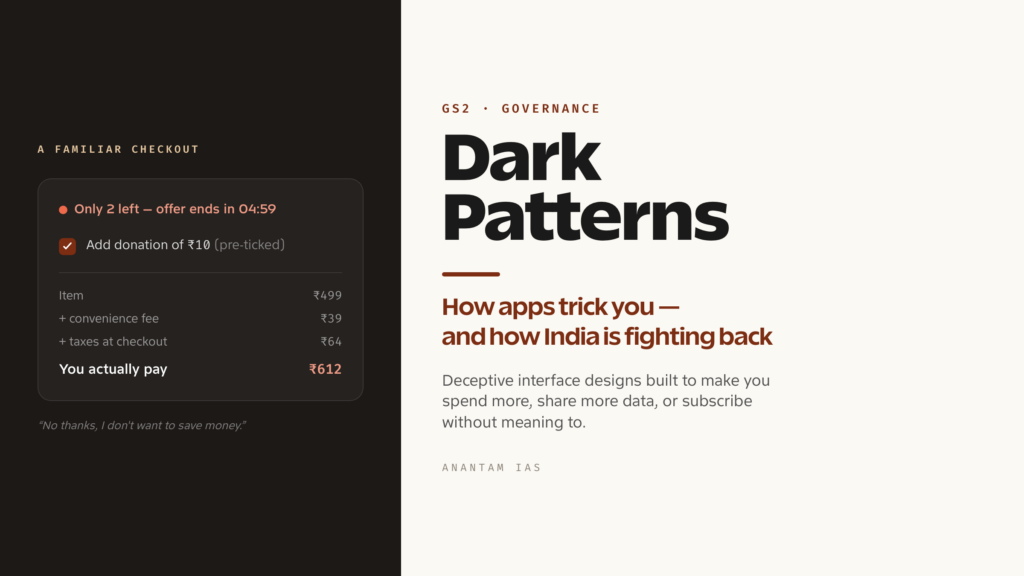
Think back to the last time an app made you feel rushed, guilty, or quietly out of pocket. A countdown timer screaming that only two rooms are left at this price. A “donate ₹10” box already ticked when you reach the payment screen. A subscription that took one tap to start and twenty minutes of hunting to cancel. None of that is an accident. These are dark patterns — interface designs deliberately built to trick you into doing something you didn’t intend, whether that’s spending more, handing over more data, or signing up for a bill you’ll forget about. The phrase was coined by the British user-experience designer Harry Brignull back in 2010, and what began as a niche complaint among designers has become one of the central consumer-protection battles of the digital economy.
And in India, this is no longer a theory problem — it has teeth. In June 2026 the Central Consumer Protection Authority fined the ed-tech firm PhysicsWallah and the security-software seller McAfee for deploying exactly these tricks, the latest in a string of penalties that has already touched Zepto, FirstCry and others. For a UPSC aspirant, dark patterns sit at a rich crossroads — consumer protection, data privacy, the ethics of design, the regulation of Big Tech, and the behavioural economics of how choices are shaped. They give you a fresh, concrete, examinable example for GS Paper 2 on governance and consumer rights, and a sharp case study for ethics and essay papers on autonomy and manipulation.
What Dark Patterns Are and the Common Types
Start with the precise definition, because examiners reward it. A dark pattern — increasingly called a “deceptive pattern,” since the designs are deceptive rather than dark in any racial sense — is a user-interface choice crafted to manipulate or mislead a user into an action that benefits the business at the user’s expense. The key word is deliberate. A confusing layout born of bad design is just bad design. A layout engineered so that the button you want is hidden and the button the company wants is glowing — that is a dark pattern. The deception is the point.
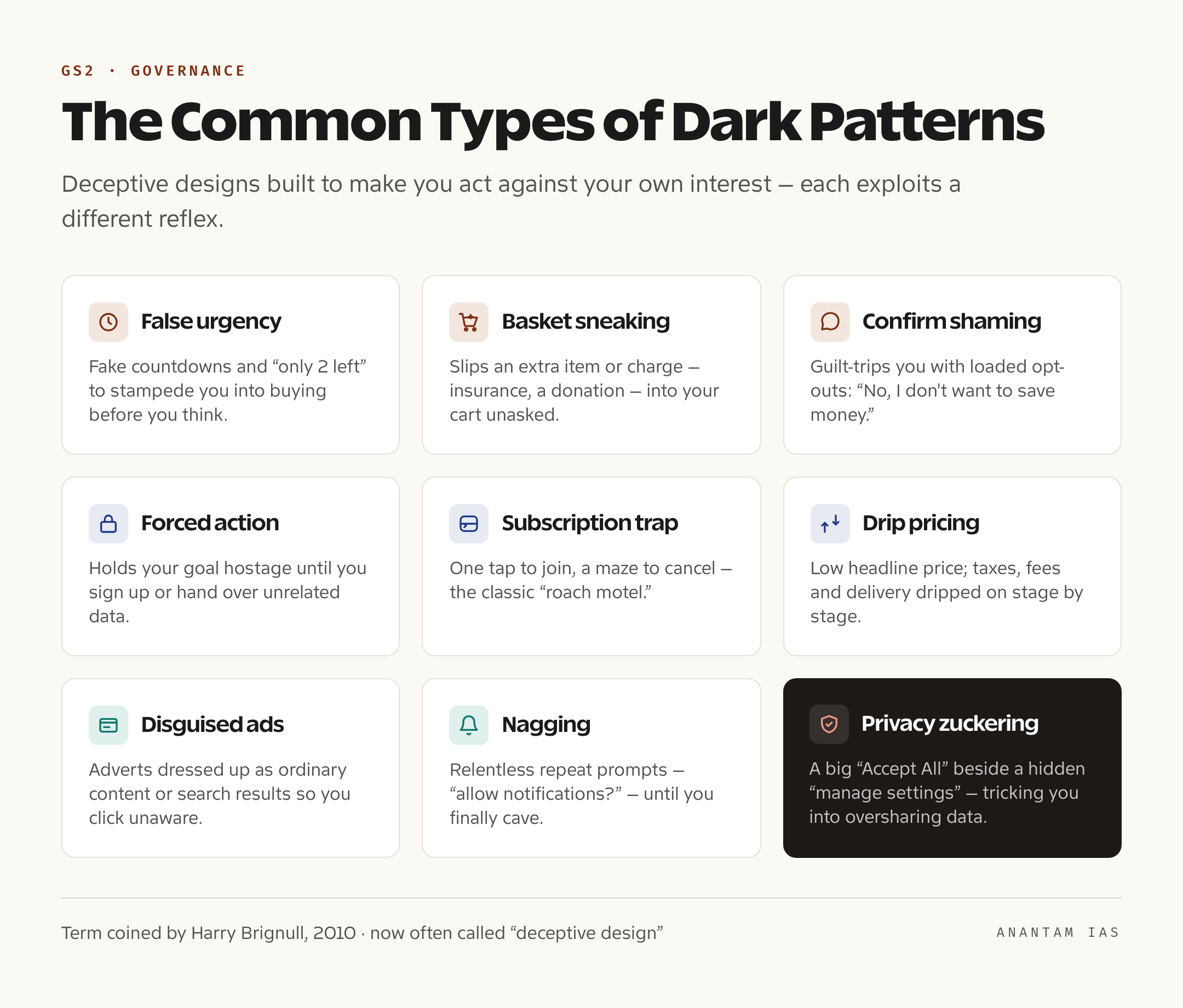
Brignull’s original catalogue named a dozen tricks, and the family has grown since, but a handful turn up again and again. False urgency and scarcity use fake countdown clocks and “only 3 left!” tags to stampede you into buying before you think. Basket sneaking slips an extra item or charge — travel insurance, a donation, a warranty — into your cart without you adding it. Confirm shaming guilts you into compliance with loaded language, the classic being a newsletter opt-out that reads “No thanks, I don’t want to save money.” Forced action holds your goal hostage until you surrender something unrelated, like creating an account or granting data access just to read an article. Subscription traps, sometimes called the “roach motel,” make signing up effortless and cancelling a maze — the trick US regulators went after Amazon for over its Prime cancellation flow. Drip pricing advertises a low headline number and then drips on taxes, delivery and convenience fees stage by stage until the final bill is far higher. Disguised advertisements dress up ads as ordinary content or search results so you click without realising you’re being sold to. Nagging wears you down with endless repeated prompts — “enable notifications?”, “rate us?”, “share your location?” — until you cave. And bait-and-switch promises one outcome and delivers another once you’ve committed.
Two more deserve their own spotlight because they reach beyond your wallet into your privacy. Privacy zuckering — named, pointedly, after Facebook’s founder — tricks you into sharing more personal data than you meant to, the everyday example being a cookie banner with a big bright “Accept All” button and a tiny, greyed-out “manage preferences” link. One study found that 89 per cent of cookie banners were manipulative in some way. The cumulative effect of all these tricks is the same: your attention, your money and your data are quietly extracted by design, not by your free choice.
Why They Work: The Psychology Being Exploited
Dark patterns aren’t magic; they are applied behavioural economics turned against you. The whole field rests on a single insight from psychology — that the human mind has two gears. There is the fast, automatic, instinctive mode the Nobel laureate Daniel Kahneman called System 1, and the slow, effortful, reasoning mode he called System 2. Good decisions usually need System 2. Dark patterns are engineered to keep you trapped in System 1, where you react rather than reflect, so the trick is over before your rational mind catches up.
The Nudge-Sludge Connection and Why That Matters
Each pattern targets a specific, well-documented bias. False scarcity exploits loss aversion — the finding that we feel the pain of a possible loss far more sharply than the pleasure of an equal gain, so “only 2 left” lights up a fear of missing out. “Hundreds bought this today” leans on social proof, our instinct to copy the crowd. Pre-ticked boxes and “Accept All” defaults exploit the default effect — the simple fact that most people stick with whatever option is pre-selected, because changing it takes effort. Nagging wears down our limited willpower and attention; confirm shaming weaponises guilt and social pressure. None of this is new psychology. What’s new is that an A/B-testing machine can now run these manipulations on millions of people at once and keep only the versions that work, refining the deception with industrial precision.
This is where a sharp conceptual distinction earns marks: the difference between a nudge and sludge. The economist Richard Thaler, who won the Nobel Prize for popularising the “nudge,” argues that the same behavioural tools can be used for good or ill. A nudge gently steers you toward a choice that’s in your own interest — auto-enrolling you in a pension you can opt out of, or placing fruit at eye level in a canteen — while leaving you free to choose otherwise. Thaler coined the word sludge for the opposite: friction and manipulation deliberately added to push you toward a choice that benefits someone else, against your own interest. A subscription that’s one click to join and a labyrinth to leave is textbook sludge. Dark patterns, in this framing, are sludge built into the screen. The ethical line is autonomy: a nudge preserves your ability to choose freely and transparently; a dark pattern engineers that ability away. For an ethics answer, that single sentence — nudges respect autonomy, dark patterns subvert it — is worth memorising.
The harms follow directly. There is plain financial harm: hidden fees and unwanted subscriptions cost consumers real money, and at scale the sums are large — India’s regulator found one pre-ticked donation box had quietly collected nearly ₹2.5 crore from over 21 lakh users. There is privacy harm, as zuckering and forced consent strip away data people never meant to give, feeding the wider machine of surveillance and behavioural advertising. And there is a deeper, corrosive harm to autonomy and trust — when every screen is suspected of trying to trick you, the basic confidence that makes online life workable erodes. That trust deficit is itself a governance problem, because a digital economy runs on it.
How India Regulates Dark Patterns
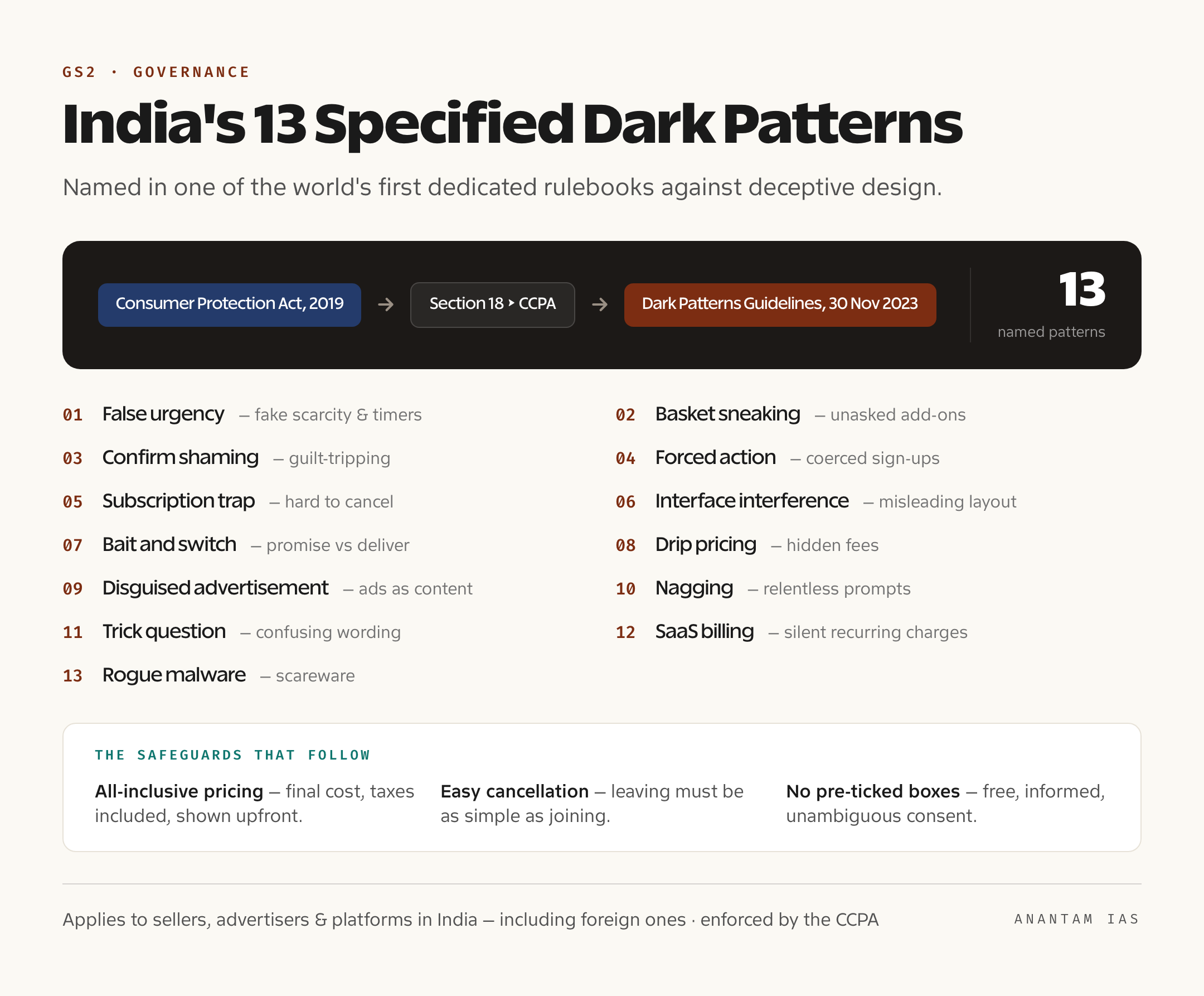
India has moved faster than most countries to name and curb these designs, and the chronology is worth knowing. The legal backbone is the Consumer Protection Act, 2019, which created the Central Consumer Protection Authority, or CCPA, as a regulator empowered to act against unfair trade practices and misleading advertisements. Using Section 18 of that Act, the CCPA issued the landmark Guidelines for Prevention and Regulation of Dark Patterns, 2023 on 30 November 2023 — among the world’s first dedicated rulebooks of its kind. The guidelines define dark patterns, prohibit their use, and list 13 specified dark patterns in an annexure, each with illustrations: false urgency, basket sneaking, confirm shaming, forced action, subscription trap, interface interference, bait and switch, drip pricing, disguised advertisement, nagging, trick question, SaaS billing, and rogue malware (scareware). Crucially, the guidelines apply not just to sellers but to advertisers and to all platforms that systematically offer goods or services in India — and they reach extra-territorially to foreign platforms serving the Indian market, which sweeps in the global e-commerce giants.
The framework has more than one layer. Even earlier, in June 2023, the Advertising Standards Council of India — the ad industry’s self-regulator — had issued its own guidelines targeting deceptive design in advertising, flagging drip pricing, bait-and-switch, false urgency and disguised ads. On the privacy side, the Digital Personal Data Protection Act, 2023 strengthens the consent architecture that privacy zuckering attacks, requiring that consent be free, specific, informed and unambiguous — the opposite of a tricked-out cookie banner. For deeper context on how the data economy itself creates the incentive to manipulate, see the explainers on surveillance capitalism and India’s Digital Personal Data Protection Act.
Enforcement is the part that has sharpened lately, and it gives you live, datable examples. Through 2025 the CCPA shifted from advisories to penalties. In June 2025 it ordered all e-commerce platforms to run a three-month self-audit to detect and remove dark patterns, and by early 2026 dozens of major platforms — Zomato, Blinkit, Meesho and others among 26 named firms — had filed compliance declarations. But a LocalCircles audit found that some 97 per cent of major Indian platforms were still using manipulative design, so the regulator started fining. It penalised FirstCry for misleading discounts, slapped a ₹7 lakh penalty on the quick-commerce app Zepto in December 2025 for dark patterns and misleading price disclosures, and in June 2026 fined PhysicsWallah ₹5 lakh for a pre-ticked donation box and other tricks, alongside a penalty on McAfee. A government Joint Working Group now brings regulators, industry and consumer groups together to keep at it. The direction is clear: India is treating dark patterns not as a design quibble but as an enforceable consumer wrong.
The Global Picture and the Road Ahead
India’s push fits a worldwide turn against deceptive design, and placing it in that frame always reads better. The European Union has taken perhaps the hardest line: its Digital Services Act, fully in force from February 2024, bans dark patterns outright for online platforms, with Article 25 prohibiting designs that “materially distort or impair” a user’s ability to make free and informed choices. In the United States, the Federal Trade Commission has gone after them through enforcement rather than a single statute, winning a record $520 million settlement from Epic Games over manipulative purchase flows in Fortnite and forcing Amazon to simplify Prime cancellation after suing it for a deliberately tortuous exit. Together these show the two regulatory models on offer — Europe’s broad statutory ban and America’s case-by-case enforcement — with India’s CCPA charting a middle path of named patterns plus active penalties.
Yet real challenges remain, and a balanced answer must name them. The CCPA guidelines, for all their ambition, are arguably soft law — they carry the force of the parent Act’s penalties but began life as guidelines, and critics note enforcement has been slow relative to the scale of the problem, with that 97 per cent figure hanging over everything. Detecting dark patterns is genuinely hard, because design lives on a spectrum and the line between a permissible persuasive nudge and an illegal manipulation is often blurry and fact-specific. Penalties of a few lakh rupees barely register against the revenues of large platforms, raising the worry that fines become a cost of doing business. And the frontier is already shifting: as interfaces become AI-generated and personalised, the same manipulation can be tailored to each individual’s weaknesses in real time, a prospect regulators are only beginning to grapple with. The way forward most analysts urge is a mix — clearer binding rules, stiffer and more deterrent penalties, mandatory “fair-by-design” standards, better consumer awareness, and the simple, powerful default that the easy choice on a screen should also be the honest one.
For Your Mains Answer
This is a high-value topic for GS Paper 2, under governance, the role and functioning of regulatory bodies, and the protection of consumer and citizen rights — the CCPA and the Consumer Protection Act, 2019 sit squarely here. It doubles as GS Paper 3 material on the regulation of the digital economy and e-commerce, and on data protection. And it is a gift for the Ethics paper (GS4) and the Essay on themes of autonomy, manipulation, consent and the moral limits of persuasion. The examiner-pleasing move is to fuse the conceptual (nudge versus sludge, System 1 versus System 2) with the concrete (the CCPA’s 13 patterns and the 2025-26 penalties).
How to Build the Answer
Move in a clean chain: define a dark pattern (deliberate deceptive design), give two or three vivid types (false urgency, drip pricing, subscription trap), explain why they work (exploiting cognitive biases, keeping users in System 1), separate the ethical wheat from the chaff (nudge versus sludge, the autonomy test), lay out the harms (financial, privacy, trust), then map the regulation (Consumer Protection Act 2019 → CCPA → 13 specified patterns → DSA and FTC abroad), and close by weighing what’s working against what isn’t. That arc — define, illustrate, explain, evaluate ethically, regulate, judge — fits almost any version of the question.
Common Mistakes to Avoid
Don’t treat every persuasive design as a dark pattern — the legitimacy test is whether the design preserves or subverts free, informed choice. Don’t confuse a nudge with sludge; that distinction is often the whole point of an ethics question. Don’t forget the legal anchor — many candidates name the CCPA but miss that its power flows from Section 18 of the Consumer Protection Act, 2019. And don’t present India as a laggard; on dedicated dark-pattern rules it was actually an early mover, even if enforcement lags.
A Compact Answer Spine
Dark pattern = deliberately deceptive interface design that tricks users (coined by Harry Brignull, 2010) → common types: false urgency, basket sneaking, confirm shaming, subscription trap, drip pricing, disguised ads, nagging, privacy zuckering → why they work: exploit cognitive biases (loss aversion, social proof, default effect) and keep users in System 1 → ethics: sludge, not nudge — they subvert autonomy → harms: financial, privacy, eroded trust → India’s response: Consumer Protection Act 2019 → CCPA Guidelines 2023 listing 13 patterns + DPDP Act 2023 + ASCI → enforcement: Zepto ₹7 lakh, PhysicsWallah ₹5 lakh, self-audits, but 97% still non-compliant → global: EU DSA ban (Art. 25), US FTC actions (Epic $520 mn, Amazon) → way forward: binding rules, deterrent penalties, fair-by-design, awareness.
Diagram or Flowchart Idea
Draw a two-part visual: on the left, a simple table of four or five dark patterns with their one-line tricks; on the right, a flow showing how a dark pattern works — cognitive bias → System 1 reaction → action benefiting the business → consumer harm — with a regulation arrow (CCPA / DSA / FTC) cutting across it. Clean, fast to sketch, and it shows you grasp both the mechanism and the response.
A Balanced-Conclusion Line
A line that lands: “Dark patterns reveal the dark side of the attention economy — design turned from a tool of convenience into a tool of coercion. India’s CCPA framework is a welcome early step, but rules on paper must become deterrence in practice, so that the easiest choice on every screen is also the honest one.”
How to Use Data Without Cramming
You need only a few anchors, not a dossier: 2010 (Brignull coins the term), 13 (specified patterns in the CCPA’s 2023 guidelines), Section 18 of the Consumer Protection Act, 2019 (the legal power), ₹7 lakh and ₹5 lakh (the Zepto and PhysicsWallah penalties), 97 per cent (platforms still non-compliant), and $520 million (the FTC’s Epic settlement). Attribute them plainly — “the CCPA’s 2023 guidelines list 13 dark patterns” — rather than scattering numbers loose.
Frequently Asked Questions
What exactly is a dark pattern, and who coined the term?
A dark pattern, now often called a deceptive design pattern, is a user-interface choice deliberately built to trick or manipulate a user into an action that benefits the business at the user’s expense — spending more, sharing more data, or subscribing unintentionally. The British UX designer Harry Brignull coined the term in 2010 and catalogued an initial set of about a dozen tricks. The deception is intentional, which is what separates a dark pattern from merely clumsy design.
What are the most common types of dark patterns?
The recurring ones include false urgency (fake countdown timers), basket sneaking (slipping extra items or charges into your cart), confirm shaming (guilt-tripping you with loaded language), forced action (holding your goal hostage for unrelated data or sign-ups), subscription traps (easy to join, hard to cancel), drip pricing (revealing taxes and fees only stage by stage), disguised ads, nagging (relentless repeated prompts), and privacy zuckering (tricking you into oversharing data, often via lopsided cookie banners).
How does India regulate dark patterns?
Through the Consumer Protection Act, 2019. Using Section 18 of that Act, the Central Consumer Protection Authority issued the Guidelines for Prevention and Regulation of Dark Patterns, 2023, which prohibit dark patterns and list 13 specified ones. They apply to sellers, advertisers and platforms operating in India, including foreign ones. The Digital Personal Data Protection Act, 2023 and ASCI’s advertising guidelines add further layers, and the CCPA has begun fining offenders such as Zepto and PhysicsWallah.
How are dark patterns different from a “nudge”?
A nudge gently steers you toward a choice in your own interest while leaving you completely free to choose otherwise — like auto-enrolling you in a pension you can opt out of. A dark pattern is the opposite, what the economist Richard Thaler calls “sludge”: friction or manipulation deliberately added to push you toward a choice that benefits someone else, against your own interest. The line between them is autonomy — a nudge respects your free, informed choice; a dark pattern engineers it away.
Practice Questions
Prelims MCQs
- The Guidelines for Prevention and Regulation of Dark Patterns, 2023 were issued by which authority?
(a) The Reserve Bank of India
(b) The Central Consumer Protection Authority
(c) The Telecom Regulatory Authority of India
(d) The Competition Commission of India
Answer: (b) The CCPA, set up under the Consumer Protection Act, 2019, issued the guidelines using its powers under Section 18 of that Act. - With reference to dark patterns, consider the practice of “drip pricing.” Which statement best describes it?
(a) Offering a refund in instalments
(b) Revealing the full price gradually by adding taxes and fees at later stages
(c) Charging different prices to different users
(d) Hiding a product until payment is made
Answer: (b) Drip pricing advertises a low headline price and discloses additional charges stage by stage, so the final amount is higher than first shown. - The term “privacy zuckering” refers to which kind of dark pattern?
(a) Tricking users into sharing more personal data than they intended
(b) Selling user data to advertisers without a licence
(c) Encrypting user data to prevent access
(d) Charging users to protect their privacy
Answer: (a) Privacy zuckering uses deceptive design — such as a prominent “Accept All” button beside a hidden “manage settings” link — to make users disclose more data than they meant to. - The Consumer Protection Act, 2019, which empowers the CCPA to regulate dark patterns, established the Central Consumer Protection Authority primarily to address which of the following?
(a) Banking frauds and monetary policy
(b) Unfair trade practices and misleading advertisements
(c) Inter-state trade disputes
(d) Stock-market manipulation
Answer: (b) The CCPA is empowered to act against unfair trade practices, misleading advertisements and violations of consumer rights, which is the basis for its dark-patterns guidelines. - The concept of “sludge,” used to distinguish manipulative design from a beneficial “nudge,” is associated with which economist?
(a) Amartya Sen
(b) Daniel Kahneman
(c) Richard Thaler
(d) Raghuram Rajan
Answer: (c) Richard Thaler, who popularised the “nudge,” coined “sludge” for friction and manipulation that push people toward choices against their own interest — the family that dark patterns belong to.
Mains Practice Questions
- What are “dark patterns” in digital interfaces? Discuss the common types and explain why they are an emerging consumer-protection concern in India. (15 marks, 250 words)
- “Dark patterns are sludge, not nudges.” In light of behavioural economics, examine how deceptive design exploits cognitive biases and why it raises ethical concerns about consumer autonomy. (15 marks, 250 words)
- Examine the framework India has built to regulate dark patterns, from the Consumer Protection Act, 2019 to the CCPA’s 2023 guidelines. How effective has enforcement been, and what reforms would strengthen it? (15 marks, 250 words)
- Compare the approaches of the European Union and the United States to regulating dark patterns with that of India. What lessons can India draw? (10 marks, 150 words)
- The rise of AI-generated and personalised interfaces threatens to make manipulative design harder to detect. Critically discuss the challenges this poses for consumer protection and suggest a way forward. (15 marks, 250 words)
Tell Google you want more of this.
Add Anantam IAS as a preferred sourceOne tap, and this site shows up more often in your own Top Stories, AI Overviews and AI Mode. Remove it any time.