Census 2027 Caste Enumeration: ‘Open Column’ Method Tested in Rehearsal
Why in News?
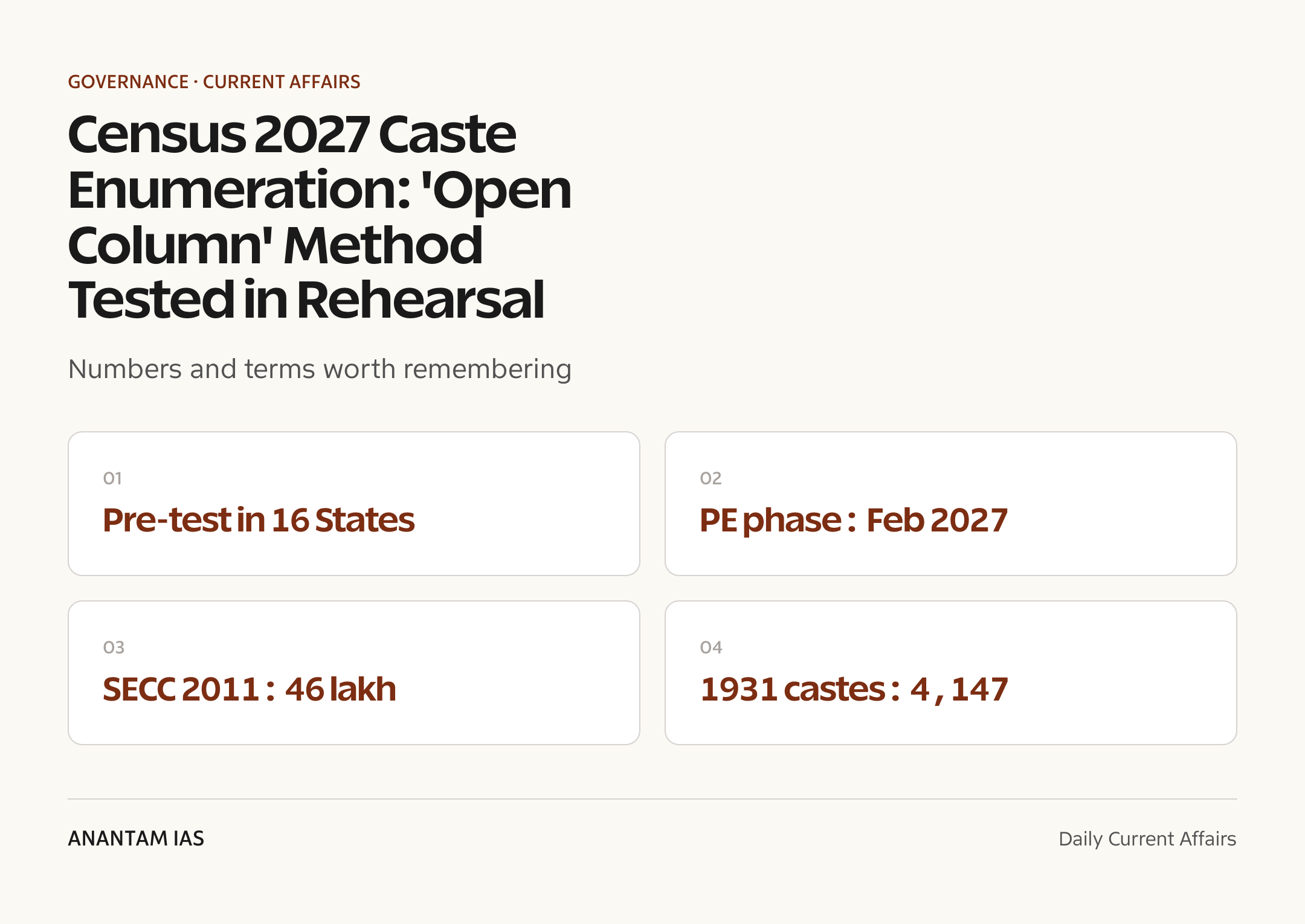
The Hindu reported that the rehearsal for the second phase of Census 2027 — Population Enumeration (PE) — began on July 6, 2026 in 16 States and Union Territories, with a form that carries an ‘open column’ in which enumerators record whatever caste a respondent declares.
It’s the first concrete signal of how India may conduct its first full caste enumeration since 1931. Officials called the exercise, ending July 20, 2026, only a ‘pre-test’: the final methodology and questionnaire will be settled from field feedback by September 2026.
- The pre-test runs July 1–20, 2026; a self-enumeration portal was open from July 1 to 5 in the rehearsal areas, and enumerator visits started on July 6.
- Scheduled Castes and Scheduled Tribes stay on pre-assigned codes from the notified SC/ST lists; every other respondent gets a free-text open column for caste.
- In Faridabad, Haryana, the rehearsal covers Ward No. 24 — 17 enumeration blocks of roughly 150–180 residential units and 650–800 people each.
- The PE phase runs nationwide in February 2027; in Ladakh and the snow-bound areas of Jammu & Kashmir, Himachal Pradesh and Uttarakhand it will finish by September 30, 2026.
- Phase one — Housing and House Listing Operations (HLO) — is still incomplete in eight States: Himachal Pradesh, Kerala, Nagaland, Tamil Nadu, Tripura, West Bengal, Assam and Manipur.
The development matters in the context of:
- The Union Cabinet approved caste enumeration on April 30, 2025; Census 2027 was notified in the Gazette on June 16, 2025 under the Census Act, 1948.
- Methodology is the make-or-break question: the SECC 2011 used an open column and returned over 46 lakh different caste names — data the government has called unreliable.
- The count will feed OBC sub-categorisation, reservation-ceiling debates, welfare targeting and the delimitation-linked politics of the 2030s.
UPSC Relevance
Prelims Relevance
- Census 2027: 16th census (8th since Independence), the first fully digital census, and the first in independent India to enumerate all castes.
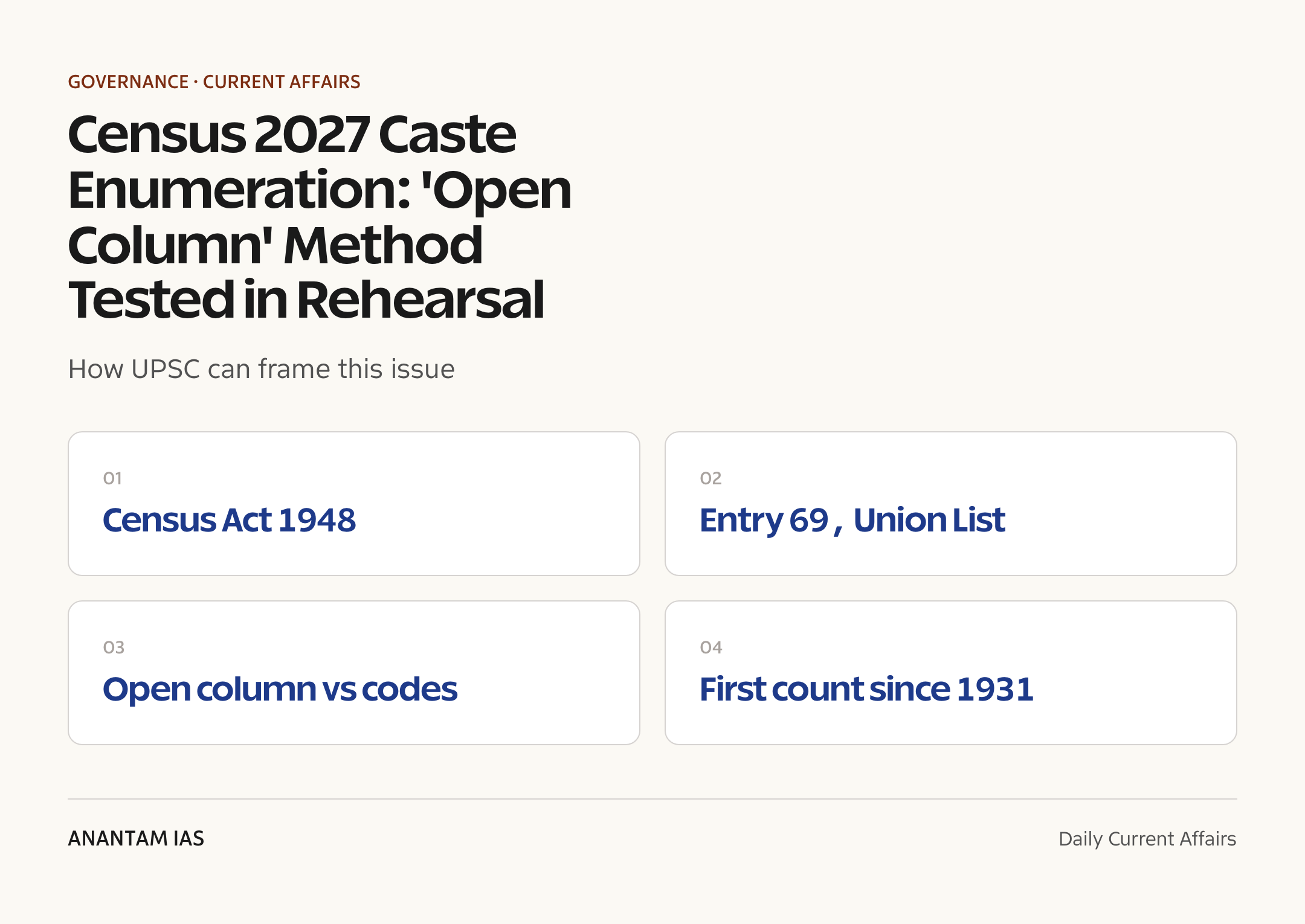
- Legal basis: the Census Act, 1948; ‘Census’ is Entry 69 of the Union List, so only the Union can conduct one.
- Nodal authority: the Registrar General and Census Commissioner of India (office set up 1949), Ministry of Home Affairs.
- Two phases: HLO then Population Enumeration (February 2027); reference date March 1, 2027 — October 1, 2026 for Ladakh and snow-bound areas.
- Open column: self-declared caste recorded as stated, no pre-coded list; codes apply only to SCs and STs.
- SECC 2011: run by the Rural Development and Housing & Urban Poverty Alleviation ministries outside the Census Act; its caste data were never released.
- Bihar Caste-Based Survey 2022–23: a State survey using a pre-coded caste list; results published in 2023.
- 1931 Census: last tabulated caste count — 4,147 castes; basis of the Mandal Commission’s 52% OBC estimate.
Mains Relevance
GS Paper 2
- Governance: how enumeration design — open column versus coded list — decides whether caste data become usable evidence or another SECC-style dead end
- Federal frame of the census; Centre–State coordination when HLO is incomplete in eight States and States run rival caste surveys
- E-governance: India’s first digital census, self-enumeration, and confidentiality safeguards under the Census Act, 1948
GS Paper 1
- Salient features of Indian society: caste as a lived, self-described identity versus an administrative category with fixed codes
- Regional variation in caste nomenclature — why one community can report itself under dozens of names
Essay
- Counting is never neutral: what a state measures, it makes visible — and governable.
- Social justice in the age of data: evidence, identity and the arithmetic of fairness.
Background and Context
The Census Machine: Act, Authority and Federal Design
The census is one of India’s oldest continuous administrative exercises, with a clear statutory and constitutional home.
- The Census Act, 1948 makes answering obligatory (Section 8), penalises false answers (Section 11), and keeps individual records confidential — not open to inspection or admissible in evidence (Section 15).
- ‘Census’ sits at Entry 69 of the Union List: only the Union can conduct a census; States may run ‘surveys’ — as Bihar did — but can’t call them a census.
- The operation is run by the Office of the Registrar General and Census Commissioner, India, set up in 1949 under the Ministry of Home Affairs, through State census directorates.
- India has held a census every decade since 1881; the 2021 round was deferred by the pandemic. A fuller timeline is in our note on Indian census history.
- The 2011 Census counted about 121 crore people with a 29-question PE schedule covering literacy, migration, marital status, fertility and travel to work.
Census 2027: Phases, Dates and the Digital Shift
The 2027 exercise is a two-phase, app-driven operation working to fixed reference dates.
- Notified in the Gazette on June 16, 2025, with a reference date of 00:00 hours, March 1, 2027 — and October 1, 2026 for Ladakh and the snow-bound, non-synchronous areas of J&K, Himachal Pradesh and Uttarakhand.
- Phase 1, the HLO, maps houses, amenities and assets; The Hindu reported it is yet to finish in eight States, including Kerala, Tamil Nadu, West Bengal and Assam.
- Phase 2, Population Enumeration (February 2027), is where the caste of every resident will be recorded for the first time.
- It is India’s first digital census: app-based collection, a household self-enumeration option, and central digital monitoring instead of paper schedules.
- The rehearsal is formally a pre-test ‘to evaluate field procedures, digital applications and operational arrangements’, as the Faridabad Deputy Commissioner’s office put it; the final questionnaire is expected by September 2026.
Caste and the Census: 1881 to 2027
Counting caste isn’t new — it’s a colonial practice that independent India deliberately discontinued.
- Every census from 1881 to 1931 recorded caste; the 1931 Census — the last tabulated count — listed 4,147 castes. The 1941 data were collected but never tabulated in wartime.
- After Independence, only Scheduled Castes and Scheduled Tribes were counted — a deliberate choice to avoid hardening caste identities in a new republic.
- The gap had costs: the Mandal Commission (1980) estimated OBCs at 52% by extrapolating 1931 data, and Indra Sawhney (1992) — source of the 50% ceiling — underlined the need for contemporary evidence.
- On April 30, 2025, the Union Cabinet approved caste enumeration in the census itself. The arguments on both sides are unpacked in our explainer on the caste census debate.
- Nomenclature is hard: with the 105th Amendment restoring separate State OBC lists, one community can carry different names and sub-caste labels across lists.
Open Column vs Coded List: What the Rehearsal Is Testing
Two rival methodologies dominate the caste-count debate, and each has a track record.
- Open column: the enumerator writes whatever the respondent declares. No community is excluded — but people answer with jati, sub-caste, surname, gotra or occupation, so the data get noisy.
- The SECC 2011 used this method and returned over 46 lakh distinct ‘caste names’; the government has long held those data unreliable, and never published the caste figures.
- Coded list: the Bihar Caste-Based Survey 2022–23 gave enumerators a pre-coded list of over 200 castes plus an ‘other’ option — clean tables (OBCs and EBCs near 63%), but a list can miss groups or force identities into boxes.
- The pre-test signals a split design: SCs/STs keep code lists, everyone else gets the open column, with enumerators entering whatever a resident says, an official told The Hindu.
- Nothing is final: pre-test feedback on the form, app and field procedure will shape the methodology announced with the September questionnaire.
Why the Stakes Are High: What Caste Data Will Decide
The caste count isn’t a statistical curiosity — it plugs straight into India’s biggest policy levers.
- OBC sub-categorisation: the Justice G. Rohini Commission reported in 2023, but splitting the OBC quota fairly needs credible population shares.
- Reservation ceilings: States citing their own surveys keep pushing past the Indra Sawhney 50% ceiling; a national count will be the reference evidence in every such battle.
- Welfare targeting: caste-disaggregated data on housing, education and jobs would move schemes from proxy targeting to direct evidence.
- Political arithmetic: the first post-2026 census also triggers delimitation and operationalises the 106th Amendment (women’s reservation).
- Federal pressure: Bihar, Karnataka and Telangana have run State caste surveys with divergent methods; only a credible national count yields comparable data.
Concerns: Accuracy, Privacy and Politics
Even strong supporters of a caste count flag serious execution risks.
- Classification chaos: with a pure open column, one jati can appear under dozens of spellings and synonyms; enumerators can’t verify or standardise — which is how SECC 2011 hit 46 lakh entries.
- Privacy: caste is sensitive personal information; Section 15 shields individual records, but the aggregation level for published caste tables is a fresh, contested call.
- Political contestation: results that shift community shares away from Mandal-era assumptions will be challenged, so the method must survive scrutiny.
- Operational strain: the HLO backlog in eight States compresses timelines, and training enumerators for a caste column is harder than for age or literacy.
- Digital divide: if better-off households self-enumerate while others rely on enumerators, error patterns could themselves become caste-skewed.
Way Forward
Standardise before counting
- Build a master caste directory with States — spellings, synonyms and sub-castes mapped to standard codes — and publish a draft for objections before February 2027.
- Reconcile the directory with Central and State SC, ST and OBC lists so census categories can be read against reservation categories.
Design the digital form smartly
- Combine both methods in the census app: an auto-suggest field drawing on the directory, with an open-text fallback routed to supervisor adjudication.
- Run real-time validation to flag improbable or duplicate caste strings during fieldwork — fixing in-flight what SECC 2011 discovered only afterwards.
Protect the data, publish the method
- Announce in advance the aggregation level for caste tables, keeping individual records within the Census Act’s confidentiality shield.
- Release a full methodology paper with the results — question wording, coding rules, error rates — so the count earns the credibility SECC 2011 never had.
Conclusion
The rehearsal answers one question and raises a bigger one. India now knows roughly how the state proposes to ask about caste; whether the answers add up to usable knowledge depends on the standardisation, validation and disclosure choices still to be made before February 2027.
For aspirants, the durable core is the frame: the Census Act, 1948, the Union’s exclusive competence, the two-phase digital design, and the SECC 2011–Bihar contrast. Remember the ‘open column’ not as a headline but as a live experiment in how a diverse republic converts identity into evidence.
UPSC Practice Questions
Prelims MCQ 1
With reference to the Census of India, consider the following statements:
- The Census is conducted under the Census Act, 1948, and ‘Census’ is a subject in the Union List.
- The Socio-Economic Caste Census (SECC) 2011 was conducted under the Census Act, 1948.
- Census 2027 will be the first census in independent India to enumerate all castes.
How many of the above statements are correct?
(a) Only one (b) Only two (c) All three (d) None
Answer: (b) Only two
Explanation:
Statements 1 and 3 are correct: the census rests on the Census Act, 1948 and Entry 69 of the Union List, and Census 2027 will record all castes for the first time (earlier rounds counted only SCs and STs). Statement 2 is wrong — SECC 2011 was run outside the Census Act by other ministries.
Prelims MCQ 2
The ‘open column’ method of caste enumeration, tested in the Census 2027 pre-test, refers to:
(a) Enumerating only those castes that appear in a pre-approved government list (b) Recording whatever caste name a respondent self-declares, without a pre-coded list (c) Counting caste exclusively through the online self-enumeration portal (d) Leaving the caste field blank for Scheduled Caste and Scheduled Tribe respondents
Answer: (b) Recording whatever caste name a respondent self-declares, without a pre-coded list
Explanation:
In the open-column design the enumerator enters the respondent’s caste exactly as stated, with no drop-down list — the approach SECC 2011 used, which produced over 46 lakh distinct caste names. SCs and STs continue on pre-assigned codes from the notified lists.
UPSC Mains Questions
- “The credibility of India’s first full caste enumeration since 1931 will depend less on the decision to count than on how the counting is done.” Examine the open-column and coded-list methodologies for Census 2027 in the light of the SECC 2011 and Bihar Caste-Based Survey experiences.
- Describe the constitutional and statutory framework governing the Census in India. How do census data shape delimitation, reservation policy and welfare targeting, and what safeguards should govern the collection and release of caste data?
- “Data is the new instrument of social justice.” In the context of caste enumeration in Census 2027, discuss how better data can improve affirmative action — and the risks of counting identity.
Sources: The Hindu and Office of the Registrar General & Census Commissioner, India.
Frequently Asked Questions
What is the open column in Census 2027?
It is a free-text field where the enumerator records whatever caste a respondent declares, without a pre-coded list. The Census 2027 pre-test, which began on July 6, 2026 in 16 States and UTs, is testing this design; SCs and STs continue to be recorded through codes.
When will caste be counted in Census 2027?
During the second phase, Population Enumeration, scheduled nationwide for February 2027 with a March 1, 2027 reference date. In Ladakh and the snow-bound areas of J&K, Himachal Pradesh and Uttarakhand it finishes by September 30, 2026. It is independent India’s first full caste count.
Why was SECC 2011 caste data never released?
Its open column returned over 46 lakh distinct caste names — the same community appeared under many spellings, sub-castes and surnames — and the government has maintained the data were error-ridden. The SECC was also conducted outside the Census Act, 1948, without the census’s statutory rigour.
Who conducts the Census in India?
The Office of the Registrar General and Census Commissioner, India — set up in 1949 under the Ministry of Home Affairs — conducts it under the Census Act, 1948. ‘Census’ is Entry 69 of the Union List, so only the Union can hold one; States may only run surveys.
How did Bihar count caste differently?
Bihar’s Caste-Based Survey 2022–23 gave enumerators a pre-coded list of over 200 recognised castes with an ‘other’ option, instead of a free-text column. That produced clean, publishable tables — OBCs and EBCs together near 63% — but a fixed list risks omitting unlisted communities.
Is Census 2027 India’s first digital census?
Yes. Enumerators will collect data on a mobile app instead of paper schedules, households get a self-enumeration option through an online portal, and operations are tracked digitally. It is the 16th census in the series that began in 1881 and the 8th since Independence.