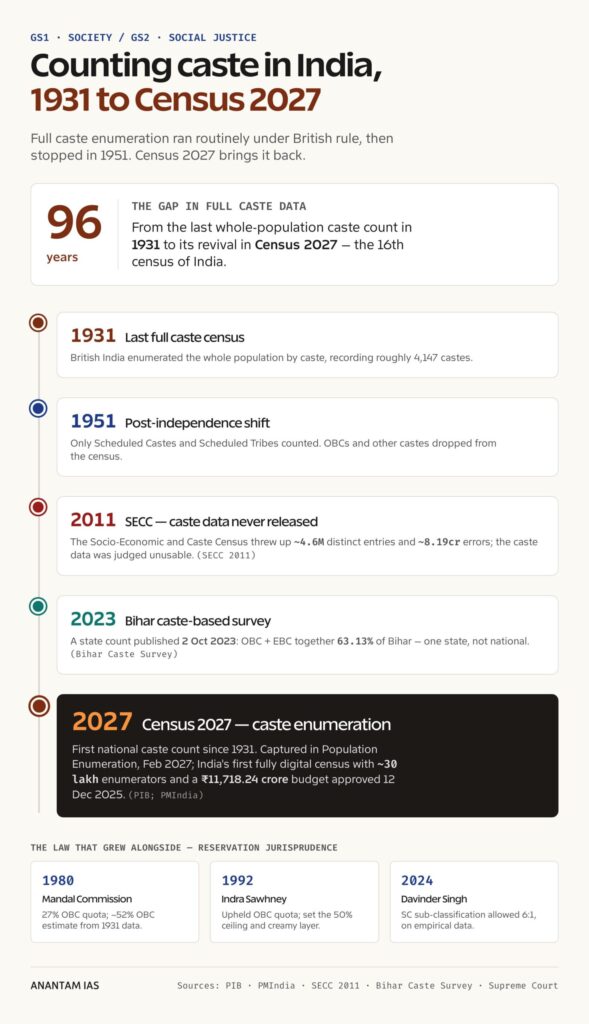
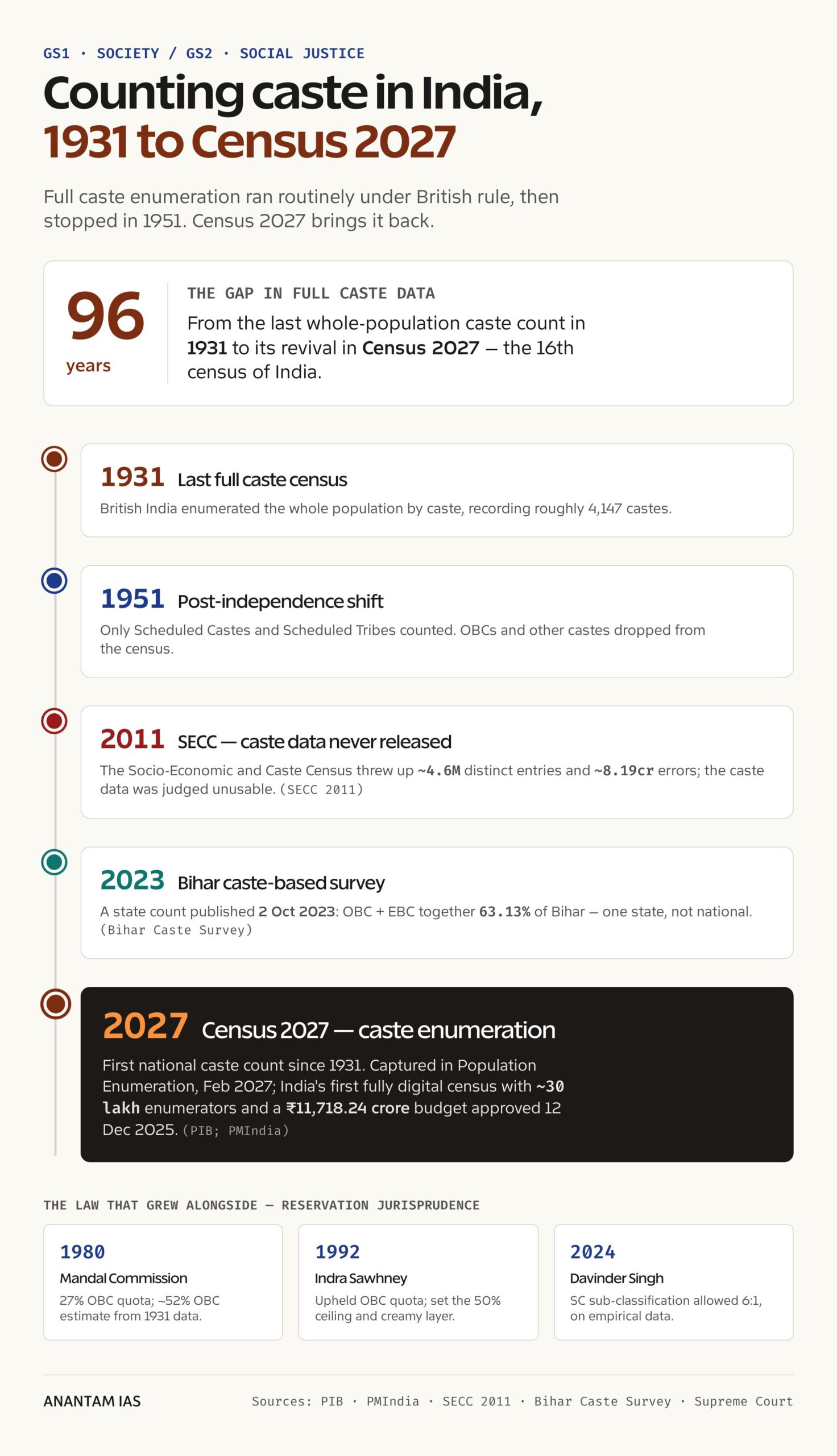
For 96 years, India ran its welfare state on a guess. Reservation for Other Backward Classes, the largest beneficiary bloc in the country, has rested since 1980 on a number the Mandal Commission pulled out of the 1931 census and stretched to fit a 1980 population. That guess put OBCs at about 52% of India. Nobody has counted since. So when the Union Cabinet approved a caste enumeration as part of Census 2027 on 12 December 2025, with a budget of ₹11,718.24 crore, it wasn’t adding a column to a form. It was promising to replace the oldest assumption in Indian social policy with a fact.
And that’s exactly why the fight is so sharp. A caste count can ground reservation and welfare in evidence instead of extrapolation. It can also harden caste as a public category, throw up classification chaos, and pile pressure on a reservation ceiling the Supreme Court drew in 1992. The question for an aspirant isn’t whether counting caste is good or bad. It’s whether the state can collect this data, use it to deliver justice, and not let the count itself become the thing that deepens caste.
The Issue, Framed
The real argument here isn’t about the census. It’s about what a count does to the thing it counts. Measure caste, and you might dissolve injustice with data. Or you might cement caste into the machinery of the state for another century. Both can be true at once, which is what makes this hard.
Start with the vocabulary, because most of the public noise comes from people using these words loosely. A caste census is the full enumeration of every person’s caste across the whole population. India did this routinely under British rule, last in 1931. From the first census of independent India in 1951 onward, the state counted only Scheduled Castes (SCs) and Scheduled Tribes (STs), the groups listed in the Constitution under Articles 341 and 342, and stopped counting everyone else’s caste. So Census 2027 doesn’t invent caste enumeration. It revives a practice India abandoned 96 years ago.
The group missing from those decades of data is the Other Backward Classes (OBC), a broad category of socially and educationally backward castes who aren’t SC or ST. The Mandal Commission, set up in 1979 and reporting in 1980, recommended 27% reservation for OBCs in central government jobs and education. But it had no fresh count. It took 1931 caste figures, subtracted the SC, ST, and forward-caste shares, and arrived at roughly 52% OBC. That single derived figure has anchored OBC policy ever since.
A few more terms you’ll need throughout. Reservation is the quota of seats and posts set aside for SC, ST, OBC, and now EWS. The creamy layer is the better-off slice within OBCs, excluded from quota benefits so the gains reach the genuinely backward. The 50% ceiling is the rule, set by the Supreme Court in 1992, that total reservation shouldn’t ordinarily cross half of all seats. And sub-classification is the newer idea that a state can split a reserved category, say SCs, into sub-groups so the most deprived among them get a dedicated share. Hold those four. They’re the load-bearing walls of this entire debate.
So the framing is this. India is about to count caste for the first time in nearly a century, into a legal system built on estimates, with courts now demanding the very data only a census can provide. The promise and the danger are the same exercise.
What the Data Says
The case for counting begins with how badly India has been guessing. The Mandal Commission’s ~52% OBC estimate came from 1931 data, but the National Sample Survey Office (NSSO) later put OBCs at about 36% in 1999-2000 and around 41% in 2007. When your three best estimates for the same population sit between 36% and 52%, you don’t have data. You have a fight dressed up as data. That 16-percentage-point spread is the entire justification for a fresh count.
India has tried once before, and it’s a cautionary tale. The Socio-Economic and Caste Census (SECC) of 2011 collected caste alongside income and asset data. The socio-economic part was released over 2015-16. The caste part never was. Why? The enumeration threw up about 4.6 million distinct entries of castes, sub-castes, surnames, gotras, and clan names, an unclassifiable mess. Roughly 8.19 crore errors were flagged in caste particulars; about 6.74 crore were fixed, leaving close to 1.46 crore unresolved. An expert group under NITI Aayog, chaired by Arvind Panagariya, was set up to vet it. The findings stayed buried, and in 2021 the Supreme Court declined to force the Union to release them after the Centre argued the data was unusable. So the precedent isn’t “we counted caste and it worked.” It’s “we counted caste and the count collapsed.”
The recent counter-example is a state, not the nation. Bihar published its Caste-based Survey on 2 October 2023. It found OBC and Extremely Backward Classes (EBC) together at 63.13% of the state, with EBC at 36.01% and OBC at 27.12%; SCs at 19.65%, STs at 1.68%, and the General or unreserved category at just 15.52%. The single largest caste group, the Yadavs, came in around 14.27%. Bihar showed a count can be done and published. But it’s one state of 13 crore people, and you can’t stretch its 63% backward share across all of India any more than Mandal should have stretched 1931.
Census 2027 itself is built to avoid the SECC mess, at least on paper. It’s India’s first fully digital census, with caste captured in the Population Enumeration phase around February 2027, a reference date of 1 March 2027 for most of the country, roughly 30 lakh enumerators, and a self-enumeration window where citizens fill their own details by mobile app. The ₹11,718.24 crore the Cabinet cleared on 12 December 2025 is the price of trying to get right what 2011 got wrong.
The Case For
The strongest argument for a caste census is almost embarrassingly simple. You can’t deliver justice to people you refuse to count. Right now the OBC quota rests on a 1931-derived guess, and a policy that touches hundreds of millions runs on a number older than the Republic itself. Replacing extrapolation with enumeration isn’t ideology. It’s basic statistical hygiene.
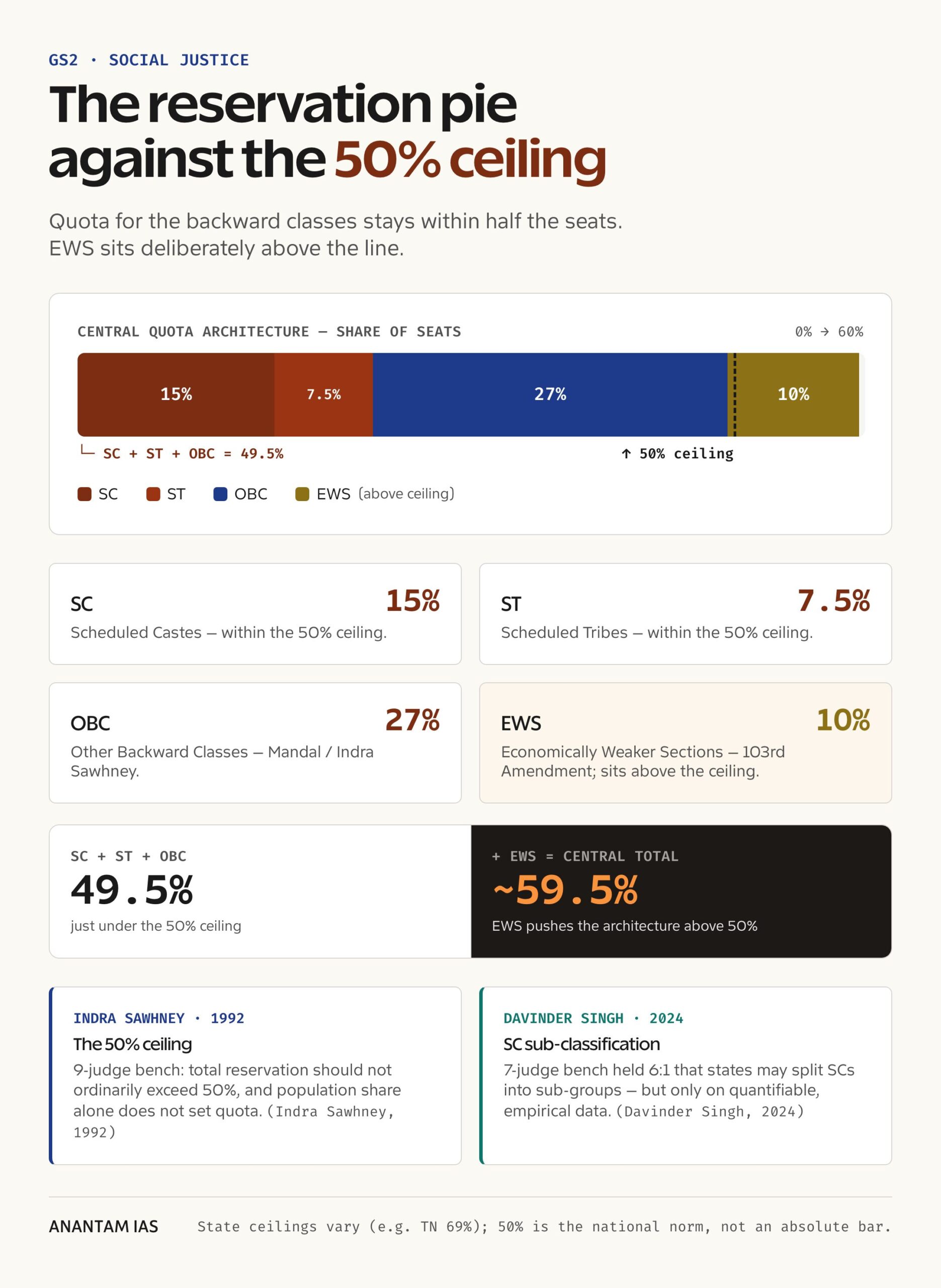
The courts asked for this, which people forget. In Indra Sawhney v. Union of India (1992), the nine-judge bench that upheld the 27% OBC quota didn’t treat backwardness as fixed. It built the whole system on the assumption that backwardness would be periodically tested against evidence, and it ordered the creamy layer screened out so the better-off within a group don’t corner the benefits. You can’t periodically test against data you never collect. Without a count, the judicial design has been flying blind for three decades.
Then the law tightened. In State of Punjab v. Davinder Singh (1 August 2024), a seven-judge bench held 6:1 that states may sub-classify Scheduled Castes, splitting the SC category so the most deprived sub-groups get a protected share, overruling the 2004 E.V. Chinnaiah ruling that had barred this. But the Court attached a condition with teeth. Any sub-classification must rest on “quantifiable and empirical data” of relative backwardness and inadequate representation. So after 2024, a state that wants to route SC benefits to its poorest sub-castes isn’t just permitted to collect this data. It’s legally required to, or the sub-classification won’t survive a court challenge. A caste census is the cleanest lawful instrument to generate it.
And here’s the part the anti-reservation camp underrates. A count can shrink reservation as easily as expand it. If the data shows certain castes have outgrown the need for OBC benefits, that’s the evidentiary basis for tightening the creamy layer and pruning the list, not padding it. Counting cuts both ways. Bihar’s 2023 survey, whatever its politics, did one thing cleanly: it replaced rumour and assertion with audited shares everyone could argue over in the open. So the case for isn’t “reservation forever.” It’s “stop legislating in the dark.”
The Case Against
Here’s what the evidence case walks past. The act of counting caste isn’t neutral. It does something to caste. The Constitution’s framers imagined a society moving toward castelessness, and the worry, voiced across the debate, is that an official, individual-level caste record makes caste more salient in public life, not less, hardening the very categories the founders hoped would fade. You can’t unsee a number once the state has stamped it official.
The accuracy problem is real and proven, not hypothetical. SECC 2011 didn’t fail from bad intentions. It failed because caste in lived reality is fluid, regional, and slippery, and self-reported caste produced 4.6 million distinct entries that no clean classification could absorb. Census 2027’s digital, pre-validated schedule is meant to fix this. But the burden of proof sits with the new exercise. Until the data is collected and released cleanly, “we’ll classify better this time” is a hope, not a result.
Then comes political mobilisation, what scholars call “competitive backwardness.” Publish the shares, and every caste bloc has a number to demand quota proportional to. Bihar’s 63% OBC-plus-EBC figure is the obvious flashpoint. A count meant to refine welfare can instead become ammunition for groups to mobilise on caste lines and parties to bid for caste votes, hardening blocs rather than dissolving them. The data doesn’t cause this. But it hands everyone a weapon.
And the count crashes straight into a legal wall: the 50% ceiling. If enumeration confirms very large backward shares, states will push to raise quotas past Indra Sawhney’s 50% limit. That ceiling has already been breached once. The 103rd Amendment (2019) added a 10% quota for Economically Weaker Sections (EWS), the poor among groups not covered by SC/ST/OBC reservation, and in Janhit Abhiyan v. Union of India (7 November 2022) a five-judge bench upheld it 3:2, accepting that the ceiling isn’t “inflexible” and letting EWS sit above 50%. So the central architecture already runs close to 60% on paper. A census showing big OBC numbers turns the ceiling from a settled rule into a live battleground the courts will have to police all over again.
There’s also a quieter risk: privacy. A digital, individual-level caste record raises real data-protection questions under the new DPDP regime, who holds it, how it’s secured, and against what misuse. No authoritative government ruling specific to Census 2027 caste data exists yet, so this is an open governance question rather than a settled one. But it’s the kind of question that should be answered before 30 crore caste records are created, not after.
The Deeper Structural Read
Step back from the slogans and the real fault line shows up. It isn’t “data versus dignity.” It’s a tension the Constitution itself carries: the same document that promises to end caste discrimination also instructs the state to use caste to deliver justice. Articles 15 and 16 ban discrimination on caste, then immediately permit special provision for backward classes. The Constitution is, in this precise sense, caste-conscious in order to become caste-blind. A census sits exactly on that contradiction.
So the honest framing is sequencing, not opposition. Counting caste is a means. Justice is the end. The danger is mistaking one for the other, treating the count itself as the achievement, when SECC already showed you can collect mountains of caste data and deliver almost nothing from it. Data without delivery isn’t social justice. It’s a press release with footnotes.
The sharpest analytical move, and the one that belongs in any answer, is to separate enumeration from quota arithmetic. The reservation system was never meant to be a mirror of population shares. Indra Sawhney deliberately rejected pure proportionality and set a ceiling precisely so that reservation stays a tool for the backward, not a headcount for every group. So a caste census that gets read as “this group is 30% of the state, so it should get 30% of the seats” misunderstands the entire jurisprudence. The count is supposed to identify who is backward and by how much, layered with deprivation data, not to convert raw numbers into automatic quota.
There’s a federal layer underneath too. Sub-classification after Davinder Singh is a state power, exercised on state data, while the census is a Union exercise run by the Registrar General. So the same dataset feeds two governments with different incentives, and the question of who classifies, who releases, and who acts on the numbers is going to generate Centre-state friction even if the count itself is flawless.
And here’s what should bother a future administrator most. The thing that makes the census powerful, that it finally produces hard caste numbers, is also what makes it dangerous, because numbers create entitlements and entitlements create politics. The same census triggers the delimitation that will redraw Lok Sabha seats and the women’s reservation under the Nari Shakti Vandan Adhiniyam (106th Amendment, 2023), which reserves a third of legislative seats for women but only takes effect after the first census and the delimitation that follows. So Census 2027 isn’t one policy lever. It’s the trigger for caste data, seat redistribution, and women’s political reservation all at once. That’s an enormous amount of consequence loaded onto a single enumeration, and the state’s capacity to handle the politics of it is the unstated variable in the whole exercise.
What Should Be Done
So what does a caste census that serves justice instead of entrenching caste actually look like? Not a vague appeal to “balance,” but a set of design choices you could hand the Registrar General tomorrow. Six of them, and none weakens the count.
- Use a pre-coded, state-validated caste schedule, not free text. The SECC collapse came from open-ended self-reporting that produced 4.6 million entries. A standardised, state-validated caste and sub-caste list, with the classification logic published openly, is the single biggest fix. Get the schedule right and you avoid replaying 2011.
- Put the data in independent statistical custody with a fixed release date. Vet it through the Registrar General and a transparent expert layer, the way the NITI Aayog group was meant to work, but with a hard publication deadline so review can’t become a burial mechanism. The lesson of SECC is that data withheld indefinitely is data wasted.
- Govern caste micro-data under strong privacy rules. Release only aggregates, lock down access, and write explicit limits on re-identification and political misuse into the rules before enumeration begins, aligned with the Digital Personal Data Protection Act. Thirty crore caste records is a target; treat it like one.
- Tie the count to deprivation, not just quota. Layer caste with education, health, asset, and occupation data so the output drives targeted welfare schemes and sharper creamy-layer screening, not bare quota expansion. A number that doesn’t change a child’s school or a family’s clinic is a number that failed.
- Build periodic review into the system. Honour the Indra Sawhney logic: revisit OBC lists against fresh data each cycle, moving benefits toward those still excluded and away from castes that have advanced. That’s how you keep the reservation policy honest instead of frozen.
- Decouple the count from the ceiling fight. Treat enumeration as fact-finding, and keep the 50% ceiling question for separate, evidence-led constitutional adjudication. Don’t let raw population shares dictate quota; that’s the proportionality trap Indra Sawhney rejected for good reason.
Do these six, and the census becomes what it was sold as: evidence for justice. Skip them, and it becomes a 4.6-million-entry mess or a quota auction. The design choices, not the decision to count, decide which one India gets.
For Your Mains Answer
This is a rare topic that sits squarely across two papers at once, which makes it high-value and easy to over-stuff. Handle it cleanly and it carries an entire GS1+GS2 answer.
GS paper mapping: GS1: Indian society, caste as a social institution, effects of counting caste on social fabric. GS2: social justice, reservation and welfare for vulnerable sections, government policies and data-based governance, federalism.
Likely question frames:
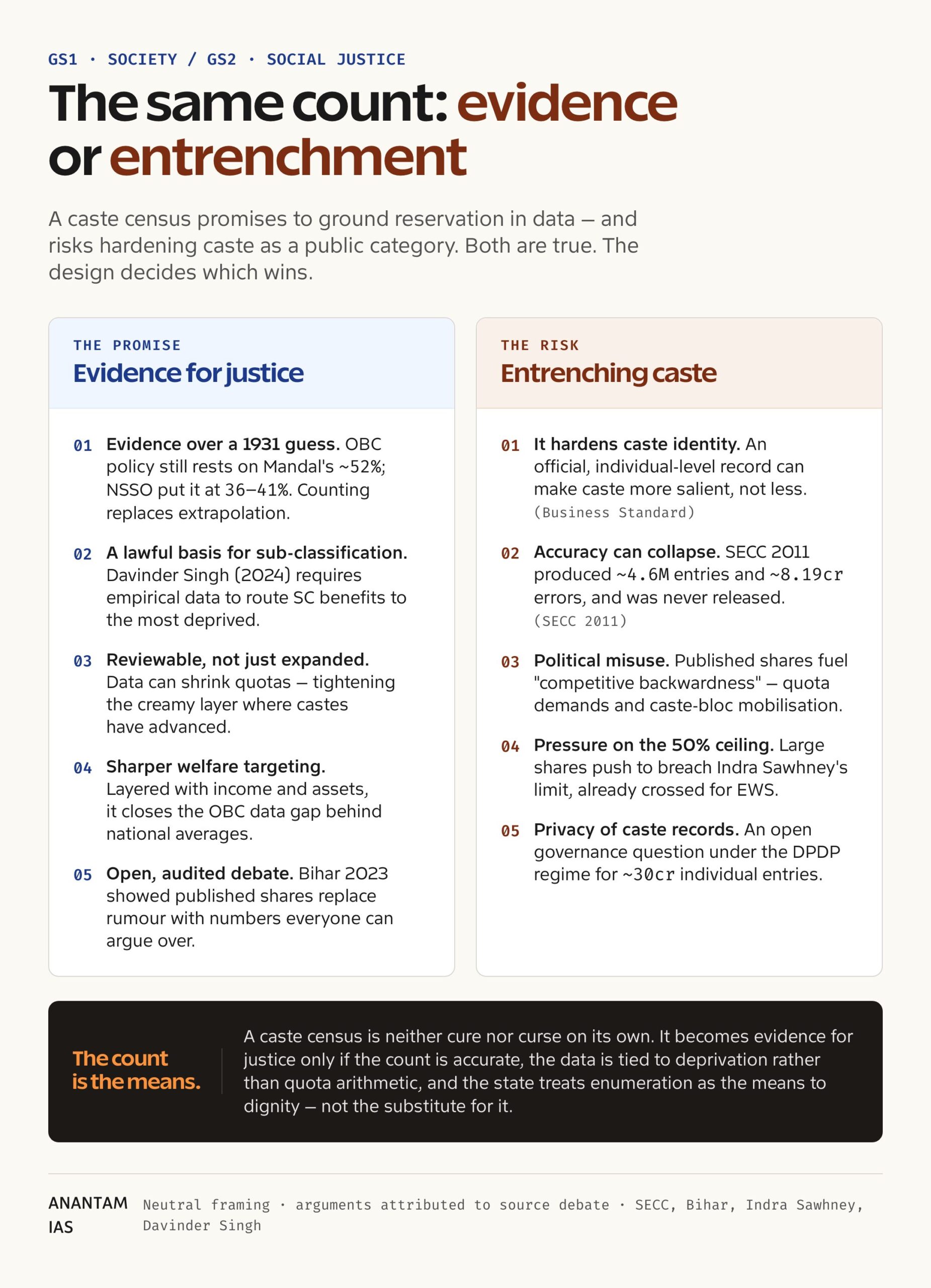
- A caste census can ground reservation in evidence, but risks entrenching caste as a public category. Critically examine in light of Census 2027.
- Reservation jurisprudence assumes backwardness will be tested against data. Discuss how caste enumeration relates to the framework laid down from Mandal to Davinder Singh.
- Evaluate whether a caste census strengthens or strains the constitutional vision of a casteless society.
Quotable data points:
- 1931, the last full caste census; Census 2027 revives it after 96 years.
- ₹11,718.24 crore, the Cabinet-approved Census 2027 budget (12 Dec 2025).
- ~52% (Mandal, 1931-derived) versus 36-41% (NSSO), the OBC estimate spread that exposes the data vacuum.
- 4.6 million caste entries and ~8.19 crore errors sank SECC 2011’s caste data; ~1.46 crore stayed unresolved.
- 63.13%, Bihar’s 2023 OBC+EBC share (EBC 36.01%, OBC 27.12%), a state figure, not national.
- 50%, the Indra Sawhney (1992) ceiling; EWS 10% upheld 3:2 in Janhit Abhiyan (2022) sits above it.
- 6:1, Davinder Singh (2024) allowing SC sub-classification on empirical data.
- 33%, women’s reservation under the 106th Amendment, gated on the census and delimitation Census 2027 triggers.
Keywords to use: caste enumeration, evidence-based policy, creamy layer, sub-classification, 50% ceiling, proportionality, competitive backwardness, casteless society, federalism, data-driven governance.
Syllabus linkages: salient features of Indian society and diversity; mechanisms and policies for protection of vulnerable sections; reservation jurisprudence (Articles 15, 16, 341, 342); statutory bodies (Registrar General, NCBC); governance, transparency, and citizen data.
Balanced conclusion line: A caste census is neither a cure nor a curse on its own; it becomes evidence for justice only if the count is accurate, the data is tied to deprivation rather than quota arithmetic, and the state treats enumeration as the means to dignity, not the substitute for it.
How to Build the Answer
Open with the contradiction, not a definition. The tension is that the Constitution uses caste to abolish caste, and a census sits right on that seam. That first sentence signals you’ve grasped both the policy and the value clash. The definition of OBC or caste census can follow in the second sentence, never the first. An opening line that frames the debate beats one that recites a glossary.
Bring data in early, but ration it hard. A strong first body paragraph can carry three figures: the 36-52% OBC estimate spread, SECC 2011’s 4.6 million entries, and Bihar’s 63%. Then say what each proves. The figure is the anchor; the “this means…” is where the mark lives. UPSC rewards the move from fact to inference, not the fact alone.
The second body paragraph should steelman the side you don’t favour. If you back the census, first admit the entrenchment and accuracy risks honestly. If you’re cautious about it, first concede that policy on a 1931 guess is indefensible. That’s how an answer reads balanced without going limp.
The way forward must be grouped, not scattered. Cluster the reforms: validated schedule, independent custody with a release deadline, privacy safeguards, data tied to deprivation, periodic review, and decoupling from the ceiling fight. Use the topic’s own vocabulary, proportionality, creamy layer, empirical data, so the answer reads as governance analysis rather than a news recap.
Close on the syllabus link and judgment, not summary. The last line should not echo the introduction. The reliable pattern is “the count is not the achievement; the delivery is,” which lets you balance evidence against entrenchment in one move.
Common Mistakes to Avoid
- Don’t treat the census as automatically good or bad. The whole topic is that the design decides the outcome. An answer that picks a flat side misses the point.
- Don’t generalise Bihar’s 63% to India. It’s one state survey. Stretching it is the exact Mandal error you’re critiquing.
- Don’t confuse population share with quota. Indra Sawhney rejected proportional reservation. An answer that equates “30% of population” with “30% quota” gets the jurisprudence wrong.
- Don’t skip the failure case. SECC 2011 is the most important precedent. An answer that doesn’t mention why the last caste count was never released is incomplete.
- Don’t forget who bears the cost. Name the genuinely backward family the data is meant to reach, and the vulnerable group whose identity a bad count could harden.
A Compact Answer Spine
- Introduction: Open with the constitutional contradiction; define caste census and OBC in the next line.
- Evidence: Use the OBC estimate spread, SECC’s collapse, and Bihar’s share, each tied to an implication.
- Arguments: The case for evidence-based reservation, then the case on entrenchment and accuracy. Keep both fair.
- Structural diagnosis: Articles 15 and 16 make the state caste-conscious to become caste-blind; the count is a means, not the end.
- Way forward: Five or six grouped design choices, each with a clear actor, Registrar General, states, NCBC, Parliament.
- Conclusion: Adapt the balanced conclusion line to the exact question wording.
Diagram or Flowchart Idea
For a 15-marker, draw one causal chain, not a decorative web. The cleanest format: 1931 guess → policy on extrapolation → courts demand data (Indra Sawhney, Davinder Singh) → caste census → either evidence-led welfare or entrenchment, depending on design. The examiner reads that logic in five seconds.
For a 10-marker, skip the diagram and use a two-column table instead: “Promise (evidence, lawful sub-classification, targeting)” against “Risk (entrenchment, classification collapse, ceiling pressure).” It’s faster to evaluate under time pressure and shows balance at a glance.
Ethics and Governance Angle
Add one ethical line even in a data-heavy answer. The deepest question here isn’t statistical. It’s whether the state can use a caste identity to dismantle caste disadvantage without making that identity permanent. That’s a genuine dilemma between equality of opportunity and the recognition of group difference, and naming it sharpens the answer.
Then convert the principle into design. Don’t just say “protect the vulnerable.” Say how: aggregate-only release, privacy rules before enumeration, data tied to deprivation, periodic review so benefits move toward the still-excluded. That’s the move from moral language to administrative maturity.
A sentence pattern that travels across topics: “The exercise is legitimate in aim, but its legitimacy depends on accuracy, transparency, and the capacity to act on what it finds.” It accepts the state’s objective without handing it a blank cheque, which is exactly what a balance question rewards.
How to Use Data Without Sounding Mechanical
Use fewer numbers than you know. Three well-explained figures beat ten dumped in a row. Lead with one that frames the vacuum (the 36-52% OBC spread), one that warns (SECC’s 4.6 million entries), and one that grounds the politics (Bihar’s 63%). One gap, one warning, one stake is usually enough.
Never leave a statistic standing alone. Follow it with “this means…” or “the policy implication is…” That tiny move turns a fact sheet into analysis. In Mains, facts are raw material; judgment is the finished answer.
Finish by asking one question: can a tired examiner follow this in a single pass? If it needs rereading, simplify. Short introduction, data early, two sides marked cleanly, grouped way forward. For UPSC, clarity is how depth becomes visible, so cut any line that sounds impressive but does no work and replace it with a fact, a cause, a consequence, or a reform.
FAQ
Why was caste not counted between 1931 and 2027?
After independence, the 1951 census and every one since counted only Scheduled Castes and Scheduled Tribes, the groups listed under Articles 341 and 342, and dropped full caste enumeration. The post-independence state treated counting all castes as something that would entrench caste rather than help dissolve it. So OBC policy ran on the 1931-derived Mandal estimate of about 52% for decades, with no fresh national count until Census 2027.
What went wrong with the SECC 2011 caste data?
The Socio-Economic and Caste Census of 2011 collected caste through open-ended self-reporting, which produced about 4.6 million distinct entries of castes, sub-castes, surnames, and clan names. Roughly 8.19 crore errors were flagged, and about 1.46 crore stayed unresolved. The caste data was judged unusable and was never released, and in 2021 the Supreme Court declined to force its publication.
Does a caste census mean reservation will cross 50%?
Not automatically. The Indra Sawhney (1992) ruling set a 50% ceiling and rejected pure proportional reservation, so population share doesn’t translate into quota by itself. But large backward shares, like Bihar’s 63%, will fuel political demands to raise quotas, and the EWS 10% upheld in Janhit Abhiyan (2022) already sits above 50%, so the ceiling is contested rather than settled.
How is Census 2027 linked to women’s reservation?
The women’s reservation law, the Nari Shakti Vandan Adhiniyam (106th Amendment, 2023), reserves a third of legislative seats for women but takes effect only after the first census and the delimitation that follows it. So Census 2027 is the trigger for three things at once: caste data, the redrawing of seats through delimitation, and the eventual rollout of women’s political reservation.
Tell Google you want more of this.
Add Anantam IAS as a preferred sourceOne tap, and this site shows up more often in your own Top Stories, AI Overviews and AI Mode. Remove it any time.