Centre Seeks Inter-State Redistribution of Lok Sabha Seats based on 2011 Census

Why in News?
The Government of India is considering redistribution of Lok Sabha seats among states using 2011 Census data.
This means:
- States with higher population growth may get more seats
- States with lower population growth may get fewer seats (relative share)
This is linked to the upcoming delimitation exercise after 2026.
UPSC Relevance
- GS-I: Demographic dividend, demographic trap
- GS-II: Delimitation Commission, Federalism (asymmetric federalism, cooperative federalism). Women’s reservation, population policy, north-south debate, electoral reforms.
Two inter-linked Bills:
- Constitution (131st Amendment) Bill, 2026: Amends Articles 81, 82 (Lok Sabha) and Article 170 (State Assemblies). Increases maximum Lok Sabha strength from the current constitutional cap of 550 (530 states + 20 UTs) to 850 seats (815 from States + 35 from UTs). Removes the long-standing “freeze” on seat allocation. Allows Parliament to decide (by ordinary law) which census data will be used for “population” — effectively enabling use of the 2011 Census (latest published).
- Delimitation Bill, 2026: Constitutes a new Delimitation Commission to:
- Reallocate seats between states (inter-state redistribution) using 2011 population data.
- Redraw constituency boundaries within each state (intra-state delimitation).
- Readjust SC/ST reserved seats and implement 33% women’s reservation (rotational, for 15 years).
What is Delimitation?
Delimitation is the process of fixing the number of seats and boundaries of constituencies based on population
Why is it done?
- To ensure equal representation
- To maintain principle of:
“One person, one vote, one value”
Who does it?
- Delimitation Commission of India
- It is an independent body whose decisions have the force of law
Constitutional Provisions
Article 81
- Seats in Lok Sabha should be proportional to population
Article 82
- After every Census → Parliament should enact a Delimitation Act
Why is This Issue Coming Now?
Freeze on Delimitation
India has not redistributed seats among states since 1971 Census.
Why?
Because of:
- 42nd Constitutional Amendment Act
- 84th Constitutional Amendment Act
These amendments froze seat allocation till 2026 to:
- Encourage population control
- Avoid penalising states that reduced population growth
Why Now? Link to Women’s Reservation
- 106th Constitutional Amendment Act, 2023 (Nari Shakti Vandan Adhiniyam): Provides 33% reservation for women in Lok Sabha and State Assemblies.
- It can take effect only after a new delimitation exercise (and will be in force for 15 years, with rotational seats).
- The 2023 Act explicitly tied implementation to the post-2026 census. These 2026 Bills fast-track it by using 2011 Census + expanding the House. One-third of the new 850 seats (~273) will be reserved for women (with sub-quotas for SC/ST women).
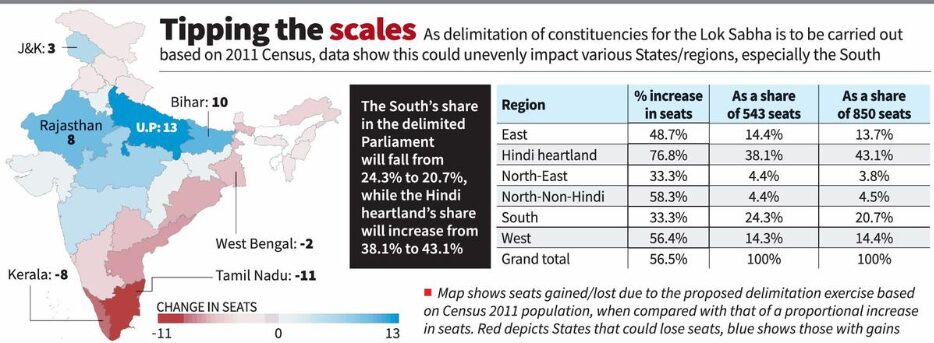
What Will Happen After 2026?
After the freeze ends:
A new delimitation exercise will happen
Now the key question is:
- Should seats be redistributed using 2011 Census data?
Recent developments suggest the Government is considering using 2011 Census for faster delimitation
Why is Redistribution Controversial?
1. North vs South Divide
Northern States:
- Higher population growth
- Likely to gain seats
Examples:
- Uttar Pradesh
- Bihar
Southern States:
- Lower population growth (due to better family planning)
- Likely to lose relative share of seats
This creates a perception of:
- “Punishment for good governance”
2. Federal Imbalance
India is a federal country, and Lok Sabha represents states.
If redistribution happens:
- Some states will gain more political power
- Others will lose influence
This may disturb Centre-State balance
3. Political Implications
- Parties strong in high-population states may benefit
- Could reshape national politics
4. Representation Inequality (Current Problem)
Because delimitation is frozen:
- Some MPs represent very large populations
- Others represent smaller populations
This creates unequal representation
5. Other Effects:
- Smaller constituencies → better representation.
- Increased Lok Sabha strength affects Presidential election (electoral college weight shifts towards LS) and joint sittings (LS dominance increases).
- State Assemblies will also see similar expansion and delimitation.
Key Constitutional Dilemma
How should Lok Sabha seats be distributed among states?
There are two competing ideas, and both are correct in their own way.
Option 1: Equality of Representation
- Seats proportional to population
- Ensures fairness
✔ Fair for individuals
❌ Unfair for some states
Option 2: Federal Balance
- Protects interests of all states
- Avoids dominance by few states
✔ Maintains federal balance
❌ Violates equal representation
This is the core tension in the debate
Possible Solutions Being Discussed
1. Increase Total Seats
- Instead of reducing seats of some states
- Increase total Lok Sabha seats
So all states gain, but proportion adjusts
2. Maintain Status Quo
- Keep current distribution
- Avoid conflict
But this worsens representation inequality
3. Hybrid Formula
- Balance population + federal considerations
- Similar to some other federal systems
Broader Implications
1. Democracy
- Affects fair representation of citizens
2. Federalism
- Impacts power balance among states
3. Governance
- Influences:
- Policy making
- Resource allocation
Conclusion
The delimitation debate reflects the tension between democratic equality and federal balance. While proportional representation is constitutionally mandated, it must be harmonised with the principles of cooperative federalism to ensure that India’s unity in diversity is preserved. Delimitation after 2026 may redraw India’s political map by reallocating Lok Sabha seats based on population, raising concerns of federal imbalance and regional inequality.”
Mains Questions:
- “The proposed inter-state redistribution of Lok Sabha seats may alter the balance of Indian federalism.” Critically analyse.
- “Delimitation based solely on population may penalise states that have successfully implemented population control policies.” Evaluate this statement.
- Examine the political, social, and federal implications of delimitation after 2026 in India.
- “India’s model of representation must balance democratic equality with regional equity.”
Discuss in the context of the ongoing delimitation debate.