The Delimitation Commission is a high-powered body constituted by the Government of India under an Act of Parliament to redraw the boundaries of parliamentary and assembly constituencies on the basis of the most recent census. Its orders have the force of law and cannot be questioned in any court. Four Delimitation Commissions have been set up since independence — in 1952, 1962, 1972 and 2002 — and a fresh round of delimitation is expected after the first census conducted in the post-2026 period.
For UPSC, the Delimitation Commission is a high-yield polity topic that connects representation, federalism, the census and contemporary debates around the women's reservation law.
Constitutional Basis
The delimitation of constituencies derives from three key articles of the Constitution.
| Article | Provision |
|---|---|
| Article 82 | After every census, readjustment of seats of the Lok Sabha among the States and division of each State into territorial constituencies to be done by Parliamentary law |
| Article 170 | Composition of Legislative Assemblies — each State Assembly divided into territorial constituencies on the basis of population as per the latest census |
| Article 327 | Parliament may make provisions with respect to elections to either House, including the delimitation of constituencies |
| Article 329 | Bars the courts from interfering in electoral matters, including delimitation orders |
Parliament has used Article 327 to enact the Delimitation Commission Acts of 1952, 1962, 1972 and 2002.
What Is Delimitation?
Delimitation means the act of redrawing the boundaries of parliamentary and assembly constituencies so that each constituency has, as far as practicable, the same population. It also involves:
- Reallocating seats among States on the basis of population
- Reserving seats for Scheduled Castes and Scheduled Tribes (Articles 330 and 332)
- Ensuring constituencies are geographically compact
The Four Delimitation Commissions
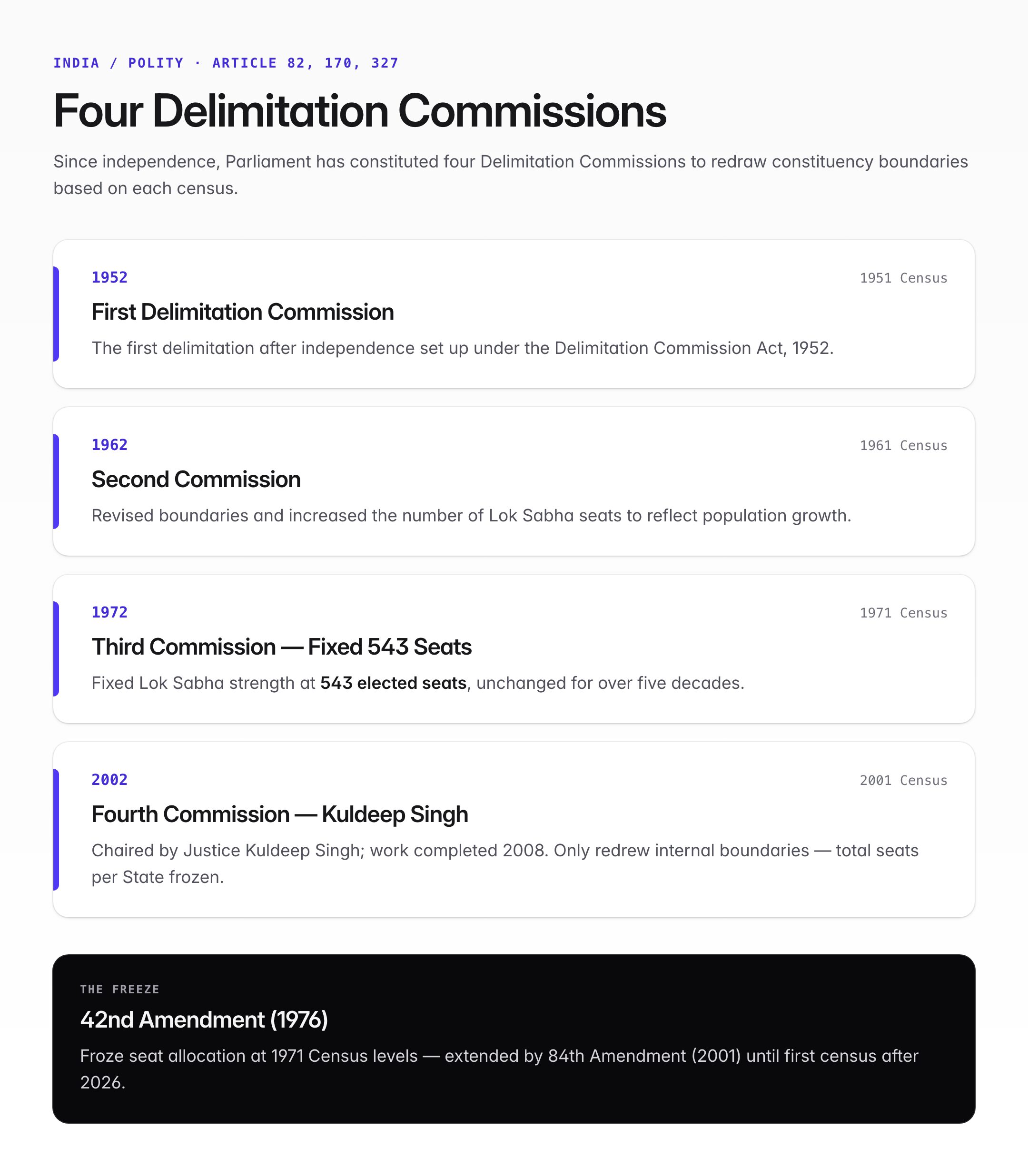
India has had four Delimitation Commissions so far, each established by a separate Act of Parliament.
| Year | Act | Census Base | Outcome |
|---|---|---|---|
| 1952 | Delimitation Commission Act, 1952 | 1951 Census | First delimitation after independence |
| 1962 | Delimitation Commission Act, 1962 | 1961 Census | Revised boundaries; increased Lok Sabha seats |
| 1972 | Delimitation Commission Act, 1972 | 1971 Census | Fixed 543 Lok Sabha seats |
| 2002 | Delimitation Act, 2002 | 2001 Census | Only redrew boundaries within States; total seats per State frozen |
The 1972 Commission
The Third Delimitation Commission (1972) is historically important because it fixed the number of Lok Sabha constituencies at 543 elected seats — a figure that has remained unchanged for over five decades.
The 2002 Commission
Set up under the Delimitation Act, 2002 and chaired by Justice Kuldeep Singh, its work was completed in 2008. It redrew the internal boundaries of constituencies in most States on the basis of the 2001 Census, but the total number of Lok Sabha seats allotted to each State was not changed, because of the freeze imposed by the 42nd Amendment.
Composition of the Delimitation Commission
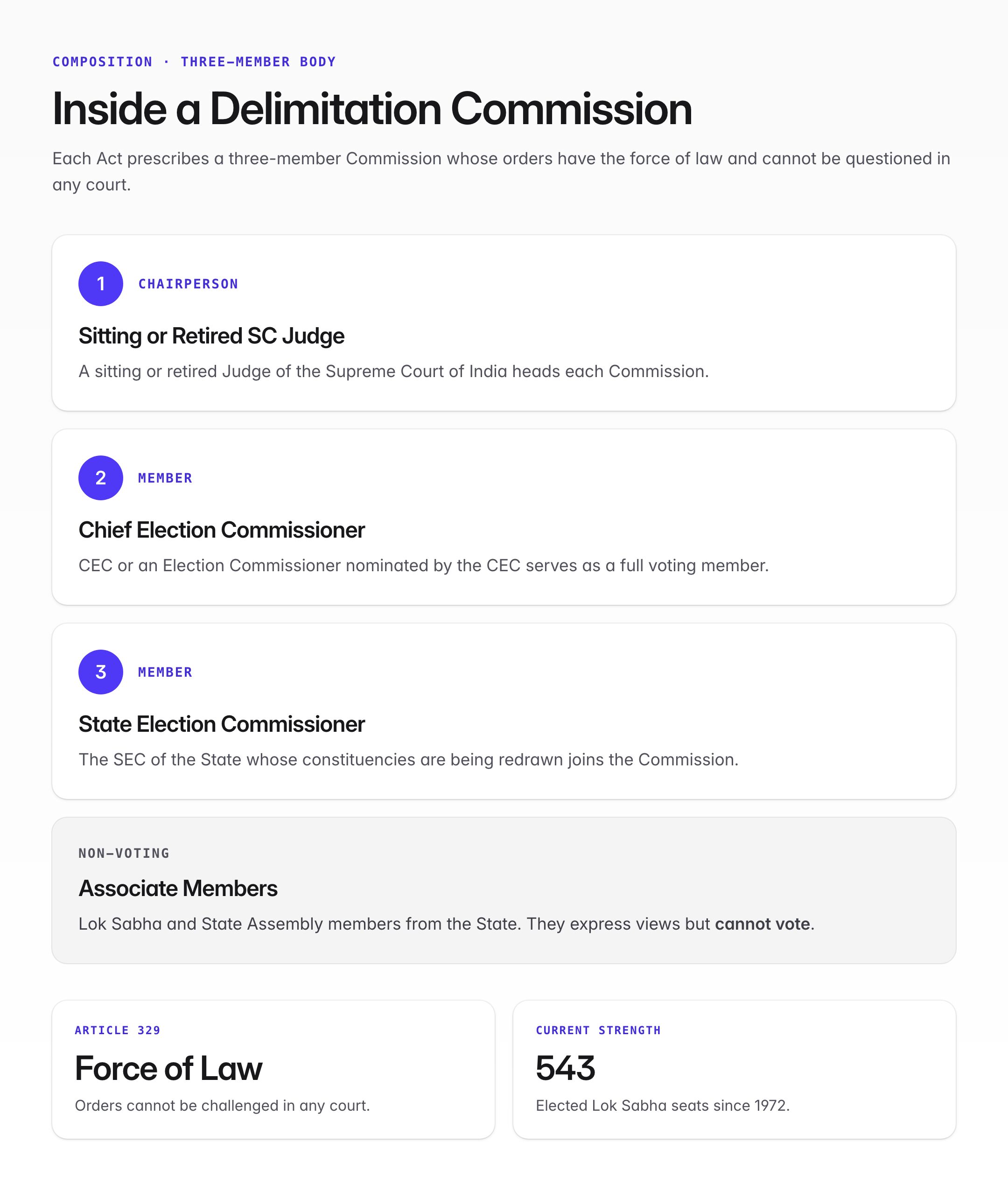
Each Act prescribes a three-member Commission.
| Member | Role |
|---|---|
| Chairperson | A sitting or retired Judge of the Supreme Court |
| Member | Chief Election Commissioner or an Election Commissioner nominated by the CEC |
| Member | State Election Commissioner of the concerned State |
In addition, each State has Associate Members nominated from among its Lok Sabha and Legislative Assembly members. Associate members can express views but cannot vote.
Process of Delimitation
The Commission follows a structured procedure before issuing a final order.
| Step | Action |
|---|---|
| 1 | Commission publishes draft proposals in the Gazette and in State dailies |
| 2 | Invites objections and suggestions from the public and political parties |
| 3 | Holds public sittings in each State for oral hearings |
| 4 | Consults Associate Members from the State concerned |
| 5 | Publishes final order in the Gazette of India and State Gazettes |
| 6 | Final order comes into force on a date notified by the President |
Once published, the orders have the force of law and cannot be challenged in any court (Article 329).
The 1976 Freeze — 42nd Amendment
This is one of the most consequential constitutional changes for representation in India.
- 42nd Constitutional Amendment, 1976 froze the allocation of Lok Sabha and State Assembly seats as per the 1971 Census
- The freeze was initially till 2000
- The 84th Amendment, 2001 extended the freeze up to the first census after 2026
- The 87th Amendment, 2003 allowed delimitation within existing State quotas based on 2001 Census, but without changing the inter-State allocation
Why the Freeze?
The freeze was introduced to reward States that had successfully implemented family planning and controlled population growth. Without the freeze, southern States (which controlled population) would have lost seats to northern States (with higher population growth).
| Concern | Explanation |
|---|---|
| Federal equity | Southern States would be penalised for effective family planning |
| Representation imbalance | Hindi-belt States would gain disproportionate Lok Sabha seats |
| Political stability | Avoiding a north-south divide in national representation |
Post-2026 Delimitation — The Looming Question
The freeze is set to end after the first census conducted after 2026. This has triggered intense political debate.
| Issue | Details |
|---|---|
| Expected increase in Lok Sabha seats | From 543 to possibly 753 or higher, given population growth |
| State-wise redistribution | Northern States likely to gain many seats; southern States to gain fewer |
| New Parliament building | Already designed with capacity for 888 Lok Sabha seats |
| Women's Reservation link | The Nari Shakti Vandan Adhiniyam, 2023 will operationalise after this delimitation |
Sample Projected Changes (Indicative Only)
| State | Current Lok Sabha Seats | Possible Post-2026 Seats |
|---|---|---|
| Uttar Pradesh | 80 | ~140 |
| Bihar | 40 | ~75 |
| Tamil Nadu | 39 | ~50 |
| Kerala | 20 | ~25 |
| Karnataka | 28 | ~40 |
These are illustrative projections; actual numbers will be fixed by the next Delimitation Commission.
Delimitation in Special Cases
Jammu and Kashmir
The Jammu and Kashmir Delimitation Commission (2020), headed by Justice Ranjana Prakash Desai, completed its work in May 2022. It increased the total Assembly seats of the UT of J&K from 83 to 90 and reserved seats for SCs and STs for the first time.
North-Eastern States
Delimitation in Assam, Arunachal Pradesh, Manipur and Nagaland was deferred for many years due to security concerns and NRC issues. The Election Commission completed delimitation of Assam in 2023.
Delimitation vs Election Commission
Students often confuse the two. They are separate institutions.
| Feature | Delimitation Commission | Election Commission |
|---|---|---|
| Nature | Temporary, constituted by Parliament | Permanent constitutional body (Article 324) |
| Purpose | Redraw constituency boundaries | Conduct elections |
| Head | Retired/sitting SC Judge | Chief Election Commissioner |
| Orders | Have force of law; not questionable in court | Regulatory, judicially reviewable |
| Frequency | Set up after each census (in principle) | Continuous |
Significance of Delimitation
- Ensures the principle of "one person, one vote, one value"
- Aligns political representation with population shifts
- Provides SC/ST reservation of seats in line with demographic data
- Makes constituencies geographically rational
- Prevents gerrymandering through an independent, judicial body
Criticisms and Concerns
| Criticism | Explanation |
|---|---|
| North-south imbalance | Post-2026 delimitation may tilt Lok Sabha towards northern States |
| Punishment for family planning | States that controlled population may lose political weight |
| Federal disquiet | Tamil Nadu, Kerala, Karnataka have raised concerns publicly |
| Lack of judicial review | Article 329 bar on courts seen as too wide |
| Transparency | Limited public engagement during actual boundary decisions |
UPSC Relevance
GS2 (Polity): Representation of the people, census-based redistribution, federalism, Articles 82, 170, 327, 329, amendments 42, 84, 87, 106.
Key Prelims facts:
- Delimitation derives from Articles 82 (Lok Sabha), 170 (State Assemblies), 327 (Parliament's power)
- Four Commissions: 1952, 1962, 1972, 2002
- Current Lok Sabha strength: 543 elected seats (fixed by 1972 Commission)
- 42nd Amendment (1976) froze seats based on 1971 Census
- 84th Amendment (2001) extended freeze until first census after 2026
- 87th Amendment (2003) allowed 2001-based intra-State delimitation
- Chairperson: Sitting/retired Supreme Court Judge
- Orders have force of law; Article 329 bars judicial review
- J&K Delimitation Commission (2020-22) headed by Justice Ranjana Prakash Desai
- The Women's Reservation Act (106th Amendment, 2023) will be operationalised only after the next delimitation
Tell Google you want more of this.
Add Anantam IAS as a preferred sourceOne tap, and this site shows up more often in your own Top Stories, AI Overviews and AI Mode. Remove it any time.