China and Rare Earth Elements

Context:
Japan successfully reduced its dependence on China for rare earth elements (REEs) after China weaponized rare-earths exports in 2010, and how the world—including India—can emulate Japan’s strategy in 2024–25 amid fresh Chinese restrictions.
UPSC Relevance:
Economy, Geography
UPSC PYQ Prelims:
Q1.Consider the following minerals: (2020)
- Bentonite
- Chromite
- Kyanite
- Sillimanite
In India, which of the above is/are officially designated as major minerals?
(A) 1 and 2 only
(B) 4 only
(C) 1 and 3 only
(D) 2, 3 and 4 only
Q2.Recently, there has been a concern over the short supply of a group of elements called ‘rare earth metals’. Why? (2012)
- China, which is the largest producer of these elements, has imposed some restrictions on their export.
- Other than China, Australia, Canada and Chile, these elements are not found in any country.
- Rare earth metals are essential for the manufacture of various kinds of electronic items and there is a growing demand for these elements.
Which of the statements given above is/are correct?
(A) 1 only
(B) 2 and 3 only
(C) 1 and 3 only
(D) 1, 2 and 3
UPSC PYQ Mains:
Q. Discuss the multi-dimensional implications of uneven distribution of mineral oil in the world. (2021)
China’s Rare Earth Weaponization and How Japan Reduce Dependency on China- A Case Study
China’s new rare earth export controls mark another step in what analysts increasingly call the “weaponization of interdependence.” Just as the U.S. leveraged its technological dominance through export bans on advanced semiconductors, China is now flexing its power in critical raw materials.
A Chinese fishing boat collided with Japanese coast guard vessels near the East China Sea in 2010.
China retaliated by:
- Using minerals as a political weapon
- Stopping REE exports to Japan
- Raising prices sharply
Impact on Japan:
- Prices of rare earths surged 10 times.
- Japan imported 90% of its REEs from China.
- Japanese auto, electronics, and robotics industries suffered.
How Japan Fought Back – A Playbook for the World:
- Diversification of Supply:
- Invested in Australia’s Lynas (now China’s biggest competitor)
- Funded mining projects in: Vietnam Brazil India Kazakhstan
- Recycling Rare Earths
- Reducing Usage
- Japanese manufacturers pushed: Technological redesign, Using less rare earths per device, Substituting materials wherever possible
- Reducing Usage
- Japanese manufacturers pushed:
- Technological redesign
- Using less rare earths per device
- Substituting materials wherever possible
- Alternative Technologies
- Investment in REE-free motors
- New materials for EVs, robotics, wind turbines
Japan reduced dependence on China from 90% → 58%, with a target of 30% by 2025.
About Rare Earth Elements:
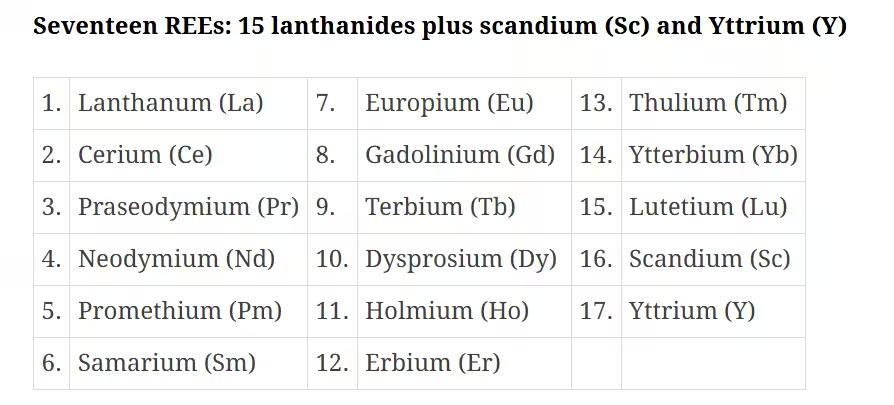
- Rare Earths are a group of 17 elements starting with lanthanum in the periodic table of elements and include scandium and yttrium. They are moderately abundant in earth’s crust but not concentrated enough to make them economically exploitable.
- Why we called ‘rare earth’: Despite the name – rare earth elements – these elements are not so rare. They are found in abundance in the Earth’s crust. However, they’re rarely found in concentrations that are economically viable for mining. Therefore, extracting and processing REEs is complex and expensive, requiring high-end techniques and specialised labour to isolate and purify them.
- REEs are characterised by high density, high melting point, high conductivity and high thermal conductance. A number of rare-earth minerals contain thorium and uranium in variable amounts, but they do not constitute essential components in the composition of the minerals.
The Rare-earth Elements (REE) are a collection of 17 elements, namely, scandium, yttrium and lanthanides (15 elements in the periodic table with atomic numbers 57 to 71, namely,
- lanthanum (La)
- cerium (Ce)
- praseodymium (Pr)
- neodymium (Nd)
- promethium (Pm)
- samarium (Sm)
- europium (Eu)
- gadolinium (Gd)
- terbium (Tb)
- dysprosium (Dy)
- holmium (Ho)
- erbium (Er)
- thulium (Tm)
- ytterbium (Yb)
- lutetium (Lu)
Note: The first commercial use was in an incandescent lamp mantle, which is composed of 99% thorium oxide and 1% cerium oxide.
Application:
The REEs find key applications in defence, electronics, energy systems etc. For instance, magnets made from rare earths are many times more powerful than conventional ones. Along with energy critical elements (ECE), such as, lithium which has become ubiquitous battery material, REEs have emerged as strategic elements essential for sustainable energy systems.
- Missile guidance & satellites
- Defence technologies
- Electronics & semiconductors
- Electric vehicles & batteries
- Wind turbines
- Smartphones
- Renewable energy equipment
- Robotics & automation
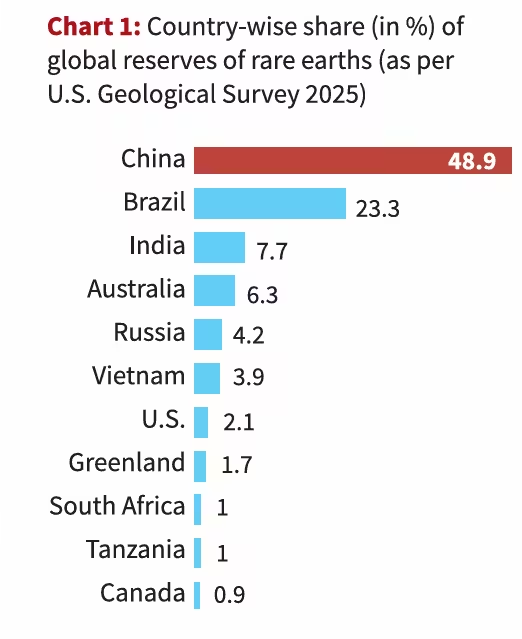
Reserves:
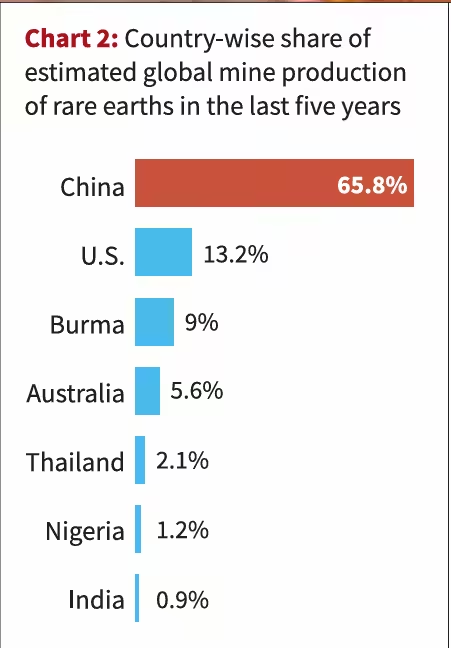
Production:
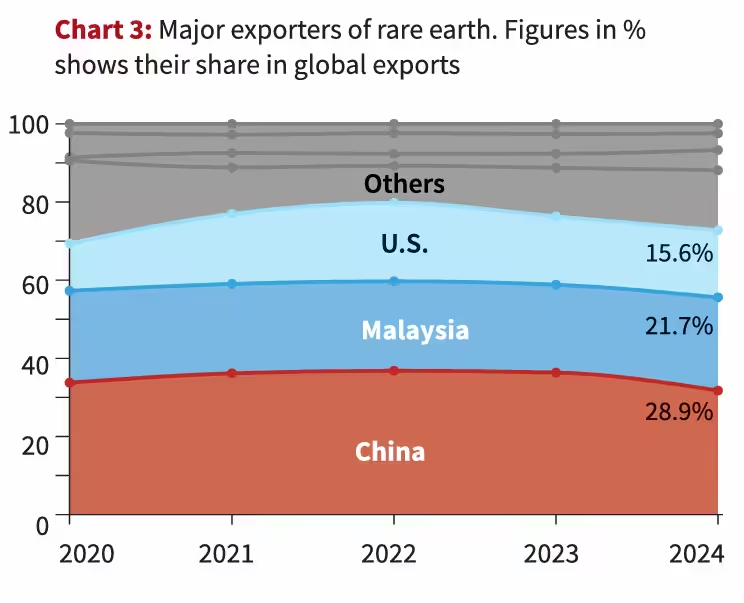
Major Exporter:
China:
China dominated the global production of rare earth minerals, separated compounds, and metals
Major Importer:
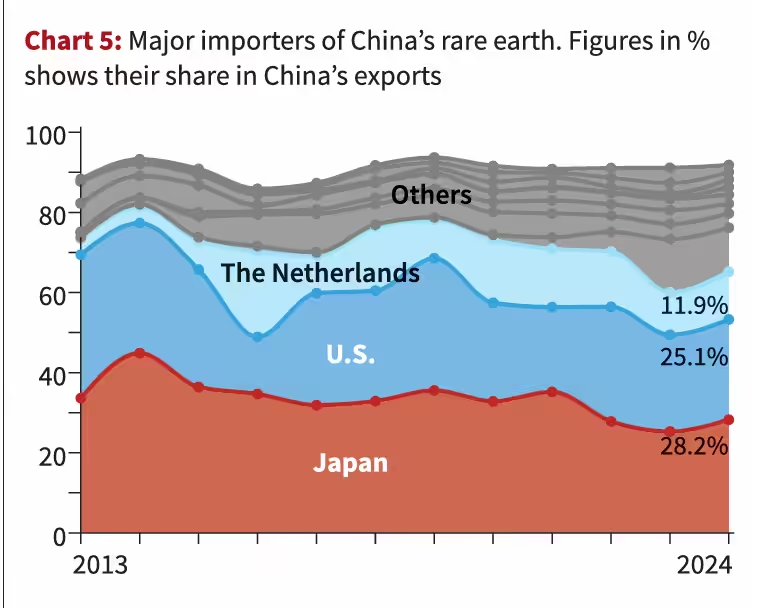
India:
According to Indian Minerals Yearbook
- Indian Rare Earth Limited (IREL), a Mini Ratna Company, is the only entity processing monazite to produce Rare-earth (RE) compounds.
- India’s REE reserves are mostly found in monazite sands (which contain thorium).
- Coastal states have the most rare earth deposits, namely Tamil Nadu, Kerala, Andhra Pradesh, and Odisha.
Despite having large reserves of REEs, India produces less than one per cent of the total world share. There are numerous reasons behind this. The primary being the negligible involvement of the private sector in the mining of REEs. IREL (India) Ltd (the erstwhile Indian Rare Earths Limited or IREL) has been the primary entity involved in the mining and processing of Rare Earth. However, recently, the government has opened up REE exploration for private entities.
India Initiatives:
- Budgetary provision:
- In Budget 2024-25: National Critical Mineral Mission to ensure supply chain.
- The Mines and Minerals (Development and Regulation) Amendment Act, 2023: Now allows private companies to bid for the exploration of critical minerals, including REEs.
- Recently Department of Atomic Energy discovered around in-situ Rare Earth Elements Oxide (REO) in Balotra, Rajasthan.