China’s Open-Weight AI: Kimi K3 Advances Despite Chip Curbs
Why in News?
The Hindu Explained reported on 27 July 2026 that Chinese developer Moonshot AI’s Kimi K3, a model with 2.8 trillion parameters, represents China’s growing ability to build capable AI systems despite restrictions on access to the most advanced chips.
The immediate issue is an open-weight AI strategy: trained parameters are made available so well-resourced users can inspect, adapt or host the model, while abundant electricity, larger clusters of less advanced chips and state-supported research partly cushion the compute constraint.
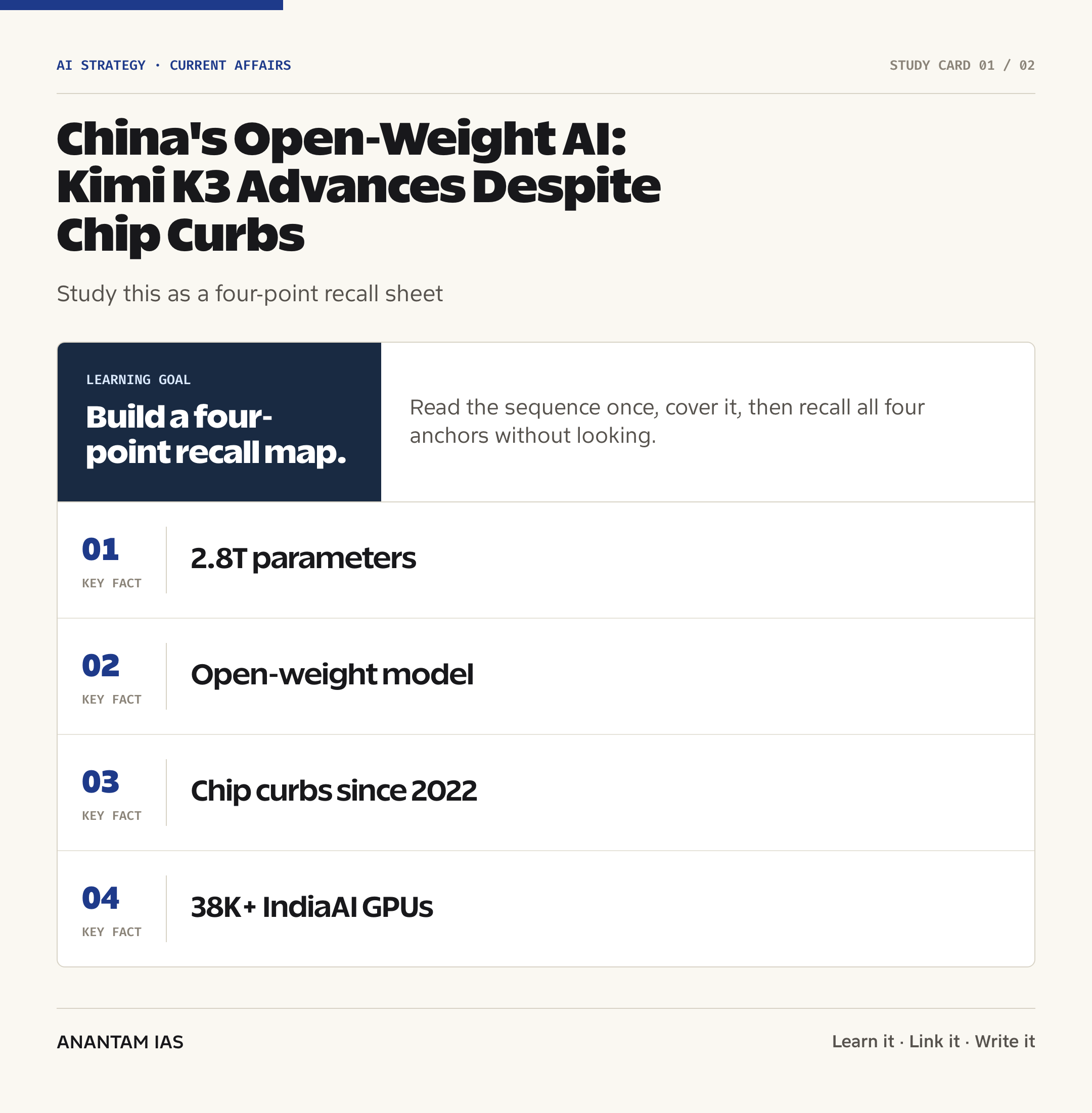
- Kimi K3 has 2.8 trillion parameters, according to The Hindu’s report; parameter count measures model scale, not reliability or social value.
- Chinese firms face restrictions on access to certain advanced graphics processing units and semiconductor-manufacturing equipment.
- The response combines model openness, engineering efficiency, electricity supply, domestic industrial capacity and a wider developer ecosystem.
- This note concerns the technology and industrial strategy; the 18 July note on China’s AI governance pitch examined WAICO and diplomatic rule-setting.
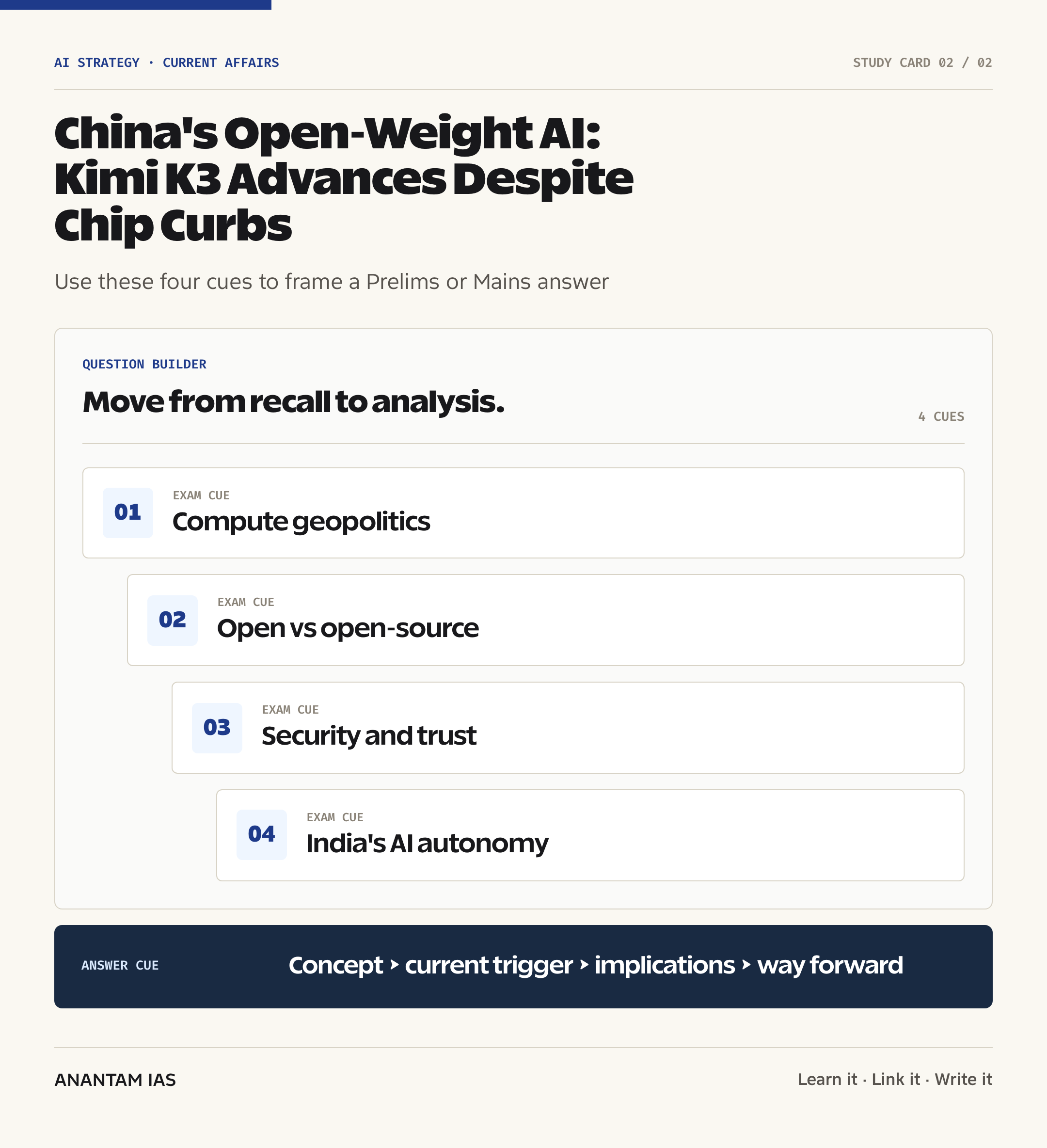
- For India, the question isn’t a binary choice between Chinese and Western models; it is how to secure compute access, local control, safety evaluation and strategic autonomy.
The development matters in the context of:
- The development matters in the context of technology denial regimes: export controls can raise costs and slow access without automatically stopping innovation.
- It also matters for AI sovereignty, because downloadable weights can reduce dependence on a single foreign application programming interface while creating new security and licensing duties.
- The episode links GS Paper 3 themes of emerging technology and indigenisation with GS Paper 2 themes of geopolitics and global rule-making.
UPSC Relevance
Prelims Relevance
- Open-weight model: trained numerical parameters are available for download or deployment; this doesn’t by itself disclose the full source code, training data or training process.
- Open-source software: source code is available under a licence permitting specified study, modification and redistribution; the term shouldn’t be used automatically for every open-weight model.
- Inference: use of a trained model to generate an output from a new input; it is distinct from the compute-intensive training stage.
- Graphics processing unit: a parallel-processing chip widely used for training and serving large AI models.
- Mixture-of-Experts: a model design in which a routing mechanism activates selected expert components for a given input, potentially reducing active computation relative to total parameters.
- Export control: a legal restriction on the transfer of specified goods, software or technology to designated destinations or end uses.
- Entity List: a U.S. export-control list that imposes licence requirements on listed foreign persons and organisations.
- IndiaAI Mission: a Union government programme approved in March 2024 for compute, datasets, foundational models, applications, skills, startup finance and safe AI.
- Strategic autonomy: capacity to make technology choices without excessive dependence on one external power, vendor or infrastructure stack.
Mains Relevance
GS Paper 3
- Role of compute, energy, algorithms, data and talent as complementary inputs in an AI ecosystem.
- Limits of judging AI capability through parameter count or vendor benchmarks alone.
- Need for indigenous foundational models, common compute and semiconductor capability under the IndiaAI Mission.
- Cybersecurity, model evaluation and supply-chain risks arising from third-party open weights.
GS Paper 2
- Use of export controls as an instrument of national security and technology competition.
- Tension between open innovation and strategic restrictions in the emerging global AI order.
- India’s options amid U.S.-China competition: selective engagement, domestic capacity and standards-based procurement.
Essay
- Scarcity can delay innovation, but it can also redirect it towards efficiency.
- Technological openness expands access only when countries possess the capacity to evaluate and deploy what is opened.
- Digital sovereignty is built through capability, not isolation.
Background and Context
What Open Weight Actually Means
Model openness is a spectrum, so exam answers should separate access to weights from access to the whole development process.
- A trained model stores learned relationships in numerical weights; releasing them can let researchers run, fine-tune, evaluate or adapt the model subject to its licence.
- An open-weight release may still withhold training data, data-cleaning methods, safety filters, full training code or compute records.
- The broader label open source is accurate only when the relevant source material and licence satisfy the claimed level of openness.
- Self-hosting can keep prompts and outputs within a chosen infrastructure boundary, but it doesn’t automatically remove model-level vulnerabilities, malicious code, unsafe outputs or hidden dependencies.
- Large open weights can remain inaccessible to small users because deployment needs memory, accelerators, electricity, cooling and technical expertise.
Why Kimi K3 Is Strategically Significant
Kimi K3 is important less as a single benchmark score and more as evidence that China has a broad route to frontier-scale AI.
- The Hindu identifies Kimi K3 as a 2.8-trillion-parameter model from Beijing-based Moonshot AI and places it within a wider group of Chinese open or open-weight systems.
- A large parameter count signals scale, but it doesn’t prove factual accuracy, safety, reasoning quality or cost-effectiveness; those require independent, task-specific evaluation.
- Chinese firms also develop lighter models for local deployment, showing that the ecosystem isn’t based only on building the largest possible model.
- The strategic effect is diffusion: once weights circulate, a foreign government can’t easily treat access as if it were a single centrally hosted service.
Chip Curbs and the Compute Constraint
Advanced AI depends on accelerators and semiconductor equipment, which makes the hardware stack a field of geopolitical competition.
- The U.S. Bureau of Industry and Security introduced controls in October 2022 covering certain advanced-computing chips, supercomputer end uses and semiconductor-manufacturing items for China.
- The controls were updated in October 2023 to adjust chip thresholds, cover more equipment and address circumvention routes.
- Such controls target access to selected high-end items and know-how; they don’t amount to a complete ban on every chip, cloud service or AI activity.
- China can partly compensate through more lower-tier chips, engineering optimisation and abundant electricity, but larger clusters bring communication, cooling, reliability and energy costs.
- Export controls may slow capability growth and raise costs, yet they can also encourage domestic substitution, model efficiency and alternative supply chains.
- An answer should avoid technological determinism: hardware matters, but data quality, algorithms, talent, infrastructure and organisational learning also shape outcomes.
China's Ecosystem Approach
The reported advance reflects an ecosystem built across research labs, large technology firms, infrastructure and policy support.
- The Hindu notes government support for AI laboratories and established firms such as Tencent, Baidu and Alibaba, creating multiple competing model families.
- A diverse model supply allows developers to select between large general systems and lighter task-specific models rather than depend on a single national champion.
- Open distribution encourages external experimentation, translations, fine-tunes and deployment tools, producing network effects beyond the original developer.
- Third-party inference can challenge closed providers, but the economics can change if developers move towards captive commercial models.
- The outcome is resilience through multiplicity, although Chinese firms still face exposure to foreign semiconductor tools, global markets and trust concerns.
Benefits and Risks of Open Weights
Open weights redistribute control from the original vendor to deployers, but they also redistribute responsibility.
- Potential benefits include local deployment, customisation, audit access, competition and reduced vendor lock-in.
- Potential risks include removal of safety safeguards, malicious fine-tuning, opaque training data, licence uncertainty and software-supply-chain compromise.
- Local hosting reduces one pathway for prompt leakage, but data can still escape through logging, plugins, telemetry, compromised dependencies or poor access controls.
- Models can encode political censorship, factual distortions or cultural assumptions; openness makes inspection possible but doesn’t guarantee that an inspection has occurred.
- Public agencies need model cards, provenance records, red-team results, incident reporting and sector-specific human oversight before deployment.
India's Strategic Choice
India can learn from open-model diffusion without exchanging one form of dependence for another.
- The Press Information Bureau reported in March 2026 that the IndiaAI common-compute facility had onboarded more than 38,000 GPUs.
- The IndiaAI Mission, approved with an outlay of ₹10,371.92 crore, includes compute, foundational models, datasets, applications, skills, startup finance and safe-and-trusted AI.
- India should evaluate foreign open weights through reproducible tests for Indian languages, constitutional values, cybersecurity, bias and sectoral accuracy.
- Procurement should require disclosure of licence terms, model provenance, update policies, security controls, energy costs and data-governance responsibilities.
- The wider technology base also matters: the notes on India’s semiconductor and emerging-technology ecosystem show why AI policy can’t be separated from chips, research and innovation institutions.
- Regulatory design should stay technology-neutral and risk-based, consistent with India’s evolving debate on AI autonomy, consent and sandboxes.
How This Differs from the July 18 Development
The two China-AI developments belong to the same competition but answer different syllabus questions.
- The 18 July note examined China’s WAICO proposal, Global South outreach and contest over international AI-governance standards.
- The 27 July development examines Kimi K3, open-weight diffusion, compute economics and adaptation to advanced-chip controls.
- The earlier issue is mainly about institutions, diplomacy and norm-setting; today’s issue is mainly about technology capability, industrial policy and strategic supply chains.
- A Mains answer can connect them: technological capability gives credibility to a governance pitch, while governance partnerships can expand markets and standards for a technology ecosystem.
- They shouldn’t be collapsed into one claim, because a country can promote open models while still seeking influence over deployment standards and international institutions.
Way Forward
Build an Indian Evaluation Layer
- Create independent benchmarks for Indian languages, public-service tasks, safety, cybersecurity and factual reliability.
- Publish reproducible evaluation protocols instead of accepting vendor scores or parameter counts as proof.
Diversify Compute and Models
- Use the IndiaAI common-compute facility to widen access for universities, startups and public-interest projects.
- Maintain a portfolio of domestic, open-weight and commercial models so that critical systems don’t depend on one vendor or country.
Secure Open-Weight Deployment
- Require weight verification, dependency scanning, sandboxing, access control and continuous red-teaming for high-impact deployments.
Link AI Policy with Industrial Policy
- Coordinate AI compute with semiconductor design, data centres, power planning, skills and research funding while preserving the ability to audit and switch systems.
Conclusion
Kimi K3 shows why AI competition can’t be reduced to possession of the newest chip. Hardware constraints remain real, but model openness, engineering choices, power, talent and ecosystem depth can partly change their effect.
For India, the durable lesson is to combine open access with verified trust. Strategic autonomy will come from compute, domestic capability, independent evaluation and secure deployment, not from uncritical adoption or blanket exclusion.
UPSC Practice Questions
Prelims MCQ 1
With reference to open-weight AI models, consider the following statements:
- Availability of model weights necessarily means that the complete training dataset is public.
- Open weights may allow a deployer to host a model on infrastructure of its choice.
- Local hosting by itself eliminates every cybersecurity and data-governance risk.
How many of the above statements are correct?
(a) Only one (b) Only two (c) All three (d) None
Answer: (a) Only one
Explanation:
Only Statement 2 is correct. Open weight doesn’t necessarily disclose training data or the complete development process. Local hosting can reduce dependence on a vendor’s remote service, but vulnerabilities, logging errors, unsafe dependencies and poor access control can still create risks.
Prelims MCQ 2
Which one of the following best describes inference in an AI system?
(a) Fabricating semiconductor wafers (b) Training a model only on labelled data (c) Using a trained model to produce outputs for new inputs (d) Publishing a model’s full training dataset
Answer: (c) Using a trained model to produce outputs for new inputs
Explanation:
Inference is the operational use of a trained model on new inputs. Training creates or adjusts the weights; inference applies those learned weights to generate a prediction or response.
UPSC Mains Questions
- Advanced-chip export controls can raise the cost of AI development without creating an absolute technological blockade. Examine this statement with reference to China’s open-weight model ecosystem and the interaction among compute, energy, algorithms, talent and industrial policy.
- Open-weight AI can support digital sovereignty, but openness isn’t a substitute for trust. Discuss the benefits and security risks of deploying foreign open-weight models in Indian public and private systems.
- Suggest a strategy through which the IndiaAI Mission can combine common compute, indigenous models, independent evaluation and international partnerships while avoiding both vendor lock-in and technological isolation.
Sources: The Hindu Explained and U.S. Bureau of Industry and Security.
Frequently Asked Questions
What is Kimi K3?
Kimi K3 is a large AI model developed by China’s Moonshot AI. The Hindu reported it as a 2.8-trillion-parameter model within China’s expanding open-weight ecosystem. The number describes total scale, not guaranteed quality. Reliability, safety, cost and suitability still need independent testing on specific tasks.
What does open weight mean?
Open weight means the trained numerical parameters of a model are made available under stated licence terms. Users may be able to run, inspect or adapt the model. It doesn’t automatically mean the training data, training code, safety process and every software component are publicly available.
Are open weight and open source identical?
No. Open weight refers specifically to access to trained parameters. Open source normally implies access to source code under a licence allowing defined reuse and modification. A model can publish weights while withholding training data, data preparation methods or parts of its software stack.
How do chip curbs affect China?
U.S. controls restrict access to specified advanced-computing chips, supercomputer end uses and semiconductor-manufacturing items. They can raise costs and slow access to leading hardware. China can partly adapt through more less-advanced chips, engineering efficiency, domestic substitution and electricity supply, but those responses carry performance and energy trade-offs.
Does local hosting prevent data leakage?
Local hosting can keep prompts and outputs within an organisation’s chosen infrastructure, reducing reliance on a remote vendor. It doesn’t remove risks from compromised dependencies, insecure logs, plugins, weak access control, malicious fine-tuning or model vulnerabilities. Security review and continuous monitoring remain necessary.
What should India learn?
India should expand common compute and domestic model capability while testing foreign open weights through transparent benchmarks for Indian languages, cybersecurity, bias and public-service accuracy. Procurement should preserve the ability to audit and switch models. Open access should complement, not replace, indigenous research, trusted infrastructure and accountable regulation.