Why in News?
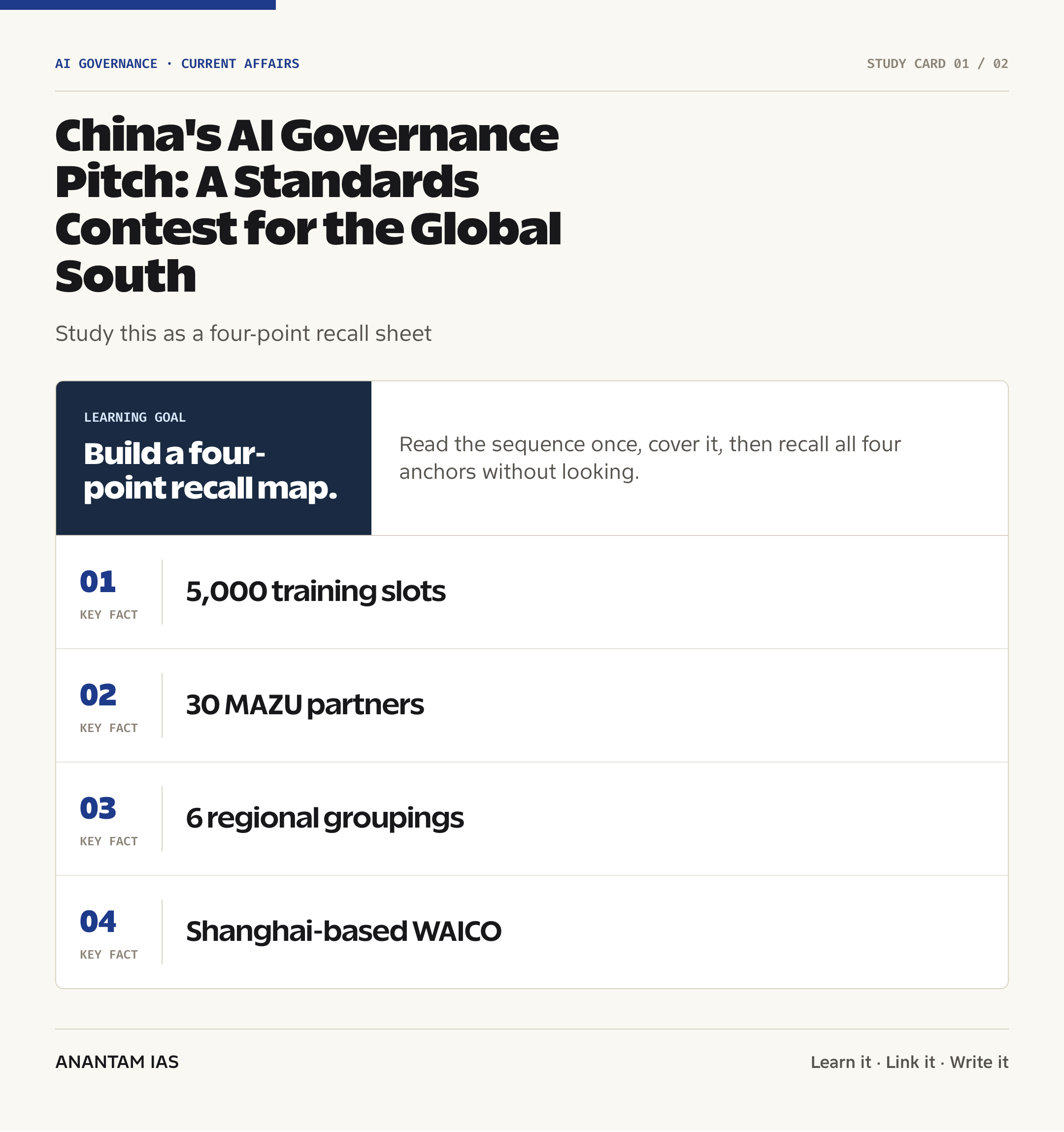
At the 2026 World AI Conference in Shanghai on July 17, Chinese President Xi Jinping announced the formation of the World Artificial Intelligence Cooperation Organization, or WAICO, as a platform aimed mainly at developing countries.
China’s Foreign Ministry said Beijing would offer developing countries 5,000 AI training and seminar opportunities over five years, build application cooperation centres with six regional groupings, and extend its MAZU meteorological warning system to 30 countries.
- WAICO has been established in Shanghai as a new international AI development and governance platform.
- The Hindu reported that China and 29 other countries, mainly from Asia, Africa and Latin America, formed the organisation.
- China proposed cooperation centres with ASEAN, the League of Arab States, the African Union, CELAC, the Shanghai Cooperation Organisation and BRICS.
- The official speech paired open-source AI and wider access with laws, technical monitoring, early warning and human control.
- India attended the Shanghai meeting through a Joint Secretary-level delegation but was not among WAICO’s initial participants, according to The Hindu.
The development matters in the context of:
- The initiative matters in the context of a widening AI divide in access to compute, data, skilled workers, safety tools and standards-setting forums.
- Training and application centres can create useful capacity, but they can also generate long-term technology dependence through models, cloud services, datasets and technical specifications.
- The development turns AI governance into an arena of strategic competition between UN-centred, rights-based, market-led and state-sovereignty-oriented approaches.
- For India, the issue joins BRICS and SCO diplomacy with its own claim to represent an inclusive, safe and development-focused Global South model.
UPSC Relevance
Prelims Relevance
- WAICO stands for World Artificial Intelligence Cooperation Organization and is based in Shanghai.
- ASEAN, the African Union, the League of Arab States, CELAC, SCO and BRICS were named for application cooperation centres.
- CELAC is the Community of Latin American and Caribbean States.
- MAZU is described by China as an AI-powered meteorological warning system.
- The Global Digital Compact was adopted as an annex to the UN Pact for the Future in 2024.
- UN General Assembly Resolution A/RES/78/311 concerns international cooperation on AI capacity-building and was adopted without a vote in 2024.
- The UN Global Dialogue on AI Governance is designed to give all governments and relevant stakeholders a forum for international AI cooperation.
- India’s AI Governance Guidelines use a principle-based, techno-legal and sector-sensitive approach rather than a single omnibus AI law.
Mains Relevance
GS Paper 2
- Changing institutions of global governance, China’s engagement with developing countries, and India’s choices inside BRICS and SCO.
- The tension between strategic autonomy, South-South cooperation and dependence on foreign digital infrastructure.
- The case for an inclusive UN-centred framework with meaningful participation by smaller states, technical experts and civil society.
GS Paper 3
- AI safety, algorithmic accountability, open-source models, data governance and technical standards.
- Public capacity in compute, datasets, multilingual models, testing, auditing and incident reporting.
- The role of interoperable standards in balancing innovation, national security, human rights and digital sovereignty.
Essay
- Technology and power: those who build standards shape markets, institutions and public values.
- Inclusion without dependence: capacity-building becomes durable only when recipients gain agency over skills, data and infrastructure.
- One technology, many societies: global rules must protect common human interests while respecting linguistic and cultural diversity.
Background and Context
What China has proposed
The Shanghai package combines an institution, training, deployment partnerships and a normative governance pitch.
- WAICO is presented as an international platform for AI development and governance, with its institutional base in Shanghai.
- The 5,000 opportunities cover training and seminar programmes for developing countries over the next five years; the announcement doesn’t specify country quotas, selection rules or funding terms.
- Application cooperation centres are intended to connect China with six regional groupings, widening the initiative beyond bilateral technology projects.
- The MAZU offer links governance diplomacy with a practical public-interest use case: AI-assisted early warning for weather hazards.
- The official address calls for alignment on development strategies, governance rules and technical standards, making standard-setting an explicit part of the initiative.
The four principles in China's pitch
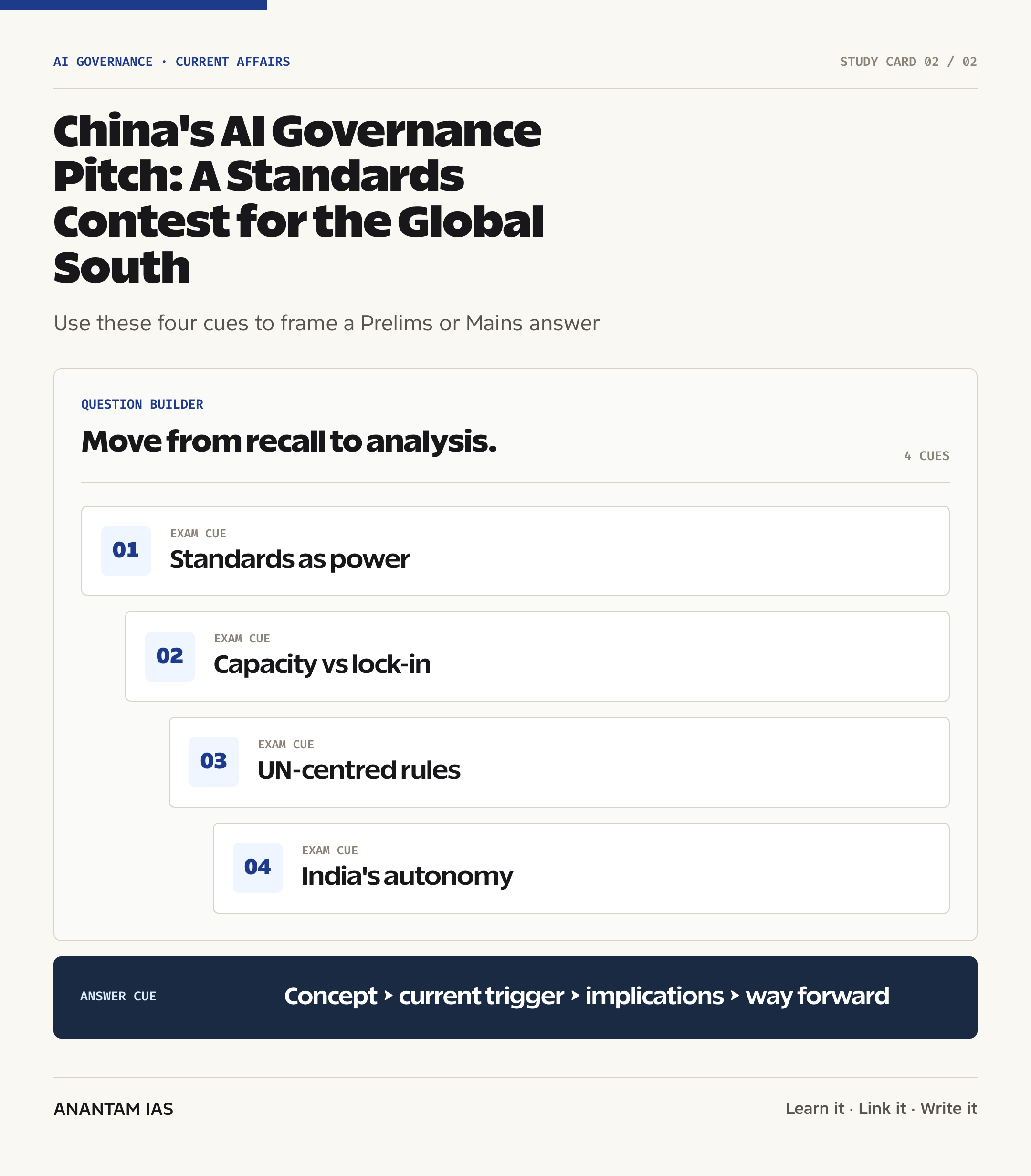
Xi’s address organised the proposed approach around development, control, cultural plurality and international cooperation.
- Openness and win-win cooperation: encourage open source, collaboration, sharing, industrial innovation and application across economic sectors.
- Security and controllability: combine laws, technical monitoring, early warning and emergency response while keeping AI under human control.
- Civilisational diversity: prevent AI systems from eroding the distinct cultures and values of different societies.
- Solidarity and multilateralism: recognise a central UN role and help Global South countries bridge AI and digital divides.
- China also opposes what it calls the overstretching of national security, a position tied to its criticism of technology restrictions and exclusive supply chains.
Why capacity-building is also standards power
Technical assistance is never only about skills; it can influence the systems and rules adopted by recipient states.
- Training officials and engineers shapes their familiarity with particular models, audit methods, cloud stacks and policy vocabulary.
- Application centres may encourage common procurement requirements, data formats and safety tests, creating path dependence even without a binding treaty.
- Open-source availability can reduce entry costs and support local adaptation, but usable AI still requires compute, maintenance, cybersecurity and high-quality data.
- The provider can gain insight into local sectors, languages and demand while building diplomatic influence through digital public goods.
- Recipient countries need transparent terms on data access, model updates, vendor switching, security audits and intellectual property to retain policy autonomy.
The wider global governance landscape
WAICO enters a crowded field where universal institutions and smaller coalitions already produce overlapping principles.
- The UN’s Global Digital Compact calls for inclusive, risk-based AI governance, capacity-building, human oversight and interoperable standards.
- The UN Global Dialogue on AI Governance provides a universal discussion forum, while an independent scientific panel is meant to strengthen evidence-based assessment.
- The UNESCO Recommendation on the Ethics of AI anchors governance in human dignity, rights, fairness, transparency, sustainability and oversight.
- The OECD AI Principles support trustworthy, human-centred AI and international interoperability, while the G7 Hiroshima process focuses strongly on advanced systems.
- The central policy problem is forum fragmentation: different institutions may duplicate work or produce incompatible definitions, tests and reporting duties.
Global South opportunities and risks
Developing countries need both a voice in rule-making and material access to the foundations of AI.
- Capacity programmes can improve public services in health, agriculture, education, disaster warning and language technology when designed around local needs.
- Participation can move states from rule-takers to contributors in standards bodies, model evaluation and cross-border incident coordination.
- But low-cost models may still lock governments into foreign cloud infrastructure, chips, cybersecurity services and update cycles.
- Weak privacy law or procurement capacity can expose citizens to surveillance, discriminatory outputs and opaque automated decisions.
- A credible partnership should measure local ownership through skills retained, datasets governed locally, independent audits enabled and vendors made replaceable.
India's position and policy assets
India has its own governance model and must assess new platforms through strategic autonomy, interoperability and public value.
- The India AI Governance Guidelines favour a balanced, agile and pro-innovation framework grounded in seven guiding principles.
- India’s architecture includes an AI Governance Group, a Technology and Policy Expert Committee, the IndiaAI Safety Institute and sectoral regulators.
- The approach is techno-legal: existing laws, sector rules and technical safeguards are combined instead of regulating every AI system through one method.
- The IndiaAI Impact Summit positioned digital public infrastructure, multilingual systems and safe AI as contributions to the Global South.
- India can work through the UN, GPAI, G20, BRICS and SCO while avoiding automatic alignment with any single country’s institutional project.
How to evaluate competing AI governance models
The label of inclusion matters less than the rules, resources and accountability built into a platform.
- Representation: do smaller states, researchers, businesses, labour groups and civil society influence decisions or merely endorse them?
- Rights and remedies: are privacy, non-discrimination, explanation, human review and grievance mechanisms operational rather than aspirational?
- Technical credibility: are common benchmarks, red-teaming, incident reporting and independent audits available across languages and sectors?
- Development value: does assistance expand local compute, datasets, institutions and research capacity instead of only distributing finished models?
- Interoperability: can national frameworks connect with UN norms and other standards without forcing countries into closed geopolitical blocs?
Way Forward
Keep universal rules at the centre
- Use the United Nations as the legitimising forum for baseline principles, scientific assessment and participation by all states.
- Require regional or plurilateral initiatives to map their standards against the Global Digital Compact and human-rights obligations.
- Avoid duplicate institutions by assigning clear functions to scientific assessment, policy dialogue, technical standards and capacity finance.
Make capacity-building recipient-led
- Let partner countries define priority sectors, local-language needs and public-interest outcomes before technology is selected.
- Publish programme terms, beneficiary selection, costs, data arrangements and evaluation metrics.
- Build local trainers, regulators, auditors and research teams so knowledge remains after a project ends.
Protect strategic and data autonomy
- Use open standards, portable data formats and contractual exit clauses to prevent vendor lock-in.
- Mandate security testing, model documentation, data minimisation and independent algorithmic audits for public deployments.
- Keep sensitive government and citizen data under enforceable jurisdictional, cybersecurity and access-control safeguards.
Build an Indian interoperability offer
- Connect the IndiaAI Safety Institute, sector regulators and standards bodies to partners across the Global South.
- Offer multilingual datasets, evaluation tools and digital public infrastructure with privacy, openness and modular architecture built in.
- Draw on the findings of the UN scientific panel to keep Indian diplomacy evidence-led.
Judge initiatives by measurable outcomes
- Track local jobs, institutions strengthened, languages covered, safety incidents reported and independent audits completed.
- Measure whether recipient states contribute to standards rather than only adopt rules written elsewhere.
- Review environmental costs, including electricity, water and hardware use, alongside claimed development benefits.
Conclusion
China’s WAICO launch turns AI capacity-building into a visible instrument of Global South diplomacy. Its training, open-model and application-centre offers may close real capability gaps, but their long-term value depends on transparency, local ownership and compatibility with universal safeguards.
India needn’t choose between disengagement and institutional alignment. A stronger response is to build an interoperable Indian offer, work through universal forums, and test every partnership against rights, resilience, strategic autonomy and measurable development gains.
UPSC Practice Questions
Prelims MCQ 1
With reference to institutions and initiatives in global AI governance, consider the following statements:
- WAICO is based in Shanghai.
- The Global Digital Compact calls for an Independent International Scientific Panel on AI and a Global Dialogue on AI Governance.
- CELAC is a regional grouping of African states.
How many of the above statements are correct?
(a) Only one (b) Only two (c) All three (d) None
Answer: (b) Only two
Explanation:
Statements 1 and 2 are correct. CELAC is the Community of Latin American and Caribbean States, not an African grouping.
Prelims MCQ 2
Which one of the following best describes a techno-legal approach to AI governance?
(a) Replacing all laws with voluntary technical standards (b) Banning high-compute models across every sector (c) Combining legal duties, institutional oversight and technical safeguards across the AI lifecycle (d) Allowing model developers to regulate themselves without public oversight
Answer: (c) Combining legal duties, institutional oversight and technical safeguards across the AI lifecycle
Explanation:
A techno-legal approach connects law and regulation with tools such as audits, testing, documentation and monitoring; it doesn’t treat either law or technology as sufficient alone.
UPSC Mains Questions
- China’s new AI cooperation architecture shows that capacity-building and technical standards are emerging as instruments of geopolitical influence. Analyse the opportunities and strategic risks this creates for Global South countries, with special reference to institutional autonomy and development needs.
- India should respond to competing global AI governance models by building interoperable public goods rather than joining rigid technology blocs. Discuss with reference to India’s AI Governance Guidelines, multilateral forums and the requirements of safe, inclusive AI.
Sources: Ministry of Foreign Affairs of the People's Republic of China and The Hindu.
Frequently Asked Questions
What is WAICO?
The World Artificial Intelligence Cooperation Organization, or WAICO, is a Shanghai-based platform announced for international cooperation on AI development and governance. China presents it as a response to Global South demands for capacity, applications and a voice in rule-making. Its practical significance will depend on membership rules, decision-making, transparency and links with existing UN processes.
What did China offer developing countries?
China announced 5,000 AI training and seminar opportunities over five years, application cooperation centres with six regional groupings, and access for 30 countries to the MAZU AI-powered meteorological warning system. The offer combines skills, institutional links and practical deployment, but detailed financing, selection, data and accountability terms remain important.
Why are AI standards geopolitically important?
Standards define accepted terminology, testing, safety thresholds, documentation and interoperability. Countries or firms that shape them can influence market access, procurement and regulation. When training and infrastructure accompany standards, recipients may gain useful capacity but also develop dependence on a provider’s models, cloud stack, evaluation tools and policy assumptions.
How does the UN govern AI?
The Global Digital Compact supplies a universal political framework focused on inclusion, human rights, capacity-building and interoperable governance. It supports an Independent International Scientific Panel on AI and a Global Dialogue on AI Governance. UNESCO’s ethics recommendation and UN resolutions on safe AI and capacity-building add normative and development-focused layers.
What is India’s AI governance approach?
India favours a principle-based, agile and techno-legal approach. It combines existing laws, sector regulators, technical safety tools and institutions such as the AI Governance Group, Technology and Policy Expert Committee and IndiaAI Safety Institute. The aim is to protect people and build trust without blocking beneficial innovation or context-specific regulation.
Should India join China-led AI platforms?
India should assess each platform by its governance, transparency, rights safeguards, data rules, interoperability and development value rather than by geopolitical labels alone. Selective cooperation can be useful, but India should preserve strategic autonomy, strengthen UN-centred processes and expand its own multilingual, safe and modular AI public-goods offer.
Tell Google you want more of this.
Add Anantam IAS as a preferred sourceOne tap, and this site shows up more often in your own Top Stories, AI Overviews and AI Mode. Remove it any time.