Coal Exchanges: Why India Is Moving to Market-Based Coal Trading
Why in News?
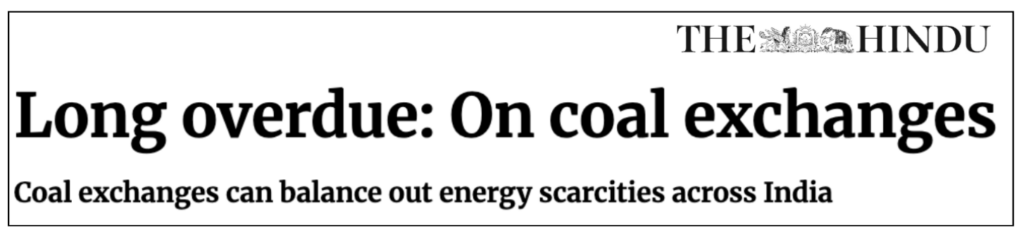
The Ministry of Coal has notified the Coal Exchange Rules, 2026, creating the legal scaffolding for organised coal exchanges where producers and buyers can trade on a common electronic platform. A Hindu editorial titled the move long overdue, arguing that transparent market-based price discovery for India’s most-used fuel is decades behind the rest of the energy economy.
The rules flow from the Mines and Minerals (Development and Regulation) Amendment Act, 2025, which inserted the concept of a Mineral Exchange and empowered the Centre to promote competitive trading of minerals, including coal and its processed forms. They mark the most structural shift in coal marketing since the 2020 commercial-mining auctions ended the old state monopoly on commercial sales.
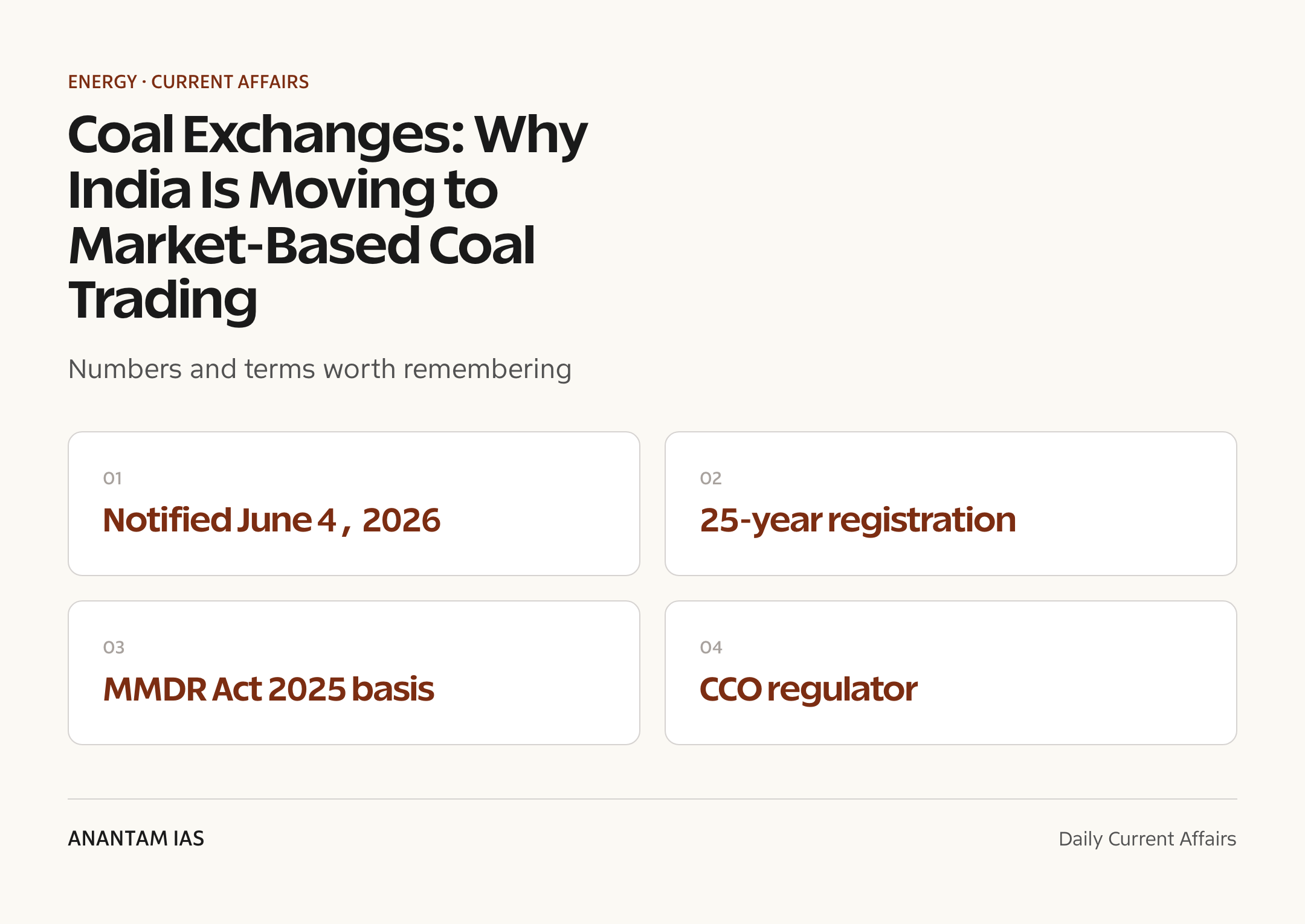
- Coal Exchange Rules, 2026 notified and gazetted on June 4, 2026 by the Ministry of Coal.
- Legal basis is the MMDR Amendment Act, 2025, which created the Mineral Exchange concept.
- The Coal Controller Organisation (CCO) was designated in December 2025 as the authority to register and regulate exchanges.
- Exchange registrations are granted for a 25-year term.
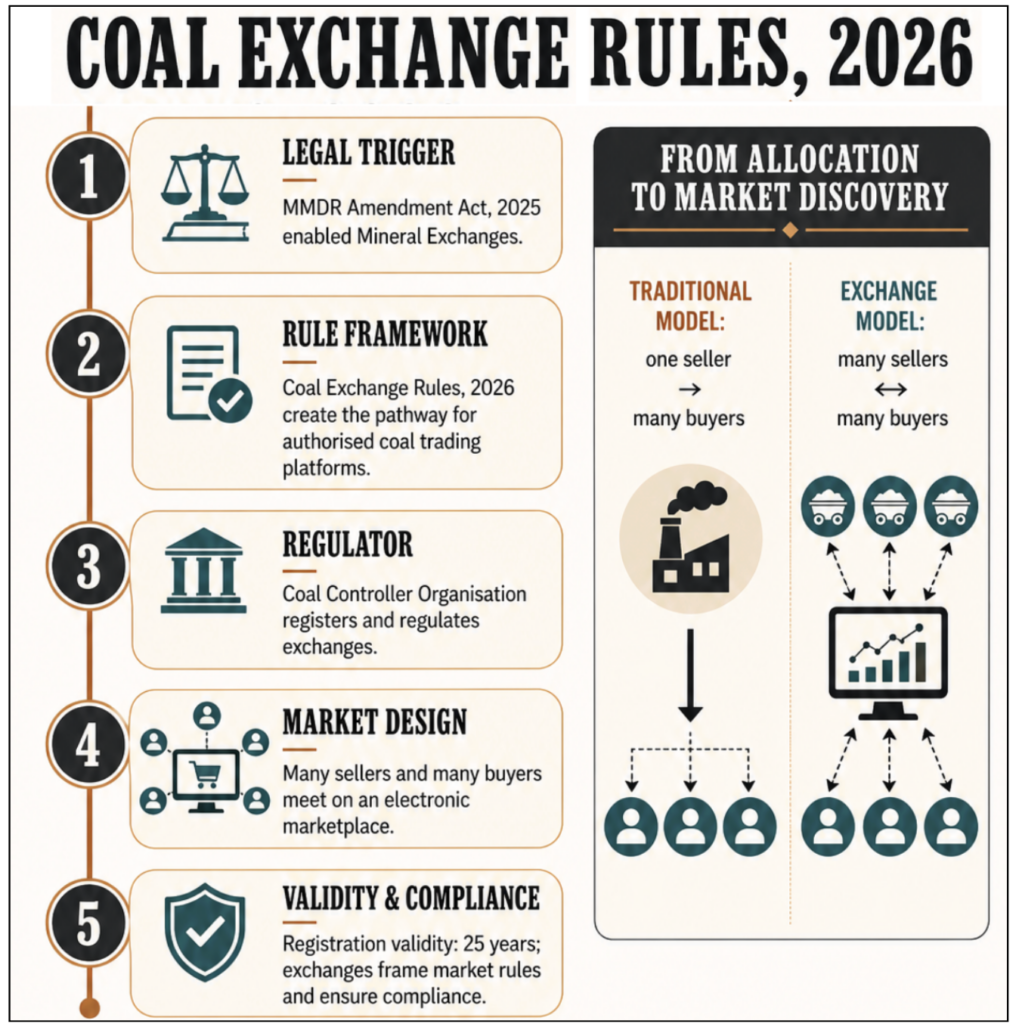
- Design shifts coal from a one-to-many seller model to a many-to-many competitive marketplace.
- Commercial and captive miners gain direct access to a wider pool of buyers.
The development matters in the context of:
- Coal still supplies roughly three-quarters of India’s electricity generation, so its pricing shapes power tariffs across the grid.
- Price discovery has long been administered or auction-driven rather than continuous and market-cleared.
- An exchange parallels the maturing of power exchanges and the gas exchange, completing the energy-trading architecture.
UPSC Relevance
Prelims Relevance
- Coal Exchange Rules, 2026 — notified by the Ministry of Coal, June 2026.
- MMDR Amendment Act, 2025 — introduced the Mineral Exchange concept.
- Coal Controller Organisation (CCO) — registering and regulating authority for exchanges.
- Coal India Limited (CIL) — Maharatna PSU, dominant domestic producer.
- Commercial coal mining auctions began in 2020 under the MMDR and CMSP Acts.
- SHAKTI scheme (2017) — transparent allocation of coal linkages to power plants.
- Power exchanges such as the Indian Energy Exchange (IEX) trade electricity contracts.
- Indian Gas Exchange (IGX) — the country’s gas-trading platform.
- Coal sector nationalised in the 1970s; CIL set up in 1975.
- Exchange registration term is fixed at 25 years.
Mains Relevance
GS Paper 3
- Infrastructure and energy: how market-based price discovery improves efficiency in the coal supply chain.
- Liberalisation of a state-dominated sector — from monopoly to commercial mining to organised exchange trading.
- Energy-transition tension: deepening coal markets even as India targets net-zero by 2070.
GS Paper 2
- Role of regulatory bodies (CCO) and the Centre-State sharing of coal royalties and revenues in a federal economy.
Essay
- Markets versus the state: who should price a strategic public resource?
- Reform by design — building institutions before crises force them.
Background and Context
From Nationalisation to a State Monopoly
India’s coal economy began as a tightly controlled public enterprise, and that legacy still frames every reform.
- Coal mines were nationalised across 1971–73; Coal India Limited (CIL) was incorporated in 1975 as the holding company.
- For decades, CIL set notified prices administratively, with supply rationed through Fuel Supply Agreements (FSAs).
- Private mining was permitted only for captive use — a plant could mine coal for its own boilers, not to sell.
- The result was a one-to-many market: a dominant seller, administered prices, and little continuous price signal — the backdrop to India’s wider coal sector reforms.
The 2020 commercial mining break:
The first big structural opening came when the captive-only rule was scrapped.
- In 2020, the government auctioned coal blocks for commercial mining, ending CIL’s monopoly on commercial sales.
- Backed by the MMDR Act and the Coal Mines (Special Provisions) Act, bidders bid a revenue share to the State.
- Captive miners were later allowed to sell surplus output in the open market, blurring the captive-commercial line.
- These reforms widened the seller base but still lacked a neutral, transparent trading venue.
How is coal allocated today?
Multiple parallel channels move coal from the pithead to the plant, each with its own pricing logic.
- Linkages: long-term supply commitments, with power-sector linkages auctioned transparently under the SHAKTI scheme of 2017.
- E-auctions: CIL sells a slice of output through spot and forward e-auctions, often at a premium over notified prices.
- Captive and commercial blocks: producers consume or sell their own mined coal.
- Imports: coastal and blending demand is met by seaborne coal priced off global indices.
What does a coal exchange change?
The exchange model layers a continuous, neutral marketplace on top of these channels.
- It converts a one-to-many model into a many-to-many platform where many sellers meet many buyers.
- Standardised contracts and electronic matching enable transparent, market-driven price discovery in near real time.
- The Coal Controller Organisation (CCO) registers and regulates exchanges, with registrations valid for 25 years.
- Smaller buyers and merchant power plants get access without locking into long-term linkages.
The energy-market parallel:
Coal is the last big energy commodity to get its own exchange, and the templates already exist.
- Power exchanges such as the Indian Energy Exchange (IEX) already clear day-ahead and term electricity contracts.
- The Indian Gas Exchange (IGX) brought spot gas trading and price discovery to natural gas.
- A coal exchange completes the trio, letting fuel and power markets send consistent signals.
- Transparent coal prices feed directly into power tariffs, since coal-fired plants generate the bulk of the grid.
The energy-transition tension
Deepening coal markets sit awkwardly beside India’s decarbonisation pledges, and the editorial flags this.
- India has pledged net-zero by 2070 and a steep rise in non-fossil capacity, yet coal still anchors baseload power.
- Efficient coal pricing can lower power costs in the near term but risks entrenching fossil dependence.
- Carbon costs and a just transition for coal-belt workers are not priced into an exchange by design.
- A liquid coal market could, paradoxically, make it easier to retire inefficient plants by exposing true fuel costs.
Risks and open questions
An exchange is a tool, not a cure — its credibility depends on liquidity, oversight and fair access.
- Thin volumes could let a few large sellers dominate, defeating the price-discovery goal.
- Logistics — railway rakes and evacuation infrastructure — must keep pace, or contracts cannot be honoured.
- Quality grading and dispute settlement need robust, independent standards.
- Centre-State coordination matters, since coal royalties are a major revenue source for mining States.
Way Forward
Build liquidity early
- Mandate that a meaningful share of CIL and commercial output routes through the exchange to seed volumes.
- Onboard merchant power plants, cement and steel buyers to broaden participation.
Strengthen the plumbing
- Align rake availability and logistics so traded contracts are physically deliverable.
- Set transparent quality grading, settlement and grievance mechanisms under the CCO.
Keep the transition in view
- Use the price transparency to identify and phase out the least-efficient plants.
- Pair market reform with a just-transition plan for coal-dependent districts and workers.
Conclusion
A coal exchange finally gives India’s most-used fuel the kind of transparent, continuous pricing that electricity and gas already enjoy. It completes a reform arc that runs from nationalisation, through commercial mining, to an open marketplace.
The payoff — lower transaction costs, fairer access and clearer signals — depends on liquidity, logistics and credible regulation. Done well, it could even sharpen India’s energy transition by exposing the true cost of coal-fired power.
UPSC Practice Questions
Prelims MCQ 1
With reference to the Coal Exchange Rules, 2026, consider the following statements:
- They derive their legal authority from the MMDR Amendment Act, 2025.
- The Coal Controller Organisation is designated to register and regulate coal exchanges.
- A coal exchange registration, once granted, is valid for a 25-year period.
How many of the above statements are correct?
(a) Only one (b) Only two (c) All three (d) None
Answer: (c) All three
Explanation:
The 2026 Rules flow from the MMDR Amendment Act, 2025 (which created the Mineral Exchange concept); the CCO is the registering and regulating authority; and registrations are granted for 25 years.
Prelims MCQ 2
Which of the following is correctly matched as an energy-trading platform in India?
(a) IEX — natural gas spot trading (b) IGX — electricity day-ahead market (c) Coal Controller Organisation — regulator for coal exchanges (d) SHAKTI — a commodity exchange for imported coal
Answer: (c) Coal Controller Organisation — regulator for coal exchanges
Explanation:
The CCO regulates coal exchanges. IEX trades electricity (not gas), IGX trades gas (not electricity), and SHAKTI is a coal-linkage allocation scheme, not an exchange.
UPSC Mains Questions
- India’s coal sector has moved from a nationalised monopoly to commercial mining and now to organised exchanges. Trace this reform arc and assess how market-based price discovery can improve efficiency in the coal supply chain. (250 words)
- A coal exchange deepens fossil-fuel markets even as India pledges net-zero by 2070. Examine whether transparent coal pricing helps or hinders the energy transition. (250 words)
- Discuss the institutional and logistical prerequisites — liquidity, regulation, evacuation infrastructure and Centre-State coordination — that will determine whether India’s coal exchanges succeed. (150 words)
Sources: Ministry of Coal and The Hindu (editorial).
Frequently Asked Questions
What is a coal exchange?
A coal exchange is an electronic marketplace where many sellers and many buyers trade coal under standardised contracts, allowing transparent, market-driven price discovery. India notified the Coal Exchange Rules, 2026, in June 2026 to set up such platforms, regulated by the Coal Controller Organisation, moving beyond the older system of administered prices, linkages and one-off e-auctions.
How is this different from the SHAKTI scheme?
SHAKTI, launched in 2017, is a policy for transparently allocating long-term coal linkages to power plants. A coal exchange is a continuous trading venue for spot and term coal contracts. SHAKTI assigns supply commitments; the exchange lets buyers and sellers transact freely and discover prices in near real time, complementing rather than replacing linkages.
Does the exchange end Coal India’s role?
No. Coal India Limited remains the dominant domestic producer. The exchange simply gives CIL, commercial miners and captive producers a neutral platform to sell, and gives buyers wider access. CIL’s notified prices, linkages and e-auctions continue, but the exchange adds a transparent market layer on top of them.
Why does coal pricing matter for power tariffs?
Coal-fired plants generate the bulk of India’s electricity, so the price of coal is a major component of the cost of power. More transparent and competitive coal pricing can lower input costs for generators, sharpen the signal of which plants are efficient, and ultimately influence the tariffs that distribution companies and consumers pay.
How does this relate to power and gas exchanges?
It completes India’s energy-trading architecture. Power exchanges such as the Indian Energy Exchange already clear electricity contracts, and the Indian Gas Exchange trades natural gas. A coal exchange brings the same transparency to the fuel that underpins much of the grid, so fuel and power markets can send consistent price signals.
What are the main risks?
Thin trading volumes could let a few large sellers dominate prices, defeating the purpose. Physical delivery depends on railway rakes and evacuation infrastructure keeping pace. Quality grading and dispute settlement need credible standards, and because coal royalties fund mining States, Centre-State coordination is essential for the system to work fairly.