India committed to net zero emissions by 2070 at COP26 Glasgow (November 2021) — part of Prime Minister Modi's Panchamrit pledge. Net zero is now the centre of global climate policy, with over 140 countries (accounting for ~90% of global GDP) having pledged variants of the goal. For UPSC, understanding the physics, the policy pathways, and the Indian challenge is essential for GS-III climate questions.
What is net zero?
Per the IPCC:
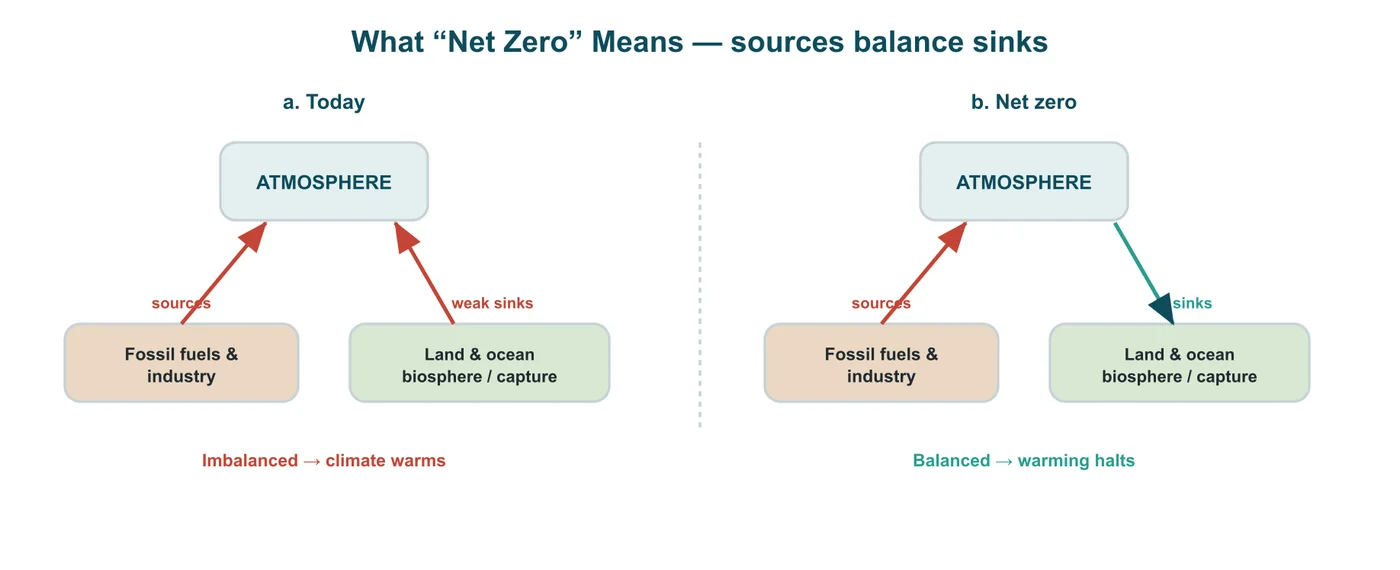
Net zero emissions are achieved when anthropogenic emissions of greenhouse gases to the atmosphere are balanced by anthropogenic removals over a specified period.
Two steps:
- Reduce human-caused GHG emissions as close to zero as possible — by decarbonising electricity, transport, industry, buildings, agriculture.
- Balance residual emissions through carbon removal — nature-based (forests, soil, blue carbon) and technological (DAC, BECCS, mineralisation).
Net zero is often used interchangeably with "climate neutrality", though strictly the latter is broader (includes radiative forcing beyond GHGs).
India's Panchamrit pledge — the five amrits
Announced by PM Modi at COP26 Glasgow (1 November 2021):
- 500 GW non-fossil installed capacity by 2030.
- 50% of energy requirements from renewables by 2030.
- Reduce projected carbon emissions by 1 billion tonnes by 2030.
- Reduce carbon intensity of the economy by 45% by 2030 (below 2005 levels).
- Net zero by 2070.
The 2022 updated NDC formally reflected points 2 and 4.
Why India chose 2070, not 2050
Common but differentiated responsibilities (CBDR)
- India is the third-largest emitter by volume but among the lowest per-capita emitters (~1.9 tCO2e/person vs US 14.9, China 8.5).
- Historical responsibility: cumulative CO2 since 1850 is dominated by developed countries.
- Development needs: India must meet aspirations of 1.4 billion people before transitioning.
- Equity principle justifies a longer timeline.
Structural challenges
- Current energy mix is carbon-intensive — coal, oil, and solid biomass (fuelwood, dung) supply ~80% of energy.
- Coal power expected to continue growing even as share declines — existing plants run below capacity.
- Energy demand doubling since 2000; forecast to accelerate with urbanisation and ACs.
- EV adoption slow — cost, charging infrastructure, grid reliability.
- Heavy industry — steel, cement, chemicals — emissions set to rise.
Policy pathways to net zero
1. Power sector decarbonisation
- Solar: ~95 GW installed (2024); 280+ GW target by 2030.
- Wind: ~56 GW; 140+ GW target.
- Nuclear: ~8 GW currently; expansion via Bharat Small Modular Reactors.
- Hydro: 47 GW; pumped storage expansion.
- Green Hydrogen Mission 2023 — 5 MMT annual production by 2030.
2. Transport
- FAME / PM E-drive schemes for EVs.
- Ethanol blending — E20 by 2025-26.
- Mass transit — metros in 21+ cities; BRT.
- Rail electrification — Indian Railways target 100% electric by 2030.
3. Industry
- PAT scheme (NMEEE) — energy efficiency trading.
- Carbon markets (CCTS) — Indian Carbon Credit Trading Scheme notified 2023.
- Green Steel — India's Green Steel Policy under MoS, 2024.
- Cement — alternative fuels, clinker substitution.
4. Agriculture and land use
- National Mission on Sustainable Agriculture.
- Natural farming — PM Pranam, Paramparagat Krishi Vikas Yojana.
- Green India Mission — forest cover expansion.
- Soil Health Card Scheme.
5. Buildings and cooling
- Energy Conservation Building Code 2017.
- India Cooling Action Plan 2019 — reduce cooling demand 20-25% by 2038.
- Super-efficient appliances via BEE.
6. Carbon Capture, Utilisation, Storage (CCUS)
- NTPC's Vindhyachal CCUS pilot.
- Deep saline aquifer storage studies.
- Direct Air Capture (DAC) — early-stage exploration.
7. Lifestyle and behaviour
- LiFE — Lifestyle for Environment — launched at COP26; UNEA 2024 adoption.
- Demand-side reductions complement supply-side transition.
Just transition
India's coal economy supports ~4 million direct workers and millions more indirectly, particularly in Jharkhand, Chhattisgarh, Odisha, Madhya Pradesh, Telangana. Just transition demands:
- Re-skilling programmes.
- Alternative livelihoods in renewables, forestry.
- Social protection for coal miners.
- Regional economic diversification.
India joined the G20 Just Energy Transition Partnership (JETP) framework but has not signed a JETP of its own (unlike South Africa, Indonesia, Vietnam, Senegal).
Global progress
Status of net-zero pledges
- EU — 2050 (legally binding).
- US — 2050 (rejoined Paris; IRA 2022).
- China — 2060 (before 2030 peak).
- Germany, UK, Japan, Canada, Korea, Brazil — 2050.
- India — 2070.
- Russia, Saudi Arabia — 2060.
UN Race to Zero
Campaign launched for regions, cities, businesses, investors to commit to net zero. Indian cities like Mumbai, Chennai, Coimbatore have joined with city-level climate action plans.
Challenges
- Pledges not matched by policies — UNEP Emissions Gap Report 2024 shows world heading to ~2.6°C on current policies.
- Short-term targets (2030) too weak to keep 1.5°C alive.
- Climate finance gap — USD 300 bn/year NCQG agreed at COP29 is below USD 1.3 trillion developing-country need.
Latest developments (2024-26)
Updated context: verify specific figures with MoEFCC, UNFCCC, and UNEP annual releases.
- COP29 Baku (2024) — NCQG of USD 300 billion/year by 2035; India critical of inadequacy.
- COP30 Belém (2025) — focus on Global Stocktake follow-up and forest finance; Net Zero language reinforced.
- Indian Carbon Credit Trading Scheme (CCTS) — compliance market operational 2025.
- Green Hydrogen Mission — first plants commissioned.
- Bharat Small Modular Reactor (BSMR) programme — advanced.
- Third NDC — expected ahead of/at COP30 with 2035 targets.
- UNEP Emissions Gap Report 2024 — reiterates urgency.
UPSC relevance
GS-III mapping
- Conservation, environmental pollution.
- Climate change.
Prelims bullets
- India's Net Zero year: 2070.
- Net Zero announcement: COP26 Glasgow, 1 November 2021.
- Panchamrit — 5 pledges; key ones: 500 GW non-fossil, 50% RE energy, 1 Gt emissions cut, 45% carbon intensity reduction.
- CCUS — Carbon Capture, Utilisation, Storage.
- BECCS — Bioenergy with Carbon Capture and Storage.
- DAC — Direct Air Capture.
- LiFE — Lifestyle for Environment.
- JETP — Just Energy Transition Partnership.
Mains angles
- "Net zero by 2070 is ambitious yet equitable for India. Critically examine."
- "Discuss the pathways and challenges to India's net-zero commitments."
- "Evaluate the role of carbon capture and LiFE lifestyle approach in meeting India's climate goals."
Essay hooks
- Equity in the climate race — per-capita vs total emissions.
- Just transition and India's coal districts.
- Net zero is a development opportunity — jobs, technology leadership, health benefits.
Quick revision
| Commitment | Target | Deadline |
|---|---|---|
| Non-fossil installed capacity | 500 GW | 2030 |
| Renewable share of energy | 50% | 2030 |
| Emissions reduction | 1 Gt | 2030 |
| Carbon intensity reduction | 45% | 2030 |
| Net zero | All GHGs balanced | 2070 |
Bottom line for UPSC: India's net-zero pledge is simultaneously one of the world's most ambitious (in per-capita equity terms) and most debated (because of the 2070 horizon). It rests on five levers: renewables scale-up, energy efficiency, green hydrogen, carbon removal, and LiFE. The global conversation is moving from pledges to implementation — and India's credibility increasingly depends on its 2030 milestones.
Tell Google you want more of this.
Add Anantam IAS as a preferred sourceOne tap, and this site shows up more often in your own Top Stories, AI Overviews and AI Mode. Remove it any time.