Critical Minerals
Context: Amitabh Kant, former CEO NITI Aayog has underscored the need to ensure timely execution, sustained institutional support and a clear commitment to self-reliance and sustainability to overcome the critical mineral challenge.

UPSC Relevance
Q1. Consider the following minerals: (2020)
- Bentonite
- Chromite
- Kyanite
- Sillimanite
In India, which of the above is/are officially designated as major minerals?
(A) 1 and 2 only
(B) 4 only
(C) 1 and 3 only
(D) 2, 3 and 4 only
Q2.Recently, there has been a concern over the short supply of a group of elements called ‘rare earth metals’. Why? (2012)
- China, which is the largest producer of these elements, has imposed some restrictions on their export.
- Other than China, Australia, Canada and Chile, these elements are not found in any country.
- Rare earth metals are essential for the manufacture of various kinds of electronic items and there is a growing demand for these elements.
Which of the statements given above is/are correct?
(A) 1 only
(B) 2 and 3 only
(C) 1 and 3 only
(D) 1, 2 and 3
What are Critical Minerals?
Critical minerals are those minerals that are essential for economic development and national security. The critical minerals for a country may vary based on its availability and concentration in the country. The government has released a list of 30 critical minerals for India.
These minerals are Antimony, Beryllium, Bismuth, Cobalt, Copper, Gallium, Germanium, Graphite, Hafnium, Indium, Lithium, Molybdenum, Niobium, Nickel, PGE, Phosphorous, Potash, REE,Rhenium, Silicon, Strontium, Tantalum, Tellurium, Tin, Titanium, Tungsten, Vanadium, Zirconium, Selenium and Cadmium.
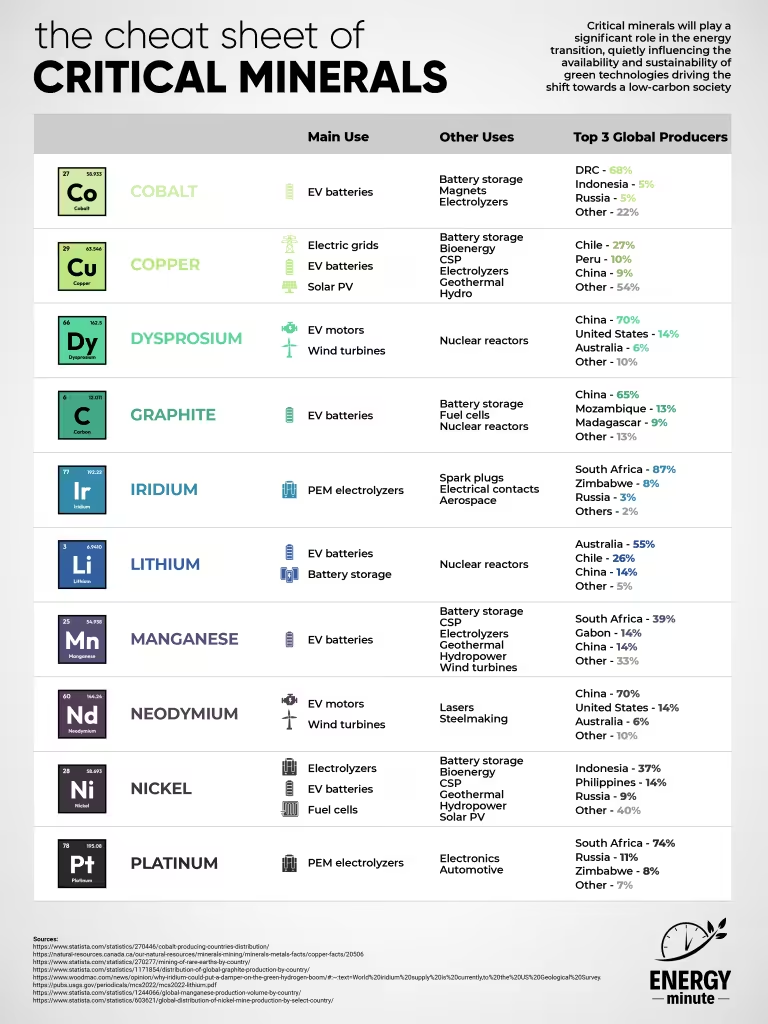
Some major critical minerals and their largest producer countries:-
- Cobalt – Democratic Republic of Congo
- Lithium – Australia
- Nickel – Indonesia
- Silicon – China
- Graphite – China
- Rare Earth Elements (as a whole) – China
Rare Earth Elements
The term “rare earth elements” is a bit misleading. While they are not always rare in terms of their abundance in the Earth’s crust, they are often found dispersed in low concentrations, making them difficult and costly to extract and refine.
The 17 REEs include:
Lanthanides: Lanthanum (La), Cerium (Ce), Praseodymium (Pr), Neodymium (Nd), Promethium (Pm), Samarium (Sm), Europium (Eu), Gadolinium (Gd), Terbium (Tb), Dysprosium (Dy), Holmium (Ho), Erbium (Er), Thulium (Tm), Ytterbium (Yb), and Lutetium (Lu).
Scandium (Sc) and Yttrium (Y): These are included because they share similar properties with the lanthanides and are often found together with them.
- India has 5th largest reserves of Rare Earth Elements according to the Government of India but doesn’t possess the capacity to extract and process the same.
Significance of Critical Minerals for India in :-
- Advanced manufacturing – Critical minerals are fundamental to advanced industries like electronics, telecommunications, and defense.
- Green Technologies and Sustainability – Transitioning to clean energy systems like e-transportation, solar panels etc.and meeting the goal of Net Zero by 2070.
- Strategic technologies – like semiconductors, advanced materials, and energy storage as India aspires to become a semiconductor hub.
- National Security – These minerals are indispensable for India’s defense, aerospace, and nuclear applications, requiring high-quality and reliable materials for sensitive equipment and infrastructure.
- Supply Chain Resilience: To mitigate risks associated with global monopolies and supply disruptions to ensure Atmanirbharta.
Their availability and accessibility will determine the pace and quality of growth for all major economies, especially India which is aiming for a Viksit Bharat by 2047.
Challenges
- High geographical concentration in some regions like Latin America and Africa.
- With limited transparency and complex value chains, China dominates the mid-stream processing stage for most key minerals, accounting for over 90 per cent of rare earth refining, 70 per cent of cobalt processing and close to 60 per cent of lithium conversion capacity.
- Recent export restrictions on rare earth elements by China have also exposed the vulnerability of India’s automotive sector, with some firms already indicating potential production cuts.
- Currently, India is 100 percent import dependent for lithium, cobalt, nickel, rare earth elements and silicon. At the same time, India’s domestic resource base for critical minerals is underdeveloped.
- Limited domestic processing capacity to refine and process minerals into battery grade or component ready materials.
- A shortage of technically qualified bidders for auctioning critical mineral blocks due to poor industry confidence in the viability of critical mineral development.
Recent Initiatives by Government:
- In 2022, the Ministry of Mines identified 30 critical minerals based on their strategic importance to clean energy and future technologies, high import dependence, domestic resource constraints and relevance for agricultural and industrial needs.
- In January 2025, the National Critical Mineral Mission (NCMM) was announced to secure critical mineral supply chains by ensuring mineral availability.
- The Geological Survey of India has ramped up exploration, with 195 projects underway over the past year and another 227 approved for the up-coming year.
- In response to the inclusion of critical minerals in the Mines and Minerals Development and Regulation) Act, the government launched four tranches of auctions for critical mineral blocks last year, and a fifth was concluded in January 2025.
- India has taken steps by joining the Mineral Security Partnership and initiating collaborations with Australia, Argentina and others. These partnerships signal a deeper alignment with global efforts to di-versify supply chains away from China.
- Khanij Bidesh India Ltd. (KABIL) was established in 2019 to ensure a consistent supply of critical and strategic minerals to the Indian domestic market and help in realizing the overall objective of import substitution.
Way Ahead :
- The NCMM plans to set up dedicated mineral processing zones with modern infrastructure.
- Production incentives modelled on PLI schemes could be used to catalyse private investment into refining, separation and chemical conversion facilities.
- International engagement and friendshoring will be vital to the creation of a diversified and resilient supply chain by leveraging geopolitical platforms such as the QUAD and G20 to secure further stable mineral trade relationships, promote joint ventures and facilitate best-practice sharing.
- Developing a critical mineral stockpiling framework will also be essential to buffer against supply disruptions and price volatility.
- Recycling offers a promising path to reduce import dependency. The recycling chain for batteries and electronics is fragmented and largely informal. India must also prioritise resource recovery by incentivising recyclers and by expanding formal infrastructure for waste collection.
- Sustainable mining practices and responsible sourcing of critical minerals are crucial. Several critical mineral reserves lie in tribal or ecologically sensitive areas where inadequate environmental, social and governance (ESG) compliance has led to delays, protests and legal challenges. India must adopt comprehensive ESG frameworks in mining, incorporating community trust-building and third-party audit mechanisms.
The contest for critical minerals will shape the contours of future economic resilience and technological sovereignty. India has the market scale, industrial ambi-tion and diplomatic leverage to lead. It must now ensure timely execution of the same.