Cryptocurrency

Context:
Several firms have started accepting crypto payments. Millions of people, including in India, are in-vesting in crypto coins.
UPSC relevance:
GS3, Prelims
PYQ :
Prelims 2016
With reference to ‘Bitcoins’, sometimes seen in the news, which of the following statements is/are correct?
- Bitcoins are tracked by the Central Banks of the countries.
- Anyone with a Bitcoin address can send and receive Bitcoins from anyone else with a Bitcoin address.
- Online payments can be sent without either side knowing the identity of the other.
Select the correct answer using the code given below:
a) 1 and 2 only
b) 2 and 3 only
c) 3 only
d) 1, 2 and 3
Prelims 2024
Consider the following statements in respect of the digital rupee:
- It is a sovereign currency issued by the Reserve Bank of India (RBI) in alignment with its monetary policy.
- It appears as a liability on the RBI’s balance sheet.
- It is insured against inflation by its very design.
- It is freely convertible against commercial bank money and cash.
Which of the statements given above are correct?
a) 1 and 2 only
b) 1 and 3 only
c) 2 and 4 only
d) 1, 2 and 4
Answer: D
Cryptocurrencies
Cryptocurrency, often called “crypto,” is a form of digital money that uses cryptography for security. Its name is derived from the Greek word “kryptos,” meaning “hidden” or “secret,” which reflects the use of encryption to secure transactions and conceal the identities of users.
Key Characteristics of Cryptocurrency:
- Digital: Cryptocurrencies are not physical coins you can see or touch.
- Transaction Process: Transactions happen without the need for a bank. Nodes on the network verify and record each transaction, ensuring transparency and security.
- Decentralized: They are not controlled by any single institution, such as a central bank or government. Instead, they operate on a decentralized network of computers called nodes.
- No intrinsic value : It is not backed by any commodity or valuable item that can be redeemed and has no inherent value of its own.
- Cryptography: Transactions are secured through multiple layers of encryption, algorithms, and codes.
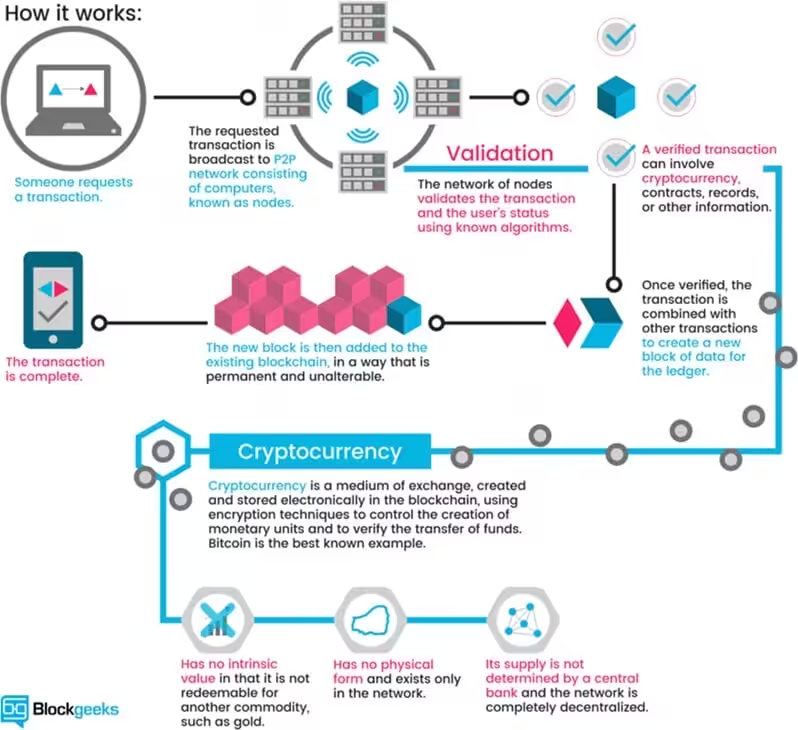
Understanding Blockchain:
Blockchain is the digital ledger that records all cryptocurrency transactions. You can think of it as a combination of a traditional accountant’s notebook and a globally shared Google Sheet.
- Blocks as Pages: In a blockchain, each “page” of transactions is called a block.
- Chaining Blocks: Once a block is full of transactions, it’s permanently sealed with a timestamp and linked to the next block using a unique code called a hash. This process creates a continuous, chronological chain of blocks, which is why it’s called a blockchain.
- Immutability: Once a block is sealed and added to the chain, its entries cannot be altered or erased. The transaction history is recorded forever, ensuring data integrity.
- Transparency: Unlike a traditional ledger, which is only accessible to a few people, a blockchain is like a shared Google Sheet. Everyone in the network has access to it and can view the entries, but they can’t delete or tamper with past records.
How a Blockchain Transaction Works?
- Transaction Creation: When someone sends crypto to another person (e.g., Ram sends a coin to Shyam), this transaction is added to a new, unsealed block.
- Block Filling: More transactions are added to this block until it’s full.
- Sealing the Block: Once full, the block is sealed and linked to the previous block in the chain using a unique hash code.
- Network-wide Visibility: Every time a new transaction is made, everyone in the decentralized network can see the updated record. This shared visibility ensures transparency, security, and trust without the need for a central authority or intermediary.
Crypto mining
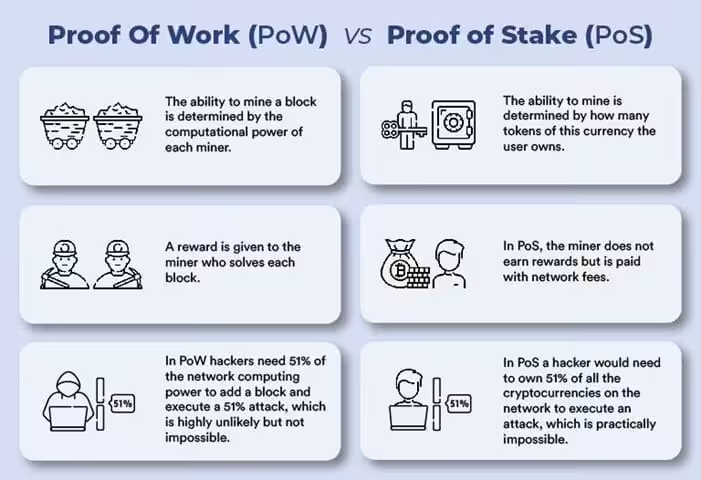
- Crypto mining is the process of validating and adding new transactions to a blockchain ledger. It’s how new coins are released into circulation and how the network is secured.
- Crypto mining is a “Proof-of-Work” (PoW) system, where miners compete to solve a complex mathematical puzzle.
- This requires a significant amount of computing power and electricity.
- The first miner to find the correct solution is rewarded.
- Proof-of-Stake (PoS) on the other hand, secures the network by requiring participants to stake a certain amount of cryptocurrency as collateral. It’s a “capital-based” system rather than an “energy-based” one and is thus more energy efficient.
Stablecoins:
- Stablecoins are a class of cryptocurrencies, with their values linked to assets.
- Unlike normal cryptocurrencies, whose values can wildly rise and fall due to investor sentiments and other factors, stablecoins are designed to maintain relatively steady prices. Hence, their name.
- This stability is achieved through the process of “pegging” the stablecoin to an asset such as fiat currency (like U.S. Dollars, EU Euros, Hong Kong Dollars, etc.), a commodity (like gold), other cryptocurrencies (such as Bitcoin), by regulating their value via computer algorithms, or by mixing multiple strategies. While the price of Bitcoin might rise or fall in the coming years, a USD-pegged stablecoin should ideally remain around $1.
- Stablecoins can also exhibit volatility. In response to both technical factors and world events, stablecoins sometimes come unpegged and their prices may rise or fall beyond the usual range, with sudden drops triggering panic amongst investors. Stablecoins have also collapsed entirely.
- Example – In May 2022, Terra’s cryptocurrency LUNA and its linked algorithmic stablecoin UST both lost most of their value in a matter of hours. Panicking investors who no longer trusted these assets quickly sold them off to minimise losses, and the prices fell close to zero.
Virtual Digital Assets
- Virtual digital assets (VDAs) are broadly defined as any information, code, or token generated through cryptographic or other means, which can be used as a store of value or unit of account, and can be transferred, stored, or traded electronically.
- Includes cryptos and non-fungible tokens.
- Excludes CBDC or Digital Rupee.
Non-fungible tokens (NFTs)
- Non-fungible tokens (NFTs) are assets like artworks, digital content, or videos that have been tokenized via a blockchain.
- NFTs cannot be replicated, divided or replaced. Cryptocurrencies are fungible, or interchangeable. While there’s no significant difference between one bitcoin and another, no two NFTs are identical.
- NFTs can represent digital collectibles or real-world items like artwork, real estate, individuals’ identities, property rights, and more.
- “Tokenizing” these real-world tangible assets makes buying, selling, and trading them more efficient and makes counterfeiting more difficult.
Difference between Crypto, CBDC and Stablecoin:
| Feature | Cryptocurrency (e.g., Bitcoin, Ethereum) | Central Bank Digital Currency (CBDC) | Stablecoins (e.g., Tether, USDC) |
| Issuer | Decentralized; not issued by any government or central bank. | Central bank of a country. | Private companies or entities. |
| Regulation & Control | Largely unregulated and decentralized. No central authority controls the network or supply. | Centralized and fully regulated by the issuing government/central bank. | Privately issued but subject to increasing government oversight and regulation. |
| Value & Volatility | Highly volatile; value is determined by market supply and demand. Not backed by any asset. | Stable; its value is pegged 1:1 to the country’s fiat currency or other valuable assets. | Designed to be stable; value is typically pegged to a fiat currency (e.g., USD) or other assets. Stability depends on the effectiveness of its backing. |
| Purpose | Often used for speculation, investment, and as a store of value. Also functions as a decentralized medium of exchange. | A digital form of a country’s fiat currency, intended for everyday transactions and payments. Aims to complement the existing financial system. | Serves as a bridge between the volatile cryptocurrency market and traditional fiat currencies, often used for trading and cross-border payments. |
| Technology | Typically built on public, permissionless blockchain technology. | Can be built using blockchain or distributed ledger technology, but often on a private, permissioned system controlled by the central bank. | Built on various blockchain technologies. |
| Liability | No central liability. Users are not protected from price volatility or firm collapses. | A direct liability of the central bank, just like physical cash. It is considered a safer form of digital money than commercial bank-issued digital money. | A liability of the private issuer. The level of protection for users depends on the issuer’s reserves and regulatory framework. |
| Privacy | Transactions can be pseudonymous, but all are recorded on a public ledger. | Privacy features vary by design. Authorities may have a degree of access to monitor for financial crimes. | Privacy varies depending on the specific stablecoin and the underlying blockchain. |
Status of Crypto currencies in India:
- It is one of the largest markets globally, with an estimated 119 million users. Its market size was valued at $2.6 billion in 2024, according to a report by consulting firm IMARC Group. Another report, by investment advisory firm HDFCTru, estimated that the market size will reach $15 billion by 2035 – exhibiting a Compound Annual Growth Rate (CAGR) of over 17 per cent between 2024 and 2035.
- According to a report released by Indian crypto exchange CoinSwitch, Gen Z (18-25) topped India’s crypto investor base for the first time with 37.6%, narrowly surpassing Millennials (26-35) at 37.3% and (36-45) at 17.8% in the third quarter of 2025. The study, drawing insights from 2.5 crore of the platform’s users, also showed that while metro cities dominate, led by Delhi (19.3%). Bengaluru (8.9%), and Mumbai (7%), cities like Jaipur, Lucknow and Patna are emerging as new centres of adoption.
- Not legal tender: In India, cryptocurrencies or virtual digital assets are not recognized as legal tender unlike CBDC.
- Legal to own and trade: Buying, selling, mining, and holding crypto or any virtual digital asset is legal.Regulatory bodies:
- RBI (monetary and financial stability)
- SEBI (if classified as securities)
- FIU-IND (anti-money laundering compliance)
- CBDT (taxation enforcement)
- Union Budget 2022 has also clarified on following points:
- The government officially categorised digital assets, including crypto assets, as “Virtual Digital Assets”.
- Income from the transfer of virtual digital assets such as crypto and NFTs will be considered capital gain and taxed at 30%.
- No deduction, except the cost of acquisition, will be allowed while reporting income from the transfer of digital assets.
- Loss from digital assets cannot be set off or carried forward of loss against any other income.
- Losses incurred from one virtual digital currency cannot be set off against income from another digital currency.
- Gifting digital assets will attract tax in the receiver’s hands.
- From 1 July 2022, 1% TDS will apply to all sell transactions of Virtual Digital Assets (VDAs), including cryptocurrencies and NFTs.
- How do crypto scams happen?
- Most crypto scams lure investors with promises of quick, guaranteed profits from new coins or trading platforms. Fraudsters often create fake websites or social media accounts that look like legitimate crypto exchanges or wallet services. Once users transfer their money or digital tokens, the scammers disappear.
- Another common trick involves “pump and dump” schemes, where groups artificially inflate a coin’s price and then sell off their holdings, leaving others with losses.
- Phishing attacks — where users are tricked into revealing private wallet keys or passwords – are also widespread.
- Prevention of Money Laundering Act (PMLA): In 2023, the Ministry of Finance brought cryptocurrency-related businesses under the purview of the Prevention of Money Laundering Act (PMLA). This requires Virtual Asset Service Providers (VASPs) and exchanges to:
- Comply with KYC norms: Perform “Know Your Customer” (KYC) procedures for all users.
- Maintain Records: Keep transaction records for a period of at least five years.
- Report Suspicious Activity: Report suspicious transactions to the Financial Intelligence Unit – India (FIU-IND).
Regulatory bodies:
- RBI (monetary and financial stability)
- SEBI (if classified as securities)
- FIU-IND (anti-money laundering compliance)
- CBDT (taxation enforcement)
Union Budget 2022 has also clarified on following points:
- The government officially categorised digital assets, including crypto assets, as “Virtual Digital Assets”.
- Income from the transfer of virtual digital assets such as crypto and NFTs will be considered capital gain and taxed at 30%.
- No deduction, except the cost of acquisition, will be allowed while reporting income from the transfer of digital assets.
- Loss from digital assets cannot be set off or carried forward of loss against any other income.
- Losses incurred from one virtual digital currency cannot be set off against income from another digital currency.
- Gifting digital assets will attract tax in the receiver’s hands.
- From 1 July 2022, 1% TDS will apply to all sell transactions of Virtual Digital Assets (VDAs), including cryptocurrencies and NFTs.
How do crypto scams happen?
- Most crypto scams lure investors with promises of quick, guaranteed profits from new coins or trading platforms. Fraudsters often create fake websites or social media accounts that look like legitimate crypto exchanges or wallet services. Once users transfer their money or digital tokens, the scammers disappear.
- Another common trick involves “pump and dump” schemes, where groups artificially inflate a coin’s price and then sell off their holdings, leaving others with losses.
- Phishing attacks — where users are tricked into revealing private wallet keys or passwords – are also widespread.
Prevention of Money Laundering Act (PMLA): In 2023, the Ministry of Finance brought cryptocurrency-related businesses under the purview of the Prevention of Money Laundering Act (PMLA). This requires Virtual Asset Service Providers (VASPs) and exchanges to:
- Report Suspicious Activity: Report suspicious transactions to the Financial Intelligence Unit – India (FIU-IND).
- Comply with KYC norms: Perform “Know Your Customer” (KYC) procedures for all users.
- Maintain Records: Keep transaction records for a period of at least five years.