Deep sea fishing and its new rules

Context: India’s 11,099-km-long coastline and EEZ spanning over 2.3 million sq km provide livelihoods for more than five million people in the fishing community. But the deep sea fishing activity has been associated with many adverse environmental effects. So, in order to balance both livelihood and environmental aspect, Union government has come up with new rules.
UPSC Relevance: Environment.
PYQ:
Q.) Other than poaching, what are the possible reasons for the decline in the population of Ganges River Dolphins? (2014)
1. Construction of dams and barrages on rivers
2. Increase in the population of crocodiles in rivers
3. Getting trapped in fishing nets accidentally
4. Use of synthetic fertilizers and other agricultural chemicals in crop-fields in the vicinity of rivers.
Select the correct answer using the code given below:
(a) 1 and 2 only
(b) 2 and 3 only
(c) 1, 3 and 4 only
(d) 1, 2, 3 and 4
What is Deep Sea fishing?
- Fishing at least 100 feet deep in waters far from the shore is known as deep-sea fishing, also known as large game or offshore fishing. Fishing operations in the open ocean, beyond the continental margin, are referred to as deep-sea fishing.
- The country’s Blue Revolution goal to fully utilise fishing resources within the 200 nautical mile exclusive economic zone has included deep sea fishing as a key component (EEZ).

Main types of Deep sea fishing
- Trolling: This is a technique in which a lure or bait is drawn through the water behind a moving boat. The lure is designed to attract fish to bite.
- Bottom fishing: This is a technique in which the bait is dropped to the bottom of the sea. The trick can be left on the bottom or lifted slightly off the bottom to attract fish.
- Jigging is a technique in which a weighted lure is dropped to the bottom of the sea and lifted and lowered to attract fish.
- Drifting: This is a technique in which the boat is allowed to drift along with the current while bait is deployed. The bait can be on the surface or suspended at a depth to attract fish.
- Chumming: This is a technique in which fish bait is scattered over the water to attract fish.
- Deep dropping: This is a technique in which the bait is dropped to the bottom of the sea, usually in depths of several hundred meters, to catch deep-sea species
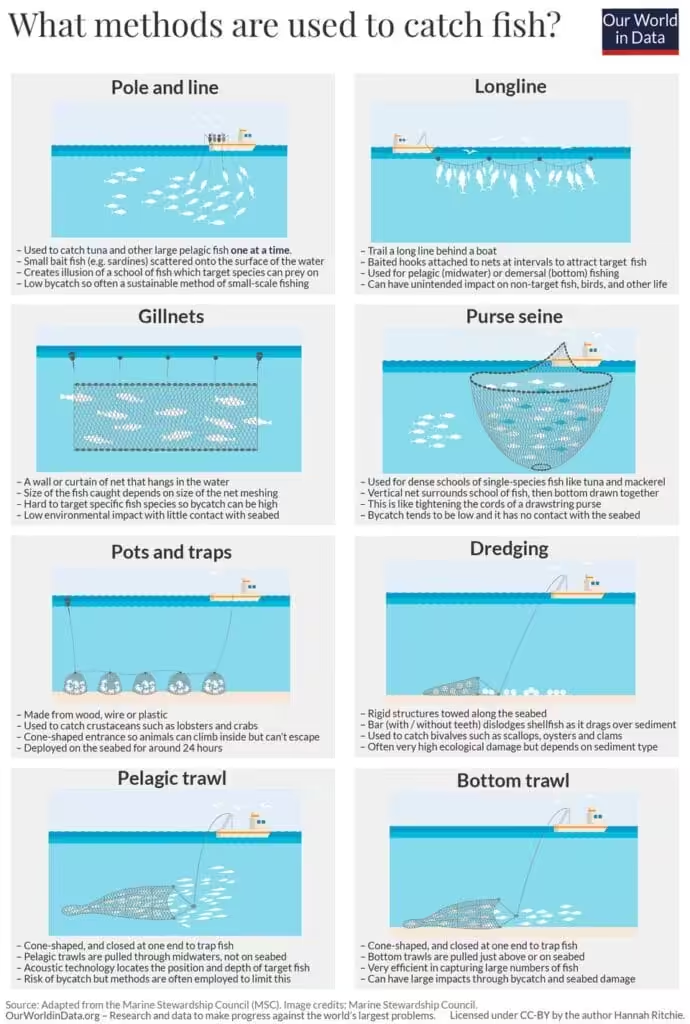
Issues and Challenges in Deep sea fishing:
- Overfishing: Overfishing is one of the greatest problems with deep-sea fishing. The populations of many fish species are declining as a result of fishing at a pace that is outpacing their capacity to reproduce. This could have a major effect on marine ecosystems and cause fish numbers to collapse.
- Bycatch: Bycatch, a term for the accidental capture of non-target species during deep-sea fishing, occurs frequently. This can include fish species, seabirds, and marine mammals, many of which are in peril of extinction.
- Habitat destruction: Deep-sea fishing techniques can cause substantial damage to the seafloor and the habitats of deep-sea species. Bottom trawling, for example, entails dragging heavy nets along the seafloor, which can destroy coral reefs and other critical habitats.
- Illegal, unreported, and unregulated fishing: Deep sea fishing is frequently done by boats that don’t follow local, national, and foreign fishing laws. This may result in illegal commerce in fish and seafood products as well as overfishing and other unsustainable fishing methods.
- Climate change: The oceans and the marine creatures that live in them are being significantly impacted by climate change. Fish populations may diminish as a result of rising ocean temperatures and acidification, necessitating the modification of fishing methods to the new environmental circumstances.
- Technological limitations: Deepwater fishing can be expensive and logistically difficult. Fishing access to deep-sea fish populations may be challenging due to inadequate technology and gear, which may reduce the potential for sustainable fishing methods.
- Threatens Livelihood of Traditional Fishers: Contrary to traditional fishers using traditional fishing gear, purse seiners frequently overfish, endangering the traditional fisher’s means of subsistence. It is a non-targeted fishing technique that catches any fish that gets in the net’s path, including young fish. As a result, they seriously harm aquatic resources.
- Threat to Food Security: The diminishing supply of oil sardines, a favourite of fish eaters in Kerala, is a serious worry. Just 3,297 tonnes of sardines were taken in by Kerala in 2021, a significant drop from the 3.9 lakh tonnes taken in 2012.
- Threatens Endangered Species: A possible trade embargo may be threatened by the non-selective fishing techniques used by purse seines that result in the bycatch of other marine living species, some of which may be endangered.
New rules for deep sea fishing:
Currently, around 238,000 fishing vessels from 13 coastal states and Union Territories are registered on the portal. Of these, about 172,000 smaller boats are exempt, while around 64,000 mechanised vessels will require access passes for EEZ operations. The central government has announced new rules for deep-sea fishing within India’s Exclusive Economic Zone (EEZ), aimed at empowering fishermen, cooperatives, and small-scale fishers. The rules, notified on November 4, fulfil a key Budget 2025–26 promise and are expected to unlock the potential of India’s vast marine resources, according to a PTI report.
- Foreign vessels will be prohibited from operating in Indian waters under the new framework.
- Focus on tuna and advanced fishing vessels :The revised norms seek to tap high-value tuna resources that remain largely underutilised, even as neighbouring countries harvest them extensively in the Indian Ocean region.
- Fishermen Cooperative Societies and Fish Farmer Producer Organisations (FFPOs) will be prioritised for deep-sea fishing using technologically advanced vessels.
- Introduction of the mother-and-child vessel model, enabling mid-sea transhipment in line with Reserve Bank of India (RBI) regulations. This move is expected to especially benefit the Andaman & Nicobar and Lakshadweep Islands, which together account for 49 per cent of India’s EEZ.
- Curbing harmful fishing practices To protect the marine ecosystem, the rules prohibit harmful fishing methods such as LED light fishing, pair trawling, and bull trawling.
- The Centre will also prescribe minimum legal sizes for various fish species and prepare Fisheries Management Plans in consultation with state governments and other stakeholders.
- Digital access pass for mechanised vessels
- Traditional and small-scale fishers using motorised or non-motorised boats are exempt from the new requirements. However, mechanised and large motorised vessels will need to obtain a free “access pass” through the ReALCRaft online portal.
- The digital system enables vessel owners to apply with minimal documentation and track their applications in real time, eliminating the need for physical visits.
- The ReALCRaft portal is being integrated with the Marine Products Export Development Authority (MPEDA) and the Export Inspection Council (EIC) for issuing Fish Catch and Health Certificates, key requirements for exporting seafood to premium international markets. This integrated digital system ensures end-to-end traceability, sanitary compliance and eco-labelling, enhancing the global competitiveness of Indian marine products.
- The ReALCraft application has been integrated with the Nabhmitra Application used by fishermen for safe navigation, which will also help marine enforcement agencies, including the Indian Coast Guard and Navy, strengthen coastal security.
- The rules also bring regulatory reforms recognising fish resources from the Indian EEZ beyond the contiguous zone as ‘Indian origin’ under revenue and customs norms, so that they are not treated as ‘imports’ while landing at Indian ports.
- Access to credit will be facilitated under flagship schemes such as the Pradhan Mantri Matsya Sampada Yojana (PMMSY) and the Fisheries and Aquaculture Infrastructure Development Fund (FIDF).
To ensure safety and security, the rules mandate the use of transponders for deep-sea fishing vessels and QR-coded Aadhaar Card/Fishers ID Card for identification.