Delhi EV Policy: Incentives Tied to Approved Models
Why in News?
The Hindu reported that the Delhi EV Policy, 2026 will give incentives only to electric-vehicle models approved by a Model Approval Committee under the Transport Department.
The policy came into effect on July 1, 2026 and links purchase incentives, scrapping incentives, DBT delivery, model empanelment and phased electrification of high-polluting vehicle segments.
- Model Approval Committee will decide which EV models are eligible for incentives under the Delhi Electric Vehicle Policy, 2026.
- Approved models alone will qualify; the committee will assess eligibility criteria, technical standards and policy conditions.
- Two-wheeler purchase incentives apply to models priced up to Rs 2.25 lakh.
- Car scrapping incentives are limited to electric cars priced up to Rs 30 lakh ex-showroom.
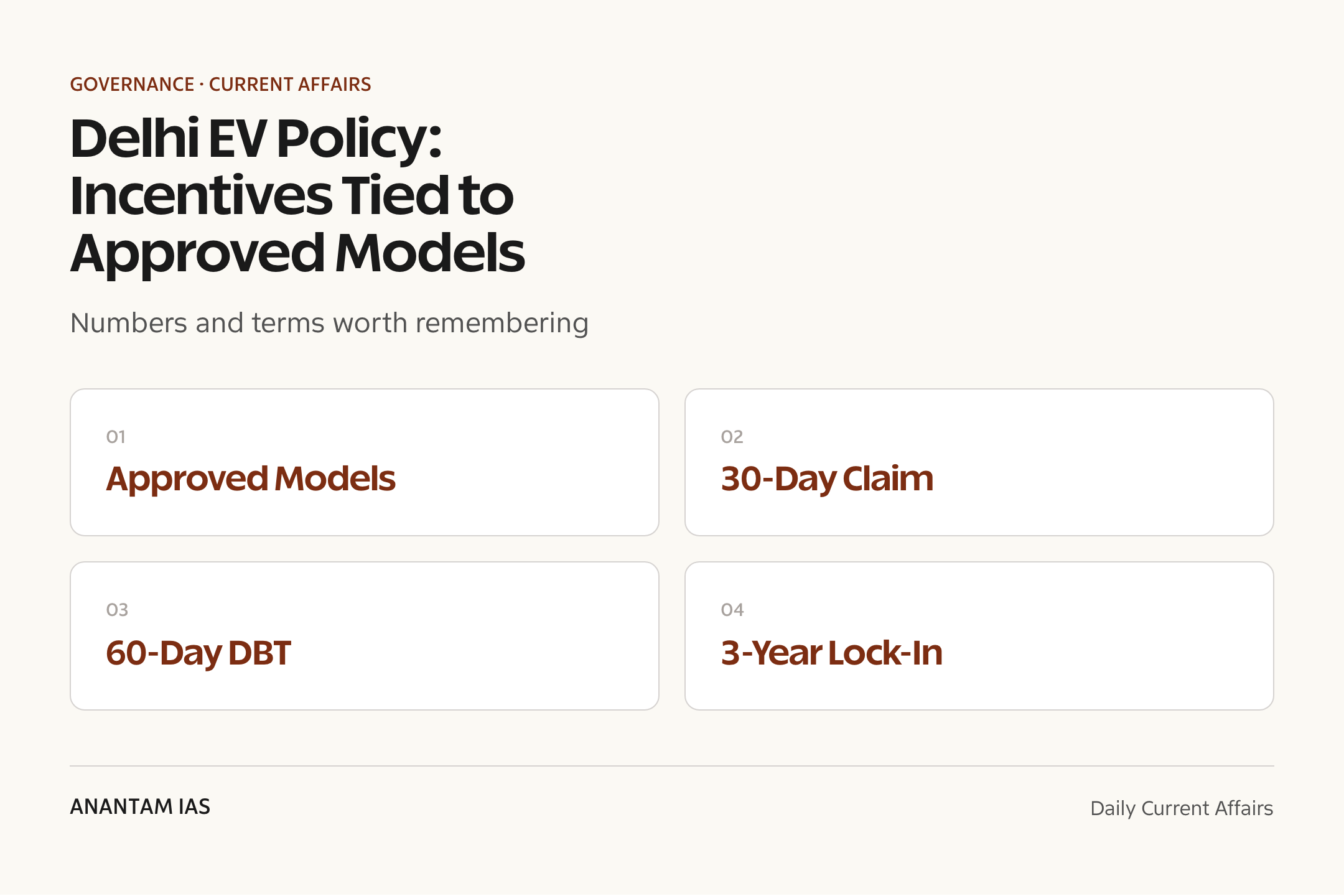
- Incentive applications must be filed within 30 days of registration, and subsidies are to be disbursed within 60 days through DBT.
- Three-year lock-in applies: vehicles availing incentives cannot be transferred or re-registered outside Delhi for three years.
The development matters in the context of:
- Subsidy design matters because public money should support models that meet safety, eligibility and technical standards.
- Urban air pollution makes Delhi’s EV push a public-health policy, not only a transport-market policy.
- Green industrial transition depends on demand incentives, charging networks, certified products and consumer trust moving together.
- State-level governance is visible here because Delhi is using policy conditions to shape markets, behaviour and environmental outcomes.
UPSC Relevance
Prelims Relevance
- Delhi EV Policy, 2026 came into effect on July 1, 2026 after notification following Cabinet approval.
- Model Approval Committee is to function under Delhi’s Transport Department for empanelment of eligible EV models.
- DBT means Direct Benefit Transfer, where subsidy support is transferred directly to eligible beneficiaries.
- Purchase incentive reduces the upfront cost of an eligible EV, usually to accelerate adoption.
- Scrapping incentive rewards replacement of older polluting vehicles with cleaner alternatives.
- Tailpipe emissions are direct exhaust emissions from vehicles; battery EVs have none during use.
- Life-cycle emissions include battery manufacturing, electricity generation, use phase and disposal or recycling.
- N1 category generally refers to goods vehicles with gross vehicle weight not exceeding 3.5 tonnes under motor vehicle classification.
- Empanelment means official listing or approval of eligible models, dealers or service providers under a scheme.
Mains Relevance
GS Paper 2
- Governance: targeted subsidies, eligibility checks, DBT, anti-leakage design and departmental accountability.
- Policy implementation: how State governments use committees, guidelines and digital systems to convert policy intent into beneficiary delivery.
GS Paper 3
- Environment: clean mobility as a response to vehicular emissions, public health and urban air pollution.
- Indian economy: EV manufacturing, approved-model markets, charging infrastructure, battery standards and green industrial transition.
Essay
- Clean air is a governance outcome, not only a technology outcome.
- Public subsidies work best when they reward standards, transparency and verified public benefit.
- Green transitions succeed when consumer trust, industry capacity and environmental goals align.
Background and Context
What Changed in the Policy
The immediate news is the shift from broad incentive promise to model-specific eligibility.
- The Hindu reported that Delhi will constitute a Model Approval Committee under the Transport Department.
- Committee approval is the gatekeeping step: only approved and empanelled models will qualify for purchase incentives.
- Technical standards and eligibility criteria become central because the policy does not treat every EV model as automatically subsidy-ready.
- Policy notification followed Cabinet approval and brought the Delhi EV Policy, 2026 into effect from July 1, 2026.
- Operational guidelines will matter in practice because buyers, dealers and manufacturers need clarity on approved models, documents and claims.
Why Approved-Model Rules Matter
A subsidy linked to approved models is a governance tool for market discipline.
- Quality control improves when government incentives are tied to tested, eligible and officially listed products.
- Consumer protection improves because buyers are less likely to depend only on dealer claims about subsidy eligibility.
- Public finance is better protected when incentives flow only after technical and eligibility checks.
- Manufacturer behaviour changes because firms have an incentive to meet standards, documentation and safety requirements.
- Market transparency becomes stronger when official lists help buyers compare eligible brands and models.
- UPSC linkage: connect this with Delhi EV Policy and two-wheeler transition for the wider mobility context.
Incentive Architecture
The policy uses both purchase support and scrapping support to shift demand.
- Purchase incentives reduce upfront cost, which is one of the biggest barriers for two-wheelers, three-wheelers and commercial users.
- Two-wheeler threshold is important: purchase incentives apply to models priced up to Rs 2.25 lakh.
- Car scrapping threshold is narrower: scrapping incentives are limited to cars priced up to Rs 30 lakh ex-showroom.
- Scrapping support links EV adoption with removal of older, more polluting internal-combustion vehicles.
- DBT delivery can reduce leakage if beneficiary identity, vehicle registration, dealer documents and bank details are verified.
- Application timeline matters because applicants must claim incentives within 30 days of registration.
DBT and Lock-In Design
The policy tries to avoid both delayed subsidy payment and misuse of subsidy-funded vehicles.
- Direct Benefit Transfer is expected within 60 days, making time-bound delivery part of the promise.
- Beneficiary targeting becomes stronger when subsidy claims are linked with Delhi registration and official records.
- Three-year lock-in prevents quick transfer or re-registration outside Delhi after receiving incentives.
- Anti-arbitrage logic is simple: public support should not become a subsidy for resale or registration-shopping outside the target jurisdiction.
- Administrative burden will rise because the Transport Department must track registration, transfer attempts and subsidy compliance.
- Digital governance can help only if databases across registration, subsidy claims and approved models are integrated.
Air-Pollution and Mobility Link
Delhi’s EV policy is best read as a clean-air intervention as much as an industrial policy.
- Vehicular pollution is a recurring part of Delhi’s air-quality problem, especially when combined with dust, industry, waste burning and seasonal factors.
- Battery EVs remove tailpipe emissions during use, which can reduce local exposure on congested roads.
- Two-wheelers and three-wheelers matter because they are high-volume urban mobility segments with everyday visibility.
- Commercial vehicles matter because high daily usage can magnify emission reductions when fleets shift to electric options.
- Public transport still remains essential; EV adoption should complement buses, metro, walking, cycling and parking reform.
- Clean-air governance can be compared with PM E-DRIVE electric buses for Centre-State clean-mobility links.
Industrial Transition Angle
Approved-model rules can shape how manufacturers, dealers and consumers behave in a new market.
- EV manufacturers need predictable demand, but they also need to satisfy safety, price and documentation conditions.
- Dealers become important intermediaries because buyers will ask whether a model is approved, subsidy-eligible and supported after sale.
- Battery ecosystem includes cells, packs, battery management systems, recycling, swapping and safe charging equipment.
- Charging infrastructure must expand along with incentives, or purchase support will not convert into sustained use.
- Green jobs can emerge in manufacturing, maintenance, software, charging operations and battery recycling.
- Risk: if approved-model lists are slow or opaque, the market can face confusion, delayed purchases and rent-seeking.
Governance Risks
The approved-model route is useful only if the approval process is credible and transparent.
- Delay risk: slow empanelment can hold back genuine buyers and compliant manufacturers.
- Opacity risk: unclear criteria can create disputes over why one model qualifies and another does not.
- Exclusion risk: small manufacturers may struggle with documentation even when their products are technically sound.
- Leakage risk: weak verification can allow subsidy claims for ineligible models, fake beneficiaries or non-compliant transfers.
- Equity risk: incentives should not mainly benefit users with private parking, better credit and higher purchasing power.
- Federal coordination matters because EV standards, batteries, road transport rules and clean-energy policy operate across Union and State layers.
How to Use It in Answers
Delhi’s approved-model rule is a compact example for both governance and environment answers.
- GS2 answer: cite it as targeted subsidy design with eligibility checks, DBT delivery and anti-misuse lock-in.
- GS3 answer: use it to show how clean mobility policy connects air pollution, battery standards and green industry.
- Policy-evaluation point: judge success by adoption, emissions impact, subsidy leakage, consumer satisfaction and charging access.
- Balanced conclusion: EV incentives are necessary, but they cannot replace public transport, enforcement against polluting vehicles and urban planning.
- Internal link: revise wider climate-policy context through adaptation finance and climate governance.
Way Forward
Publish Clear Model Lists
- Transport Department should maintain a public, searchable list of approved models, eligible variants, price limits and dealer details.
- Version control should show when a model is added, suspended or removed so buyers are not misled.
- Appeal mechanism should exist for manufacturers whose models are rejected or delayed.
Make DBT Reliable
- Subsidy dashboards should track application date, registration number, approval stage, payment status and grievance timelines.
- Data integration between registration records, bank details, approved-model lists and transfer restrictions can reduce leakage.
- Grievance redressal should be time-bound because delayed subsidies weaken trust in the policy.
Protect Equity
- Low-income commuters, gig workers and small commercial operators need finance, charging access and repair support.
- Rental housing users and street-parked vehicle owners need safe charging options beyond private garages.
- Women users can benefit if charging points, last-mile routes and service centres are safe and accessible.
Link EVs With Urban Planning
- Charging stations should be planned around workplaces, markets, residential clusters, metro stations and freight nodes.
- Public transport should remain central so the city does not merely replace petrol congestion with electric congestion.
- Air-quality monitoring should test whether EV adoption produces measurable local pollution gains.
Conclusion
Delhi EV Policy, 2026 shows that clean mobility is not only about announcing subsidies. The hard part is deciding who qualifies, how quickly support reaches them and whether the subsidy produces real public benefit.
The approved-model rule can improve standards, transparency and consumer trust if the process is fast, public and technically credible.
For UPSC, the bigger lesson is that green transition governance works when environmental goals, public finance, industrial standards and citizen delivery are designed together.
UPSC Practice Questions
Prelims MCQ 1
With reference to the Delhi EV Policy, 2026, consider the following statements:
- A Model Approval Committee under the Transport Department will determine eligible EV models for incentives.
- All EV models sold in Delhi automatically qualify for purchase incentives without empanelment.
- Vehicles availing incentives cannot be transferred or re-registered outside Delhi for three years.
How many of the above statements are correct?
(a) Only one (b) Only two (c) All three (d) None
Answer: (b) Only two
Explanation:
Statements 1 and 3 are correct. Statement 2 is incorrect because incentives are tied to approved and empanelled models.
Prelims MCQ 2
Which one of the following best explains the governance purpose of an approved-model rule in an EV subsidy policy?
(a) It removes the need for technical standards. (b) It allows incentives only for models that meet notified eligibility and technical criteria. (c) It gives incentives only to imported petrol vehicles. (d) It prevents the use of Direct Benefit Transfer.
Answer: (b) It allows incentives only for models that meet notified eligibility and technical criteria.
Explanation:
Approved-model rules help target subsidies, protect consumers and link public support with verified eligibility standards.
UPSC Mains Questions
- The Delhi EV Policy, 2026 links incentives to approved models under a committee-based system. Examine how such eligibility rules can improve transparency, consumer protection and public finance in welfare delivery.
- Electric mobility policy is both an environmental intervention and an industrial-transition strategy. Discuss with reference to State-level EV incentives, charging infrastructure and air-pollution governance.
- Subsidies can accelerate green transitions, but they also require safeguards against leakage and exclusion. Analyse using the approved-model rule under Delhi’s EV policy.
Sources: The Hindu and Switch Delhi, Transport Department.
Frequently Asked Questions
What is the approved-model rule?
It means EV incentives will apply only to models approved and empanelled by the Model Approval Committee under Delhi’s Transport Department. The rule links subsidy eligibility with technical standards, price conditions and policy criteria instead of treating every EV model as automatically eligible.
Why is a committee needed?
A committee can verify whether a vehicle model meets the notified conditions before public money is spent. This improves quality control, reduces subsidy leakage, protects buyers from misleading claims and gives manufacturers a standards-based route to eligibility.
What is the DBT timeline?
The Hindu reported that applicants must apply for incentives within 30 days of vehicle registration. Subsidies are to be disbursed within 60 days through Direct Benefit Transfer, subject to eligibility checks and policy compliance.
What is the three-year lock-in?
Vehicles receiving incentives cannot be transferred or re-registered outside Delhi for three years. This prevents buyers from taking Delhi’s subsidy and quickly shifting the vehicle out of the target jurisdiction.
How does this affect air pollution?
The policy targets electrification of two-wheelers, three-wheelers and commercial vehicles, which are important urban mobility segments. EVs remove tailpipe emissions during use, but cleaner outcomes also need charging infrastructure, renewable power and public transport integration.
What should UPSC aspirants remember?
Treat the issue as a GS2-GS3 bridge. It is about subsidy targeting, DBT, regulatory standards, clean-air policy, EV manufacturing, consumer protection and the practical governance needed for a green transition.