The mid-year UN climate talks in Bonn, Germany, running from 8 to 18 June 2026, became the staging ground for a sharp demand: that developed countries triple public adaptation finance to roughly USD 120 billion a year by 2035. The Bonn session is the 64th meeting of the UNFCCC subsidiary bodies (SB64), the technical and political workshop where the texts that COP30 in Belem, Brazil, will later adopt are drafted and bargained over.
The headline figure is a multiplier on an older promise. The Glasgow Climate Pact of 2021 asked rich nations to double adaptation finance from a 2019 baseline by 2025, taking it to about USD 40 billion a year. Bonn 2026 reframed that as a floor, not a ceiling, and tied adaptation money to the wider battle over the New Collective Quantified Goal and the Baku-to-Belem roadmap. For UPSC, this is the live edge of the climate-finance and equity debate that runs through GS-III and International Relations.
What makes the moment sharp is the calendar. Every climate year now bends toward Belem, where COP30 will sit in November 2026, and Bonn is the last full negotiating session before that summit. Whatever ambition survives the June talks in draft form is roughly what ministers will have to work with in Brazil. So the demand to triple adaptation finance is less a slogan than a marker laid down early, an attempt to set the anchor before the bargaining narrows. Adaptation finance, unlike the more glamorous mitigation pledges, rarely makes headlines, which is precisely why its backers chose a single, hard, memorable number.
An examiner will read Bonn 2026 not as a press event but as a test of whether the global climate-finance architecture can move from pledges to delivery, and where India’s equity argument fits inside it.
Quick Facts
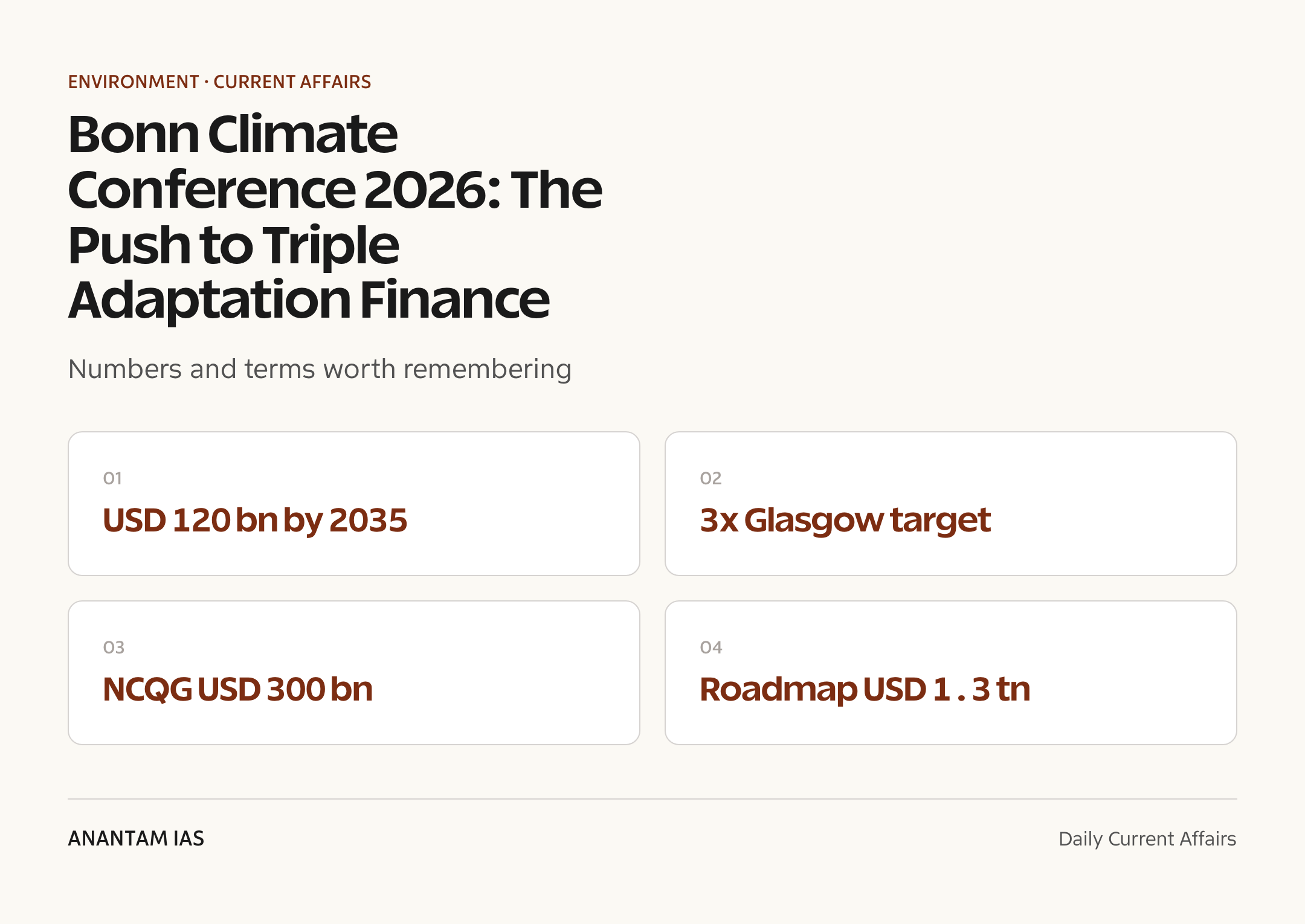
- The June 2026 Bonn talks are the 64th sessions of the UNFCCC subsidiary bodies (SB64), held 8-18 June 2026.
- The demand at Bonn was to triple public adaptation finance to about USD 120 billion a year by 2035.
- The Glasgow Climate Pact (2021) sought to double adaptation finance from a 2019 baseline by 2025, to about USD 40 billion a year.
- The New Collective Quantified Goal set at COP29 Baku is at least USD 300 billion a year by 2035, scaling toward USD 1.3 trillion from all sources.
- The Global Goal on Adaptation is anchored in Article 7 of the Paris Agreement.
- The UAE-Belem work programme aims to narrow over 9,000 proposed adaptation indicators to about 100 for adoption at COP30.
- The Loss and Damage Fund was operationalised at COP28 Dubai in 2023, with the World Bank as interim host.
- COP30 is scheduled for Belem, Brazil, in November 2026.
- Sources: UNFCCC, Subsidiary Bodies (SB64), Bonn and IISD Earth Negotiations Bulletin.
What Just Happened
Bonn does not adopt binding decisions. It is the engine room: the Subsidiary Body for Scientific and Technological Advice (SBSTA) and the Subsidiary Body for Implementation (SBI) meet in parallel tracks to refine draft texts that COP30 will later finalise. At SB64 the loudest theme around adaptation was finance. Health and development coalitions, backed by vulnerable-country negotiators, pressed developed nations to triple public adaptation finance to about USD 120 billion a year by 2035, treating the 2025 doubling target of roughly USD 40 billion as an interim step rather than the destination.
The number is not arbitrary. It is three times the Glasgow-era adaptation target, and it lands at the same 2035 horizon used for the New Collective Quantified Goal on climate finance. By aligning the adaptation ask with the NCQG timeline, advocates tried to force adaptation, which has long been the under-funded twin of mitigation, into the centre of the finance conversation instead of its margins.
Alongside the finance push, SB64 carried forward the technical work on the Global Goal on Adaptation. Negotiators worked to streamline the indicators that will measure adaptation progress worldwide, the so-called UAE-Belem work programme, with the aim of handing COP30 a workable shortlist. Adaptation, food systems, a just transition, and the means of implementation, including finance, access and quality, ran through the Bonn agenda.
The indicator work is technical but consequential. Experts had begun with more than 9,000 proposed metrics, distilled them to roughly 490, and now aim to land near 100 indicators that COP30 can adopt. A late but important shift at Bonn was the insistence that the final set must include means-of-implementation indicators, ones that track not just whether a country adapted, but whether it could access finance, and whether that finance was of adequate quality. That single design choice decides whether the GGA becomes a tool that holds donors accountable or stays a catalogue of project counts.
It is worth being clear about what Bonn did and did not settle. Because the subsidiary bodies cannot adopt decisions, no new finance figure was agreed and no indicator list was locked. What emerged instead was direction and pressure: draft conclusions, bracketed text where countries still disagree, and a political signal from vulnerable nations and civil society that adaptation finance will be a red line at Belem. In UNFCCC practice, that is how outcomes are built, the contours are drawn in June so that November can fill them in.
Background and Context
The United Nations Framework Convention on Climate Change (UNFCCC), agreed at the 1992 Rio Earth Summit, is the parent treaty for global climate cooperation. It works through annual Conferences of the Parties (COP) and two permanent subsidiary bodies created under the Convention: SBSTA, which feeds in scientific and technical advice, and SBI, which reviews implementation and finance. The June meeting in Bonn, home of the UNFCCC secretariat, is the year’s only formal sitting of these bodies outside the COP itself, which is why it shapes what is realistic by the time leaders gather.
The treaty system has layered three milestones on this base. The Kyoto Protocol (1997) bound only developed countries to emission cuts, a top-down model that strained as emerging economies grew. The Paris Agreement (2015) replaced it with a bottom-up design built on Nationally Determined Contributions, voluntary pledges that each country sets and revises, alongside a long-term temperature goal of holding warming well below 2 degrees Celsius and pursuing 1.5 degrees. Crucially, Paris put adaptation and finance on the same footing as mitigation, which is the legal hook that makes the Bonn adaptation-finance fight more than rhetoric.
Adaptation, the work of building resilience to climate impacts already locked in, sits at the heart of this session. The Paris Agreement (2015) created the Global Goal on Adaptation (GGA) in its Article 7, a collective aim to raise adaptive capacity, strengthen resilience and cut vulnerability. COP28 in Dubai (2023) gave the GGA structure through the UAE Framework for Global Climate Resilience, with eleven targets, seven thematic ones covering water, food, health, ecosystems, infrastructure, poverty and livelihoods, and cultural heritage, plus four covering the adaptation cycle. The UAE-Belem work programme was then launched to build indicators to measure that progress.
Climate finance is the other static anchor. COP29 in Baku (2024) replaced the expired USD 100 billion goal with the New Collective Quantified Goal (NCQG): at least USD 300 billion a year by 2035 with developed countries in the lead, and a wider call to scale finance toward USD 1.3 trillion a year from all public and private sources. The COP29 and COP30 presidencies, Azerbaijan and Brazil, were tasked with a Baku-to-Belem roadmap to chart how that USD 1.3 trillion can be reached. The roadmap maps five fronts: replenishing concessional finance, rebalancing fiscal space for indebted nations, rechanneling private capital, improving coordination, and reshaping the wider financial system. The Loss and Damage Fund, operationalised at COP28 with the World Bank as interim host for an initial four-year period, completes the picture by addressing harm that adaptation cannot prevent.
Three concepts knit the static syllabus together. The first is the split between mitigation, cutting greenhouse-gas emissions at source, and adaptation, adjusting to the warming already in train; finance has historically tilted toward the former. The second is Common But Differentiated Responsibilities and Respective Capabilities (CBDR-RC), the founding equity principle of the UNFCCC that recognises rich nations’ historical emissions and greater capacity, and so places the lead obligation on them. The third is the architecture of climate funds, the Green Climate Fund, the Adaptation Fund, the Global Environment Facility and the Loss and Damage Fund, which are the channels through which any new pledge must actually flow. Bonn 2026 is where these durable concepts meet a live number.
Key Threads at Bonn SB64 2026
- Adaptation finance: the call to triple public adaptation finance to about USD 120 billion a year by 2035, three times the Glasgow target.
- GGA indicators: narrowing the UAE-Belem indicator list toward roughly 100, so adaptation progress can finally be measured.
- Subsidiary bodies: SBSTA and SBI draft the technical and implementation texts that COP30 in Belem will adopt.
- Finance architecture: linking adaptation money to the NCQG and the Baku-to-Belem roadmap to USD 1.3 trillion.
- Means of implementation: indicators to track access, quality and finance, not just outputs, so support reaches the most vulnerable.
- Just transition: work on a just-transition mechanism and food systems carried forward as part of the resilience agenda.
Why It Matters for UPSC
This is a high-yield topic because it ties a current development to durable syllabus themes.
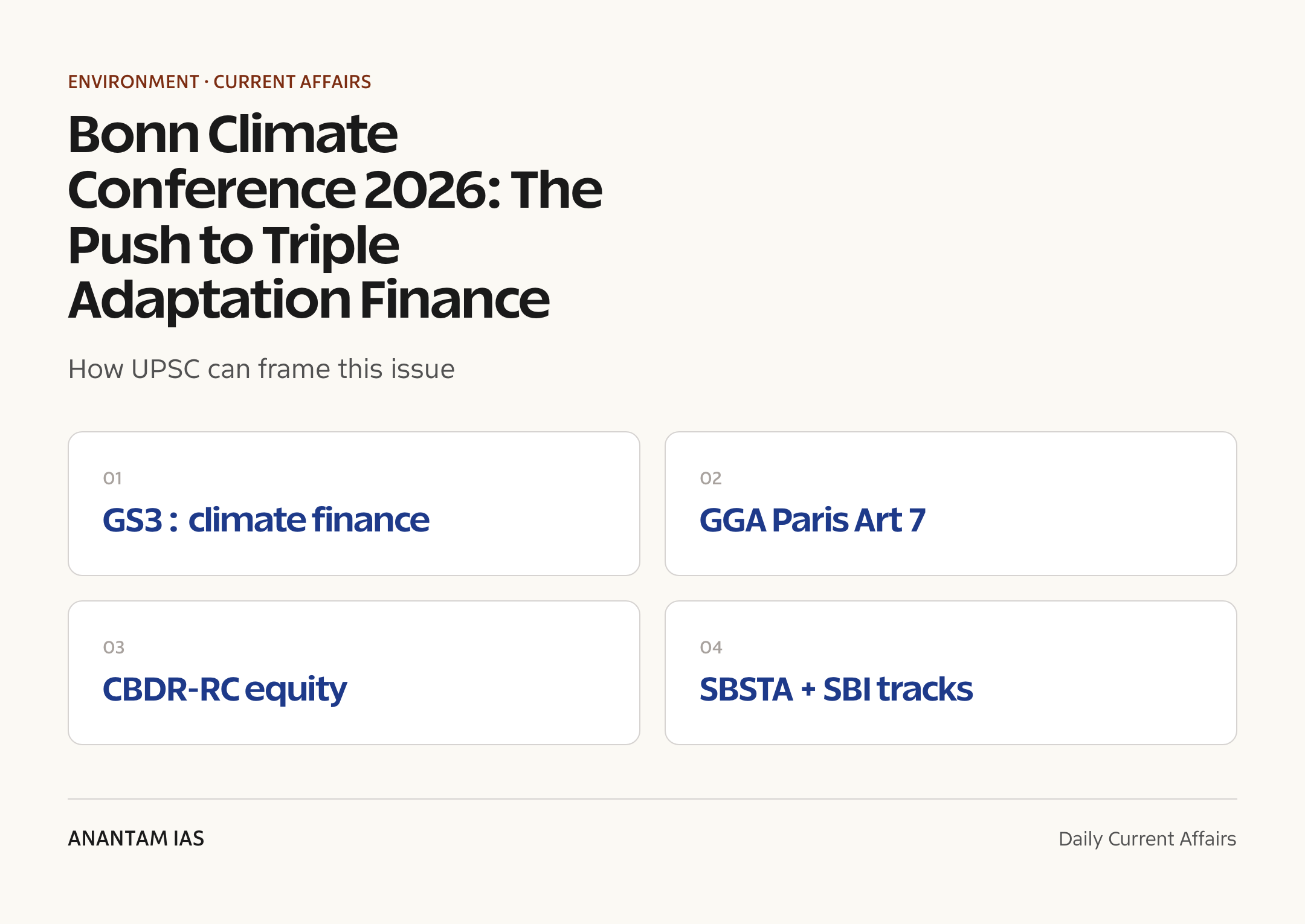
- It is core GS-III material on climate change, environmental governance and the adaptation-versus-mitigation finance gap.
- It links current news to static syllabus: UNFCCC, the Paris Agreement, the GGA, the NCQG and the Loss and Damage Fund.
- Prelims-relevant terms cluster here: SBSTA, SBI, GGA, NCQG, CBDR-RC, UAE Framework and the Baku-to-Belem roadmap.
- It feeds International Relations answers on North-South equity and Essay material on climate justice and intergenerational responsibility.
What It Means: Environment Lens
Adaptation is finally fighting for finance parity with mitigation. Most climate money has flowed to mitigation, the work of cutting emissions, because it produces measurable tonnes of carbon avoided and bankable returns. Adaptation, by contrast, protects lives and livelihoods in ways markets struggle to price, so it has been chronically starved. The Bonn push to triple adaptation finance is an attempt to correct that imbalance before COP30 hardens the numbers. The deeper problem the talks expose is that the Baku-to-Belem roadmap fixes a headline of USD 1.3 trillion but carries no separate, ring-fenced adaptation sub-target, which is exactly why advocates put a hard figure on the table at Bonn. The asymmetry is not accidental: mitigation projects, a solar park or a transmission line, attract private capital because they return revenue, while a sea wall or a drought-resistant cropping programme protects the poorest and pays back in disasters avoided, a benefit no balance sheet captures. Left to the market, adaptation will always be under-supplied, which is the structural case for public, concessional finance that the Bonn demand is built on.
Indicators are where ambition meets accountability. A goal with no way to measure it is a slogan. The UAE-Belem work programme matters because it decides what counts as adaptation progress, and whether finance, access and quality, not just project counts, are tracked. Streamlining thousands of proposed indicators to a usable set is a quiet but decisive fight: too few and the picture is shallow, too many and no developing country can report against them. The choice of indicators will shape who gets funded and on what evidence.
For India, the structural argument is equity, not charity. India frames climate finance through Common But Differentiated Responsibilities and Respective Capabilities (CBDR-RC): the countries that built their wealth on past emissions owe a finance and technology obligation to the developing world, which faces the heaviest adaptation burden with the fewest resources. India has consistently argued that adaptation finance must be public, grant-based and additional, not loans that deepen debt. Bonn 2026 hands India a sharper line for COP30: that delivery, predictability and the quality of finance matter as much as the headline figure.
The fight over numbers is really a fight over definitions. A pledge of USD 120 billion means little until it is clear what counts. Is a market-rate loan from a development bank adaptation finance, or only a grant? Does money routed through private intermediaries count toward a public target? Developing countries have long warned that headline figures are inflated by re-labelled aid, double-counted loans and over-stated private leverage. This is why the GGA indicator work and the finance fight are two halves of one problem: without agreed definitions and a way to measure access and quality, even a tripled target can dissolve into accounting. India and the wider developing-country bloc press as hard on the rules of the game as on the size of the cheque, because a transparent USD 40 billion in grants may help more than an opaque USD 120 billion in loans.
Bonn is a stress test of multilateralism itself. The deeper lesson for an answer is procedural. The UNFCCC works by consensus, which gives every party a brake and makes ambition slow and incremental. The subsidiary-body system exists to do the patient, unglamorous drafting that consensus demands, and the June session is where goodwill or distrust built up over a year is converted into bracketed text. When commentators say a COP succeeded or failed, much of that outcome was already shaped in Bonn. For India, a rising power that speaks for the Global South on equity, this process is also a platform: the place to insist that the burden of a crisis it did least to cause is shared on fair terms.
Challenges and Concerns
- The Baku-to-Belem roadmap names USD 1.3 trillion but sets no separate, binding adaptation finance sub-target.
- Much climate finance is delivered as loans, which adds to the debt burden of the countries it is meant to help.
- Bonn produces only draft texts, so the political fight over numbers is deferred to COP30 in Belem.
- The gap between adaptation needs and finance available remains wide, and the 2025 doubling target was itself contested.
- Streamlining the GGA indicators risks dropping metrics that matter to the most vulnerable communities.
Prelims Pointers
- UNFCCC was adopted at the 1992 Rio Earth Summit; its secretariat is in Bonn, Germany.
- The two permanent UNFCCC subsidiary bodies are SBSTA (scientific and technological advice) and SBI (implementation).
- The June 2026 Bonn talks are the 64th sessions of the subsidiary bodies (SB64).
- The Global Goal on Adaptation is established under Article 7 of the Paris Agreement.
- The UAE Framework for Global Climate Resilience was adopted at COP28 Dubai in 2023.
- The New Collective Quantified Goal sets at least USD 300 billion a year by 2035, scaling toward USD 1.3 trillion.
- The Glasgow Climate Pact (2021) sought to double adaptation finance from a 2019 baseline by 2025.
- The Bonn push sought to triple public adaptation finance to about USD 120 billion a year by 2035.
- The Loss and Damage Fund was operationalised at COP28 in 2023, with the World Bank as interim host.
- The Baku-to-Belem roadmap was tasked to the COP29 and COP30 presidencies, Azerbaijan and Brazil.
- COP30 is scheduled for Belem, Brazil, in November 2026.
- CBDR-RC stands for Common But Differentiated Responsibilities and Respective Capabilities.
Mains Practice Questions
- The Global Goal on Adaptation has been called a goal without a metric. Examine how the UAE-Belem work programme on indicators tries to fix this, and the trade-offs in narrowing the indicator list. (GS-III, 15 marks)
- Adaptation finance has long been the under-funded twin of mitigation. Critically analyse the demand to triple public adaptation finance and the gaps in the global climate-finance architecture. (GS-III, 15 marks)
- Discuss the principle of Common But Differentiated Responsibilities and Respective Capabilities (CBDR-RC) and its relevance to India’s stance on climate finance in the run-up to COP30. (GS-III, 10 marks)
- Mid-year UNFCCC sessions at Bonn shape the texts that COP later adopts. Explain the roles of SBSTA and SBI and why the Bonn session matters for climate negotiations. (GS-II, 10 marks)
Way Forward
The credible next step is a separate, time-bound adaptation finance sub-goal inside the Baku-to-Belem roadmap, so adaptation is not crowded out by the larger USD 1.3 trillion headline.
Quality matters as much as quantity: shifting from loans toward grant-based, predictable and additional public finance, and locking in a lean but meaningful GGA indicator set at COP30, would turn Bonn’s pressure into delivery that vulnerable countries can actually use.
Frequently Asked Questions
What is the Bonn Climate Conference 2026?
It is the mid-year UN climate meeting held in Bonn, Germany, from 8 to 18 June 2026, formally the 64th sessions of the UNFCCC subsidiary bodies (SB64). It is a technical and political workshop that drafts the texts COP30 in Belem will later adopt, the only formal sitting of these bodies outside the COP itself.
Why triple adaptation finance to USD 120 billion?
The figure is three times the Glasgow-era target of about USD 40 billion a year. Advocates set it at the 2035 horizon to match the New Collective Quantified Goal, pushing adaptation, long under-funded next to mitigation, into the centre of the finance debate ahead of COP30. It signals a floor, not a ceiling.
What is the Global Goal on Adaptation?
The Global Goal on Adaptation (GGA) is a collective aim under Article 7 of the Paris Agreement to raise adaptive capacity, strengthen resilience and reduce vulnerability. COP28 gave it shape through the UAE Framework for Global Climate Resilience, and the UAE-Belem work programme is now building indicators to measure progress against it.
What is the NCQG and the Baku-to-Belem roadmap?
The New Collective Quantified Goal, agreed at COP29 Baku, sets at least USD 300 billion a year by 2035 with developed countries leading, scaling toward USD 1.3 trillion from all sources. The Baku-to-Belem roadmap, run by the COP29 and COP30 presidencies, charts how that USD 1.3 trillion can be reached.
What is India’s stance on climate finance?
India argues through CBDR-RC, that nations enriched by past emissions owe a finance and technology obligation to the developing world. It presses for adaptation finance that is public, grant-based and additional rather than loans that deepen debt, and insists delivery and predictability matter as much as the headline number.
What are SBSTA and SBI?
They are the two permanent subsidiary bodies under the UNFCCC. SBSTA provides scientific and technological advice; SBI reviews implementation and finance. Both meet each June in Bonn and at every COP, drafting the technical groundwork that ministers later turn into formal decisions. Bonn is their engine room.
Tell Google you want more of this.
Add Anantam IAS as a preferred sourceOne tap, and this site shows up more often in your own Top Stories, AI Overviews and AI Mode. Remove it any time.