Is Delimitation a Threat to Cooperative Federalism?
Why in News?
Delimitation is expected after the 2026 Census, as the freeze on Lok Sabha seats (since 1976, extended in 2002) will end. This raises concerns about fair representation and federal balance, especially between high- and low-population growth states.
UPSC Relevance:
GS-II: Polity & Governance, Federalism, Democracy, Population Policy.
What is Delimitation?
Delimitation means redrawing the boundaries of parliamentary and assembly constituencies, and redistributing the number of seats in Lok Sabha and State Legislatures based on the latest population (Census) data.
It is done by a Delimitation Commission set up under the Delimitation Commission Act.
Constitutional Background
| Provision | What it says |
| Article 81 | Lok Sabha seats must be distributed among states so that the ratio of seats to population is roughly equal for all states |
| Article 82 | After every Census, Parliament must readjust constituencies via a Delimitation Act |
| 84th Constitutional Amendment, 2002 | Froze the number of Lok Sabha & Assembly seats until the first Census after 2026 — as an incentive for states to control population growth Note: Earlier 42nd Amendment (1976) Froze seats till 2001 |
So the next delimitation will happen after Census 2026, results of which are expected by 2028, followed by a new Lok Sabha in 2029.
What Will Happen After 2026?
- Census likely in 2026
- Results by ~2028
- Delimitation Commission will be formed
- New seat allocation before 2029 Lok Sabha elections
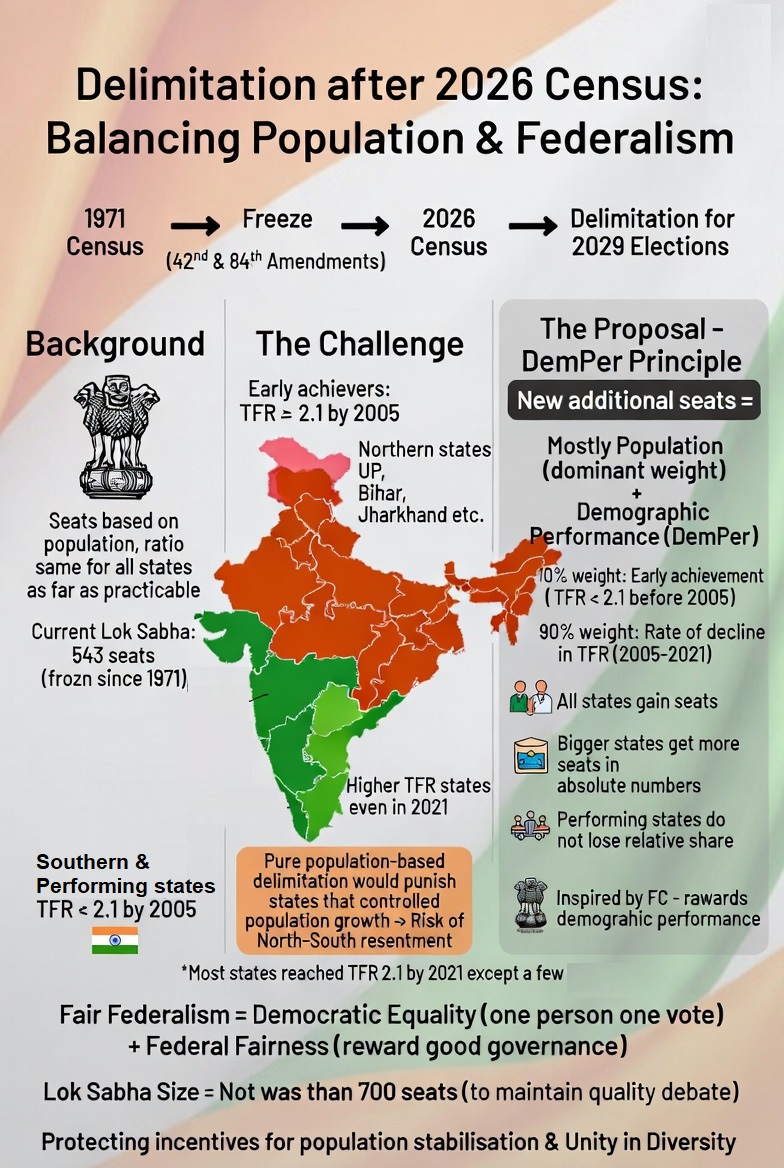
Why the North-South Divide is the Core Problem?
This is the heart of the controversy.
- Southern states (Tamil Nadu, Kerala, Karnataka, Andhra Pradesh, Telangana) controlled their population growth successfully decades ago.
- Northern states (Uttar Pradesh, Bihar, Madhya Pradesh, Rajasthan — earlier often called BIMARU states) grew much faster.
If seats are allocated purely on population, southern states will lose seats (or gain far fewer) compared to northern states, despite having better governance.
This feels deeply unfair to the south — they are being penalised for good performance.
The TFR (Total Fertility Rate) Data
TFR = Average number of children born per woman.
A TFR of 2.1 = replacement level (population stabilises).
| Year | States at TFR ≤ 2.1 |
| 2005–06 (NFHS-3) | 9 states: HP, Punjab, Delhi, Goa, AP, Karnataka, Kerala, Tamil Nadu |
| 2019–21 (NFHS-5) | Almost all major states EXCEPT Bihar, UP, Jharkhand, Meghalaya, Manipur |
Whats the Solution? DemPer (Demographic Performance) Principle:
It is a two-factor model for seat allocation, borrowing logic from the Finance Commission.
Finance Commission Parallel
- The Finance Commission already rewards demographic performance — it uses population (50% weight) + demographic performance + other criteria to distribute funds to states. The same logic can apply to delimitation.
How DemPer Would Work?
Step 1: Keep the existing 543 seats unchanged — no state loses anything.
Step 2: For new/additional seats beyond 543, apply both:
- Population size (dominant factor)
- Demographic Performance (DemPer)
Two Components of DemPer
| Component | What it measures | Weightage |
| Early Achievement | Achieving TFR ≤ 2.1 before 2005 | 10% |
| Rate of Decline | How fast TFR fell between 2005–2021 | 90% |
The 90% weight on rate of decline is significant — it rewards improvement, not just early achievers. So even states like Bihar or UP that are improving fast get credit.
What are the Key Outcomes of DemPer Principle?
- Every state gains seats — no state loses
- More populous states get more seats in absolute numbers — population principle remains dominant
- States that controlled population don’t lose their proportional share — federalism protected
- It incentivises states to keep improving on population management
What is the Ideal Lok Sabha Size?
| Year | India’s Population | Avg. population per seat |
| 1971 | ~54 crore | 10–11 lakh per seat |
| Now | ~140 crore | Much larger |
The Lok Sabha should not exceed 700 seats to keep parliamentary debate meaningful and deep. Going beyond that risks making the House unwieldy.
- Too many MPs → poor debate quality
- Need balance between representation and efficiency
It’s Not Just a North-South Issue
Delimitation fairness is not only a southern states’ concern.
States like Punjab, Haryana, Himachal Pradesh, and Goa in the north and west also controlled their populations early. So the issue is really about rewarding responsible governance across India, not a regional battle.
Conclusion:
Delimitation after 2026 presents a critical challenge of balancing democratic equality with federal fairness. A purely population-based approach risks penalising states that successfully controlled population growth. Incorporating a Demographic Performance-based model, similar to the Finance Commission’s approach, can ensure equitable representation, preserve cooperative federalism, and strengthen the unity of India while maintaining democratic legitimacy.
Mains Questions
- “Delimitation based purely on population undermines cooperative federalism. Critically examine.”
- “Should demographic performance be a criterion in delimitation? Analyse with reference to the Finance Commission model.”
- “The 84th Constitutional Amendment froze Lok Sabha seats till 2026. What are the implications of the upcoming delimitation for federal balance in India?”