Demographic Dividend

Why in news:
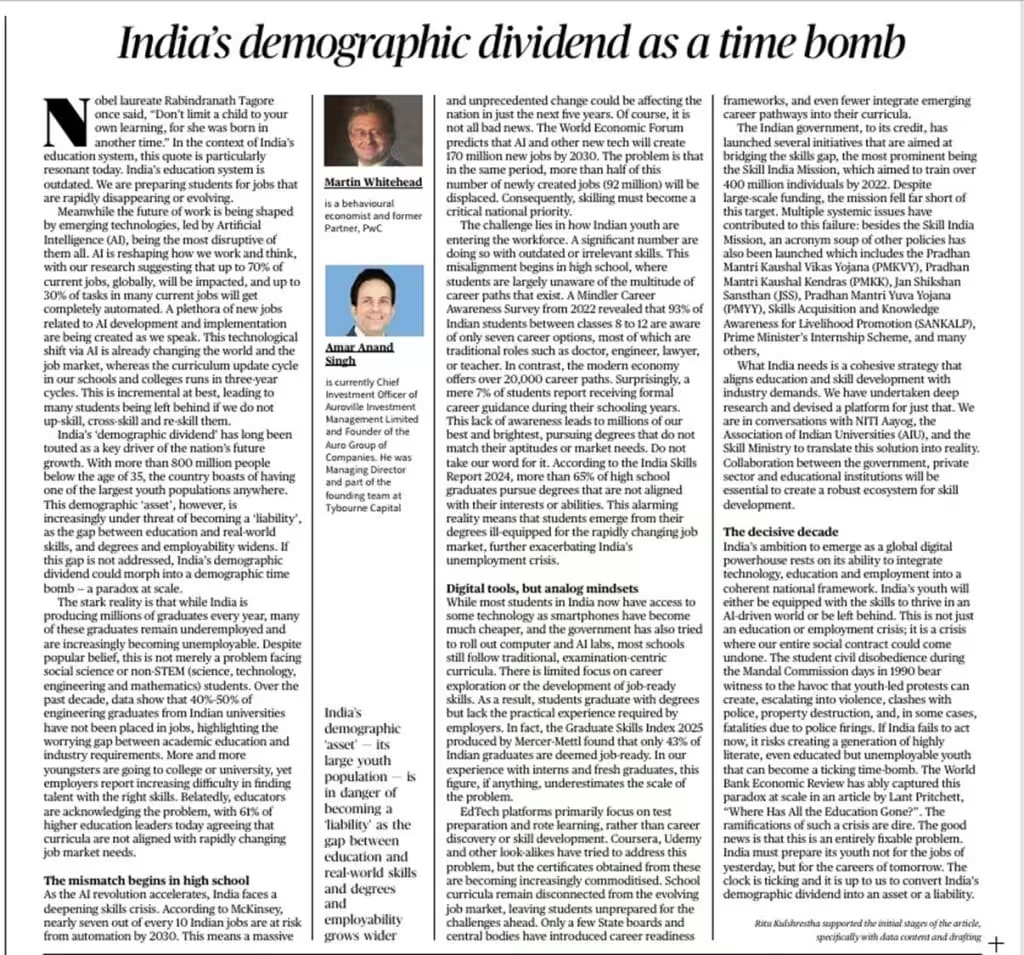
This article highlights the paradox of India’s demographic dividend – while a large youth population is often considered an asset, in India’s case, it is increasingly at risk of turning into a “demographic time bomb.”
UPSC Relevance:
UPSC PYQ 2013:
Q. To obtain full benefits of demographic dividend, what should India do?
(a) Promoting skill development
(b) Introducing more social security schemes
(c) Reducing infant mortality rate
(d) Privatization of higher education
UPSC PYQ 2012:
Q. Consider the following specific stages of demographic transition associated with economic development: (2012)
- Low birthrate with low death rate
- High birthrate with high death rate
- High birthrate with low death rate
Select the correct order of the above stages using the codes given below:
(a) 1, 2, 3
(b) 2, 1, 3
(c) 2, 3, 1
(d) 3, 2, 1
UPSC PYQ 2016:
Q. “Demographic Dividend in India will remain only theoretical unless our manpower becomes more educated, aware, skilled and creative.” What measures have been taken by the government to enhance the capacity of our population to be more productive and employable?
UPSC PYQ 2014:
Q. “While we flaunt India’s demographic dividend, we ignore the dropping rates of employability.” What are we missing while doing so? Where will the jobs that India desperately needs come from? Explain. ?
Key Points from the Article:
- Demographic Dividend Concept
- India has one of the largest youth populations globally, with over 800 million people below the age of 35.
- Challenges Highlighted
- Mismatch of Skills and Jobs:
- India produces millions of graduates every year, but many lack employability due to outdated curricula and insufficient skills.
- Example: 40–50% of engineering graduates remain unemployed or underemployed.
- Technological Disruption:
- AI and automation are reshaping work. Research suggests 70% of current global jobs will be impacted, with 30% completely automated.
- India risks massive job losses if workers are not re-skilled.
- Education Deficit:
- Curricula in Indian schools and universities are not aligned with real-world skills or evolving job market demands.
- 61% of employers believe graduates lack job-ready capabilities.
- Awareness Gap:
- A large portion of youth are unaware of the full range of career opportunities.
- Surveys show 93% of students between classes 8–12 consider only 7 career options (doctor, engineer, lawyer, etc.), ignoring newer fields.
- Mismatch of Skills and Jobs:
What is Demographic Dividend:
Demographic dividend is the economic growth potential a country can achieve when its working-age population (ages 15-64) is significantly larger than its dependent population of children and the elderly.
Understanding India’s demographic dividend
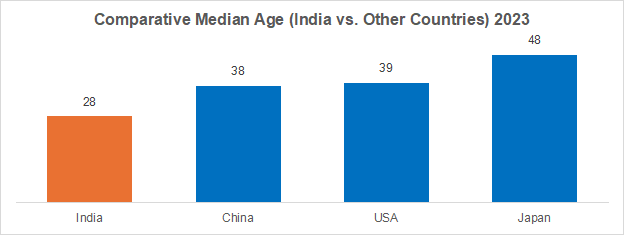
With over 65% of its population under 35 and a median age of 28 compared to 38 in China and 48 in Japan, India possesses a dynamic labour force capable of driving productivity.
Key drivers of India’s demographic dividend:
- Expanding labour force:
- India’s working-age population is expected to grow to 1 billion by 2047, sustaining the demographic dividend well into the next few decades. This increasing labour force is key as many developed nations face shrinking working populations.
- The rise of the gig economy and the spread of digital platforms like Uber, Swiggy, and Zomato have created flexible employment opportunities, particularly for the youth. Remote work models and hybrid job structures are integrating India’s talent pool into the global workforce.
- Urbanisation and economic participation
- Rapid urbanisation has been a driver of India’s economic growth. With 35% of the population residing in cities, this figure is expected to reach 50% by 2050. Urban centres serve as hubs for industrial activity and financial services, creating employment opportunities across sectors.
- The growth of smart cities and large-scale infrastructure projects under the Smart Cities Mission and AMRUT has further accelerated urban development. These initiatives have enhanced urban living standards and expanded employment in construction, real estate, transportation, and utilities.
- Increasing female participation
- Despite the demographic advantage, India’s female labour force participation remains a challenge. The Female Labor Force Participation Rate (FLFPR) stands at 41%, significantly lower than the global average of 47%. Socio-cultural norms, lack of workplace safety, inadequate childcare facilities, and limited access to skill training contribute to this disparity.
- Education and skill development
- A well-educated and skilled workforce is fundamental to leveraging the demographic dividend. While India has made significant strides in improving literacy rates, the focus now shifts to enhancing the quality of education.
- The Skill India Mission and Pradhan Mantri Kaushal Vikas Yojana (PMKVY) have been instrumental in providing vocational training to millions of youth. These initiatives focus on foundational and advanced skills, ranging from IT services and AI to renewable energy and healthcare management.