Digital Tourism Stack: Shared Discovery Across Travel Platforms
Why in News?
The Ministry of Tourism launched the National Digital Tourism Stack initiative on September 27, 2026, with a pilot planned for January 2027.
- The Ministry of Tourism is developing the infrastructure with the Open Network for Digital Commerce (ONDC) and support from ICDIA.
- The programme plans implementation from October 2026, a January 2027 pilot and wider rollout from July 2027.
- Proposed capabilities cover cataloguing, discovery and supplier credentials, alongside payments, ratings and grievance redressal.
- The launch announced a programme; it did not establish that its proposed travel pass or identity services were already available.
- Small tourism providers can remain difficult to discover when their offers are scattered across separate platforms and languages.
- Shared infrastructure could widen market access, but accurate listings and accountable transactions determine whether discovery produces reliable bookings.
UPSC Relevance
Prelims Relevance
- Lead ministry: Ministry of Tourism.
- ONDC: Open Network for Digital Commerce.
- ICDIA: International Centre for DPI Innovation and Advancement.
- Interoperability: participating systems exchange and use information through compatible arrangements.
- Status distinction: announced programme, planned pilot and proposed wider rollout are different implementation stages.
Mains Relevance
GS Paper 2
- Digital public infrastructure, service accountability and inclusion of small providers.
- Coordination among the Centre, States, Union Territories and private platforms.
GS Paper 3
- Competition, transaction costs and market access in the tourism economy.
Essay
- Digital inclusion requires useful participation, not merely online registration.
Background and Context
What makes this a stack?
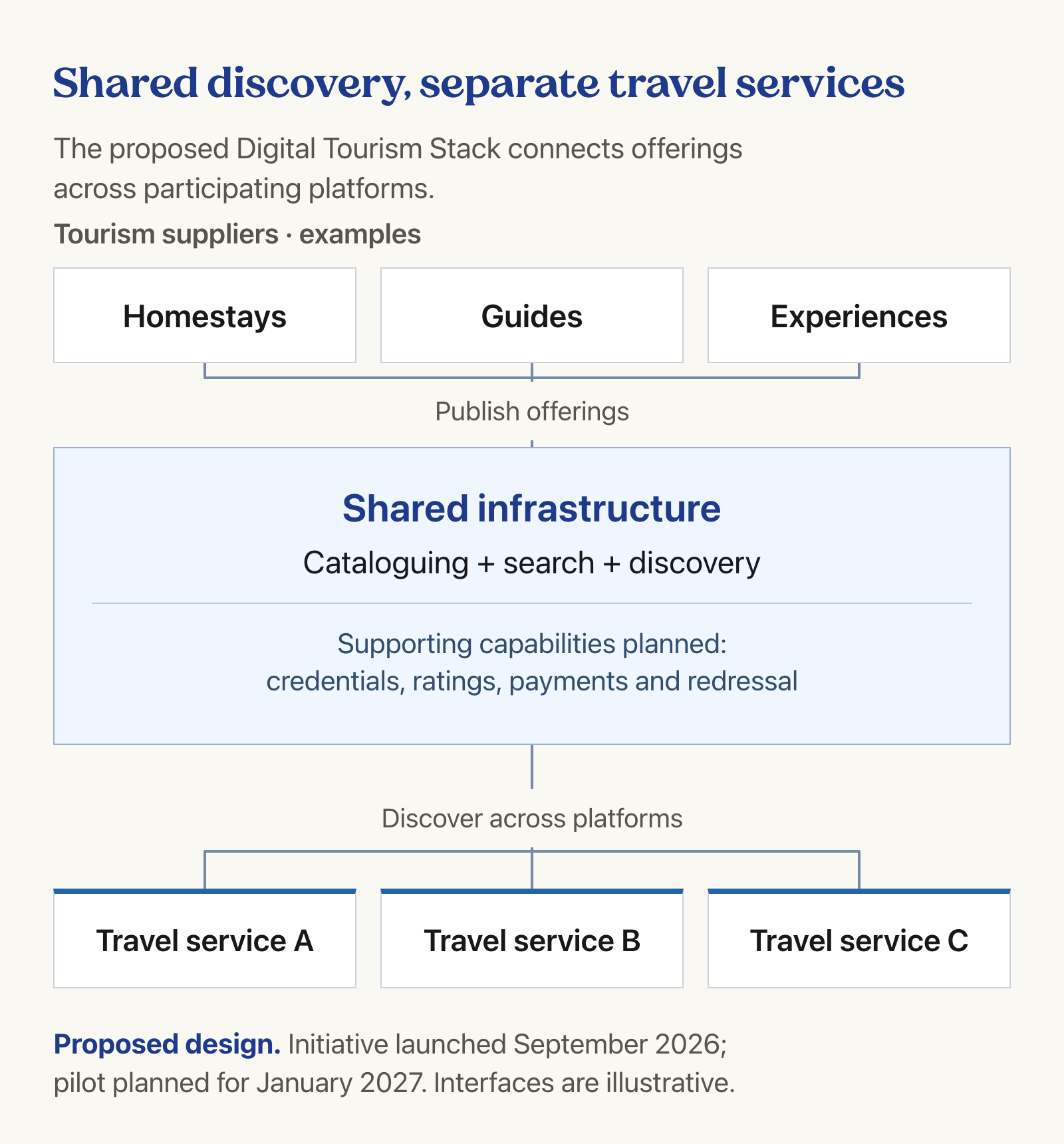
The proposed stack supplies common capabilities on which different tourism businesses can build their own services.
- The programme note describes an open infrastructure layer. Providers would publish offerings through an open network, allowing travellers to discover them across participating platforms without requiring one uniform booking interface.
- A traveller-facing platform handles the user experience: searching, comparing and arranging a trip. Shared capabilities can support that experience while different businesses retain their own services and presentation.
- A catalogue describes what is offered. For a guide or homestay, usable descriptions must distinguish the service, availability and conditions; digitising an incomplete listing does not make it reliably bookable.
- The practical problem is fragmentation: offerings are dispersed across platforms and languages, while some remain offline. Shared discovery aims to make those suppliers easier to find through participating services.
- Like the proposed land stack, the relevant distinction is between digitised records and reusable infrastructure. Tourism applies that distinction to service discovery and transactions.
From discovery to a trustworthy transaction
A search result becomes useful only when the traveller and supplier can complete a dependable transaction.
- Supplier credentials would help establish who provides a service. Credentials and customer ratings answer different questions: verified identity alone cannot establish the quality of every future experience.
- Ratings and reviews are planned trust inputs. Their usefulness depends on authentic feedback and correction mechanisms; a large number of reviews cannot substitute for clear service terms or accountable providers.
- Payment assurance for suppliers is a proposed capability. It should be read as an implementation objective, rather than an announced universal government guarantee covering every failed tourism transaction.
- Grievance redressal matters when discovery, payment and service delivery involve different actors. A traveller needs a clear route to raise a complaint without being passed indefinitely between participating businesses.
- A homestay example illustrates the intended logic: a provider publishes an offering, a traveller discovers it through a participating platform, and supporting capabilities help booking and use. This describes the design, not observed deployment.

What remains to be demonstrated
The launch establishes policy direction; the pilot must show that participating services can work together in practice.
- The programme timetable separates initial implementation, pilot and wider rollout. These milestones are plans; they provide no evidence yet of completed national coverage or successful transactions across the network.
- Verified traveller identity and UPI-based options for foreign travellers are envisaged. The source does not establish that every visitor can already use them through the new stack.
- The longer-term integrated travel pass could combine access to experiences, monuments and transport. It is a vision, not evidence of a currently usable nationwide pass or uniform admission entitlement.
- Small-provider inclusion needs practical onboarding, usable language options and help correcting listings. A technically open network can still exclude businesses that cannot maintain availability or respond to booking requests.
- Transaction infrastructure differs from the Domestic Tourism Survey: the stack concerns service discovery and exchange, while a survey estimates travel patterns. One cannot replace the other.
Way Forward
Test the complete service journey
- Evaluate the pilot through cross-platform discovery and completed bookings, including whether small providers can maintain accurate offers.
- Specify complaint ownership, refund procedures and supplier payment terms before increasing participation.
- Make identity-data handling and consent understandable; collect only what the specific transaction requires.
- Publish pilot findings and unresolved failures so wider rollout follows demonstrated service reliability.
Conclusion
- The Digital Tourism Stack offers an infrastructure approach to fragmented tourism services. Its value depends on whether separate platforms can discover, transact and resolve problems reliably.
- For governance analysis, distinguish open access, verified trust and operational performance. A launch announcement establishes intent; implementation evidence must establish the benefits.
UPSC Practice Questions
Prelims MCQ 1
With reference to the National Digital Tourism Stack, consider the following statements:
- It is designed as shared infrastructure supporting discovery across participating platforms.
- Its announcement established that a nationwide integrated travel pass was already operational.
- The Ministry of Tourism is developing it in collaboration with ONDC.
How many of the above statements are correct?
(a) Only one (b) Only two (c) All three (d) None
Answer: (b) Only two
Explanation:
Statements 1 and 3 are correct. The integrated travel pass is a longer-term vision; the programme note does not describe it as operational.
Prelims MCQ 2
Which distinction best explains the proposed Digital Tourism Stack?
(a) It replaces all travel businesses with a single booking agency. (b) It measures household tourism through survey recall periods. (c) It provides shared capabilities while businesses develop traveller-facing services. (d) It guarantees the quality of every service once a supplier is identified.
Answer: (c) It provides shared capabilities while businesses develop traveller-facing services.
Explanation:
The programme envisages shared infrastructure for discovery, credentials and transactions, supporting services developed by participating businesses.
UPSC Mains Questions
- How can shared digital infrastructure improve market access for small tourism providers? Discuss the governance conditions required for reliable transactions.
- Distinguish a digital platform from a shared digital infrastructure layer, using the National Digital Tourism Stack as an example.
Sources: PIB, Ministry of Tourism and Ministry of Tourism programme note.
Frequently Asked Questions
What is the National Digital Tourism Stack?
It is a proposed shared digital infrastructure layer intended to make tourism offerings discoverable across participating platforms, supported by capabilities such as supplier credentials, payments, ratings and grievance redressal.
Is the Digital Tourism Stack already fully operational?
The initiative was launched on September 27, 2026, but implementation remains phased. Its programme note plans a January 2027 pilot and wider rollout from July 2027; proposed capabilities are not confirmed live services.
Will it create one compulsory tourism booking app?
The programme describes shared infrastructure through which participating businesses can develop their own traveller-facing services. It does not describe replacing all travel platforms with one compulsory government booking application for travellers.
How do credentials differ from customer ratings?
Credentials help establish who a supplier is, while ratings communicate customer assessments of experiences. Neither alone guarantees future service quality; clear terms, authentic feedback and effective complaint handling remain necessary.