DRDO DURGA-II: India’s 100 kW Laser Weapon Enters Navy Trials
Why in News?
In April 2026, the Defence Research and Development Organisation (DRDO) confirmed that its DURGA-II directed-energy weapon, rated at the 100 kW class, has entered Indian Navy trials. The system is being mounted on an Offshore Patrol Vessel for harbour-defence and anti-drone evaluation off the Visakhapatnam coast.
The announcement follows DRDO’s earlier public demonstration of the 30 kW Mk-II laser dazzler-and-soft-kill system in April 2025 at the Kurnool test range, conducted before the Indian Air Force. The Mk-II could blind sensors and disable fixed-wing drones at short ranges. DURGA-II moves India from soft-kill to kinetic-kill capability against fast-moving aerial threats.
Momentum has come from two operational shocks. The Russia-Ukraine war, now into its fifth year, has normalised swarm-drone warfare at the tactical edge. And the October 2025 Jammu and Punjab swarm attacks, in which dozens of low-cost drones tested Indian air defence along the western border, exposed the cost-exchange problem of using expensive missile interceptors against cheap unmanned aerial systems.
UPSC Relevance at a Glance
| Dimension | Coverage |
|---|---|
| GS Paper | GS3 – Defence Technology, Internal Security, Science and Technology |
| Prelims | DURGA-II, CHESS, LASTEC, DRDO, directed-energy weapons, HELWS, Iron Beam |
| Mains | Counter-drone doctrine, indigenisation, cost-exchange, strategic deterrence |
| Syllabus Tags | Indigenous technology, security challenges, border management |
Background and Context
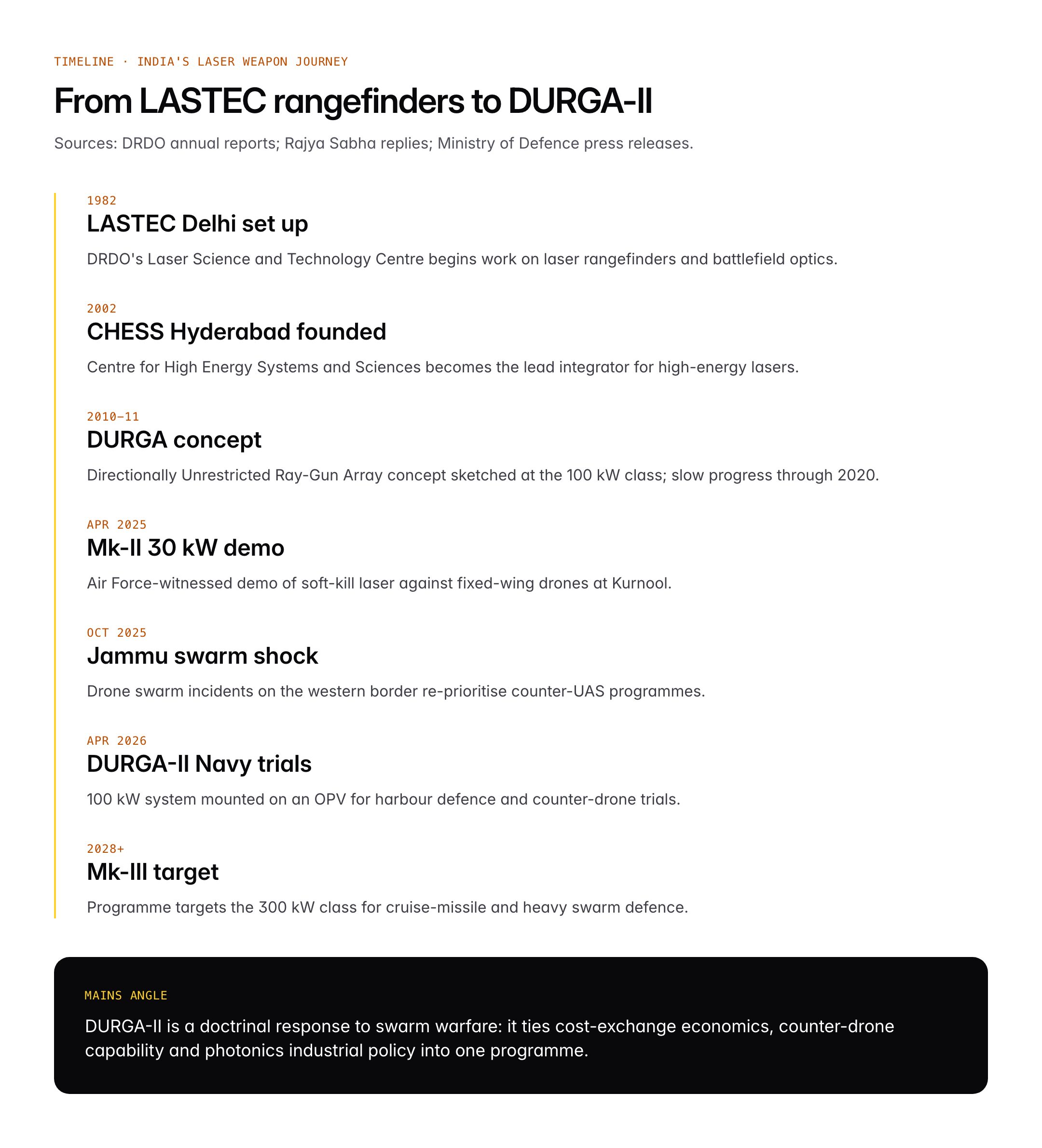
Directed-energy weapons (DEWs) use concentrated electromagnetic energy, typically lasers or high-power microwaves, to damage or destroy targets. DEW research in India began in the early 1980s at the Laser Science and Technology Centre (LASTEC), Delhi, a DRDO lab originally focused on ballistic laser rangefinders. In 2002, DRDO set up the Centre for High Energy Systems and Sciences (CHESS) in Hyderabad as the lead integrator for high-energy laser platforms.
The first conceptual designs of DURGA (Directionally Unrestricted Ray-Gun Array) were floated around 2010-11. These envisaged a naval-mounted laser at the 100 kW class, but progress stalled for a decade because of the twin bottlenecks of high-power fibre lasers and beam-director optics.
Three exogenous shocks reopened the programme. First, the cost-exchange crisis in Ukraine, where a Rs 15-25 lakh surface-to-air missile was being used to intercept Rs 1-2 lakh drones. Second, the debut of operational DEWs abroad: the United States deployed HELWS on Stryker vehicles and a 50 kW laser on USS Preble; Israel advanced the Iron Beam for mortar and rocket defence in the 2024-25 window; and China openly displayed the Silent Hunter truck-mounted laser for export. Third, the 2025 border drone incidents inside India.
DRDO compressed its roadmap. The 30 kW Mk-II was demonstrated in April 2025. DURGA-II, in the 100 kW class, was bench-tested through 2025 and rolled into Navy trials in April 2026. A Mk-III programme at the 300 kW class is in concept phase, aimed at countering cruise missiles and heavier swarms by the end of the decade.
Key Features of DURGA-II
Architecture and engineering
- Hybrid laser core: DURGA-II combines a fibre laser array with a solid-state laser stage, which gives it modular scalability, better beam quality and a more compact footprint than chemical lasers.
- Power and thermal budget: The system is rated at the 100 kW class output, drawn from an onboard power pack with about 1 MW of thermal management for cooling the laser head and electronics.
- Beam director: A stabilised gimbal with adaptive optics compensates for atmospheric turbulence and platform motion. Tracking is cued by radar and electro-optical sensors.
- Engagement envelope: Estimated effective range of about 5 km against small unmanned aerial systems, mortars, and unguided rockets. Engagement time per target is in single-digit seconds.
- Platform: Initial trials on an Indian Navy Offshore Patrol Vessel. Army and Air Force variants are planned on truck and shelter platforms.
Kill chain and doctrine
- Dazzle mode: Low-power sensor denial, inherited from Mk-II.
- Soft-kill mode: Disable optical and electronic payloads.
- Hard-kill mode: Structural damage to airframe or warhead, enabled by the 100 kW class output.
Institutional anchor
- CHESS Hyderabad leads integration; LASTEC Delhi supplies the beam source; private industry partners include Tata Advanced Systems, L&T and Paras Defence for optics and power electronics.
- The Integrated Defence Staff coordinates doctrine and tri-service trials.
Cost-exchange logic
DRDO’s internal estimate puts the cost per engagement at Rs 5-10 lakh, compared with Rs 15-25 lakh for a surface-to-air missile interceptor. For drones priced at Rs 1-5 lakh, this reverses the cost-exchange ratio that currently favours the attacker.
Significance
- Strategic deterrence against low-cost drone swarms, anti-ship missiles in terminal phase and loitering munitions, a capability the Indian armed forces lacked until now.
- Reduces the cost-exchange penalty. Every successful laser engagement saves up to 20x the per-shot cost of a conventional interceptor.
- Places India in a small DEW club with the United States, Israel, China, Russia and the United Kingdom, raising its profile in defence technology diplomacy and potential exports under the Rs 50,000 crore defence export target.
- Validates the indigenisation push under Atmanirbhar Bharat Defence, with over 70 percent domestic content across the beam source, power pack and optics.
- Creates a platform for civil-military spinoffs in industrial laser cutting, additive manufacturing and atmospheric sensing.
- Answers the October 2025 swarm attack lesson directly, giving border and high-value asset defenders a scalable counter-swarm tool.
Concerns, Criticisms and Challenges
The DURGA-II programme is promising but not problem-free.
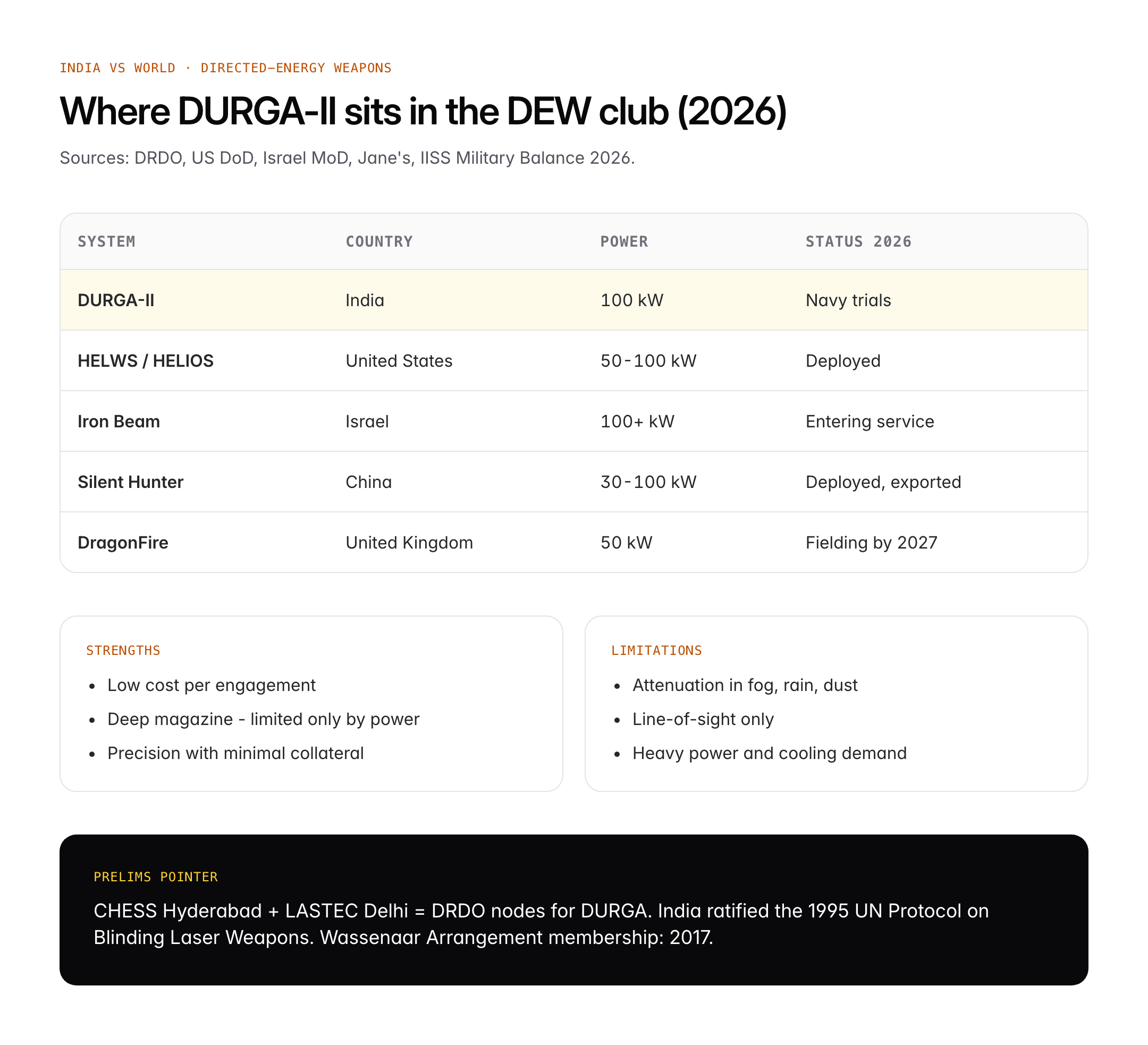
- Atmospheric limitation. Laser beams attenuate in rain, fog and dust. Effective range drops sharply in humid coastal conditions, the very environment the Navy trial is evaluating. Desert and high-altitude performance is yet to be published.
- Power and cooling. Sustaining the 100 kW beam for sequential engagements requires large power packs and thermal stores. Integration on smaller Army vehicles remains an open engineering challenge.
- Line-of-sight constraint. DEWs cannot engage targets beyond the horizon or behind terrain, unlike surface-to-air missiles with datalink guidance.
- Export controls. Key photonics components are covered by the Wassenaar Arrangement dual-use list; while India is a member since 2017, certain pump diodes and high-damage-threshold coatings still require import.
- Doctrine and escalation. A blinding-capable laser raises obligations under the 1995 UN Protocol on Blinding Laser Weapons, which India ratified. Rules of engagement will have to separate soft-kill from hard-kill modes clearly.
- Counter-DEW measures. Adversaries are already experimenting with ablative coatings, retro-reflective countermeasures and hardened sensors. The advantage window may be shorter than optimism suggests.
- Budgetary scale. Moving from Mk-II to a 300 kW Mk-III will require sustained R&D funding, which competes with recurring modernisation outlays under the Defence Services Estimates.
Comparative and Historical Perspective
| System | Country | Power class | Platform | Status 2026 |
|---|---|---|---|---|
| DURGA-II | India | 100 kW | OPV, Army vehicles (planned) | Navy trials, Apr 2026 |
| HELWS / DE M-SHORAD | United States | 50-100 kW | Stryker, naval | Deployed |
| Iron Beam | Israel | 100+ kW | Fixed site | Entering service, 2025-26 |
| Silent Hunter | China | 30-100 kW | Truck | Deployed, exported |
| Peresvet / Zadira | Russia | Classified | Fixed / mobile | Limited operational |
| DragonFire | United Kingdom | 50 kW class | RN ships | Fielding by 2027 |
India’s 2026 entry brings it within a decade-adjusted parity with the US 2014 LaWS demonstration at 30 kW, and 2021-22 Navy HELIOS at 60 kW. The Mk-III 300 kW target closes this gap meaningfully.
Way Forward
- DRDO and the Integrated Defence Staff should finalise joint counter-drone doctrine that blends DURGA-II with point-defence guns and electronic warfare, not as a standalone system.
- MoD Department of Defence Production should accelerate private-sector orders for beam directors and power electronics to crowd-in investment, following the iDEX – ADITI framework.
- Ministry of External Affairs should proactively engage CCW Protocol IV and export-control forums to shape DEW norms, not lag them.
- Ministry of Defence should fast-track an Integrated Air and Missile Defence Command so that DEWs, missiles and electronic warfare report to a single command chain.
- DST-DRDO-IISc should fund a photonics mission to domesticate pump diodes, fibre laser combiners and high-damage optical coatings.
- Indian Navy, Army and Air Force should conduct a tri-service integration exercise in 2027 to validate DURGA-II against swarm targets in coastal, desert and mountain conditions.
- NITI Aayog and DPIIT should ensure dual-use spinoffs in industrial lasers reach MSMEs, following the ISRO-style technology transfer playbook.
Conclusion
DURGA-II is not merely a prestige weapon. It is a doctrinal response to a world where the cheapest attacker has the advantage. By demonstrating a 100 kW laser on an operational Navy platform in April 2026, India has bought itself a counter-swarm capability that matches the operational lessons of Ukraine and Jammu 2025.
The programme is still short of the 300 kW threshold that makes DEWs a true cruise-missile and fast-jet defence, and the atmospheric, doctrinal and industrial challenges are real. Yet the direction is correct. If India can pair DURGA-II with coherent tri-service doctrine, export-control diplomacy and a deep photonics supply chain, it will be among the first middle powers to normalise directed-energy weapons in day-to-day force structure. See related coverage on Agni-P Missile, Apache Helicopter and Nuclear Weapon Technologies.
Prelims Pointers
- DURGA-II expands to Directionally Unrestricted Ray-Gun Array, Phase II.
- Rated at 100 kW class, up from Mk-II 30 kW demonstrated April 2025.
- Developed by CHESS Hyderabad and LASTEC Delhi under DRDO.
- Hybrid architecture: fibre laser plus solid-state stage.
- Estimated engagement range about 5 km.
- Mk-III target 300 kW class for cruise missile and heavy swarm defence.
- Cost per engagement Rs 5-10 lakh versus Rs 15-25 lakh per missile interceptor.
- India ratified the 1995 UN Protocol on Blinding Laser Weapons.
- Foreign comparators: US HELWS, Israel Iron Beam, China Silent Hunter, UK DragonFire.
- First platform for trials: Indian Navy Offshore Patrol Vessel.
- India joined the Wassenaar Arrangement in 2017.
- IDS, the Integrated Defence Staff, coordinates tri-service DEW doctrine.
Mains Practice Question
Q. Directed-energy weapons are reshaping the economics of air defence. Critically examine the strategic and doctrinal implications of DRDO’s DURGA-II programme for India’s counter-drone capability. (15 marks, 250 words)
- Describe DURGA-II specifications, CHESS-LASTEC lineage, Navy trial context and the Mk-II to Mk-III roadmap.
- Analyse its implications for cost-exchange, strategic deterrence and counter-swarm operations after Ukraine and the October 2025 Jammu incidents.
- Identify atmospheric, industrial, export-control and doctrinal limits, and outline a tri-service integration plan.
Frequently Asked Questions
What is DURGA-II?
DURGA-II stands for Directionally Unrestricted Ray-Gun Array, Phase II. It is a 100 kW class directed-energy laser weapon developed by DRDO through CHESS Hyderabad and LASTEC Delhi. The system uses a hybrid fibre plus solid-state laser architecture and is designed to destroy small drones, mortars and rockets at ranges of about five kilometres.
Why is DURGA-II in news in April 2026?
In April 2026, DRDO confirmed that DURGA-II has entered Indian Navy trials aboard an Offshore Patrol Vessel off the Visakhapatnam coast. This marks India’s jump from the 30 kW Mk-II dazzler demonstrated in April 2025 to a 100 kW kinetic-kill laser, placing India in the same directed-energy weapons club as the United States, Israel and China.
How is DURGA-II different from the Mk-II laser shown in 2025?
The 30 kW Mk-II was a soft-kill system. It could blind sensors and disable small drones at short range but could not structurally damage a fast-moving target. DURGA-II at 100 kW offers kinetic-kill capability, structurally destroying airframes, optics and warheads, and can be mounted on naval and mobile platforms.
What is the cost-exchange advantage of directed-energy weapons?
DRDO estimates DURGA-II’s cost per engagement at Rs 5-10 lakh of electricity and consumables, against Rs 15-25 lakh per surface-to-air missile interceptor. When the target drone itself costs Rs 1-5 lakh, lasers reverse the attacker’s cost advantage that swarm tactics exploit, as seen in Ukraine and the October 2025 Jammu incidents.
Which agencies developed DURGA-II?
The Centre for High Energy Systems and Sciences (CHESS) in Hyderabad led integration, with the beam source supplied by the Laser Science and Technology Centre (LASTEC) in Delhi. Both are DRDO laboratories. Private sector partners include Tata Advanced Systems, L&T and Paras Defence for optics, power electronics and structural elements.
What are the limitations of laser weapons like DURGA-II?
Laser beams attenuate sharply in fog, rain and dust, reducing effective range. Sustained fire demands heavy power and thermal management. The system is line-of-sight only and cannot engage beyond the horizon. Dual-use photonics components face export-control restrictions under the Wassenaar Arrangement, and counter-DEW measures like ablative coatings are already in development.
How does this affect UPSC Prelims and Mains?
For Prelims, remember DURGA-II full form, 100 kW rating, CHESS and LASTEC, Navy trial in April 2026, and foreign equivalents like HELWS and Iron Beam. For Mains GS3, DURGA-II supports answers on indigenous defence technology, counter-drone doctrine, cost-exchange economics, border management and India’s place in the global directed-energy weapons club.
How does India compare with the global DEW club?
The US deploys HELWS at 50-100 kW on land and naval platforms, Israel is fielding Iron Beam at 100 kW plus, China exports the Silent Hunter, and the UK is fielding DragonFire by 2027. India at 100 kW in 2026 closes the parity gap. DRDO’s Mk-III roadmap at 300 kW plus aims to bring cruise-missile class defence within reach by the late 2020s.