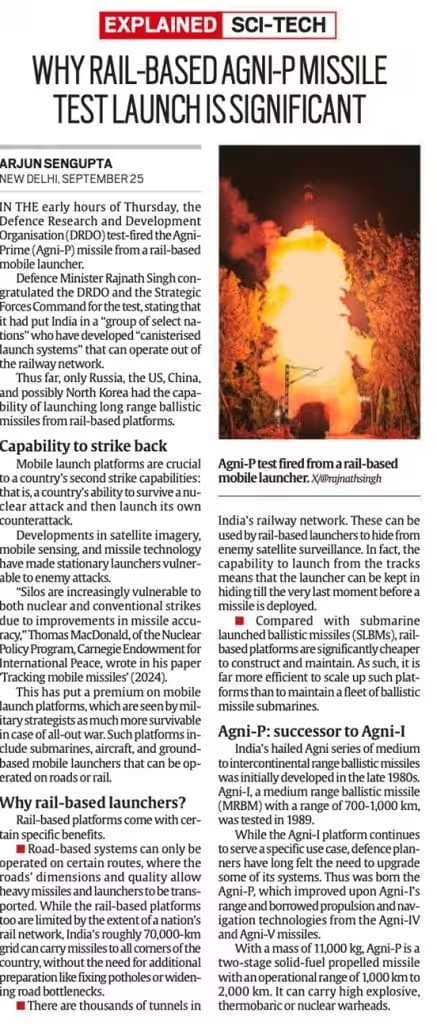
Context:
India has become the latest country to conduct rail-based missile launching, only after Russia, USA, China and possibly North Korea.
UPSC Relevance:
Important defense related developments of India.
PYQ:
Q. Consider the following statements
1. Ballistic missiles are jet-propelled at subsonic speeds throughout their fights, while cruise missiles are rocket-powered only in the initial phase of fight.
2. Agni-V is a medium-range supersonic cruise missile, while BrahMos is a solid-fuelled intercontinental ballistic missile.
Which of the statements given above is/are correct?
[A] 1 only
[B] 2 only
[C] Both 1 and 2
[D] Neither 1 nor 2
About Agni-P missile:

- Agni Prime is a nuclear-capable new-generation advanced variant of the Agni class of missiles. It is a two-stage solid- fuel canister missile with a maximum range of 1,000 to 2,000 km.
- It is lighter than all the earlier Agni series of missiles.
- It is equipped with the Multiple Independently Targetable Re-entry Vehicle (MIRV) technology.
Advantage of rail-based launchers:
- India’s roughly 70,000 km railway grid can carry missiles to all corners of the country, without the need for additional preparation like fixing potholes or widening road bottlenecks.
- The Presence of thousands of tunnels in India’s railway network can be used by rail-based launchers to hide from enemy satellite surveillance.
- Rail-based platforms are significantly cheaper to construct and maintain as compared to submarine launched ballistic missiles.
Agni-P, which combines Agni-I’s range with propulsion and navigation technologies borrowed from the Agni-IV and Agni-V missiles.
Tell Google you want more of this.
Add Anantam IAS as a preferred sourceOne tap, and this site shows up more often in your own Top Stories, AI Overviews and AI Mode. Remove it any time.