Election Commission- Crisis of Credibility
Context: On June 24, the Election Commission of India (ECI) announced the commencement of the Special Intensive Revision (SIR) of electoral rolls of Bihar, entailing the verification of nearly 8 crore voters. The ECI also declared that the SIR exercise would be extended to the entire country. Lack of transparency has continued to characterise the exercise on the ground, raising concerns about the credibility of the process.

UPSC Relevance:
GS 2, Appointment to various Constitutional Posts, Powers, Functions and Responsibilities of various Constitutional Bodies.
PYQ:
Mains 2022: Discuss the role of the Election Commission of India in light of the evolution of the Model Code of Conduct.
Mains 2017: To enhance the quality of democracy in India the Election Commission of India has proposed electoral reforms in 2016. What are the suggested reforms and how far are they significant to make democracy successful?
Election Commission of India
Why?
India, being a vast and diverse democratic republic, requires an independent and autonomous body to ensure that the electoral process is free, fair, and transparent. The Election Commission of India (ECI) was envisaged to play this crucial role, preventing the electoral system from being influenced by the executive branch of the government or political parties.
Constitutional Provisions
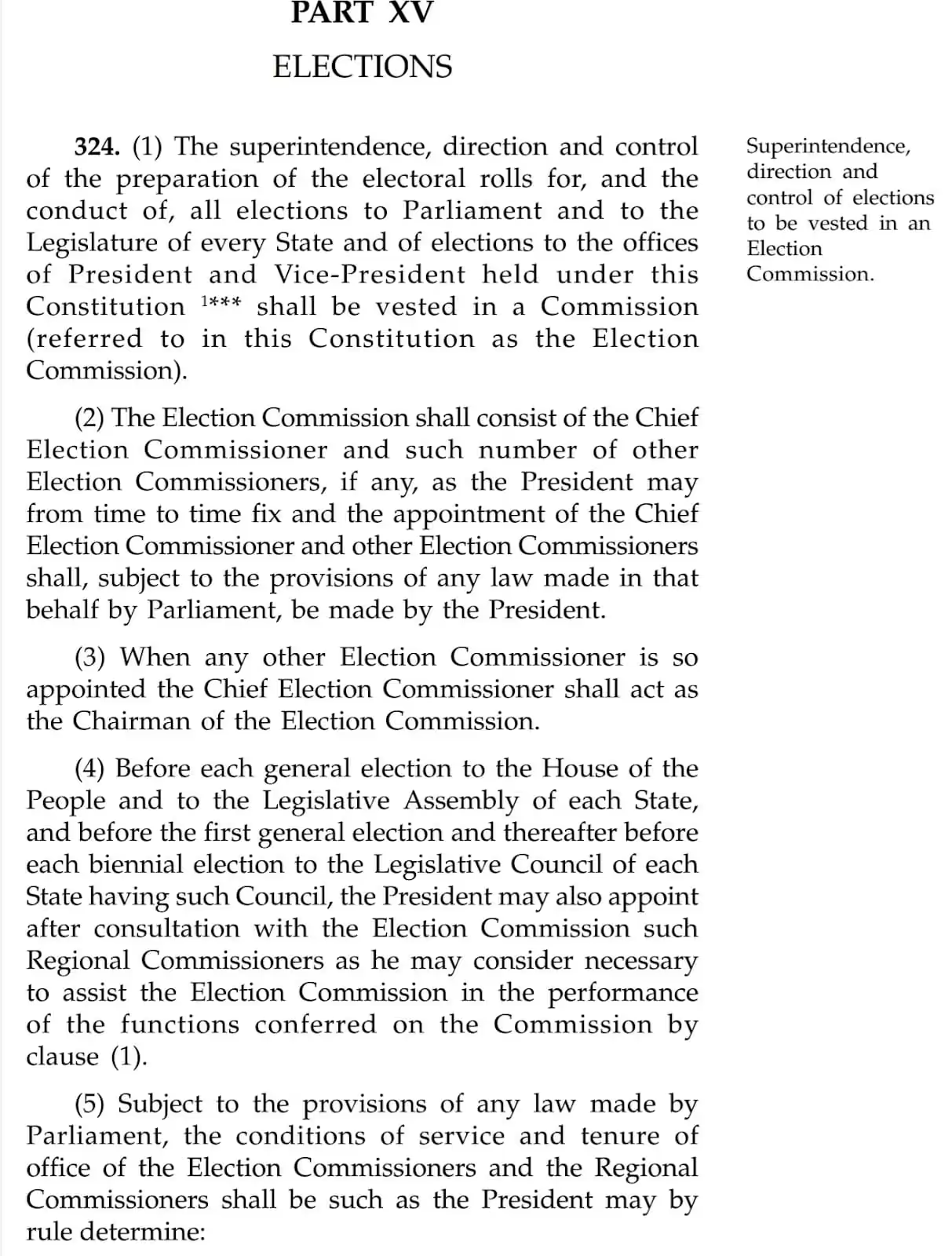
Article 324 grants the Election Commission the “superintendence, direction, and control” of the preparation of electoral rolls and the conduct of all elections to Parliament, State Legislatures, and the offices of the President and Vice-President.
Composition [1+2]
The Election Commission of India is a multi-member body.
- Chief Election Commissioner (CEC): The ECI is headed by a Chief Election Commissioner.
- Other Election Commissioners (ECs): The President can appoint a number of other Election Commissioners as deemed necessary. Since 1993, the commission has consisted of one Chief Election Commissioner and two Election Commissioners.
- Chairman: When other Election Commissioners are appointed, the Chief Election Commissioner acts as the Chairman of the Election Commission.
- Decision-Making: The CEC does not have overruling powers. All decisions are taken by a majority vote among the three members.
Appointment Process
- Constitutional Mandate: The Constitution of India specifies that the President shall appoint the CEC and other ECs, subject to the provisions of any law made by Parliament.
- The Chief Election Commissioner and Other Election Commissioners (Appointment, Conditions of Service and Term of Office) Act, 2023 now governs the appointment process.
- Selection Committee: According to the 2023 Act, the President appoints the commissioners based on the recommendation of a Selection Committee consisting of:
- The Prime Minister (as Chairperson)
- The Leader of the Opposition in the Lok Sabha (or the leader of the single largest opposition party)
- A Union Cabinet Minister nominated by the Prime Minister
- Search Committee: A Search Committee, headed by the Law Minister, suggests a panel of names to the Selection Committee.
Tenure and Removal:
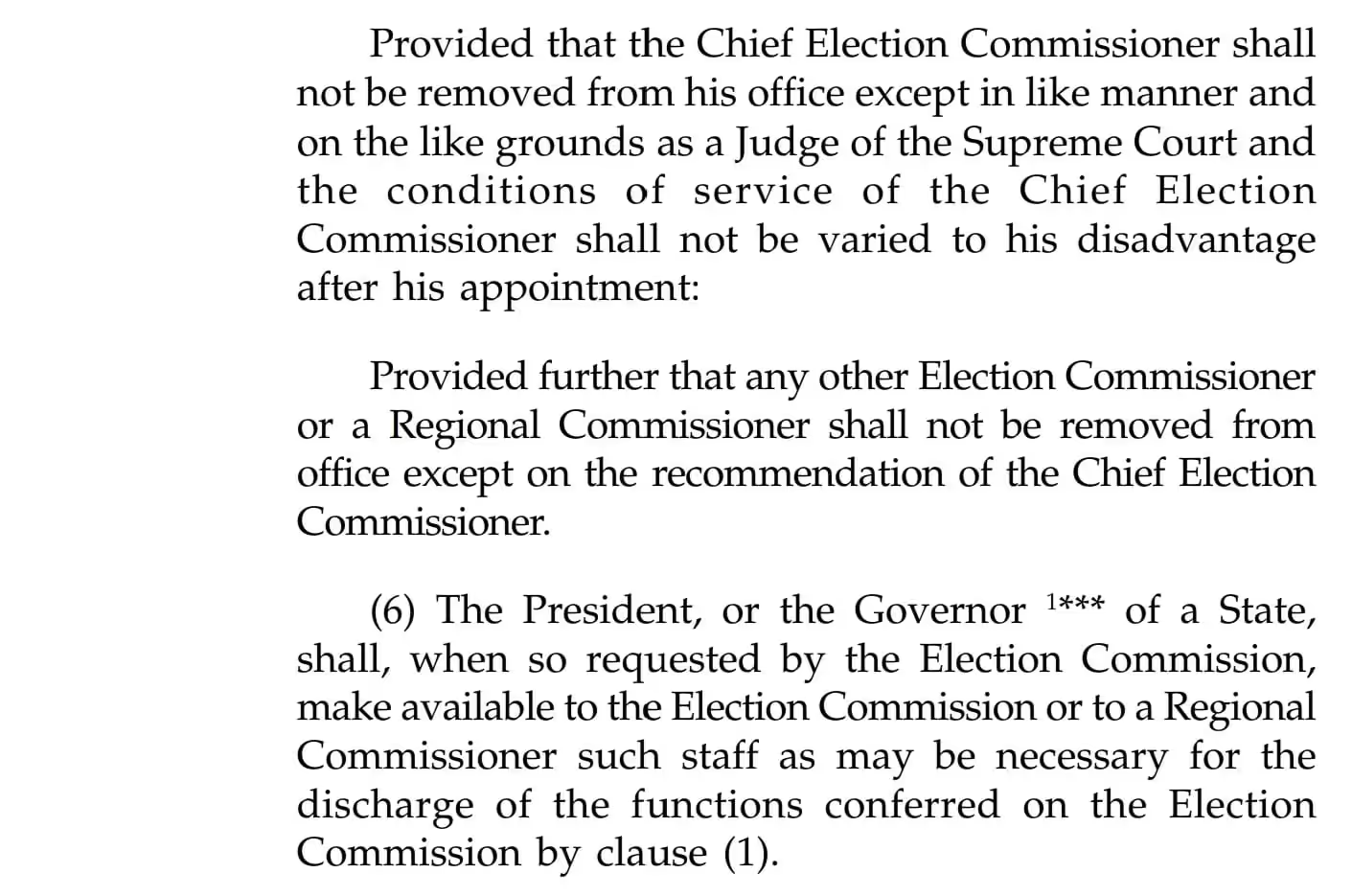
- The conditions of service and tenure of the CEC and other Election Commissioners are determined by the President, subject to any law made by Parliament.
- The CEC cannot be removed from office except in the same manner and on the same grounds as a judge of the Supreme Court.
- Other EC’s cannot be removed from office except on the recommendation of the CEC.
Staff: The President and the Governor of a state are required to make available to the Election Commission any staff that is necessary for the discharge of its functions, when requested by the Commission.
Salary: As per the 2023 Act, the salary and other conditions of service of the CEC and ECs are now equivalent to that of the Cabinet Secretary of the Government of India.
Eligibility: The Constitution of India does not explicitly prescribe any specific qualifications. The 2023 Act specifies that a person must be holding or have held a post equivalent to the Secretary to the Government of India. They must also possess integrity and experience in managing and conducting elections.
Powers and Functions
The ECI has wide-ranging powers to ensure free and fair elections. These include:
- Conducting Elections: The ECI has the superintendence, direction, and control of the entire process for conducting elections to the Parliament, state legislatures, and the offices of the President and Vice-President.
- Insulation from Executive Interference: The Constitution has designed the ECI to be insulated from political pressure. It sets election schedules, determines polling locations, and manages all related logistics.
- Voter Management: The ECI is responsible for preparing and updating electoral rolls, ensuring all eligible citizens are registered, and issuing voter identification cards (EPIC).
- Political Party Regulation: It registers and recognizes political parties and ensures they maintain internal party democracy by holding periodic organizational elections. It also allots election symbols to them and solve disputes related to symbols.
- Code of Conduct: The ECI enforces a Model Code of Conduct to ensure a level playing field for all political parties and candidates during elections, preventing unfair practices.
- Advisory and Quasi-Judicial Functions: The ECI provides opinions to the President or Governor on matters of post-election disqualification of sitting members of Parliament or state legislatures. It also has the power to disqualify candidates for failing to lodge election expense accounts.
Measures ensuring independence of ECI
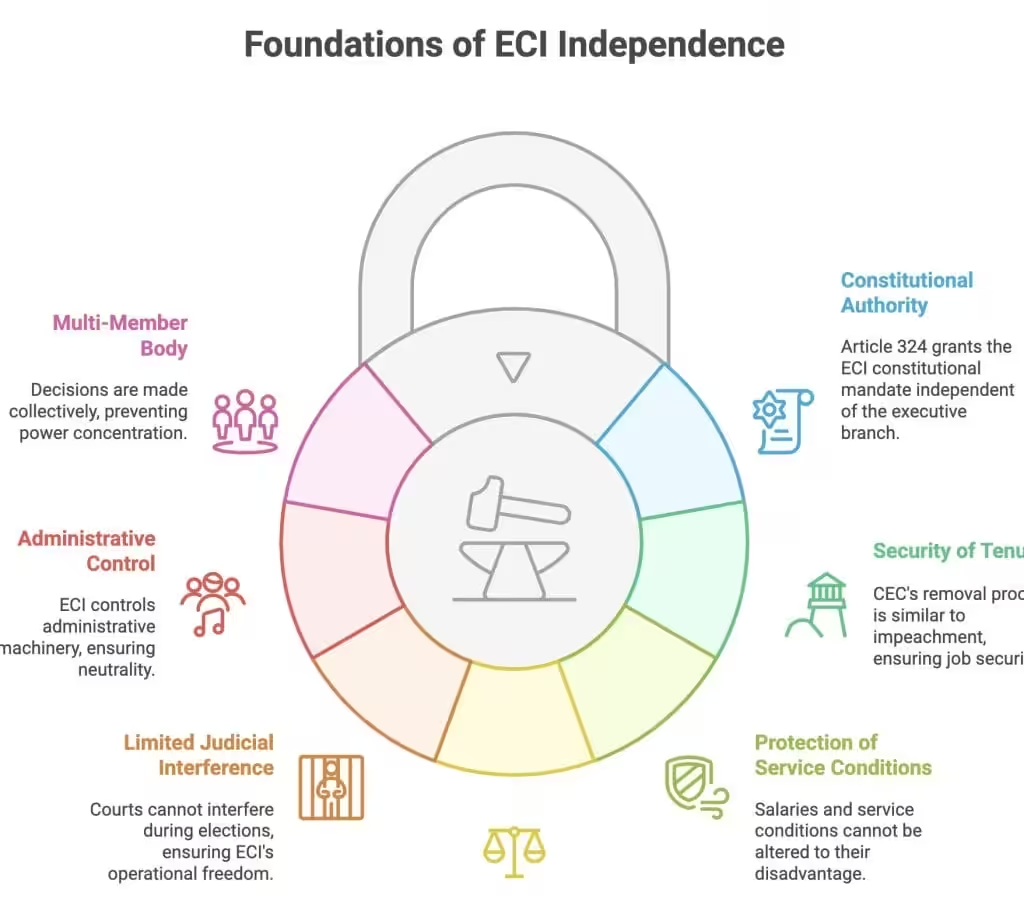
- Constitutional Authority: Article 324 of the Constitution explicitly vests the “superintendence, direction, and control” of elections in the ECI, giving it a constitutional mandate independent of the executive branch.
- Security of Tenure: The Chief Election Commissioner (CEC) has a secure tenure and can only be removed from office through a process similar to the impeachment of a Supreme Court judge. This requires a special majority in both Houses of Parliament on the grounds of “proved misbehaviour or incapacity.” This provision prevents the government from removing the CEC at will.
- Other EC’s can only be removed from office on the recommendation of the CEC. This acts as a safeguard against the government unilaterally removing ECs.
- Protection of Service Conditions: The salary and service conditions of the CEC and other Election Commissioners (ECs) cannot be altered to their disadvantage after their appointment. This protects them from financial pressure.
- Quasi-Judicial Role: The ECI acts as a quasi-judicial body for resolving disputes related to political party symbols and other election matters, further strengthening its autonomy.
- Limited Judicial Interference: Article 329 bars courts from interfering in electoral matters during the election process, except through an election petition filed after the election is over. This ensures the ECI can carry out its functions without constant judicial interruption.
- Administrative Control: The ECI has extensive control over the administrative machinery during elections. It can transfer, suspend, or take disciplinary action against government officers assigned to election duties, ensuring they act in a neutral and non-partisan manner.
- Multi-Member Body: The ECI has been a multi-member body since 1993, with decisions made by a majority vote of the CEC and two ECs. This prevents power from being concentrated in a single individual and ensures collective decision-making.
Challenges
- Appointment Process: A significant challenge lies in the appointment of the Election Commissioners. The Chief Election Commissioner and Other Election Commissioners (Appointment, Conditions of Service and Term of Office) Act, 2023 grants the executive a significant role in the appointment process. The Selection Committee is chaired by the Prime Minister and includes a Union Cabinet Minister, giving the government a majority. This has raised concerns about the potential for executive influence in the appointments, undermining the ECI’s autonomy.
- Lack of autonomy for other EC’s: There is no clarity on distribution of power among the EC’s. The tenure of the other EC’s is subject to CEC’s discretion, threatening their independence in decision making.
- Funding and Financial Autonomy: The ECI is not a “charged expenditure” body like the Comptroller and Auditor General (CAG) or the Supreme Court. Its budget is subject to parliamentary approval, which can lead to concerns about its financial independence.
- Enforcement of the Model Code of Conduct (MCC): While the MCC is a powerful tool, it does not have statutory backing. The ECI’s power to enforce it is based on its constitutional authority, but without a specific law, its actions can be challenged and sometimes seen as lacking the necessary legal teeth.
- Influence of Money and Media: The increasing influence of money in politics, including illegal campaign funding and voter bribery, remains a major challenge. ECI has no effective control over it. Additionally, biased media coverage and the spread of misinformation and fake news, particularly on social media, can create an uneven playing field.
- Role of Criminality: The ECI struggles to curb the entry of candidates with criminal backgrounds into politics. Despite various directives from the Supreme Court and the ECI, political parties continue to give tickets to candidates with pending criminal cases.
- Logistical Challenges: The sheer size and diversity of the Indian electorate present enormous logistical challenges. Maintaining accurate voter lists, managing the voting process in remote and difficult-to-reach areas, and ensuring the safety of election officials and voters are ongoing tasks.
- Demands for Transparency: The ECI has faced criticism and legal challenges over its transparency, particularly regarding the deletion of voter names from electoral rolls and the lack of detailed public disclosure about the reasons for such deletions. This can erode public trust in the electoral system.
Recent concerns on Transparency – raised by the author
- Massive voter deletion: The draft voter list for Bihar shows that 65 lakh voter names were deleted, which is an average of about 27,000 per constituency. This number exceeds the winning margin in two-thirds of the seats from the 2020 elections.
- Failure to disclose information: The ECI has not provided a full list of the deleted names or the reasons for their removal. The booth-level lists shared with political parties also lack this crucial information. This lack of transparency makes it difficult for political parties and citizens to verify if the deletions are justified, violating the public’s right to information.
- Unclear Rationale for the SIR : It is unclear what prompted the ECI to suddenly undertake a nationwide Special Intensive Revision (SIR) involving nearly 100 crore voters. The author questions if there was a sudden discovery of large-scale inaccuracies that necessitated such a massive and hurried exercise.
- Debate Over Citizenship Proof Requirements : This decision of proving citizenship has caused a debate, as many people, including former Election Commissioners, say the ECI has never before asked every voter to prove their citizenship by producing documents like passports and birth certificates. This has led to suspicion that the SIR is a back-door attempt to implement a National Register of Citizens (NRC).
- Far reaching consequences : Failing to prove citizenship could lead to more serious repercussions than just losing voting rights. Election officers have the power to refer cases of suspected foreign nationals to authorities under the Citizenship Act, 1955.
- Undermining democracy: The lack of transparency and potential disenfranchisement of eligible voters erodes trust in the democratic process and the institutions meant to safeguard it.
Suggested Reforms
1. Reforms to ensure Autonomy from Executive
- Establish an independent collegium: The Supreme Court, in its Anoop Baranwal judgment (2023), recommended the formation of a collegium for appointments, comprising the Prime Minister, the Leader of the Opposition, and the Chief Justice of India. This would ensure a more balanced and non-partisan selection process.
- Security of Tenure :The 255th Law Commission Report and other expert bodies have recommended that all Election Commissioners should be given the same constitutional protection.
2. Reforms to Tackle Money and Muscle Power
- Strengthen Disqualification Laws: The Dinesh Goswami Committee and the 255th Law Commission Report have recommended that a person should be disqualified from contesting elections even if a court frames charges against them for a serious offense, rather than waiting for a conviction.
- State Funding of Elections: The Indrajit Gupta Committee on State Funding of Elections (1998) recommended partial state funding of elections for recognized political parties. This would reduce the reliance on private and often unaccounted-for donations. The government could provide certain in-kind facilities like airtime on state-owned media (Doordarshan, All India Radio), fuel for vehicles, and electoral rolls to recognized parties.
3. Legal Reforms
- Give the MCC Statutory Backing: There have been long-standing demands to give the MCC a statutory basis. This would empower the ECI with stronger legal teeth to enforce its provisions and impose stricter penalties on violators.
- Power to deregister Party :The ECI should have the power to de-register political parties for serious violations of the law or for failing to submit their financial accounts and to hold internal democratic elections.
4. Reforms to Improve Transparency and Accountability
- Transparent Electoral Roll Management: The ECI should have a more transparent and systematic process for voter deletion. The full list of deleted names, along with the specific reasons for deletion, should be made public and easily accessible.
5. Reforms to Strengthen ECI’s Administrative and Financial Autonomy
- Financial Autonomy: The ECI’s budget should be a “charged expenditure” on the Consolidated Fund of India, similar to the Supreme Court. This would ensure its financial independence.
- Dedicated Secretariat: The ECI should have a permanent and dedicated secretariat with its own staff, reducing its reliance on temporary staff from various government departments. This would enhance its administrative control and impartiality.
- A separate civil service cadre for the ECI, similar to the Indian Foreign Service (IFS) or Indian Police Service (IPS), would ensure a dedicated and trained workforce for election management.
6. Technological Integration
- The ECI should leverage technology, including Artificial Intelligence and data analytics, to effectively monitor and combat the spread of fake news, hate speech, and misinformation on social media platforms during elections.
- The introduction of technologies like Remote Electronic Voting Machines (RVMs) could be a reform to address the issue of voter migration and improve voter turnout. Totaliser Machines can be used to ensure secrecy.
A credible and autonomous ECI is essential to ensure that elections are not just a ritual, but a genuine expression of the will of the people and safeguarding procedural as well as substantive democracy. It prevents the manipulation of the electoral process by those in power and provides a level playing field for all political parties and candidates. The reforms suggested, particularly in the appointment process, enforcement powers and financial autonomy, are crucial steps towards safeguarding this independence.