EPFO Amnesty Scheme 2026: One-time compliance window for exempted PF trusts
Why in News?
The Employees’ Provident Fund Organisation (EPFO), under the Ministry of Labour & Employment, has invited applications for the Amnesty Scheme, 2026 — a one-time window for establishments running Provident Fund (PF) trusts recognised under the Income Tax Act, 1961 to regularise their exemption status. PIB confirmed the scheme through a release on 12 July 2026.
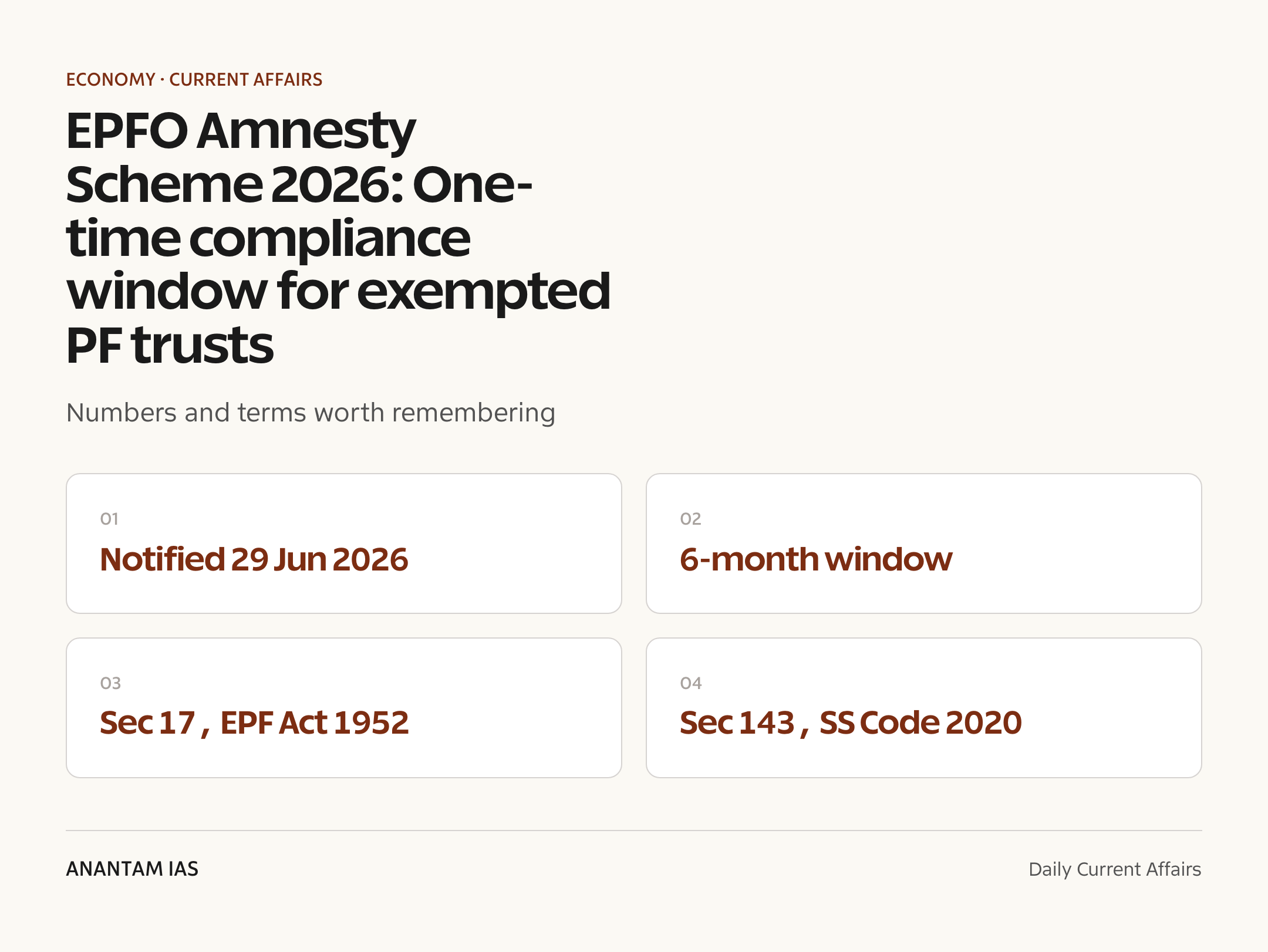
The scheme was notified on 29 June 2026 and stays open for six months. It flows from the Finance Act, 2026, which ties income-tax recognition of provident funds to exemption under Section 17 of the EPF & MP Act, 1952 — so trusts that never obtained a formal exemption notification must now regularise or migrate.
- Notified on 29 June 2026 via Gazette notification GSR 525(E); the window runs for six months from notification.
- Covers establishments operating a PF trust recognised under the Income Tax Act, 1961 but lacking a formal exemption notification from the Central or State government.
- Amnesty is granted retrospectively under Section 17 of the EPF & MP Act, 1952 and Section 143 of the Code on Social Security, 2020.
- Two routes: Category I (move to compliance as an un-exempted establishment) and Category II (continue as an exempted establishment under the Code).
- Reliefs are conditional — member accounts must have received contributions and interest at or above statutory EPFO rates.
The development matters in the context of:
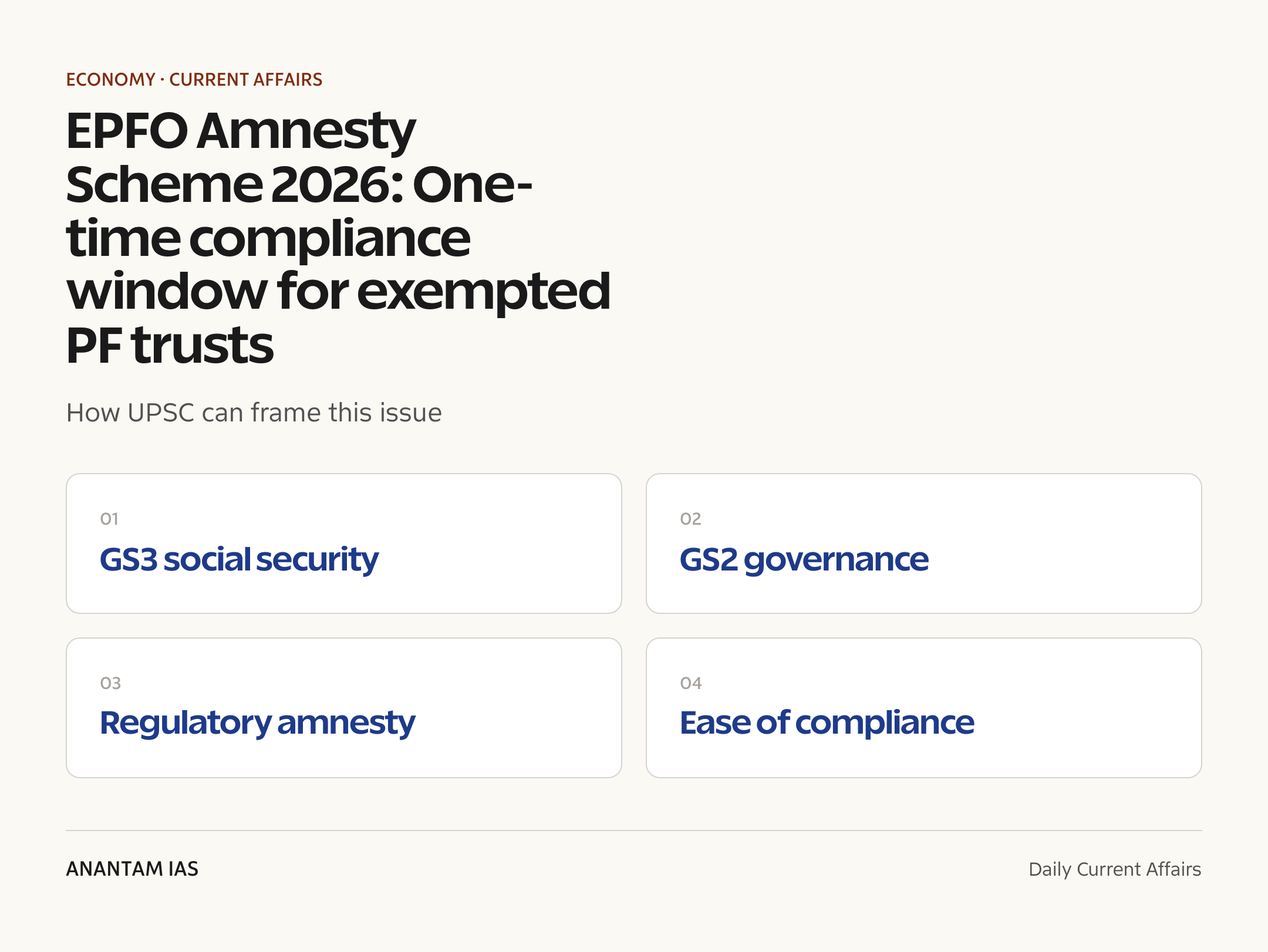
- A live case study of regulatory amnesty in social security — usable in GS3 (economy, employment) and GS2 (governance) answers.
- It shows tax-law and labour-law convergence: the Finance Act, 2026 now hinges PF tax recognition on a labour-law exemption.
- It anchors the static syllabus — the EPF & MP Act, 1952 and the Code on Social Security, 2020 — to a dated, testable development.
UPSC Relevance
Prelims Relevance
- Amnesty Scheme, 2026 — EPFO’s one-time regularisation window for PF trusts; notified 29 June 2026, open for six months.
- EPFO — statutory body under the EPF & MP Act, 1952, Ministry of Labour & Employment; runs the EPF, EPS (1995) and EDLI (1976) schemes.
- Section 17, EPF & MP Act, 1952 — power to exempt an establishment that runs its own PF trust with benefits not less favourable than the statutory scheme.
- Section 143, Code on Social Security, 2020 — the exemption provision under the Code; amnesty is granted retrospectively under both sections.
- Exempted PF trust — an employer-managed private trust that holds and invests employees’ PF in-house, subject to EPFO oversight and income-tax rules.
- Recognised provident fund — a PF recognised for tax benefits (Fourth Schedule, Income Tax Act, 1961); recognition under the Income-tax Act, 2025 now requires a Section 17 exemption.
- Category I vs Category II — regularise and comply as un-exempted vs regularise and continue as exempted under the Code.
- GSR 525(E) — gazette notification dated 29.06.2026; Part C of its Annexure to the Employees’ Provident Fund Scheme, 2026 carries the amnesty.
Mains Relevance
GS Paper 3
- Social security and formalisation of the workforce — a conditional amnesty widens the statutory net without years of litigation.
- Ease of doing business vs worker protection: conditional relief as a design template for compliance schemes.
- Fiscal-legal coherence: aligning the Finance Act, 2026 and labour law ends dual, contradictory recognition regimes.
GS Paper 2
- Governance: a rule-based, time-bound amnesty as an alternative to prolonged quasi-judicial proceedings; the moral-hazard critique of repeated amnesties.
- Statutory bodies: EPFO’s regulatory role over exempted trusts and its coordination with the tax administration.
Essay
- Forgiveness as statecraft: when should the state offer amnesty for past non-compliance?
- Good regulation simplifies: one law, one recognition, one window.
Background and Context
EPFO and India's Provident Fund Architecture
The EPFO is the statutory anchor of retirement savings for India’s organised workforce.
- The Employees’ Provident Fund Organisation (EPFO) is a statutory body under the Ministry of Labour & Employment, created by the EPF & Miscellaneous Provisions (EPF & MP) Act, 1952.
- It administers three schemes — the EPF Scheme, 1952, the Employees’ Pension Scheme (EPS), 1995 and the EDLI Scheme, 1976.
- The Act generally covers establishments employing 20 or more persons; contributions come from both employer and employee.
- The tripartite Central Board of Trustees (CBT), chaired by the Union Labour Minister, sets policy and recommends the annual EPF interest rate.
The Exempted-Trust Regime under Section 17
Exemption lets an employer run the provident fund in-house — without diluting employee benefits.
- Section 17 of the EPF & MP Act, 1952 empowers the appropriate government to exempt an establishment from the statutory scheme if it maintains its own PF trust offering benefits not less favourable than EPFO’s.
- The Hindu explains that in an exempted provident fund, the employer sets up a private trust to manage PF contributions, run privately but bound by the rules of the Income Tax Department and the labour ministry.
- Exempted trusts must credit interest at or above the statutory EPF rate, and EPFO retains supervisory oversight.
- In parallel, tax law treated such funds as recognised provident funds under the Fourth Schedule of the Income Tax Act, 1961, with favourable tax treatment.
- The gap: many establishments ran trusts recognised for tax purposes but never secured the formal exemption notification under labour law — compliant on one statute, irregular on the other.
What Triggered the Scheme: Finance Act 2026 Alignment
A tax-law change made labour-law regularisation unavoidable.
- PIB confirmed that the Finance Act, 2026 has aligned the income-tax framework for recognised provident funds with the EPF & MP Act, 1952.
- Recognition under the Income-tax Act, 2025 — the statute replacing the 1961 Act — is now available only to provident funds that hold an exemption under Section 17 of the 1952 Act.
- Trusts without a formal exemption notification risked losing recognised PF status, and with it the tax treatment of members’ balances — so a one-time regularisation route was opened.
- Amnesty is granted retrospectively under Section 17 of the 1952 Act and Section 143 of the Code on Social Security, 2020, the code that subsumes the EPF & MP Act.
- Its legal home is Part C of the Annexure to the Employees’ Provident Fund Scheme, 2026, issued via GSR 525(E) dated 29 June 2026.
Scheme Design: Eligibility and the Two Categories
The scheme is precise about who can apply and on what terms.
- It applies to establishments operating a PF trust recognised under the Income Tax Act, 1961 but lacking a formal exemption notification from the appropriate government — Central or State.
- Category I: establishments seeking retrospective trust regularisation that have already started compliance as un-exempted establishments, or opt for prospective compliance as un-exempted.
- Category II: establishments seeking retrospective regularisation that choose to continue as exempted establishments under the Code on Social Security, 2020.
- The window runs for six months from the date of notification (29 June 2026).
- The Hindu notes the eligible pool spans small businesses to large enterprises that contributed to PF but never formalised exemption.
Benefits, Reliefs and Employee Safeguards
Relief for employers is conditional on members having been kept whole.
- Retrospective regularisation: exemption status and trust recognition are granted from the inception of the trust up to the designated cut-off date.
- Waivers under the Code on Social Security, 2020: minimum employee-headcount and corpus-size norms are waived, and the 3-year prior-compliance rule is deemed satisfied.
- Abatement of legal proceedings: pending assessments for dues, damages and interest are withdrawn and stand abated; past finalised orders are treated as void ab initio (void from the beginning).
- The core safeguard: these reliefs apply only if member accounts received contributions and interest at par with or better than statutory rates.
- For workers, formalisation brings legal clarity on the status of the employer’s trust, cleaner benefit administration and smoother portability.
Employer Obligations and Application Process
The amnesty isn’t automatic — it runs on application, audit and verification.
- A formal application must be addressed to the Central Government; it may be submitted by email to the jurisdictional EPFO Regional Office.
- An expression of interest can be sent to [email protected].
- Trust accounts must be audited by a Chartered Accountant; any special or compliance audit directed by EPF authorities must be completed within 3 months of the application.
- Detailed procedure sits in the circulars and SoPs on the EPFO website, and regional offices will guide and process applications.
Amnesty as a Policy Instrument
The scheme sits in a longer Indian tradition of time-bound compliance windows.
- A regulatory amnesty trades relief on past defaults for future formalisation: the state gains compliance and fewer disputes; firms gain certainty.
- Precedents include EPFO’s Employees’ Enrolment Campaign, 2017, and tax-side windows such as Vivad se Vishwas (direct-tax) and Sabka Vishwas (legacy indirect-tax disputes).
- The standing critique is moral hazard — repeated amnesties can reward defaulters and demoralise firms that complied on time.
- This scheme’s answer is conditionality: relief flows only where workers’ accounts were credited at or above statutory rates — it forgives a paperwork lapse, not denial of benefits.
Way Forward
Outreach within the window
- EPFO regional offices and industry chambers should map recognised trusts lacking exemption notifications and contact them early — six months is a short runway.
- Publish a plain-language checklist and SoP with online status-tracking, so smaller establishments aren’t deterred by procedure.
Protect workers through the transition
- Verify the statutory-rate condition rigorously before granting relief; member balances are the non-negotiable test.
- Build audit capacity — the 3-month special-audit timeline needs coordinated planning between EPF authorities and Chartered Accountants.
Credibility after the deadline
- Once the window closes, act firmly against holdouts — an amnesty deters future default only if the post-amnesty enforcement is visibly stricter.
- Use this tax-labour alignment as a template for wider social security coverage, including registration-linked benefits for gig and informal workers under the Code.
Conclusion
The Amnesty Scheme, 2026 is a small notification with a large signal: after the Finance Act, 2026, a provident fund trust can’t stay recognised by the tax department while remaining invisible to the labour regulator. One recognition now presupposes the other.
Its design is worth remembering — retrospective relief, waived thresholds, abated proceedings, all conditional on employees having received statutory-or-better benefits. That conditionality separates a worker-friendly regularisation from a plain employer bailout.
The test lies in execution: six months of outreach, credible audits and firm post-window enforcement will decide whether this becomes a model for other compliance backlogs in India’s social security architecture.
UPSC Practice Questions
Prelims MCQ 1
With reference to the EPFO Amnesty Scheme, 2026, consider the following statements:
- It offers a one-time window to establishments running Provident Fund trusts recognised under the Income Tax Act, 1961 but lacking a formal exemption notification.
- The scheme remains open for a period of three years from the date of its notification.
- Amnesty is granted retrospectively under Section 17 of the EPF & MP Act, 1952 and Section 143 of the Code on Social Security, 2020.
How many of the above statements are correct?
(a) Only one (b) Only two (c) All three (d) None
Answer: (b) Only two
Explanation:
Statements 1 and 3 are correct, as per the PIB release of 12 July 2026. Statement 2 is wrong — the scheme, notified on 29 June 2026, is open for six months, not three years.
Prelims MCQ 2
Which of the following best describes an ‘exempted’ establishment under India’s provident fund law?
(a) An establishment placed entirely outside the EPF & MP Act, 1952, with no provident fund obligations (b) An establishment permitted to manage employees’ provident fund through its own private trust, with benefits at least matching the statutory scheme (c) An establishment whose employees are exempt from making any provident fund contribution (d) An establishment whose provident fund contributions are paid by the government on its behalf
Answer: (b) An establishment permitted to manage employees' provident fund through its own private trust, with benefits at least matching the statutory scheme
Explanation:
Under Section 17 of the EPF & MP Act, 1952, an exempted establishment runs its own PF trust in place of the statutory scheme, but must offer benefits not less favourable than EPFO’s and remains under its regulatory oversight.
UPSC Mains Questions
- Amnesty schemes trade relief on past non-compliance for future formalisation. In the light of the EPFO Amnesty Scheme, 2026, examine the case for and against regulatory amnesties in India’s social security architecture. (250 words)
- The Finance Act, 2026 makes income-tax recognition of provident funds conditional on exemption under the EPF & MP Act, 1952. Discuss how such alignment of tax law and labour law can promote ease of compliance while protecting workers’ interests. (250 words)
Sources: PIB, Ministry of Labour & Employment and The Hindu.
Frequently Asked Questions
What is the EPFO Amnesty Scheme 2026?
It is a one-time, six-month window notified on 29 June 2026 that lets establishments running Provident Fund trusts recognised under the Income Tax Act, 1961 — but lacking a formal exemption notification — regularise their status retrospectively under Section 17 of the EPF & MP Act, 1952 and Section 143 of the Code on Social Security, 2020.
Who is eligible to apply under the scheme?
Establishments operating a PF trust recognised for income-tax purposes but without a formal exemption notification from the Central or State government. They apply either under Category I, moving to compliance as un-exempted establishments with EPFO, or Category II, continuing as exempted establishments under the Code on Social Security, 2020.
What is an exempted provident fund trust?
It is a private trust through which an employer manages employees’ provident fund in-house instead of routing it to EPFO. The trust must offer benefits at least as favourable as the statutory scheme, credit interest at or above EPFO’s declared rate, and follow the rules of both the labour ministry and the income-tax authorities.
Why was the amnesty scheme needed now?
The Finance Act, 2026 aligned tax law with labour law: recognition of provident funds under the Income-tax Act, 2025 is now available only to funds exempted under Section 17 of the EPF & MP Act, 1952. Trusts recognised for tax but never formally exempted risked losing that status, so a one-time regularisation route was opened.
What reliefs do applicant establishments receive?
Approved establishments get retrospective exemption and trust recognition from the trust’s inception to a designated cut-off date, waiver of headcount and corpus norms under the Code on Social Security, deemed satisfaction of the 3-year compliance rule, and abatement of pending proceedings for dues, damages and interest — provided members received statutory-or-better benefits.
How can establishments apply for the amnesty?
A formal application addressed to the Central Government can be emailed to the jurisdictional EPFO Regional Office, and an expression of interest to [email protected]. Trust accounts must be audited by a Chartered Accountant, and any special or compliance audit directed by EPF authorities must be completed within three months of applying.