The man who brought your dinner last night has no paid sick leave. If a car clips his scooter on the next delivery, there’s no employer to file the accident claim, no provident fund quietly building behind his pay, no pension waiting at sixty. He’s one of roughly nine in ten Indian workers who keep the economy running and carry almost none of its protection. For decades that was just the way things were. But on 21 November 2025 the government notified the Code on Social Security, 2020 into force, and for the first time an Indian statute names “gig worker” and “platform worker” and says they’re owed a floor of security. So the law finally caught up to the delivery rider. The harder question is whether the rider will ever feel it.
That gap is the whole topic. A statute that recognises you is not the same as a benefit that reaches you. India has built the recognition, the database, even a financing instrument on paper. What it hasn’t yet built is the plumbing that turns a registration into a hospital bill paid, a pension credited, a widow’s family kept afloat. The mark-scoring question for you isn’t whether the Code is a good law. It’s why recognition keeps outrunning disbursement, and what closes the distance.
The Issue, Framed
The fight here isn’t about whether informal workers deserve social security. Almost everyone agrees they do. The fight is about why the system keeps promising it and so rarely delivering it, and who falls through the cracks while we wait.
Let’s fix the vocabulary first, because this topic drowns in loose terms. The informal or unorganised sector means work outside the reach of formal labour law and contributory benefits. No written contract, no traceable employer, no provident fund or insurance deducted from a regular wage. Think street vendors, construction labour, domestic workers, small-farm hands, the rickshaw puller. Social security is the cushion against life’s predictable shocks, sickness, injury, maternity, old age, the death of a breadwinner. A social-security floor is the minimum that cushion should never drop below: a basic package of accident, health, maternity and pension cover that every worker gets, regardless of how irregular the job is.
Now the newer category. A gig worker is anyone earning outside a traditional employer-employee relationship, paid per task or per gig. A platform worker is the subset whose gigs come through a digital platform, the food-delivery rider, the cab driver, the home-service technician booked on an app. Every platform worker is a gig worker. Not every gig worker is on a platform. That distinction matters, because the new law leans hardest on the platforms, which have the digital trail and the aggregator at the centre to actually collect a contribution.
The architecture rests on a few named pieces. e-Shram is the National Database of Unorganised Workers, an Aadhaar-linked registry launched in August 2021 where unorganised workers sign up and get a unique ID. The Code on Social Security, 2020 consolidates nine older social-security laws into one framework spanning organised, unorganised, gig and platform workers (PIB, 22 November 2025). And the financing idea is an aggregator contribution, a levy on the platforms paid into a Social Security Fund. Recognition, registry, fund. The scaffolding is up. Whether anything load-bearing sits on it is the rest of this piece.
What the Data Says
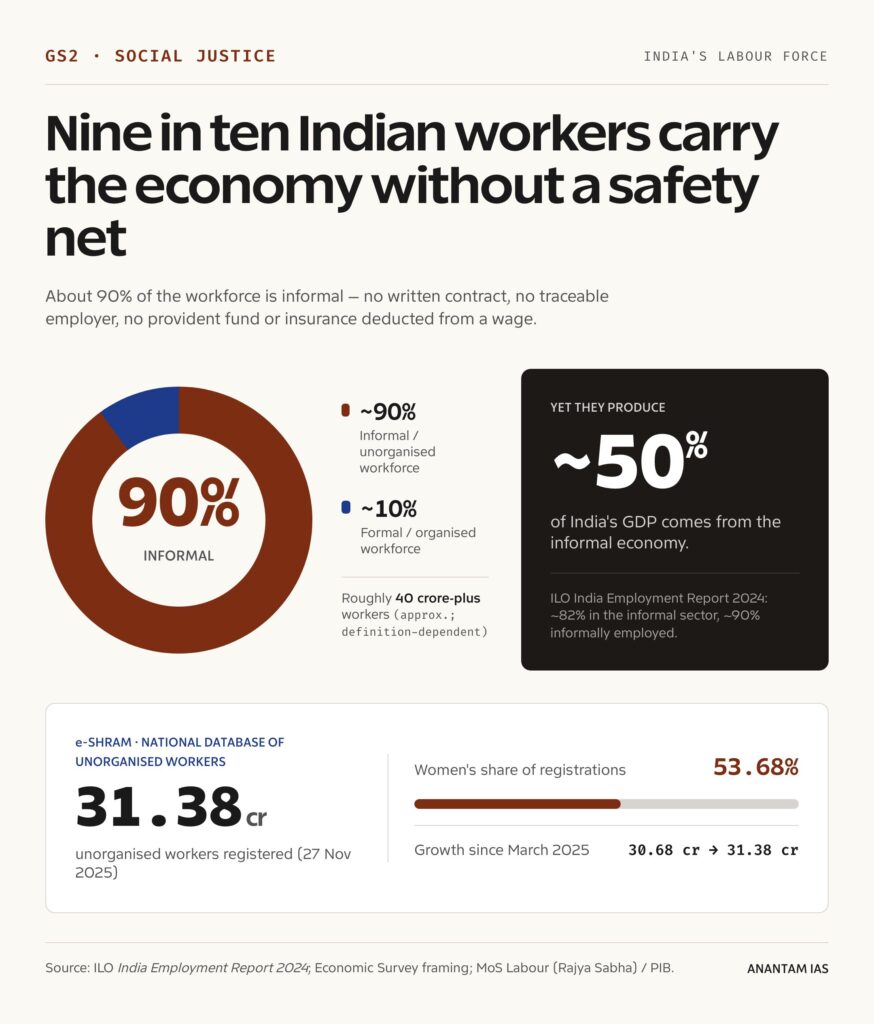
Start with the scale, because it’s the number that should reframe how you think about Indian labour. About 90% of India’s workforce is informal, and that informal economy contributes close to 50% of GDP (Economic Survey framing). Read that twice. Nine in ten workers, half the national output, and almost none of the formal safety net. The ILO’s India Employment Report 2024 sharpens it: nearly 82% of workers are in the informal sector, and nearly 90% are informally employed, meaning even many who work in formal firms get no formal protection.
How many people is that in absolute terms? Roughly 40 crore-plus workers, though the exact count drifts between 42 and 47 crore depending on how you define the base, so treat any single precise figure as approximate. The proportion is rock-solid. The headcount is a range. That’s an honest distinction worth carrying into an answer.
The registry side has moved fast. e-Shram has crossed 31.38 crore unorganised-worker registrations as of 27 November 2025 (MoS Labour, in a written reply to the Rajya Sabha), up from 30.68 crore in March 2025. And here’s a number that quietly rewrites the gender story of Indian labour: women were 53.68% of those registrations (PIB, March 2025). The majority of India’s enrolled unorganised workers are women. So when policy treats the informal worker as a male default, the data says otherwise.
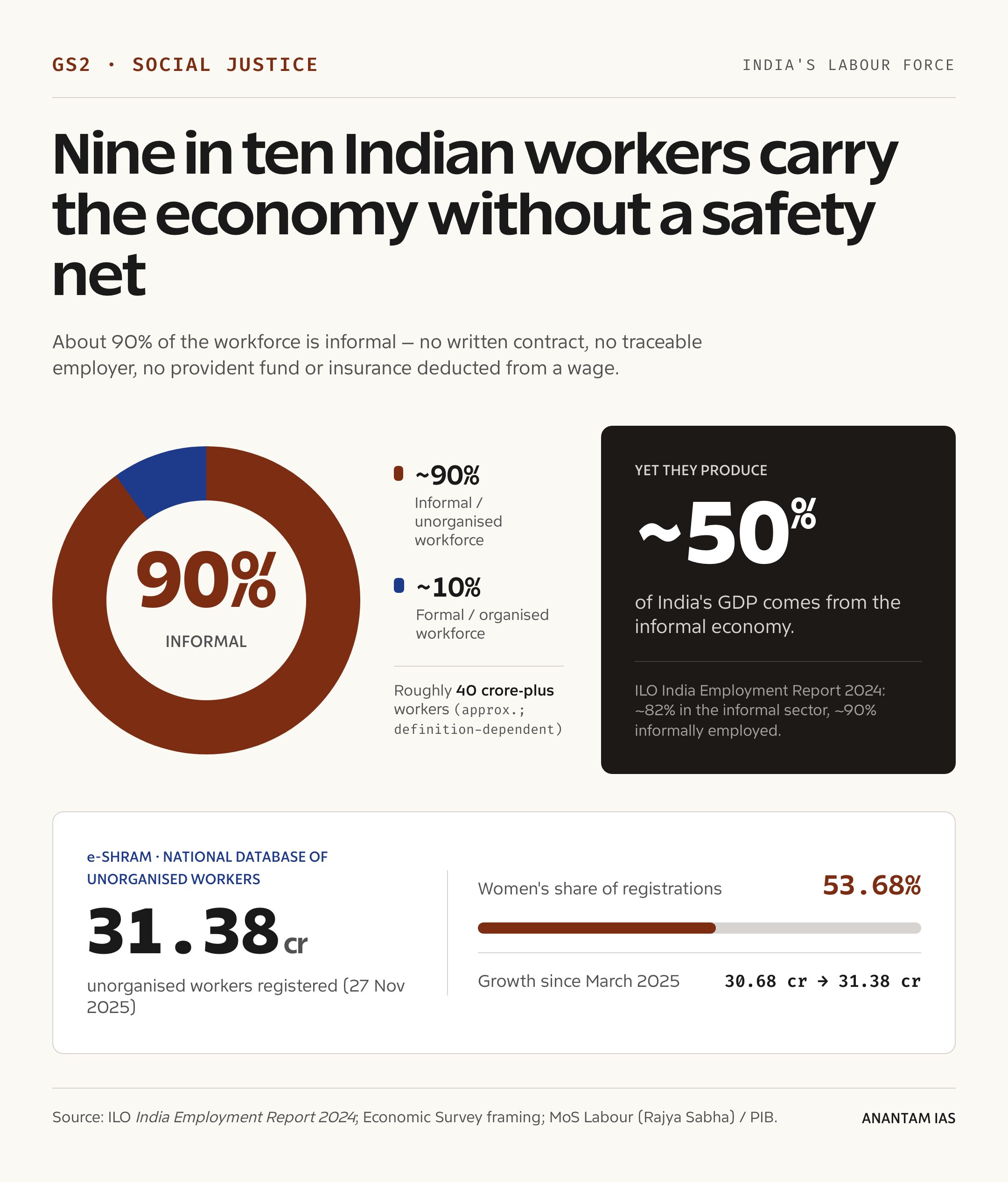
Now the part that’s growing fastest. NITI Aayog’s June 2022 report put India’s gig workforce at 77 lakh in 2020-21, projected to reach 2.35 crore by 2029-30, climbing from 1.5% to 4.1% of total livelihood. That’s roughly a threefold jump in a decade. Women make up about 28% of gig workers, below their share of the broader unorganised registry, and the skill mix in 2020-21 ran about 47% medium-skilled, 22% high-skilled and 31% low-skilled (NITI Aayog 2022). One caution to flag in your answer: these figures rest on a single 2022 projection, not a continuous official series, so cite them as indicative rather than a measured current stock.
The Case For
The case that the framework is genuinely taking shape is stronger than the cynics allow, and a lazy answer that calls the Code “just paper” misses what actually changed. So let’s state the progress at full strength.
For the first time, the law sees these workers. The Code on Social Security defines and recognises gig and platform workers through Sections 113 and 114, and it statutorily defines “aggregator” (PIB, 9 December 2025). Before this, a delivery rider sat outside the Payment of Wages Act, the Minimum Wages Act, the EPF Act and the ESI Act, in a legal blank space. Recognition isn’t a benefit by itself. But you can’t build entitlements for people the statute can’t even name. So this is the necessary first brick.
And the Code is now in force, not pending. It was notified on 21 November 2025 alongside the other three labour codes, replacing a patchwork of nine social-security statutes with a single framework (PIB; EY). For years the standard exam line was “passed but not implemented.” That line is now wrong. The honest framing is that it’s in force, with the operational rules still being finalised.
There’s a real financing instrument, defined in law. Aggregators must contribute 1 to 2% of their annual turnover, capped at 5% of the amount paid to gig and platform workers, into a Social Security Fund (PIB, 9 December 2025). That’s not a vague appeal for corporate goodwill. It’s a turnover-linked levy with a statutory home, layered with government and CSR money. So the funding isn’t meant to depend on the Budget alone.
The registration backbone is live and genuinely at scale. Those 31.38 crore e-Shram registrations make it one of the largest worker databases anywhere, Aadhaar-linked and, since the October 2024 One-Stop-Solution, wired to central welfare schemes. And portability is built into the design: each worker’s unique Aadhaar-linked ID is meant to let benefits follow them across platforms and states (PIB, 9 December 2025), which directly targets the way migration usually knocks people off welfare rolls.
The Budget put money and a delivery channel behind the promise. Budget 2025-26 announced identity cards and e-Shram registration for gig workers plus health cover under AB-PM-JAY, the Ayushman Bharat scheme worth ₹5 lakh per family a year, targeting roughly 1 crore gig workers (PIB; HDFC Bank). An Aggregator Module on e-Shram has been tested, with major platforms onboarded. So a real disbursement pipe, AB-PM-JAY, has been pointed at this workforce.
And the states didn’t wait. Rajasthan passed India’s first platform-gig welfare law in 2023, with a 1 to 2% welfare cess on the value of each transaction (Cyril Amarchand). Karnataka followed with a 2025 Ordinance levying 1 to 5% per transaction by aggregator category (ELP). Two live state pilots, two working templates for transaction-mapped collection. So the central design isn’t theoretical; pieces of it are already running on the ground.
The Case Against
Here’s what the progress story walks past. A law on the books, a database, and a fund defined on paper are not the same as a sick rider getting his hospital bill paid. On the only test that matters, money reaching a worker, the gap is wide.
In force does not mean operational. As of late 2025, the central and state rules under the Code, and crucially the exact contribution rate inside that 1 to 2% band, were still unnotified. Legal commentary noted the Social Security Fund risked “existing on paper” with the Section 109 rates pending (LiveLaw; Business Standard). A fund with no fixed rate and no collection switched on is an account number, not a safety net.
The financing itself is contested. Aggregators have pushed back on a turnover-linked levy, and the 5%-of-payouts cap plus the turnover base leave the actual revenue uncertain (Business Standard). So even the money pillar, the strongest part of the new design, isn’t settled.
Registration is not the same as a benefit, and this is the joint where Indian welfare keeps breaking. Thirty-one crore e-Shram sign-ups have not automatically become cash, insurance or pension in hand. The link between a name in a database and a rupee disbursed is the weak weld, the same pattern that left earlier contributory schemes like the pension plans for unorganised and informal workers badly under-subscribed (ORF). Enumeration is easy. Entitlement is hard.
Then there’s the missing middle, the structural trap of informal-sector welfare. A large band of workers is too well-off to qualify for fully subsidised welfare, yet too irregular in income to afford a formal contributory scheme on their own (ORF). They fall between the two stools the system offers. The Code doesn’t yet have a clean answer for them.
The old contributory channels still don’t reach the bottom. Even with EPF applicability widened to establishments with 20-plus employees and ESIC extended pan-India, most informal workers stay outside provident fund and employees’ insurance for one simple reason, they have no traceable employer relationship to anchor a deduction. The plumbing assumes an employer. The informal economy mostly doesn’t have one.
And portability, the design’s most elegant promise, is promised, not proven. Benefits following a worker across states and platforms depends on rules, fund liquidity and inter-state coordination none of which has been demonstrated at scale. There’s also a federal seam: the Rajasthan and Karnataka cess models could collide or duplicate with the central fund, raising the risk of a double levy or jurisdictional confusion for aggregators operating in many states. Worst of all, the people most likely to be left out, low-literacy, low-skilled, women and migrant workers, are the very ones who hit the most friction at registration, the Aadhaar mismatch, the missing smartphone, the form in the wrong language. So the safety net risks being thinnest exactly where the fall is hardest.
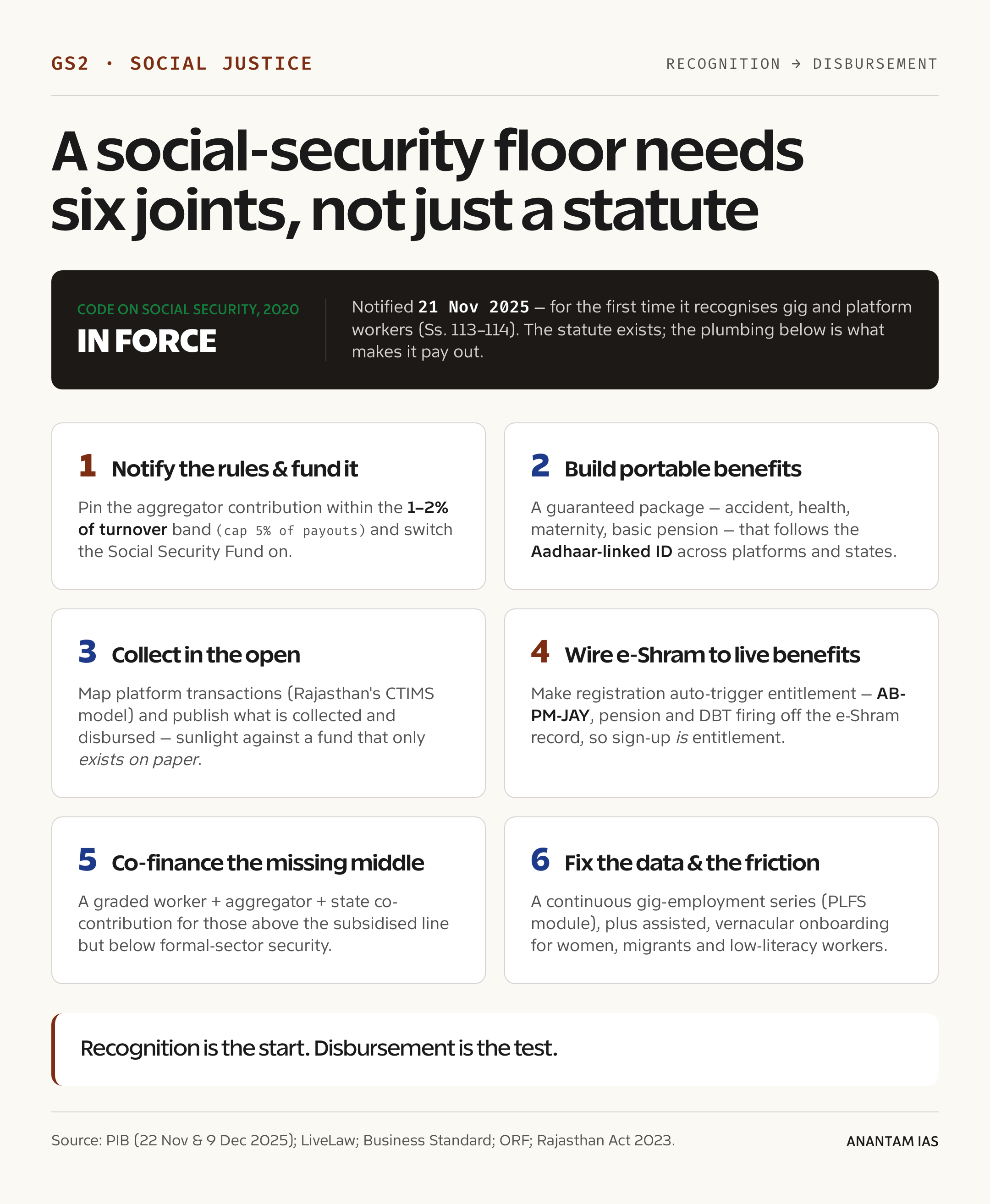
The Deeper Structural Read
Step back from the Code and the real fault line shows up. It isn’t “good law versus bad implementation.” It’s that India built its entire social-security machine around an assumption the modern economy has quietly abandoned: that work means a stable employer who can be made to deduct and remit on your behalf.
Provident fund, employees’ insurance, gratuity, every one of them runs through an employer relationship. The contribution gets deducted from a regular wage and matched by a firm with a registered address. So the system doesn’t just miss informal workers by accident. It misses them by architecture. The moment the employer disappears, whether you’re a street vendor or an app-based rider, the entire collection mechanism has nothing to grip. The gig economy didn’t create this gap. It made an old gap impossible to ignore, because now even workers tethered to a billion-dollar platform have no “employer” in the legal sense.
That’s why the Code’s real innovation is conceptual, and it belongs in your answer. By placing the aggregator at the centre and taxing its turnover, the law invents a new collection point to replace the missing employer. The platform becomes the anchor the wage-deduction model used to rely on. It’s a genuinely clever fix for the platform slice of the economy. But notice what it leaves untouched: the construction labourer, the domestic worker, the small-farm hand, the bulk of that 90%, have no aggregator at all. So the most elegant part of the Code solves the problem for the most visible workers and barely reaches the largest, least visible group.
There’s a deeper philosophical choice buried here too, and it’s the one a future administrator should sit with. Does social security in India remain contributory, tied to what a worker or a platform pays in, or does it shift toward a universal, rights-based floor funded from general revenue, owed to you because you’re a citizen who works? The contributory model is fiscally cautious but structurally excludes anyone without a payer. The universal-floor model is inclusive but expensive and politically heavy. The Code straddles both, contributions from aggregators, subsidies from the state, and that straddle is exactly why it feels unfinished. It hasn’t decided what it wants to be.
And here’s the part that should bother you most. Registration has been treated as the achievement, the headline, the press release. But a database is a means, not an end. When the State celebrates 31 crore sign-ups while the disbursement rules sit unnotified, it has confused counting workers with protecting them. That confusion, enumeration mistaken for entitlement, is the single most important structural lesson this topic teaches, and it travels far beyond labour into every welfare scheme India runs on a registry.
What Should Be Done
So what does an actual floor look like, not a softer plea for “better implementation” but a sequence a labour secretary could act on this quarter? Eight moves, and none of them needs a new law, because the law already exists.
- Notify the rules and fix the rate. Issue the central and state rules under the Code and pin a definite aggregator contribution within the 1 to 2% band, with a clear collection mechanism. The single fastest way to turn the Code on Social Security, 2020 from statute into cash is to switch the Fund on. Everything else waits on this.
- Build a universal, portable floor. A guaranteed minimum package, accident, health, maternity and a basic pension, that follows the worker through the Aadhaar-linked ID regardless of employer or platform. Decide the philosophical question by answering it: a floor every working citizen gets, topped up by contributions, not a benefit you only reach if a payer exists.
- Operationalise aggregator contributions in the open. Map platform transactions the way Rajasthan’s gig-worker welfare law does through its transaction-tracking system, then publish what’s collected and what’s disbursed. Sunlight on the Fund is the cheapest guard against it quietly “existing on paper.”
- Wire e-Shram to live benefits. Make registration auto-trigger entitlement: AB-PM-JAY health cover, accident insurance, pension enrolment and direct benefit transfer firing off the e-Shram record. The fix for the registration-isn’t-benefit gap is to make sign-up and entitlement the same event, not two separate hurdles.
- Co-finance the missing middle. A graded model, worker plus aggregator plus state co-contribution, for those above the fully-subsidised line but below formal-sector security. Don’t leave the band that can’t afford a full scheme and doesn’t qualify for a free one to fend for itself.
- Fix the data. Stand up a continuous official gig and platform-employment series, through a Periodic Labour Force Survey module or aggregator and e-Shram data, so targeting and accountability stop resting on a single 2022 projection. You can’t protect a workforce you only measure once a decade.
- Lower the registration friction. Assisted and vernacular onboarding, offline enrolment camps, and proactive sign-up for women, migrants and low-literacy workers. The safety net has to be thickest where the fall is hardest, not thinnest.
- Sequence the federalism. Treat the Rajasthan and Karnataka Acts as live pilots and align them under the central Code so a multi-state aggregator faces one coherent regime, not a double levy, and so a worker isn’t caught between two systems.
Every one of these turns recognition into something a worker can actually draw on. A floor that pays out when a rider is hospitalised, that follows a migrant from Patna to Pune, that the poorest can reach without a smartphone, is the whole point of writing the law in the first place.
For Your Mains Answer
This is a GS2-plus-GS3 crossover gift. It sits on welfare for vulnerable sections and policy implementation, and it sits equally on employment, formalisation and the platform economy. Frame it as both and you double the mileage.
GS paper mapping: GS2: welfare schemes for vulnerable sections, social-sector development (health, social security), and issues in the design and implementation of government policy. GS3: employment and inclusive growth, formalisation of the informal economy, effects of the digital platform economy on labour, and mobilisation of resources to finance welfare.
Likely question frames:
- “Recognition is the easy part; disbursement is the test.” Critically examine India’s social-security architecture for gig and informal workers in light of the Code on Social Security, 2020.
- The Code on Social Security, 2020 invents a new collection point to replace the missing employer. Discuss how far this addresses the structural exclusion of informal workers from social security.
- Examine the challenges in building a universal, portable social-security floor for India’s 90% informal workforce, and suggest a way forward.
Quotable data points:
- About 90% of India’s workforce is informal, contributing nearly 50% of GDP (Economic Survey framing); nearly 82% in the informal sector and ~90% informally employed (ILO India Employment Report 2024).
- e-Shram crossed 31.38 crore registrations as of 27 November 2025; women were 53.68% of registrations (MoS Labour, Rajya Sabha / PIB).
- The Code on Social Security, 2020 merges nine social-security laws and came into force on 21 November 2025; it recognises gig and platform workers under Sections 113 and 114 (PIB).
- Aggregators must contribute 1 to 2% of annual turnover, capped at 5% of worker payouts, to a Social Security Fund; the exact rate was still unnotified in late 2025 (PIB; LiveLaw).
- India’s gig workforce: 77 lakh (2020-21) projected to 2.35 crore by 2029-30, roughly threefold; women about 28% (NITI Aayog, June 2022).
- Budget 2025-26 targets AB-PM-JAY health cover of ₹5 lakh per family a year for about 1 crore gig workers via e-Shram (PIB).
- Rajasthan (2023) levies a 1 to 2% per-transaction welfare cess; Karnataka (2025 Ordinance) levies 1 to 5% (Cyril Amarchand; ELP).
Keywords to use: informal and unorganised sector, social-security floor, portability, aggregator turnover contribution, Social Security Fund, missing middle, formalisation, enumeration versus entitlement.
Syllabus linkages: welfare of vulnerable sections, social-sector and welfare-scheme design and implementation, inclusive growth, employment, formalisation of the informal economy, Centre-State relations, mobilisation of resources.
Balanced conclusion line: A statute that names the gig worker is a real beginning, but social security is measured at the point of disbursement, not the point of registration; the floor exists only when the rider who breaks his leg gets his bill paid without an employer, a contract, or a smartphone standing in the way.
How to Build the Answer
Open with the conflict, not a definition. The tension here is that recognition has outrun disbursement, the law sees these workers, the benefit doesn’t yet reach them. That first sentence shows the examiner you’ve grasped the real problem, not just the news. A definition of informal sector or gig worker can follow in the second sentence.
Bring data in early, but ration it. A strong opening body paragraph can carry three numbers: 90% informal contributing 50% of GDP, 31.38 crore e-Shram registrations, and 77 lakh to 2.35 crore gig growth. Then say what they prove, that the scale is enormous, the registry is built, and the fastest-growing slice is the one the new law targets. UPSC rewards the move from fact to inference.
The second body paragraph should steelman the other side. If your stance is critical, first admit the genuine progress, statutory recognition for the first time, a defined fund, a live registry, before showing the gap. If your stance is optimistic, first name what’s still unbuilt. That’s how an answer reads balanced rather than vague.
Group the way forward, don’t scatter it. Cluster the reforms: notify the rate, build a portable floor, collect transparently, wire e-Shram to live benefits, co-finance the missing middle, fix the data, lower friction, sequence the federalism. Use the topic’s own vocabulary, social-security floor, aggregator contribution, missing middle, so the answer sounds like policy analysis, not a news recap.
Close on the syllabus link, welfare for vulnerable sections, formalisation, inclusive growth. The last line should show judgment, not echo the introduction. The reliable pattern is “the goal is not X alone, but X with Y,” which lets you balance recognition with disbursement.
Common Mistakes to Avoid
- Don’t write that the Code is unimplemented. It came into force on 21 November 2025. The accurate framing is “in force, with rules and the contribution rate still being operationalised.” Getting this date and status right signals current awareness.
- Don’t treat gig and informal as the same thing. Gig and platform workers are a small, fast-growing slice; the informal economy is the 90% ocean around them. An answer that conflates the two misses the structural point.
- Don’t celebrate registration as the achievement. 31 crore sign-ups is enumeration, not entitlement. Name the disbursement gap explicitly.
- Don’t go one-sided. This topic has real arguments both ways. Steelman the progress before the gap, or the gap before the progress.
- Don’t forget the worker. Name the delivery rider, the domestic worker, the migrant who can’t read the form. UPSC rewards policy that names who gains and who’s at risk.
A Compact Answer Spine
- Introduction: Open with the recognition-versus-disbursement gap in one sentence; define informal sector and gig or platform worker in the next.
- Evidence: Use two or three attributed data points, the 90% informal share, the 31.38 crore e-Shram figure, the gig-growth projection, and tie each to a policy implication.
- Arguments: The case that the framework is taking shape, then the case on the implementation gap. Keep both fair.
- Structural diagnosis: The system assumes an employer; the informal economy has none. The Code’s fix is to make the aggregator the new collection point, which reaches platform workers but not the bulk of informal labour.
- Way forward: Four to six grouped reforms, each with a clear actor, Centre, state, aggregator, NITI or PLFS for data.
- Conclusion: Adapt the balanced conclusion line to the exact question wording.
Diagram or Flowchart Idea
For a 15-marker, draw one causal chain, not a decorative mind map. The cleanest here: informal economy with no employer to deduct from → social security historically excludes 90% of workers → Code on SS 2020 makes the aggregator the new collection point → e-Shram ID enables portability → but rules, rate and disbursement still pending → recognition outruns benefit. The examiner reads that logic in five seconds.
For a 10-marker, skip the diagram unless it’s genuinely simple. A two-column table, “Framework taking shape” against “The implementation gap,” does more work and is faster to evaluate under time pressure.
Ethics and Governance Angle
Add one ethical line even in a GS2 or GS3 answer. The question isn’t only efficiency. It asks who bears the cost when the system fails. Here that’s a concrete person: the rider with no accident cover, the woman who makes up 53.68% of e-Shram yet whose benefits stay theoretical, the migrant struck off a welfare roll when he crosses a state line. Naming that person sharpens the answer.
Then convert empathy into design. Don’t merely say “protect informal workers.” Say how: notify the rate, wire e-Shram to live benefits, co-finance the missing middle, lower registration friction for the low-literacy worker. That’s the move from moral language to administrative maturity.
A useful sentence pattern travels across topics: “The scheme is legitimate in aim, but its legitimacy depends on disbursement, transparency and reach.” It accepts the State’s objective without handing it credit for a benefit not yet delivered, which is exactly what a balance question rewards.
How to Use Data Without Sounding Mechanical
Use fewer numbers than you know. Three well-explained figures beat ten scattered ones. Lead with one big number (90% informal), use a second for scale (31.38 crore on e-Shram), and a third for direction (77 lakh to 2.35 crore gig growth). One structural figure, one registry figure, one trend figure is usually enough.
Never leave a statistic standing alone. Follow it with “This means…” or “The policy implication is…” That tiny move turns a fact sheet into analysis. In Mains, facts are raw material; judgment is the finished answer.
Finish by asking one question: can a tired examiner understand this in a single pass? If it needs rereading, simplify. Short introduction, data early, two sides marked cleanly, grouped way forward. For UPSC, clarity is how depth becomes visible. Cut any line that sounds impressive but does no work, and replace it with a fact, a cause, a consequence, or a reform. Always be specific.
FAQ
Is the Code on Social Security, 2020 actually in force?
Yes. It was notified into force on 21 November 2025, alongside the other three labour codes (PIB; EY). The accurate framing is that the Code is in force but its operational rules, and the exact aggregator contribution rate within the 1 to 2% band, were still being finalised in late 2025. So recognition is law; full disbursement is still being switched on.
What’s the difference between a gig worker and a platform worker?
A gig worker is anyone earning outside a traditional employer-employee relationship, paid per task. A platform worker is the subset whose work comes through a digital app or platform, like a food-delivery rider or app-based cab driver. Every platform worker is a gig worker, but not every gig worker is on a platform. The Code on Social Security leans on platforms because the aggregator gives a clear point to collect a contribution.
How are gig workers’ benefits meant to be funded?
Through an aggregator contribution: platforms pay 1 to 2% of their annual turnover, capped at 5% of what they pay gig and platform workers, into a Social Security Fund (PIB, 9 December 2025), layered with government and CSR money. This replaces the missing employer with the platform as the collection point. The catch is that the exact rate inside that band was still unnotified in late 2025.
Why does registration on e-Shram not guarantee benefits?
Because a database records who you are, not what you’re owed. e-Shram has 31.38 crore registrations (November 2025), but a sign-up only becomes a benefit when the disbursement rules, the fund, and the auto-link to schemes like AB-PM-JAY are all live and connected to that record. That link is the weak joint in Indian welfare, where enumeration regularly outpaces entitlement.
Tell Google you want more of this.
Add Anantam IAS as a preferred sourceOne tap, and this site shows up more often in your own Top Stories, AI Overviews and AI Mode. Remove it any time.