FCRA Amendment Bill: Designated Authority and NGO Asset Control
Why in News?
The Ministry of Home Affairs issued a detailed clarification on the Foreign Contribution (Regulation) Amendment Bill, 2026 after concerns arose about the proposed Designated Authority and its control over assets connected with foreign contributions.
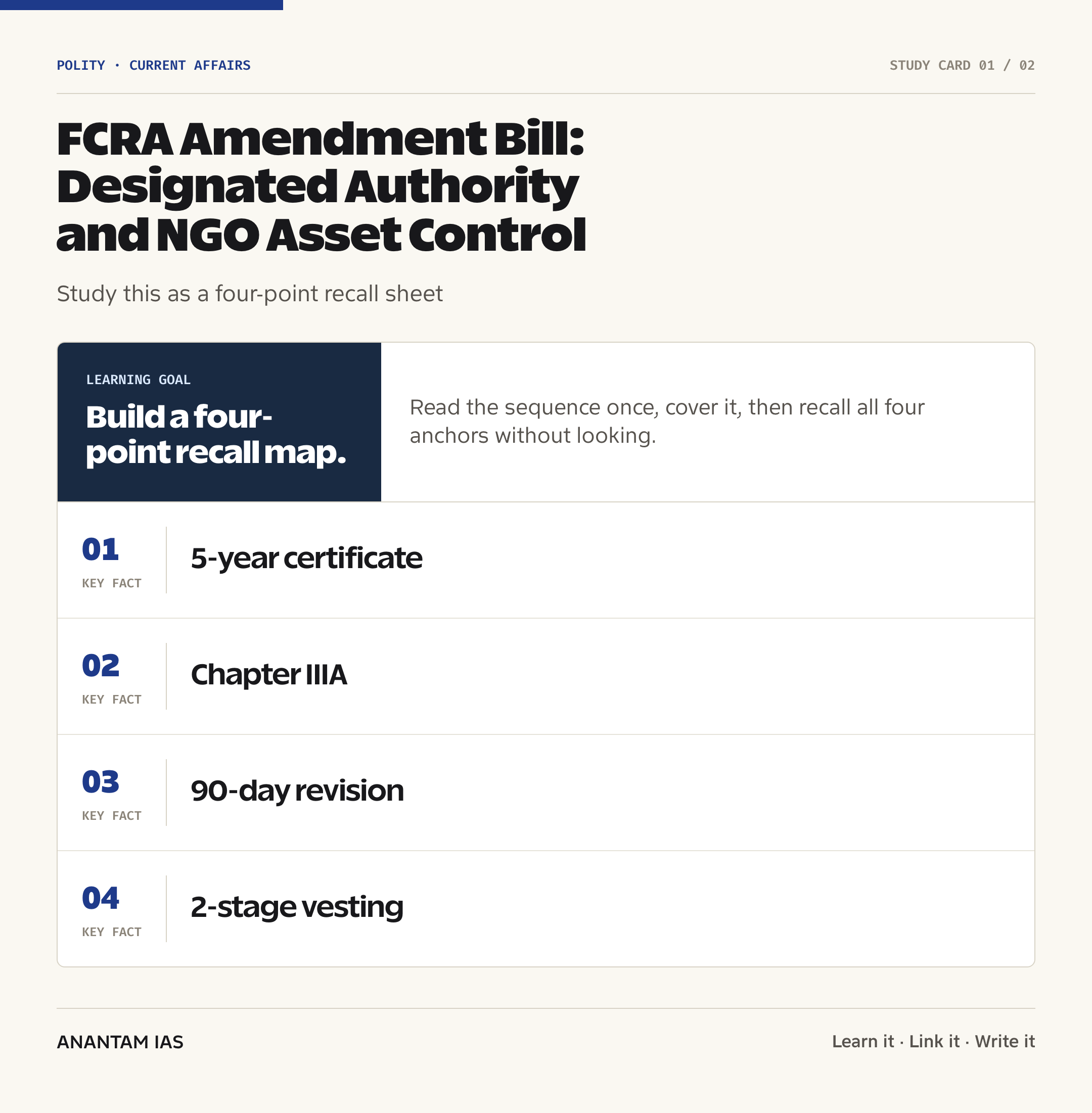
The Bill, introduced in the Lok Sabha on 25 March 2026, would replace the limited asset-management framework in Section 15 of the FCRA, 2010 with a new Chapter IIIA. PIB stressed that vesting is initially provisional, assets must be restored when registration returns within the prescribed period, and orders of the Authority carry statutory remedies.
- PIB clarified that the proposed mechanism concerns foreign contribution and assets created from it, not an NGO’s unrelated asset pool.
- Registration ending through cancellation, surrender or cessation would trigger provisional vesting in the Designated Authority.
- Failure to obtain a fresh, renewed or restored certificate within the prescribed period would convert provisional vesting into permanent vesting.
- Permanently vested assets must serve public purposes; transfer to government bodies is preferred, while sale proceeds and unused foreign contribution go to the Consolidated Fund of India.
- An Authority order may be revised within 90 days, followed by a judicial appeal to the District Judge or another notified judicial officer of the prescribed rank.
The development matters in the context of:
- This matters in the context of balancing national-interest regulation with the institutional autonomy of civil-society organisations.
- It raises a due-process distinction between remedies against a Designated Authority’s order and remedies against the Central Government’s underlying renewal decision.
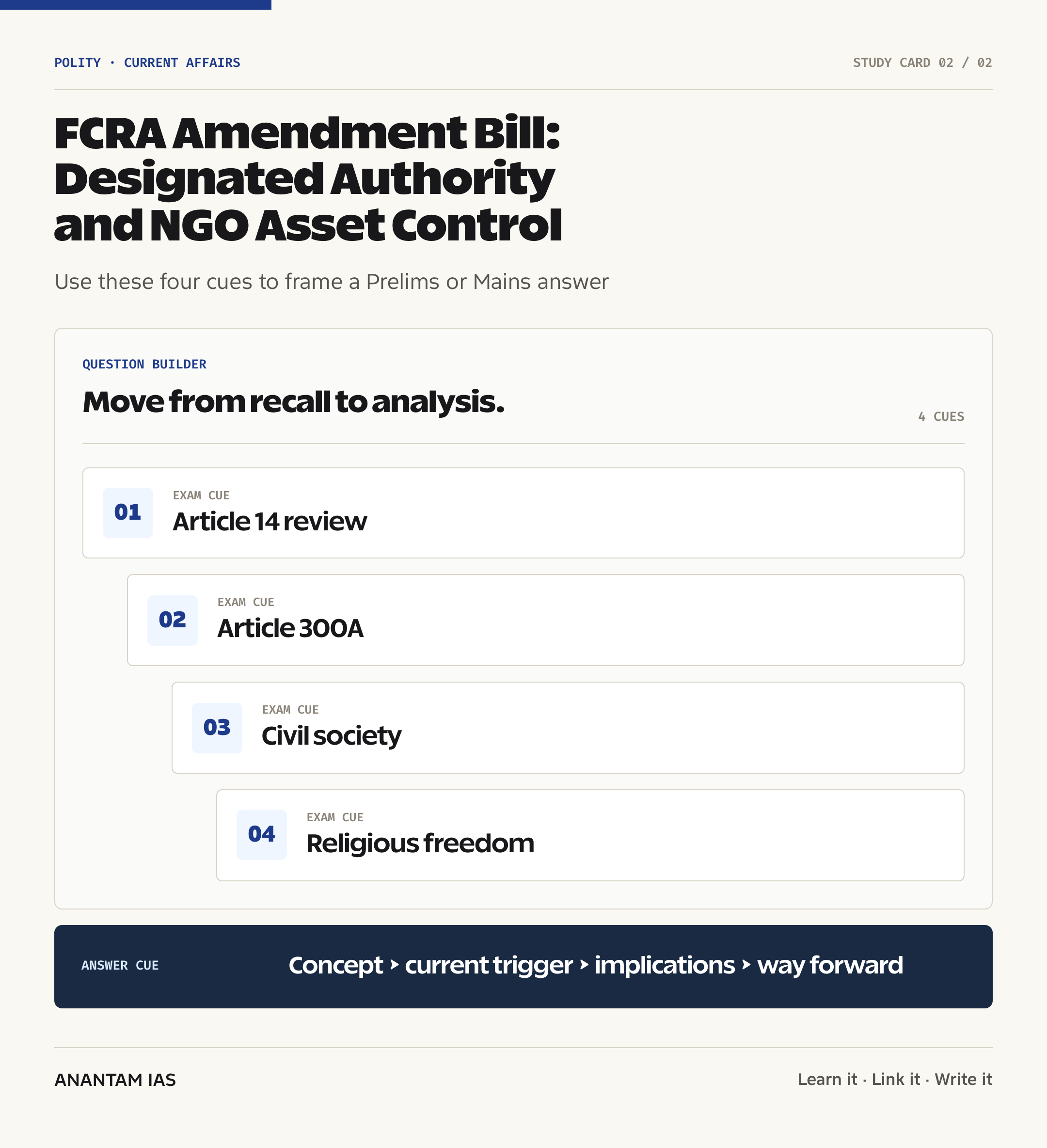
- Mixed-funded assets bring Article 14 and Article 300A questions into the design of identification, valuation and return procedures.
- Places of worship connect the statutory safeguard to Articles 25 and 26 and religious-institution management.
UPSC Relevance
Prelims Relevance
- The FCRA, 2010 is administered by the Ministry of Home Affairs and regulates the acceptance and use of foreign contribution and foreign hospitality.
- An FCRA registration certificate is valid for five years; a separate prior-permission route applies to a specific source, amount and purpose.
- Existing Section 15 already provides for vesting of foreign contribution and assets when registration is cancelled or surrendered.
- Proposed Section 14B covers cessation where renewal was not sought, was refused, or was not completed before expiry.
- Proposed Chapter IIIA contains Sections 16A to 16L on vesting, management, duties, powers, revision, appeal and exemption.
- A mixed-funded asset would initially vest wholly, but a distinct or ascertainable portion funded from other sources may be returned on application.
- Permanent assets must be applied to public purposes; sale proceeds and unused foreign contribution are credited to the Consolidated Fund of India.
- The religious character of a permanently vested place of worship must be maintained.
- Revision and appeal against an Authority order each carry a proposed 90-day window.
- The Bill reduces the general maximum imprisonment for contravention from five years to one year and requires prior Central approval to begin an FCRA investigation.
Mains Relevance
GS Paper 2
- Examine the balance between executive oversight, civil-society autonomy and accountable use of foreign funds.
- Distinguish statutory appeal, Article 226 judicial review and the procedural hearing required at different stages.
- Apply Articles 14, 19(1)(c), 25, 26 and 300A without treating foreign funding as an unrestricted fundamental right.
GS Paper 4
- Assess proportionality, reasoned orders and conflict safeguards when public authority manages private charitable assets.
- Discuss how auditability and enforcement can coexist with institutional trust and continuity of essential social services.
Essay
- Regulation and freedom: democratic states must guard national interest without shrinking legitimate civic space.
- Procedure as justice: the quality of notice, hearing, reasons and appeal shapes the legitimacy of state power.
- Public purpose and private initiative: charitable assets often sit at the intersection of donor intent, community need and regulatory control.
Background and Context
FCRA Architecture and the Existing Asset Rule
The Bill builds on an asset-vesting idea already present in the FCRA, 2010, but gives it a larger procedural structure.
- The Act regulates foreign grants and donations so their acceptance and use do not harm sovereignty, public order, security or national interest.
- An eligible organisation may use either a renewable registration certificate or prior permission tied to a defined source and project.
- Existing Section 15 says foreign contribution and assets created from it vest in a prescribed authority when a certificate is cancelled or surrendered.
- Under the existing rules, that prescribed authority is associated with the concerned State Government or Union Territory administration; the present framework does not comprehensively settle supervision, restoration, final disposal and legacy cases.
- The current provision also permits the prescribed authority to manage the person’s activities in public interest and use foreign contribution or dispose of assets when adequate operating funds are unavailable.
- PIB said nearly 22,000 registrations had been cancelled and about 15,000 deemed ceased over the previous decade, while State authorities faced practical difficulty taking possession and maintaining the connected assets.
- The 2026 Bill would omit Section 15 and insert Chapter IIIA, making an officer or authority notified by the Central Government the Designated Authority.
Trigger, Provisional Vesting and Restoration
The proposed sequence separates temporary custody from final transfer, making provisional vesting the first legal step.
- Proposed Section 16A(1) is triggered from the date of cancellation under Section 14, surrender under Section 14A, or cessation under proposed Section 14B.
- Cessation covers three situations: no renewal application, refusal of renewal, or failure to obtain renewal before the five-year certificate expires.
- During provisional vesting, the Authority may take possession directly or through an Administrator, safeguard assets and supervise their management.
- When public interest requires, it may manage the organisation’s activities for the prescribed period and use foreign contribution to maintain those assets and activities.
- Because the duration and manner of management are largely left to prescribed rules, the subordinate legislation will determine how intrusive provisional control becomes in practice.
- If a fresh certificate is granted or the old certificate is renewed or restored by revision within the prescribed period, the Authority must return the unused contribution and provisionally vested assets, subject to prescribed conditions.
- PIB’s clarification is important: cancellation does not itself mean permanent appropriation, and expiry or cessation does not automatically establish fraud or criminal wrongdoing.
Permanent Vesting and Public-Purpose Disposal
Permanent vesting follows only after restoration fails within the prescribed time or an organisation becomes inoperative or defunct.
- Under proposed Section 16A(5), foreign contribution and connected assets permanently vest when no fresh, renewed or restored certificate is secured within the prescribed period.
- The Authority must apply permanently vested property for public purposes, not for the personal benefit of an official or the former organisation’s functionaries.
- Public purpose should be stated asset by asset because a school, clinic, shelter and cultural institution have different beneficiaries, operating needs and community dependencies.
- It may transfer an asset to a Central or State ministry, department, authority, agency or local authority, such as placing a hospital with a health department.
- When direct public use is not suitable, the asset may be sold or otherwise disposed of; the proceeds and unused contribution enter the Consolidated Fund of India.
- Former key functionaries and persons acting for their benefit cannot directly or indirectly acquire an interest in a disposed vested asset.
- A sale or transfer certificate issued by the Authority is proposed as conclusive proof for registration even when the original title deeds are unavailable.
Mixed Funding and the Prior-Permission Distinction
The difficult asset question is not a wholly foreign-funded bank balance, but property built from foreign and domestic money together.
- Proposed Section 16A(2) says an asset acquired partly from foreign contribution and partly from other sources initially vests wholly in the Authority.
- The organisation may seek return of a distinct or ascertainable portion created from domestic sources; the Authority must return that portion when satisfied.
- This design places the first evidentiary burden on the organisation, making reliable ledgers, title records, donor restrictions and valuation methods central to fairness.
- PRS Legislative Research notes that an inseparable mixed asset, such as one hospital ward built from pooled donations, may make the domestic portion difficult to identify in physical terms.
- The Bill also creates a potential difference between certificate holders and the prior-permission route: cessation-based vesting attaches to a registration certificate, while prior permission is project- and source-specific.
- Rules should state how proportional shares, improvements, depreciation and third-party interests are treated so an ascertainable domestic component is not lost through procedural uncertainty.
Authority Powers, Organisational Duties and Accountability
The proposed Authority combines custody and management powers with record-keeping duties and civil-court powers for evidence.
- It must maintain inventories, accounts and records, report suspected violations or fraud, and send periodic reports to the Central Government.
- The Authority and Administrator may summon persons, examine them on oath, compel documents, receive affidavits and issue commissions like a Civil Court for specified purposes.
- An affected organisation and its key functionaries must provide access to books, electronic records, premises, bank accounts, lockers, securities and movable assets.
- They cannot alienate, encumber, conceal, remove or otherwise deal with connected property without the Authority’s approval and must continue activities under its supervision.
- The Authority must act under Central Government directions, while specified government officers, banks and public bodies must provide it institutional assistance.
- The Bill defines key functionary broadly to include directors, partners, trustees, a Karta, office-bearers, governing-body members and persons responsible for management.
- These powers need transparent inventories, independent valuation, asset-specific reasons and periodic disclosure because the same institution may identify, manage and propose disposal of valuable property.
Remedies and the Due-Process Distinction
The Bill creates remedies against the Authority, but the legal trigger for vesting may arise from a separate Central Government decision.
- Under proposed Section 16J, the Authority may revise its own Chapter IIIA order on its motion or on application within 90 days.
- Under proposed Section 16K, an aggrieved person may appeal within 90 days to the District Judge or a notified judicial officer not below Civil Judge, Senior Division.
- These remedies can test an Authority’s decisions on possession, identification, management, return or disposal; PIB correctly describes them as safeguards against an Authority order.
- Revision by the same Authority can correct an error quickly, while an appeal before a judicial officer supplies external adjudication; both work best when the initial order discloses facts and reasons.
- PRS identifies a different gap: neither the existing Act nor the Bill gives a dedicated appeal or prior hearing against the Central Government’s denial of renewal, even though denial can trigger cessation and vesting.
- A renewal decision remains open to constitutional scrutiny through High Court writ jurisdiction, but writ review is not identical to a fact-intensive statutory appeal.
- A sound procedure should give prompt notice, disclosed reasons subject to lawful confidentiality, an opportunity to respond, a speaking order and a stay route before irreversible disposal.
Constitutional Balance and Religious Institutions
The constitutional test is not whether foreign funding is unlimited, but whether statutory power is exercised through non-arbitrary and proportionate procedure.
- In Noel Harper v. Union of India (2022), the Supreme Court upheld major 2020 FCRA restrictions and rejected an absolute right to receive foreign contribution.
- Article 14 still requires intelligible classifications, consistent criteria and protection against arbitrary identification, valuation or disposal of assets.
- Article 19(1)(c) protects citizens’ freedom to form associations, subject to Article 19(4); management takeover can affect associational functioning even when receipt of foreign money itself is regulated.
- Article 300A allows deprivation of property only by authority of law, making the statutory basis, public purpose and fairness of the vesting procedure constitutionally relevant.
- For permanently vested property that is wholly or partly a place of worship, proposed Section 16A(7) requires the Authority to entrust management as prescribed and preserve its religious character.
- That safeguard must operate alongside Articles 25 and 26, which protect religious freedom and denominational management subject to public order, morality, health and other constitutional limits.
Way Forward
Specify the Vesting Rules
- Define the prescribed restoration period, inventory method, valuation date, maintenance standard and sequence from provisional control to permanent vesting.
- Create an asset register that separates foreign-funded, domestic-funded and mixed components and records third-party rights, liabilities and donor restrictions.
Make Hearing Effective
- Provide an organisation with notice, relevant material, adequate response time and a reasoned renewal order before cessation produces serious asset consequences.
- Allow an interim stay of management transfer or sale while revision, appeal or judicial review is pending, except where urgent preservation is recorded.
Separate Custody from Disposal
- Use independent professional valuation and a transparent disposal plan, with audit trails reviewed by the Comptroller and Auditor General or another suitable oversight mechanism.
- Require conflict declarations and prohibit connected persons from influencing the selection of a transferee or buyer.
Protect Service Continuity
- Keep schools, hospitals, shelters and places of worship functioning during litigation through time-bound interim management and beneficiary-protection plans.
- Match a permanently vested asset to a public body capable of preserving its charitable purpose before considering sale.
Improve Regulatory Trust
- Publish anonymised data on cessation, restoration, asset return, permanent vesting and disposal to permit parliamentary and public scrutiny.
- Issue standard operating procedures and train officials so similar cases receive consistent treatment across States and Union Territories.
Conclusion
The FCRA Amendment Bill, 2026 attempts to close a real administrative gap left by Section 15: long-term custody of foreign-funded assets without a complete path for supervision, restoration or lawful disposal.
Its legitimacy will depend less on the label Designated Authority and more on the quality of notice, hearing, valuation, reasons, review and service continuity. A carefully bounded mechanism can protect public purpose and regulatory accountability without treating every lapse as wrongdoing or every civil-society body as suspect.
UPSC Practice Questions
Prelims MCQ 1
With reference to the Foreign Contribution (Regulation) Amendment Bill, 2026, consider the following statements:
- It proposes provisional vesting when an FCRA certificate is cancelled, surrendered or deemed to have ceased.
- A mixed-funded asset may vest wholly, subject to return of a distinct or ascertainable portion created from other sources.
- A permanently vested place of worship must retain its religious character.
How many of the above statements are correct?
(a) Only one (b) Only two (c) All three (d) None
Answer: (c) All three
Explanation:
All three follow proposed Sections 14B and 16A. Vesting begins provisionally; mixed assets have a domestic-portion return mechanism; and the Authority must preserve the religious character of a permanently vested place of worship.
Prelims MCQ 2
Which statement best distinguishes the remedies discussed in the FCRA Amendment Bill debate?
(a) Every renewal refusal is automatically appealed to the District Judge. (b) Authority orders have proposed revision and judicial appeal, while renewal refusal lacks a dedicated statutory appeal in the Bill. (c) Only the Supreme Court may examine an Authority order. (d) Permanent vesting cannot be reviewed by any court.
Answer: (b) Authority orders have proposed revision and judicial appeal, while renewal refusal lacks a dedicated statutory appeal in the Bill.
Explanation:
Proposed Sections 16J and 16K cover revision and appeal from Designated Authority orders. PRS notes that the separate Central Government decision refusing renewal has no dedicated appeal under the Bill, although constitutional judicial review remains available.
UPSC Mains Questions
- The FCRA Amendment Bill, 2026 seeks to replace indefinite custodial uncertainty with a structured regime for provisional and permanent asset vesting. Examine whether its safeguards adequately balance national-interest regulation, civil-society autonomy and continuity of public services.
- Distinguish remedies against an order of the proposed Designated Authority from remedies against refusal to renew an FCRA certificate. Why is this distinction central to procedural fairness under Articles 14 and 300A?
- Assets created from both foreign and domestic contributions present a hard regulatory problem. Discuss how identification, valuation, proportionality and independent review should shape a constitutionally sound vesting framework.
Sources: PIB, Ministry of Home Affairs and The Hindu.
Frequently Asked Questions
What does the FCRA Amendment Bill propose?
It proposes a new Chapter IIIA under which a notified Designated Authority would provisionally receive, protect and manage foreign contribution and connected assets after cancellation, surrender or cessation of registration. Assets return if registration is restored within the prescribed period; otherwise, they may vest permanently and be applied to public purposes.
Does cancellation immediately transfer assets permanently?
No. The first stage is provisional vesting. If the organisation obtains a fresh certificate or gets its certificate renewed or restored within the prescribed period, the Authority must return unused foreign contribution and the provisionally vested assets. Permanent vesting follows only when restoration fails within that period or specified defunct-organisation provisions apply.
Can domestic-funded property also vest?
An unrelated domestic asset is outside the stated mechanism. But an indivisible asset created partly from foreign contribution and partly from other sources would initially vest wholly. The organisation may apply for return of a distinct or ascertainable domestic-funded portion, making documentation and fair valuation especially important.
What remedies exist against Authority orders?
The Bill permits the Designated Authority to revise a Chapter IIIA order within 90 days, either on its own or on application. An aggrieved person may also appeal within 90 days to the District Judge or another notified judicial officer of at least the prescribed seniority.
Why does PRS identify a due-process gap?
The statutory revision and appeal concern orders made by the Designated Authority. PRS notes that refusal by the Central Government to renew the underlying certificate has no dedicated hearing or appeal mechanism in the Bill, even though refusal triggers cessation. High Court judicial review remains available, but it is structurally different from a statutory appeal.
How are places of worship protected?
For an asset permanently vested in the Authority that is wholly or partly a place of worship, the Bill requires management to be entrusted as prescribed and its religious character to be maintained. This statutory safeguard operates alongside constitutional protections for religious freedom and denominational affairs under Articles 25 and 26.